Archery Competition Divisions Explained for Beginners
Archery competition divisions are usually chosen in this order: discipline first, bowstyle second, age category third, and beginners should enter the simplest class their bow and age allow. Pick the wrong division and you can land in the wrong score group, lose eligibility, or get moved on event day. This guide explains archery competition divisions, age categories, and what to select on a tournament entry form with plain-English examples.
What archery divisions mean


Divisions are the equipment classes that keep score comparisons fair. In plain terms, your bow style sets the division, and the age group sets the category inside that division. World Archery uses a similar framework across target, indoor, field, and 3D rulebooks.
Division versus category
A division is typically the bow class, such as recurve, compound, barebow, traditional, or longbow. A category is the division plus an age group, such as Senior Recurve or U18 Compound. That difference matters because the same bow can enter different age bands, and those bands may change distances or round length.
Where World Archery fits
World Archery is the governing body whose rulebook covers target, indoor, field, and 3D competition classes. Local clubs and national federations can use the same labels, but not always the same entry rules. Beginners should check the event bulletin before registering, because local naming and eligibility details can differ.
Recurve, compound, and barebow divisions
These are the three divisions most beginners see first on a standard entry form. Recurve is the Olympic target archery division, compound uses cams and cables, and barebow is the stripped-down recurve-style class. Each one allows different equipment, so the right choice starts with the bow already in hand.
Recurve division
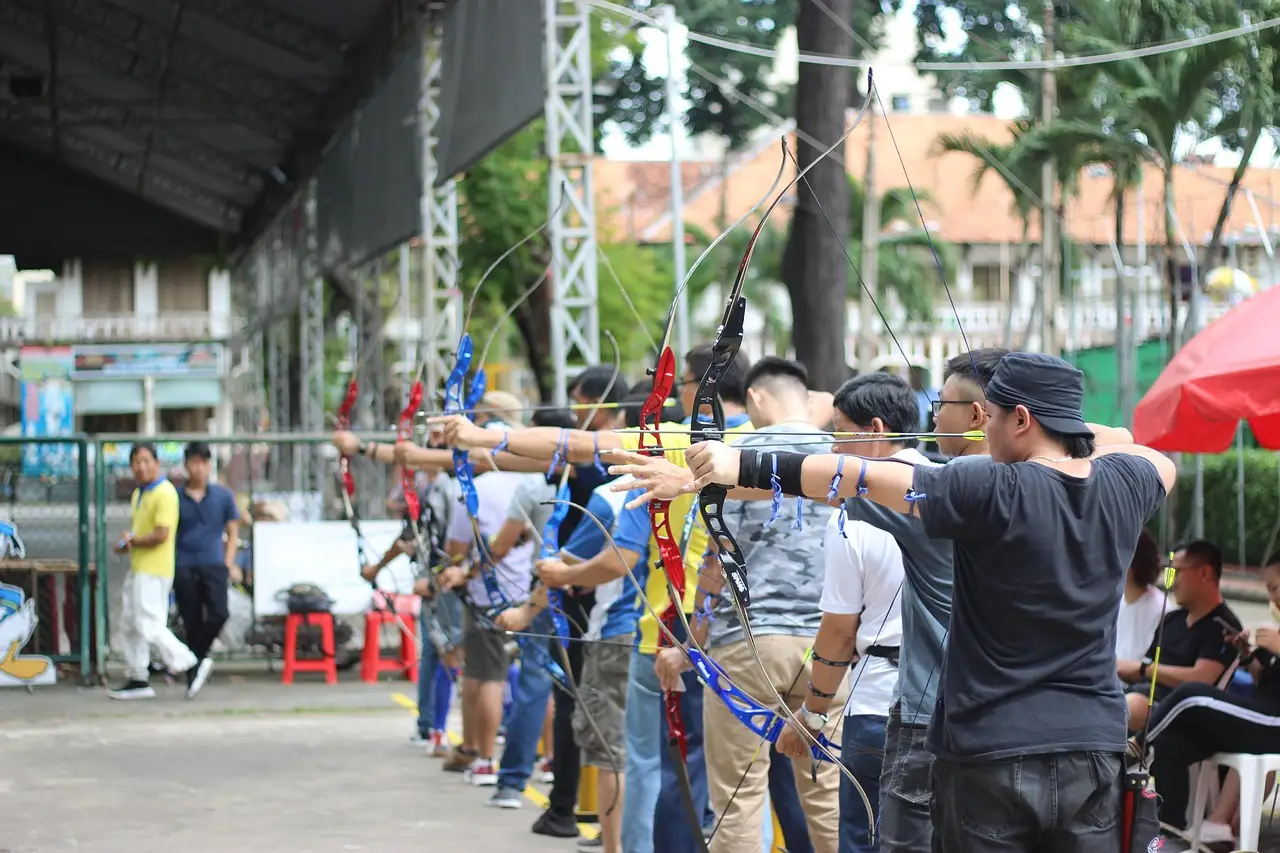
Recurve archers shoot with a sight and stabilizer system, use bare fingers rather than a mechanical release aid, and compete in the Olympic target archery division. Outdoors, recurve is commonly shot at 70 meters. That makes it the standard choice for many target rounds and a common first step for beginners joining club-to-sanctioned events.
Compound division
Compound division allows a sight, scope, stabilizers, and a mechanical release aid. The bow uses cams and cables, and the let-off gives higher holding comfort at full draw. Compound appears in target, indoor, field, and 3D formats, so it suits archers who already practice with a compound and want the matching competition class.
Barebow division
Barebow uses the same general recurve platform but strips the equipment down. It typically allows no sight, is shot with fingers, and keeps accessories limited, which can help keep equipment costs lower. Barebow is common in field and 3D, and it is a practical entry point for archers who want a simpler setup without moving into traditional gear.
Traditional and longbow divisions
Traditional and longbow are often seen in field and 3D more than in standard target events. They suit archers who want a simpler, non-sighted setup, but the exact eligibility depends on the event rulebook. Beginners should not assume these divisions are available in every target tournament.
Traditional division
Traditional division requires a wood-based riser and no sight. It also uses a simple plastic arrow rest and no stabilizer. In World Archery context, traditional is generally a field and 3D option, not a standard target class. That matters when a beginner is filling out an entry form for a local or sanctioned event.
Longbow division
Longbow division uses natural wooden arrows and no arrow rest. It is also tied to field and 3D only in World Archery context. Because the equipment is so specific, longbow archers should confirm that the event actually offers that division before paying an entry fee or selecting an age category.
Why these divisions are grouped with field and 3D
Field and 3D events often allow the simpler, more traditional bow styles that are less common in indoor or outdoor target lines. That does not mean every event includes them. The entry form and event bulletin decide what is open, and beginners should match the bow they own to the event type before choosing a division.
Which division should I enter?
The simplest registration path is event type first, bowstyle second, age category third. Start by deciding whether the event is indoor target, outdoor target, field, or 3D. Then match the bow you already shoot to the correct division, and finally choose the age group that fits your birth year and the event rules.
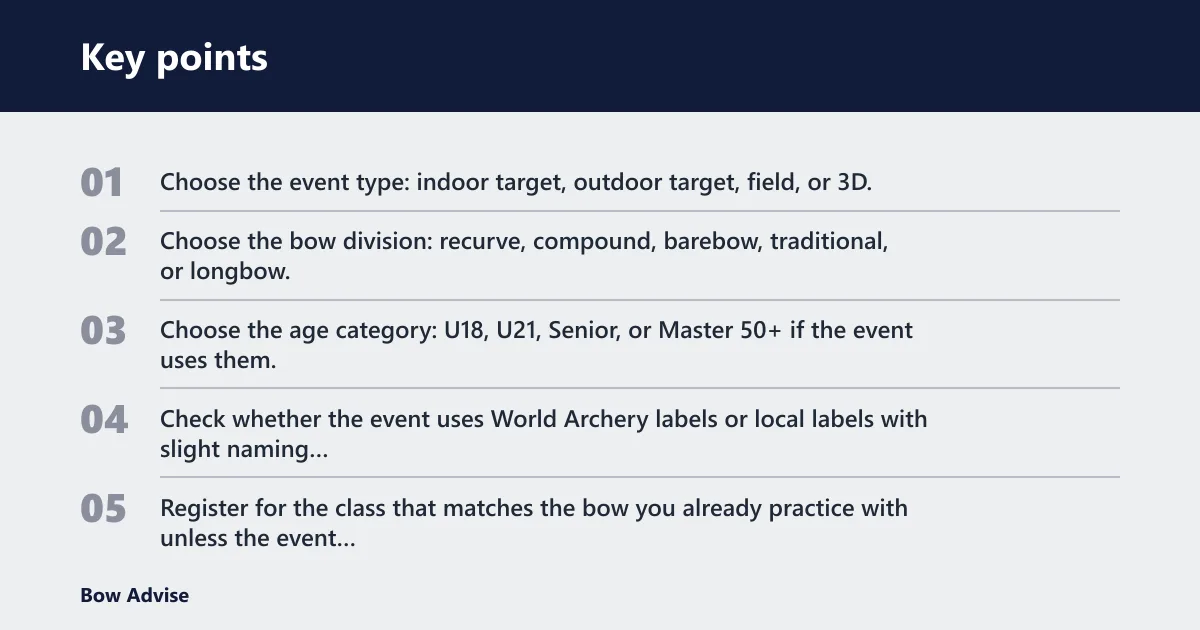
- Choose the event type: indoor target, outdoor target, field, or 3D.
- Choose the bow division: recurve, compound, barebow, traditional, or longbow.
- Choose the age category: U18, U21, Senior, or Master 50+ if the event uses them.
- Check whether the event uses World Archery labels or local labels with slight naming differences.
- Register for the class that matches the bow you already practice with unless the event rules say otherwise.
Say your bow is a recurve with a sight, stabilizer, and fingers only. That points to recurve division, then to the age group that fits the archer. A common first-timer mistake is choosing barebow because the bow has no release aid, even though the sight makes it a recurve entry.
Suppose your setup is a compound with a scope and mechanical release aid. That is a compound entry, even if the event is indoor. If the tournament is a winter event with shorter distances, the division still stays compound; only the round format changes.
Beginners should usually enter the division they already practice with. That is the safest choice because score comparison stays honest and the equipment check is straightforward. Only switch divisions if the event rules and your actual bow setup clearly fit the new class.
Do age categories change the entry?
Yes. Age categories can change who you are grouped with, and they can also affect distances or round length. U18, U21, Senior, and Master 50+ are common categories, but the exact labels and cutoffs can vary by event. The age group is not a substitute for the bow division; it sits on top of it.
U18, U21, senior, and Master 50+
U18 athletes may compete through the year of their 17th birthday. U21 athletes may compete through the year of their 20th birthday. Master category starts from the year of the archer’s 50th birthday onward. Senior is the open adult group when the event does not use a narrower age split.
How age groups affect distances and round length
Age categories can change distances or round lengths in some events. That is why a U18 entry may not shoot the same round as a Senior entry, even when both are in the same bow division. Beginners should check the event bulletin before registering, because the score sheet may be tied to both division and age.
When category matters more than division
Category matters most when the event has separate awards or separate rounds by age. A beginner can be in the right bow division and still be entered in the wrong age class. That can affect score grouping, podium eligibility, and sometimes the distance shot on the day.
Which division comparison table
This table is the quickest way to match a bow to a registration choice. Read the bow type first, then check which accessories are allowed, then look at the common event types, and finally compare your own setup to the beginner example. It is a practical registration aid, not a rulebook replacement.
| Bow type | Allowed accessories | Common event types | Beginner example |
|---|---|---|---|
| Recurve | Sight allowed, stabilizer allowed, bare fingers only, no mechanical release aid | Target, indoor, outdoor | A beginner with a 30 lb recurve, sight, and finger tab enters Recurve Senior or U21 Recurve. |
| Compound | Sight and scope allowed, stabilizers allowed, mechanical release aid allowed | Target, indoor, field, 3D | A beginner with a compound bow, peep, scope, and release aid enters Compound Senior. |
| Barebow | No sight, fingers only, limited accessories | Field, 3D, some target events | A beginner shooting a stripped recurve with no sight and no stabilizer enters Barebow. |
| Traditional | No sight, no stabilizer, simple plastic arrow rest, wood-based riser | Field, 3D | A beginner with a wood riser and simple rest enters Traditional if the event offers it. |
| Longbow | No sight, no arrow rest, natural wooden arrows | Field, 3D | A beginner with a longbow and wooden arrows enters Longbow when the tournament lists it. |
How to read the allowed accessories column: if your bow has a sight, you are not in traditional or longbow, and if it uses a release aid, it is not recurve or barebow. How to read the common event types column: if the event is indoor target, recurve and compound are the most likely classes; if it is field or 3D, traditional and longbow may also appear.
What archery competition divisions are for beginners?
For beginners, the main divisions are recurve, compound, barebow, traditional, and longbow. Recurve, compound, and barebow are the most common starting points in target events, while traditional and longbow are more often linked to field and 3D. The right one is the bow you already shoot, not the one you hope to own later.
Frequently asked questions
What is the difference between recurve, compound, and barebow divisions?
Recurve allows a sight and stabilizer system but uses bare fingers and no release aid. Compound allows a sight, scope, stabilizers, and a mechanical release aid, with cams and cables. Barebow removes the sight and keeps the setup simple, which usually lowers equipment cost and keeps the class closer to basic recurve hardware.
What division should I enter for my first archery tournament?
Enter the division that matches the bow you already practice with. If your bow has a sight and you shoot with fingers, that is usually recurve. If it has a release aid, it is compound. If it has no sight and a stripped-down setup, it may be barebow. Check the event bulletin before registering.
Can beginners shoot indoor competitions first?
Yes. Indoor events are often the easiest first competition because the target distance is typically 18 meters and the conditions are controlled. Indoor season typically runs through winter months, so it is common for new archers to start there before moving to outdoor target, field, or 3D events.
Do archery divisions vary by target, field, and 3D events?
Yes. Target archery often centers on recurve and compound, while field and 3D frequently include barebow, traditional, and longbow as well. World Archery covers all of these formats in its rulebook, but not every local event offers every division, so the event listing matters as much as the bow.
What equipment is allowed in each archery division?
Recurve allows a sight and stabilizer system, fingers only, and no mechanical release aid. Compound allows a sight, scope, stabilizers, and a mechanical release aid. Barebow uses the recurve-style bow with no sight and limited accessories. Traditional allows no sight and no stabilizer, while longbow uses no arrow rest and natural wooden arrows.
Do I need to compete only against people in my own division?
Usually yes, because division and category are used to group archers for fair scoring. Your score is compared with others in the same division, and often the same age category too. Some local events may also run open or mixed classes, but beginners should assume the standard division and category split unless the bulletin says otherwise.
How do age categories work in archery competitions?
Age categories split entries by age band, such as U18, U21, Senior, and Master 50+. They are separate from bow divisions, so a person can be a U18 Recurve or a Master Compound. In some events, the age group changes the distance shot or the round length, so it is not a casual label.
Which archery division is easiest for beginners to start with?
The easiest division is usually the one the beginner already practices with, because that avoids equipment changes and registration errors. For many new archers, indoor recurve or indoor compound is the simplest first event. Barebow can also be approachable if the bow is already set up that way.