How Many Arrows Should a Hunting Quiver Hold?
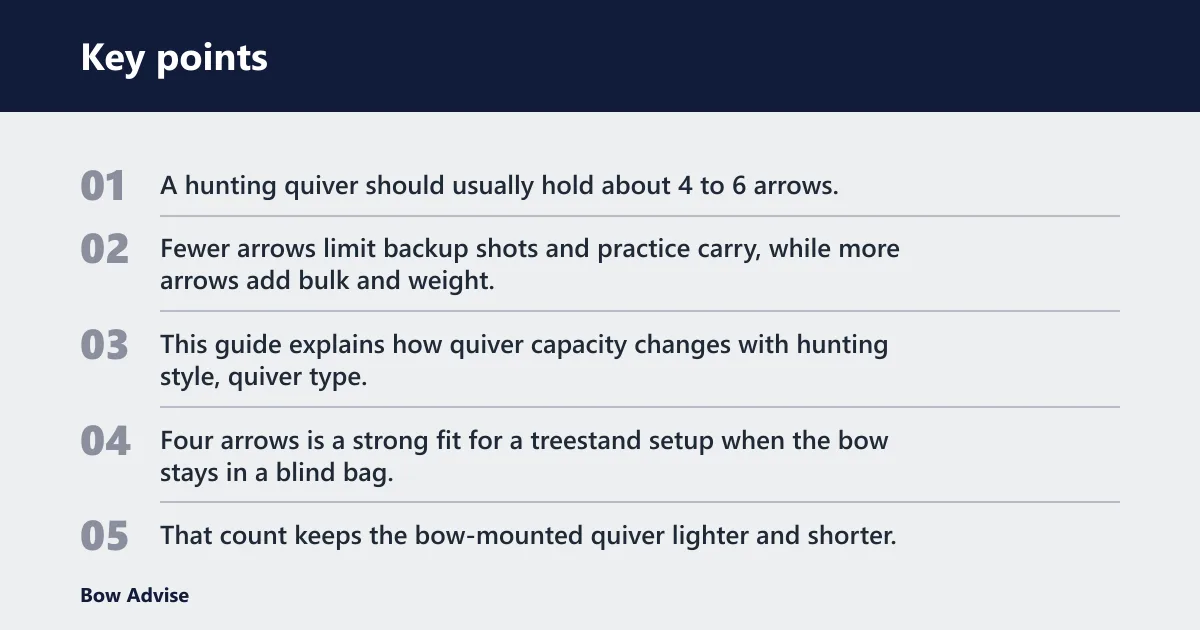
A hunting quiver should usually hold about 4 to 6 arrows, with 5 arrows often used as an all-around choice for many bowhunters. Fewer arrows limit backup shots and practice carry, while more arrows add bulk and weight. This guide explains how quiver capacity changes with hunting style, quiver type, and shot planning.
Quick answer for hunting quiver capacity


Why 4 arrows fits many treestand hunters
Four arrows is a strong fit for a treestand setup when the bow stays in a blind bag, on a haul line, or with close-range gear. That count keeps the bow-mounted quiver lighter and shorter, which helps with stand clearance, limb room, and quieter movement in tight brush or on metal platforms.
Outdoor Life’s budget quiver holds four arrows, which shows that a 4-arrow setup is not a compromise for every hunter. It can be the right fit when the hunt is stationary, shots are limited, and you want the least possible clutter on the bow.
When 5 arrows is the balanced default
Five arrows is the best middle ground for many modern hunters. It gives enough backup for a lost arrow, a miss, or a damaged vane, while keeping the bow-mounted quiver compact. Outdoor Life’s best overall bow quiver holds five arrows, plus a bonus arrow, which matches this balance well.
A 5-arrow quiver also leaves more room for broadheads, large-diameter shafts, and taller fletching without crowding the hood. That matters because a quiver packed too tightly can rattle, press vanes, or make the bow feel front-heavy.
When 6 arrows makes sense
Six arrows is a sensible choice for hunters who expect longer days in the field, longer walk-ins, or extra insurance against damaged arrows. It is also a practical number for beginners who want a small hunting-ready set without adding the most possible weight to the bow.
Six works best when the quiver, bow balance, and arrow length all cooperate. If the hood gets crowded, or the top arrow starts contacting the riser, dropping to five can solve the problem faster than changing the whole setup.
How many arrows can a quiver hold?
A quiver can hold very different numbers depending on the type. For hunting, a bow-mounted quiver usually carries 3 to 7 arrows, while target-style quivers can hold more. The useful question is whether the quiver fits the hunt, the bow, and the arrows.
Bow-mounted hunting quivers: 3 to 7 arrows
A bow-mounted hunting quiver usually carries 3 to 7 arrows and mounts on the riser or accessory rail. It adds weight to the bow, so capacity must be balanced against handling, balance, and clearance. For most hunters, 4, 5, or 6 arrows is the sweet spot.
Lower-capacity hunting quivers are common because they keep the bow compact. Higher-capacity models can still work, but they may project farther from the riser and make the bow feel bulkier in a treestand or while stalking through cover.
Hip quivers: 6 to 12 arrows
A hip quiver carries 6 to 12 arrows and is usually worn on the waist or hip. It is common in target and field archery because arrows are easy to grab, and the quiver stays off the bow. That makes it useful for practice, not for most hunting setups.
Back quivers: 12 to 24 or more arrows
A back quiver carries 12 to 24 or more arrows and is worn over the shoulder. It is common in traditional archery and some 3D use, but arrow retrieval is slower and less convenient than with a bow-mounted hunting quiver. It is not a common modern hunting standard.
Field or target quivers: 6 to 12 arrows
A field or target quiver typically holds about 6 to 12 arrows and is often worn on the belt. Many include pockets for small accessories. These quivers are good for range sessions and field courses, where quick access matters more than keeping gear compact on a hunting bow.
Ground quivers and arrow tubes: storage versus carry
A ground quiver typically holds 12 or more arrows and stands at the shooting line. It is not worn on the body. An arrow tube or hard case can hold 12 to 36 arrows and is used for transport and storage, not for shooting. Those products solve travel and protection, not field carry.
| Bow type | Hunting style | Recommended arrow count | Why that count works | Common failure mode if you go lower or higher |
|---|---|---|---|---|
| Compound bow | Treestand hunting | 4 to 5 | Keeps the bow compact, quieter in tight spaces, and easier to maneuver near rails, trees, and blind fabric. | Too low leaves little backup; too high adds noise, bulk, and more chances of clearance trouble. |
| Compound bow | Spot-and-stalk | 5 to 6 | Gives a better buffer for long walks, field repairs, and missed shots without making the bow feel stripped down. | Too low can leave you short after a lost arrow; too high can snag in brush and make the bow nose-heavy. |
| Recurve or traditional bow | Stalking, woods, and close-range hunting | 4 to 6 | Works well with simple gear and keeps the load modest on a bow that is often carried a lot. | Too low means little spare capacity; too high can make a back or bow quiver awkward and slower to manage. |
| Compound or traditional setup | Backup-heavy hunting | 6 | Useful when broadhead protection, shaft length, or remote travel makes extra arrows worthwhile. | Too low leaves no margin for damage; too high can clutter the quiver, raise weight, and create rattling. |
Why quiver type changes capacity
Capacity changes because quiver design changes how arrows sit, how they are protected, and how much room they need. A bow-mounted hunting quiver keeps arrows close to the riser. A hip, back, or field quiver carries them away from the bow, which changes access, weight, and storage needs.
Arrow diameter and broadhead protection
Capacity varies by brand, arrow diameter, and fletching size. Wider shafts take more room. Broadheads also need secure hood space so the blades do not rub, strike other arrows, or catch on the quiver wall. If a quiver is packed too tightly, broadhead heads can crowd each other and become annoying to remove quietly.
Suppose a hunter switches from slim target-style shafts to a thicker hunting shaft with fixed broadheads. The same quiver may hold fewer arrows cleanly, even if the label still suggests a higher count. The issue is fit, not the number printed on the package.
Fletching size and hood clearance
Large vanes or long feathers need more hood clearance. If the fletching presses into the hood or rubs against the next shaft, the quiver becomes noisier and less secure. That is one reason a 6-arrow quiver may work with small vanes but feel crowded with larger fletching.
Quiet retention and bow balance
Hunters usually want quiet, secure arrow retention. A quiver that rattles or lets arrows shift is a problem in a stand or when crawling into position. Bow-mounted quivers also affect bow balance, because every extra arrow changes front weight and can change how the bow settles in the hand.
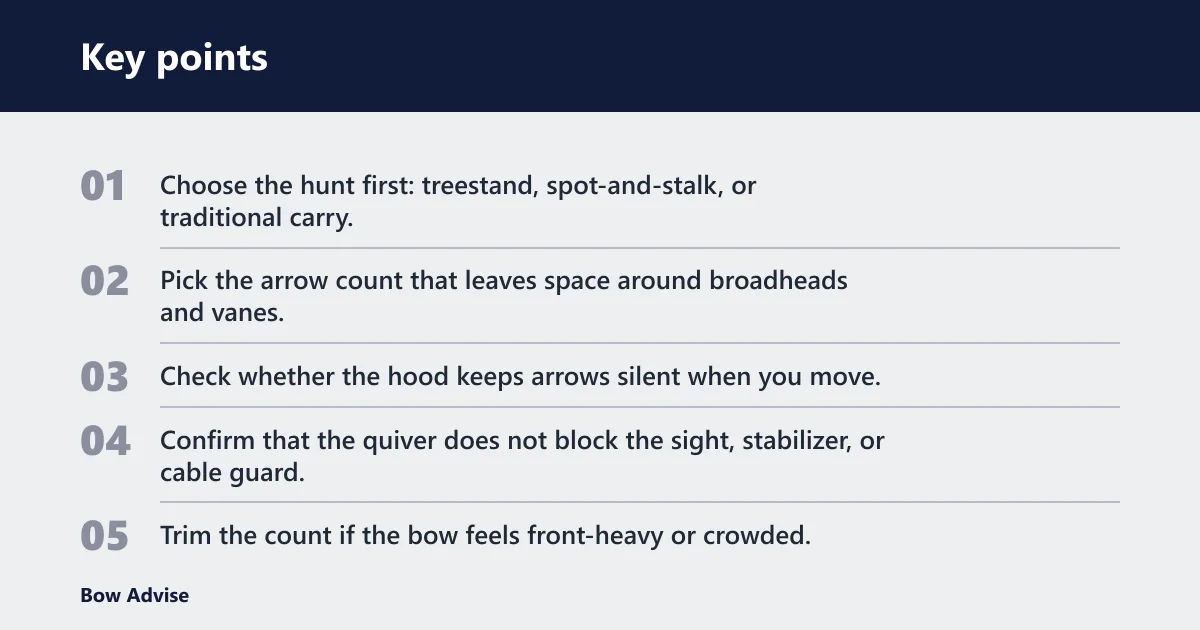
- Choose the hunt first: treestand, spot-and-stalk, or traditional carry.
- Pick the arrow count that leaves space around broadheads and vanes.
- Check whether the hood keeps arrows silent when you move.
- Confirm that the quiver does not block the sight, stabilizer, or cable guard.
- Trim the count if the bow feels front-heavy or crowded.
A common first-timer mistake is loading every slot because the quiver can hold them. That often creates more clutter, more rattle, and less room for easy grabs when the shot comes fast.
How many arrows should I carry in the field?
Most hunters typically carry about 4 to 6 arrows in the field, with 5 often used as a default. That number gives room for a primary shot, a follow-up, and one spare without forcing the bow-mounted quiver into a bulky or noisy setup. More arrows help only if they still stay secure and quiet.
One clean shot planning
If a hunter expects one close, controlled opportunity, four arrows is usually enough. It keeps the rig lean and simple. That can matter in a treestand, where excess gear can knock against the rail or brush a tree trunk when drawing.
Follow-up shot planning
Five or six arrows makes more sense when a hunter wants a reserve for follow-up work, a damaged shaft, or a broadhead that gets dulled in transit. The extra arrow count is insurance, but only if the quiver still allows clean access without pulling other arrows loose.
When extra arrows stop helping
Beyond 6 arrows, many hunting quivers start giving back less than they take away. The load gets heavier. The hood gets busier. Clearance issues become more common. For most bowhunters, that tradeoff is worse than the benefit of carrying more steel or carbon on the bow.
How many arrows should a beginner keep ready?
A beginner should keep a small hunting-ready group and separate it from practice arrows. For practice, a dozen matched arrows is a practical number for a target archer. For hunting, six matched hunting arrows is a practical number for beginners who want enough margin without buying or carrying more than needed.
Match arrows as a set of 12
Matched arrows should have the same spine, length, weight, and fletching. Buying them in sets of 12 is common, and it gives enough arrows for tuning, practice, and a few losses. Consistent arrow flight matters more when a new archer is still learning anchor, release, and form.
Keep a small hunting-ready group
Beginner hunters do well with six matched hunting arrows that are set up the same way. That count is enough for field carry and still leaves a small reserve. It also keeps the quiver from becoming crowded before the archer has learned what capacity feels best in a blind, tree stand, or brush line.
Separate practice arrows from hunting arrows
Practice arrows and hunting arrows should not be treated as the same pile. Hunting arrows need the correct broadheads, spine, length, and fletching for the bow. Practice arrows can be used more freely. Keeping the two groups separate helps avoid mixing broadhead-tipped arrows into casual range work.
Traditional and historical quiver counts
The traditional historical number for a quiver is 24 arrows. That number comes from medieval English archers and is best understood as a historical reference, not a modern hunting standard. It shows how large some traditional arrow bundles were, but it does not set today’s bow-mounted hunting capacity.
The medieval sheaf of 24 arrows
A sheaf of arrows often referred to 24 arrows. In historical archery, that number made sense for mass use and organized supply. It is a useful reference point for tradition, but it is far larger than what most hunters want on a modern bow-mounted quiver.
Why that number does not set modern hunting capacity
Modern hunting quivers are shaped by compact carry, silence, bow balance, and arrow protection. A hunting quiver that tried to hold anywhere near 24 arrows would be unwieldy on the bow, hard to move with, and far more likely to snag, rattle, or block other gear.
Frequently asked questions
How many arrows fit in a hunting quiver?
Most hunting quivers fit 4 to 6 arrows well, even though some models go from 3 to 7. For field use, 5 is the best all-around count for many bowhunters because it balances backup capacity, weight, noise control, and easy access on the bow.
Is a 4-arrow or 5-arrow quiver better for hunting?
Four arrows is better when the hunt is tight, short, or highly mobile, especially in a treestand. Five arrows is better as the default for most hunters because it gives more margin without adding much bulk. If the quiver gets crowded, 4 can be the cleaner choice.
Does quiver capacity change by quiver type?
Yes. Bow-mounted hunting quivers usually hold 3 to 7 arrows, hip quivers 6 to 12, back quivers 12 to 24 or more, and field quivers 6 to 12. Ground quivers and hard cases are for support roles, not for carrying arrows into a hunting position.
What is the traditional number of arrows in a quiver?
A traditional historical number is 24 arrows. That is a medieval reference tied to English archers, not a modern hunting rule. Today, most bowhunters choose a much smaller count because compactness, silence, and bow balance matter more than historical bundle size.
How many arrows should a beginner keep ready at the range?
A beginner target archer should keep a dozen matched arrows ready at the range. That number supports practice, tuning, and a few lost arrows. For hunting practice, six matched hunting arrows is a more practical ready set, especially when broadheads and field carry are part of the plan.