Barebow Competition Essentials: Gear, Rules and Scoring
Barebow competition means a recurve setup with no sight, no clicker, and no release aid. Rules differ across World Archery, USA Archery, IFAA, NFAA, and local events, so the exact rule check comes from the event rulebook, but the practical test stays simple: the bow must pass inspection, tune cleanly, and score without equipment disputes. This guide focuses on what belongs on the bow, what stays off it, and how those choices affect scoring on the line.
What gear do I need for barebow competition?
The core setup is a recurve riser, limbs, a legal arrow rest, a pressure button or plunger, a barebow tab, and arrows that tune well together. Barebow competition also depends on the event rules, because some federations set extra limits on weights, markings, and attachments.
World Archery barebow is recurve-based and does not allow a sight, clicker, or release aid. It is commonly used in field, 3D, target, and indoor archery. That means the bow can still be simple and competitive, but every part must be chosen with legality and tune in mind.
Must-have

surwolf ILF Recurve Bow Riser 25 Inch is a barebow-style recurve handle that fits the role of the main platform. A riser like this matters because the barebow class starts with a recurve bow that can pass inspection, and the rest of the setup must stay within the class limits.
Drawback: the listing does not by itself prove tournament legality in every federation, so the buyer still has to confirm weight placement and ring-test fit against the event rulebook.

AMEYXGS ILF Bow Limbs belong in the main bow setup because barebow starts with a recurve platform, and matched limbs help the bow tune predictably. Consistent limbs matter when the archer is using string walking or gap shooting, since both methods depend on repeatable arrow flight.
Drawback: limb weight and length must match the riser and the event’s barebow limits, so the model title alone is not enough to confirm fit.

SAS Barebow Suede Leather Archery Finger Tab is central to barebow aiming because the tab is where crawl marks are usually recorded. A simple scale on the tab supports string walking, and the finger protection helps keep anchor pressure consistent through a round.
Drawback: the scale should be a simple reference for crawl notes, not a sight picture or pointer; if the markings are hard to read or they change from arrow to arrow, the notes become unreliable.
Nice-to-have

KESHES Bowstring Serving Thread Jig is useful for nock points and arrow rest setup. That matters because a barebow archer needs the rest and serving area to be clean enough for consistent arrow launch, especially when tuning for crawl positions at different distances.
Drawback: serving material helps with setup, but it does not fix a bad tune on its own. Nock height and rest alignment still need to be checked after serving work.
Consumables and spares

SAS Barebow Stabilizer Weight Stainless Steel is a competition-style weight set, but barebow legality depends on the federation. Some rule sets allow fixed weights in limited positions on the riser, while others define the placement and shape more narrowly, and the setup still has to pass the inspection ring test. Dampers and stabilisation are handled differently by different federations, so the exact allowed configuration must match the event’s rule set.
Drawback: this type of weight can create a legality problem if it changes the bow’s shape enough to fail the inspection ring test.
What are the rules for barebow archery?

Barebow rules are built around what must stay off the bow. The bow is recurve-based, with no sight, no clicker, and no release aid. Fixed riser weights may be allowed, but the exact placement and whether dampers or other stabilising parts are allowed depends on the federation, and the bow still has to pass inspection.
The easiest way to think about it is this: the bow must look and measure like barebow, not like a modified target recurve with extra accessories. If a part helps aim like a sight, time the shot like a clicker, or steady the bow like a stabilizer, it is a red flag.
The 12.2 cm ring test
The complete barebow setup must fit through a 12.2 cm ring at its widest point, including fitted weights. That check controls barebow legality because it tests the full setup as it will be used, not just the bare riser. If the setup fails the ring test, it is not ready for barebow inspection.
For home checking, the practical step is to assemble the bow exactly as it will be shot, then verify that every fitted weight and attachment still leaves the setup compact enough to pass. If the event uses a different local inspection method, that rule still sits on top of the federation standard.
Rest and plunger
An arrow rest is allowed in barebow. It may be a simple stick-on rest or an adjustable design, but it must let the arrow leave cleanly. A pressure button or plunger is also allowed, and it helps absorb initial arrow flex and correct arrow flight.
That is why barebow tuning still matters. A legal rest and plunger can still shoot badly if the nock point, centershot, or arrow spine are off. Clean flight is a scoring issue, not just a comfort issue.
Bottom-riser weights only
Fixed weights are commonly attached to the bottom of the riser, but the exact placement limit depends on the federation. Some rule sets are stricter than others, and some also define whether dampers or other stabilising parts may be used. That rule matters because some setups look close to legal at first glance, then fail inspection once side weights, rod-style supports, or damping parts are added.
A common beginner mistake is clipping a large sight window sticker onto the riser and assuming it will not affect barebow legality. Suppose the bow passes on the riser alone, then fails once a fitted weight and rubber damper are mounted elsewhere. The fix is to strip the setup back to the allowed configuration before weigh-in.
Barebow tournament readiness checklist
Use this as a home checklist before equipment control. It turns the rulebook into a go or no-go audit, which is what most beginners need before weigh-in or inspection.
| Gear item | Legal or illegal under barebow rules | First thing to verify before competition |
|---|---|---|
| Recurve riser and limbs | Legal | Assemble the exact competition bow and confirm it is recurve-based |
| Sight | Illegal | Remove any sight bar, scope, or aiming aid before inspection |
| Clicker | Illegal | Check the bow for any clicker plate or drawing aid |
| Release aid | Illegal | Make sure the tab is the only release interface in use |
| Arrow rest | Legal | Confirm it lets the arrow clear without rubbing or bounce-off |
| Pressure button / plunger | Legal | Check that it is set for the arrow and sits square to the shelf |
| Fixed riser weights | Legal only on the bottom of the riser | Verify the weight is mounted below and the bow still passes the 12.2 cm ring test |
| Other stabilisation or dampers | Illegal | Remove side rods, long bars, and damping accessories |
| Barebow tab | Legal | Check that any crawl scale is simple, readable, and not a sighting system |
| Arrow marks or reference lines | Depends on the event rule | Make sure no mark turns into an aiming reference that the federation forbids |
Quick red flags are easy to spot: extra weights on the wrong part of the riser, marks that behave like a sight, and a tab setup that changes from arrow to arrow. If any of those show up, stop and correct them before the bow reaches equipment control.
- Strip the bow to the legal base setup.
- Check the rest, plunger, and tab.
- Mount only allowed bottom-riser weights.
- Confirm the arrows and crawl notes match the round you entered.
How do barebow archers aim?
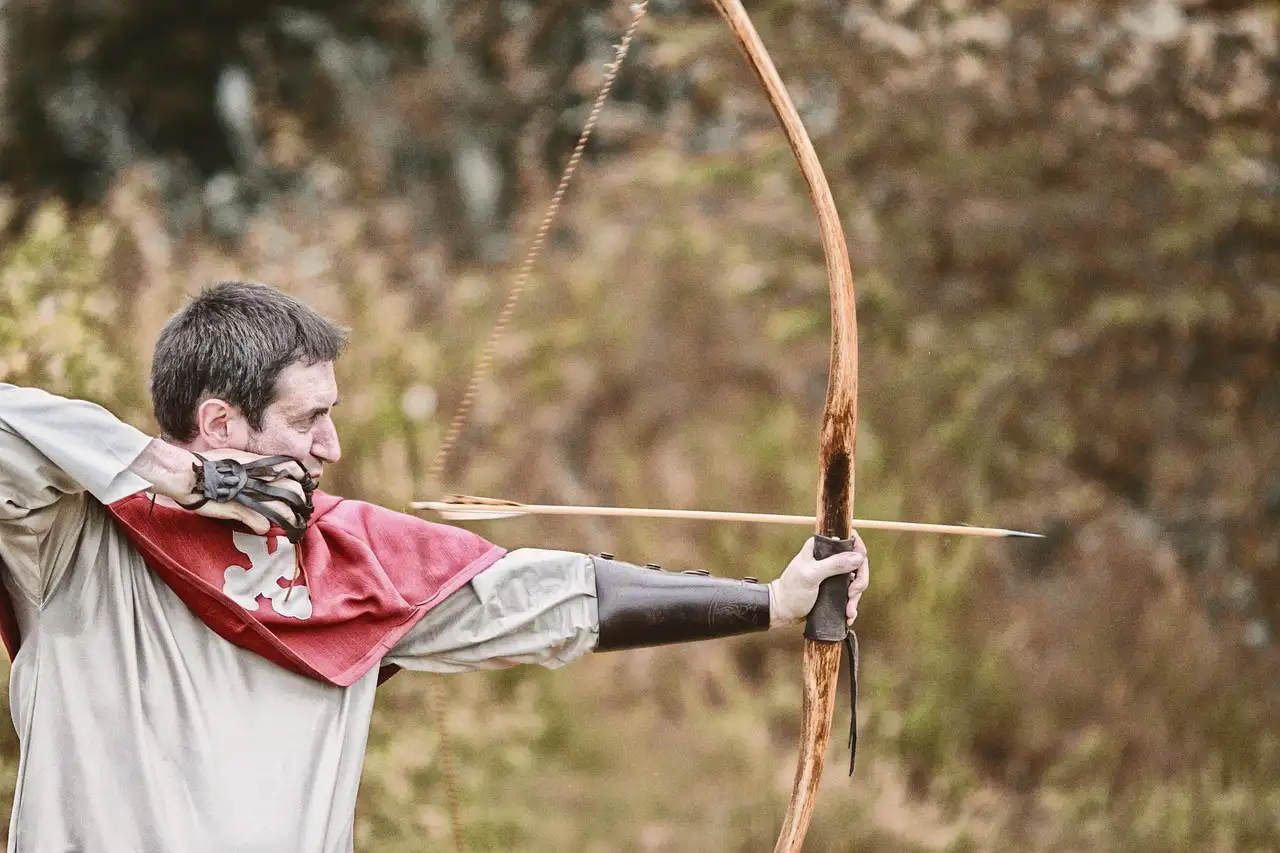
Barebow archers usually aim by string walking or gap shooting. Some also use face walking. All three methods stay within barebow culture, but the setup has to remain legal and the aiming reference must not turn into a sight or other banned device.
The main issue for competition is not which method sounds best. It is whether the method holds up across distances without creating a class violation or a scoring mess.
String walking
String walking is the primary barebow aiming method for many archers. It uses a tab scale, and the crawl position changes by distance. The closer the crawl to the nock, the more the point of impact changes, so the archer records crawl marks for different yardages or meters.
That is why the tab matters so much. If the crawl mark is vague, the shot process becomes inconsistent, and the point of impact shifts more than the archer expects. Clean crawl notes help, but they still need practice at the distances used in the event.
Gap shooting
Gap shooting keeps a fixed anchor and uses a measured gap below the target. The archer sees the arrow point or reference point below the scoring area and adjusts the gap for distance. It is simple in concept, but it still depends on clear distance awareness and repeatable form.
For a beginner, the key detail is that the anchor stays fixed while the gap changes. That separates it from string walking, where the crawl changes. Mixing the two without a plan can create misses that look random but are actually setup errors.
Face walking
Face walking changes anchor height on the face and is used by some barebow archers. It can work, but it also changes the feel of the shot and can make crawl or anchor notes harder to keep straight across a round.
If face walking is used, the archer should treat it as a controlled system, not a casual adjustment. The point of impact must be known before competition, or the scoring plan breaks down as soon as the distance changes.
Picture a shooter who has one crawl mark for 18 meters and another for 30 meters, but the tab scale is smudged. At the line, the wrong crawl is easy to pick by mistake. The result is a clean shot with the wrong impact, which is a setup problem rather than a judging problem.
How does barebow scoring work?
Barebow scoring uses the same target values as the round being shot, but it becomes sensitive when an arrow touches a line. A line-breaking arrow gets the higher value, and a judge makes the final call in a scoring disagreement. Xs and 10s matter because they can decide ranking and tie outcomes.
In practice, the round format matters too: indoor rounds are often shot on smaller target faces, while outdoor and field-style rounds use the face and distance for the event being entered. The value system does not change, but the scorecard context does, and barebow archers usually need to know the distance, face, and tie-break method before the first end.
Arrow calls and judge involvement
When an arrow touches the line, the higher value counts. If there is a disagreement, a judge makes the final call. That means archers should not argue over a borderline shot at the target face; they should call it, record it, and ask for a judge only when the event process allows it.
A common first-timer mistake is assuming a close arrow is automatically the lower score. It is not. The line belongs to the higher value, and that is why careful target checking matters after every end.
Scorecard checks
Archers should review scores before signing the scorecard. On paper scorecards, that means checking every end total, every arrow value, and any X or 10 mark used by the event. On electronic scoring, it means verifying the entered values before confirming the round.
For barebow archers, this matters because a tight group often includes line calls. One missed number can change the total more than a single ordinary shot. Signing too early turns a simple correction into a formal scoring problem.
Scoring-prep box
- Call each arrow clearly before anyone touches the face.
- If an arrow breaks a line, record the higher value.
- Ask for a judge if the call is disputed.
- Check X and 10 marks on the scorecard or screen.
- Review the total before signing.
Suppose a barebow archer shoots two arrows that appear to touch the 10 ring and one that is clearly in the 8. If the line-break call is not checked carefully, the score can be entered wrong and signed before the correction window closes. The fix is to verify each end before moving on.
What should you tune before a barebow event?
Before a tournament, check the rest, plunger, arrows, and tab together. Barebow tuning is not a separate luxury step. It is what makes string walking, gap shooting, or face walking deliver the same impact from end to end without creating avoidable scoring loss.
The goal is clean arrow flight. If the arrow leaves the bow badly, the aiming method becomes less reliable, and the scorecard starts showing the problem.
Rest and plunger check
Start by confirming that the rest lets the arrow leave cleanly. Then check the pressure button or plunger so it absorbs the arrow’s initial flex without making the shaft kick or kick back. A useful barebow check is to tune at the crawl or anchor you expect to use most, then confirm that the arrows group consistently and the bare shafts do not show a clear impact mismatch with the fletched shafts. If the arrow is marking the rest heavily or the paper tear stays obviously off-center, the tune needs work.
The basic rule is simple: a legal setup can still be badly tuned. Barebow competition punishes bad tune because the aiming method already asks the archer to manage distance change through crawl or gap, not through an unstable bow.
Arrow consistency
Use arrows that match in spine, length, and point setup as closely as possible. Consistent arrows matter because the same crawl position should not produce different impacts for no clear reason. If one arrow drifts outside the group while the rest stay tight, inspect that shaft first.
That check is especially important in barebow, where the archer may be using the same tab marks at several distances. A small arrow mismatch can look like a form problem, when it is really an equipment mismatch.
Tab crawl notes
Write down crawl positions in a simple way that can be read quickly on the line. A barebow tab may include a simple scale for string walking, and that scale should be clear enough to repeat under match pressure. Confirm the distance for each mark before the round starts.
Do not trust memory alone. A crawl that works on one practice lane may not match the competition round if the distance, target size, or shooting rhythm changes.
What should I check before entering a barebow tournament?
Check the bow, the tab, the arrows, and the event rulebook. The bow must be legal, the aiming method must be allowed, and the scorecard process must be understood before the first end. That is the fastest way to avoid equipment control issues and scoring mistakes.
For World Archery barebow, the key checks are straightforward: no sight, no clicker, no release aid, legal rest and plunger, fixed weights only on the bottom of the riser where allowed, and a setup that passes the 12.2 cm ring test. Then match your tune and crawl notes to the round you entered.
Frequently asked questions
How is barebow scoring different from other divisions?
The values are not different, but the calls matter a lot because barebow shots often sit close to the line. A line-breaking arrow gets the higher value, judges decide disputes, and Xs and 10s matter on the scorecard. Careful review before signing is essential.
Can barebow archers use a rest and plunger?
Yes. A rest and pressure button or plunger are allowed in barebow. The rest should let the arrow leave cleanly, and the plunger should help the arrow flex correctly on release. They are legal tools, but they still need tuning to shoot well.
What aiming methods are allowed in barebow?
String walking, gap shooting, and face walking are common barebow aiming methods. String walking changes the crawl on the tab by distance. Gap shooting keeps a fixed anchor and uses a measured gap below the target. Face walking changes anchor height on the face.
What size ring must a barebow fit through?
The complete barebow setup must fit through a 12.2 cm ring, including fitted weights where those are allowed. That is the practical legality check for the setup as a whole. If the setup fails that test, it is not ready for barebow competition inspection.