Best Competition Bow Accessories (2026): Research Shows
For most tournament archers, the best-value bow accessories are a clicker or stabilizer setup for recurve, a quality sight and arrow rest for compound, and a reliable bow sling; everything else is secondary unless it fixes a specific problem. Poor accessory choices cost points through inconsistent shots, tuning drift, and avoidable distractions under pressure. This guide ranks the accessories by competition value and separates must-haves from comfort upgrades for recurve and compound setups.
Quick comparison
| Product | Badge | Best for | Price | ||
|---|---|---|---|---|---|
 | Bee Stinger Competitor Stabilizer Black/Silver 27 in.Bee Stinger | Our pick | 27 in. · Black/Silver · Stabilizer | $157.99 Price as of 28 Oct 2026 | View |
 | XP PRO Achieve – 9" Carbon Bar Diamond Weave for Compound –Axcel Archery Sights | Pair with it | 9 in. · Diamond Weave · Carbon Bar | $594.92 Price as of 28 Oct 2026 | View |
 | HAMSKEA ARCHERY SOLUTIONS Hybrid Target Pro RH Black Micro Tune Arrow RestHamskea | Also great | RH · Black · Micro Tune Arrow Rest | $189.99 Price as of 28 Oct 2026 | View |
 | Stan SX4 Thumb Release Aid for Archery & Bowhunting – FastStan | Also great | Large · Black Aluminum · Thumb Release Aid | $309.99 Price as of 28 Oct 2026 | View |
 | Easton Genesis XX75 Aluminum Arrows with Diamond VanesEaston | Our pick | $43.96 Price as of 26 Nov 2026 | View |
The list below separates accessories by scoring impact, setup risk, and value, not by how common they are on a sales page. That matters because some gear tightens groups, while other pieces mainly improve carry, noise control, or comfort. In scoring rounds, the accessories that matter most are the ones that reduce avoidable variables on the line.
Conquest Archery groups essentials like sights, stabilizers, arrow rests, and quivers, and that is the right starting point for competition planning. Pyramyd AIR’s archery accessories listing also shows how broad the category gets, with 1,857 results, so a ranking approach helps prevent clutter.
How we chose
The ranking below uses four filters: direct effect on scoring consistency, setup risk, rule and compatibility risk, and value for money. That keeps hunting-oriented add-ons from outranking parts that matter more in a tournament line.
Recurve and compound are treated differently. A recurve shooter may gain more from a stabilizer and clicker-driven setup, while a compound shooter usually gets more from a precise sight and a dependable release aid. World Archery equipment rules and USA Archery rules are the first checks for what is legal in the division; manufacturer manuals are the second check for what fits the bow correctly.
Weight and clutter matter. A bow that grows too nose-heavy, wide, or accessory-heavy can be harder to settle, harder to carry through a field round, and easier to misconfigure. The more parts you add, the more opportunities you create for vibration, loose hardware, and clearance issues.
Compatibility gets special weight too. A great accessory is a poor buy if it does not fit the riser, the handedness, the sight holes, or the bow’s bushing pattern. For compound, compatibility often centers on the bow’s sight mount and rest interface; for recurve, it often centers on the riser’s threaded bushings, sight window, and plunger/clicker setup.
Competition accessory priority table
| Accessory | Scoring impact | Setup risk | Value for money | Buy now / later / skip | Compatibility checklist |
|---|---|---|---|---|---|
| Bow sight | High for compound; moderate for recurve target setups | Medium | High | Buy now | Target sight adjustability; correct mounting pattern; aperture options; rule-compliant setup |
| Stabilizer | High for balance and shot feel | Medium | High | Buy now | Length in inches; front or rear placement; riser bushing fit; target-use balance goals |
| Arrow rest | High for compound; moderate for target recurve setups that use one | High | High | Buy now | Center-shot alignment; left/right fit; cable or limb clearance; tune repeatability |
| Release aid | High for compound | Medium | High | Buy now | D-loop compatibility; wrist strap or handheld match; tension adjustability; anchor repeatability |
| Bow sling | Moderate | Low | High | Buy now | Fits hand position; does not block the grip; quick on/off; legal for the division |
| Quiver | Moderate | Medium | Medium | Later | Bow-mounted or target style; arrow capacity; handedness; profile tightness to riser |
| String suppressor | Moderate for noise and feel | Medium | Medium | Later | Front or rear placement; front stabilizer bushing fit; compact tournament setup; bow clearance |
| Sight mount bracket | Low to moderate | Medium | Medium | Later | Picatinny compatibility; standard sight-hole fit; aluminum construction; bow-model fit |
| Riser tape | Low | Low | High | Buy now | Athletic tape material; grip coverage; tackiness; sweat and wet-weather hold |
| Extra weights and add-on accessories | Low unless solving a known issue | High | Low | Skip for most archers | Only if balance or rule compliance is already understood; avoid clutter and excess mass |
Bow sight: best for aiming

A sight is one of the first competition buys because it directly affects how cleanly the archer can aim and repeat the same hold. For compound archers, it is usually a must-buy; for target recurve, the value depends on class rules and whether the event setup uses a sight at all. World Archery and USA Archery both separate permitted sight use by division, so legality comes before features.
Adjustability and aperture choices
A competition sight should move cleanly in windage and elevation, hold position without backlash, and allow a clear aiming point. Aperture size matters too: a larger aperture can be faster, while a smaller one can sharpen the sight picture for careful target work.
Manufacturer manuals and coaching sources agree on the same basic setup logic: get the sight aligned, confirm the bar is square, and verify the sight track returns to the same point after movement. If the scale is hard to read or the slide creeps, the sight is not helping score consistency. For compound, that usually means a dial or slider that tracks repeatably; for recurve, it means a simple but secure sight that stays put through ends.
Mounting fit and rule checks
Conquest Archery lists a Universal Picatinny Sight Mount Bracket at 1.4 oz, which shows how some modern setups move toward lighter, standardized mounts. That can help compatibility on newer bows, but the bracket still has to match the bow’s sight-hole pattern or Picatinny interface.
Rule compliance matters because some divisions limit sight features, peeps, or electronic aids. A sight that is mechanically excellent is still a bad purchase if the event class does not permit the setup. For tournament archers, the sight mount bracket is a compatibility part, not a scoring upgrade by itself.
When an upgrade is worth it
Upgrade a sight when the current one drifts, wobbles, or forces repeated re-zeroing. A sight with poor repeatability can waste practice time and create avoidable misses at longer distances.
Say your compound sight has clean marks, but the windage block shifts after transport. That is a competition problem, not a cosmetic one. In that case, a more secure sight is worth more than another accessory hanging off the bow.
Do you need a stabilizer for competition?
Yes, for most target setups a stabilizer is worth serious attention because balance changes the way the bow settles through the aim and after the shot. The right setup is not about making the bow heavy for its own sake; it is about steady hold, cleaner reaction, and less jump at release. Coaching sources on target archery generally treat balance as a control issue, not an aesthetic one.
Front vs rear stabilizer setup
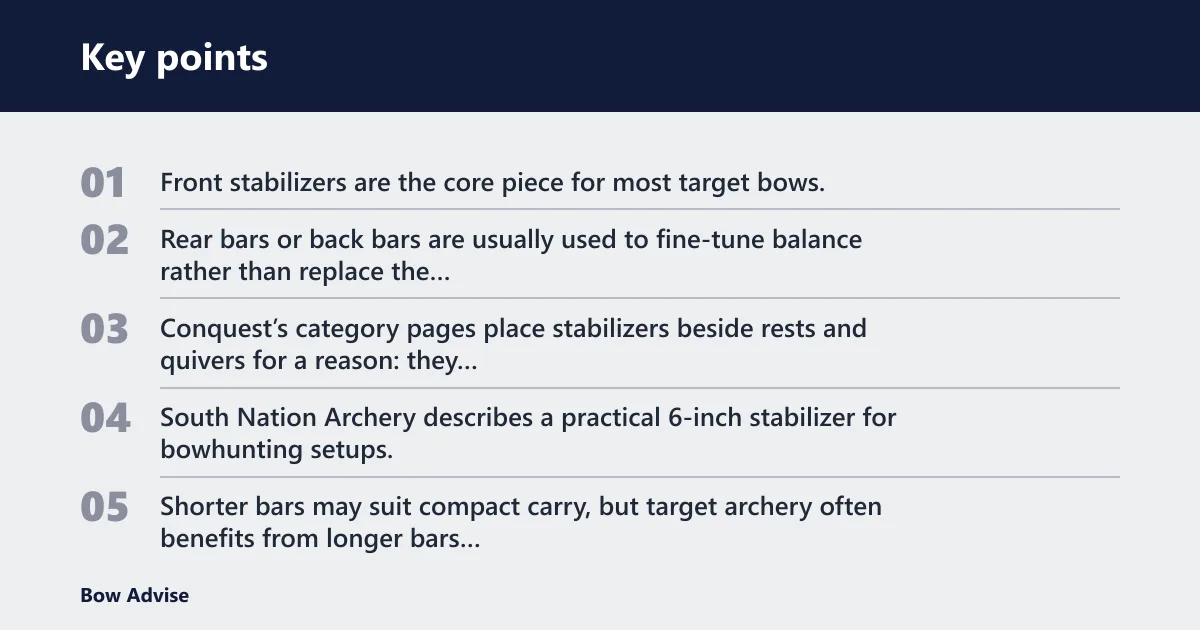
Front stabilizers are the core piece for most target bows. Rear bars or back bars are usually used to fine-tune balance rather than replace the front bar. Conquest’s category pages place stabilizers beside rests and quivers for a reason: they are core equipment, not extras.
South Nation Archery describes a practical 6-inch stabilizer for bowhunting setups, which is a useful contrast. Shorter bars may suit compact carry, but target archery often benefits from longer bars because they give more control over balance.
Best lengths and balance goals
A 27-inch stabilizer, like the Bee Stinger Competitor Stabilizer, is generally considered to fit the target-archery camp. Longer bars generally help steady the bow’s hold, but they also add front weight and can feel awkward in crowded shooting lines or field events.
Too much mass can backfire. If a bow becomes hard to hold at full draw or starts tipping forward between ends, the setup is asking for fatigue instead of control. The better tradeoff is enough mass to calm movement without forcing grip pressure or shoulder strain.
When extra weight helps and when it hurts
Extra stabilizer weight helps when it settles the pin or sight ring without making the bow slow to recover between shots. It hurts when the archer compensates by gripping harder, lifting the bow shoulder, or shortening the shot cycle to escape fatigue.
In competition, accessories hurt more than help when they make your hold less repeatable under pressure. If the front end gets too heavy, the sight picture may look calmer while the shot itself becomes harder to execute cleanly.
Quiver: best for arrow carry
A quiver is useful, but it is rarely a score-first buy for target competitors. Its main value is arrow storage, quick access, and keeping the line organized; after that, the best quiver is the one that stays out of the way.
Bow-mounted vs target quiver
Bow-mounted quivers are more common on hunting bows, while target quivers usually ride on the hip or stand nearby. For tournament use, many archers prefer a lighter carry solution because it keeps the riser cleaner and the bow easier to manage on the line.
That said, some bow-mounted quivers work well for field rounds or when convenience matters more than a minimal profile. The tradeoff is simple: a mounted quiver adds on-bow bulk, while a separate target quiver shifts carry off the bow.
Capacity, detach systems, and profile
Look for quick-detach options if the quiver needs to come off between practice and competition. A tight profile matters too. Quivers that sit close to the riser are less likely to snag, and Conquest’s Offset Quiver Bracket specifically moves the quiver closer to the bow centerline.
That centerline idea matters because a quiver hanging wide can make the bow feel unbalanced and awkward in transport. More capacity is not automatically better if the quiver becomes a side load on the riser.
Left- and right-handed fit
Handedness is easy to miss. A quiver that fits a right-handed bow poorly can interfere with the rest, sight bar, or cable path. Target archers should confirm the mounting side before assuming a universal fit.
The same source lists the Neet N-613 as a beginner target quiver, and it is clip-on with no belt required. That style suits newcomers who want simple carry, but it is still worth checking capacity and fit before buying.
What other accessories are worth buying?
After the core aiming and balance pieces, the next buys are the ones that reduce noise, reduce vibration, or make the bow easier to manage between ends. These are useful, but they are usually later purchases unless they solve a specific complaint.
String suppressors and compact tournament setups
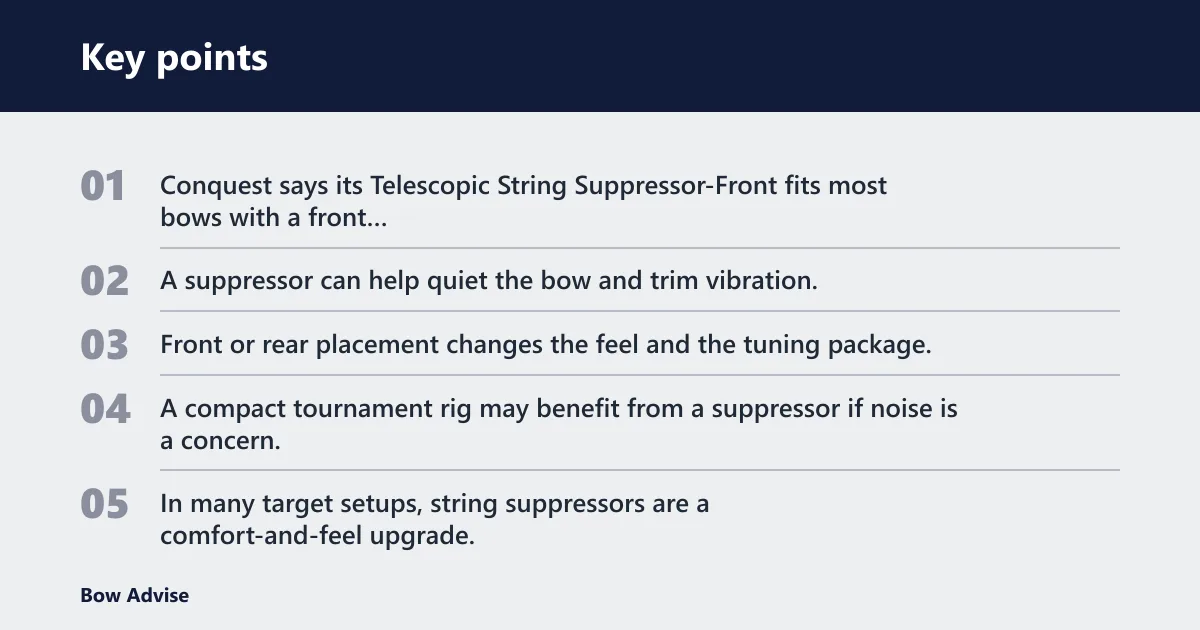
Conquest says its Telescopic String Suppressor-Front fits most bows with a front stabilizer bushing. That is the key compatibility point. A suppressor can help quiet the bow and trim vibration, but it should not interfere with the front bar or crowd the bow’s front end.
Front or rear placement changes the feel and the tuning package. A compact tournament rig may benefit from a suppressor if noise is a concern, yet the accessory is still secondary to sighting and balance. In many target setups, string suppressors are a comfort-and-feel upgrade, not a ranking changer.
Sight mount brackets for modern bows
Modern bows with Picatinny interfaces or nonstandard sight-hole layouts may need a bracket like Conquest’s Universal Picatinny Sight Mount Bracket. At 1.4 oz, it is light enough to be a practical interface piece rather than a major weight addition.
The drawback is simple: a bracket solves fit, not aim quality. If the sight itself is not repeatable, the mount only preserves a poor system more securely. Manufacturer manuals are the place to confirm mounting depth, screw length, and torque before committing to a bracket.
Release aids, riser tape, and lower-priority upgrades
Release aids belong high on the list for compound archers because they affect trigger control, anchor repeatability, and D-loop use. A handheld thumb release, such as the Stan SX4 Thumb Release Aid, fits archers who want travel and tension control; a wrist strap release may suit those who want a more familiar hold. The tradeoff is that a release adds another tuning variable, so it should match the archer’s draw cycle and D-loop setup.
Riser tape is a small buy with real value. Athletic tape material can protect the grip, add tackiness, and stay steadier in wet or sweaty conditions. It does not change score like a sight does, but it can keep the bow hand from slipping when pressure rises. For recurve, this can matter more than flashy add-ons because a consistent grip line supports clean execution and a cleaner clicker response.
Suppose a compound archer already has a solid sight and rest, but the grip starts sliding in humid weather. Riser tape is the cheaper fix. A bulkier quiver or extra weight would not solve that problem.
Which one should you buy first?
Buy the accessory that removes the biggest current limitation. For most archers, that means sight and stabilizer work first, then release or quiver upgrades, then noise-control and convenience pieces. The best order depends on division, but the pattern is the same: fix score-related issues before adding comfort features.
Budget-first order
Start with the item that most directly affects aiming or balance. If the bow is already stable and the sight is trustworthy, then a better sling or riser tape may be enough for now. If the sight drifts or the bow feels twitchy, those issues outrank every convenience add-on.
Recurve-first order
For recurve, the first accessory dollars usually go to stabilizer setup, then to string and grip consistency, and then to a quiver or extra damping if needed. A recurve setup should stay clean and predictable. Heavy add-ons can create more problems than they solve. The clicker deserves special attention because it directly supports timing and expansion; if you ignore it, you can spend money on accessories while leaving the biggest control variable untouched.
Compound-first order
For compound, the first dollars usually go to sight, arrow rest, and release aid. A reliable bow sling comes next for safe handling, followed by stabilizer tuning and only then by noise-control extras. Based on specs and reviews, that order gives the highest scoring return.
What to skip until later
Skip oversized quivers, decorative add-ons, and weight stacks you do not need. Skip any accessory that forces a new clearance problem, makes the bow awkward to hold, or adds tuning complexity without solving a known issue.
A common first-timer mistake is adding a long quiver, a heavy stabilizer, and a suppressor all at once. The bow may look complete, but the setup can become front-heavy, crowded, and harder to tune cleanly. In scoring rounds, that kind of clutter usually costs more than it helps.
Bow sight: best for aiming
A good tournament sight gives repeatable elevation and windage, a clean sight picture, and a mounting system that does not wander under use. For compound archers, that makes it one of the highest-value purchases on the bow.
Frequently asked questions
What bow accessories are actually worth buying for archery competitions?
The most worth-it accessories are the ones that affect aim, balance, and repeatability: sight, stabilizer, arrow rest, and release aid for compound; stabilizer and clean grip setup for recurve. Quivers, suppressors, and brackets matter more when they solve a fit or convenience issue. If an accessory does not improve consistency or remove a clear limitation, it usually belongs lower on the list.
Do I need a stabilizer for tournament archery?
Most target archers benefit from one because it helps with balance and bow feel. It is especially useful when the bow jumps too much at release or feels unstable at full draw. The wrong length or too much weight can still hurt control, so fit matters. World Archery and USA Archery equipment guidance also makes it important to confirm that the setup is legal for your division.
Which quiver is better for target archery: bow-mounted or hip quiver?
For most target rounds, a hip or separate target quiver is easier to live with because it keeps the bow cleaner and lighter. Bow-mounted quivers are more convenient in some field or crossover setups, but they add bulk and can make the bow feel wider. If you already struggle with balance or front-end clutter, the hip quiver is usually the safer choice.
Is a sight upgrade worth it for competition archery?
Yes, if the current sight has backlash, poor repeatability, or limited adjustment. A better sight is one of the clearest score-related upgrades for compound archers. For recurve, the value depends on the class rules and how much the sight system limits aiming control. The best sight is the one that holds zero, tracks cleanly, and matches the division’s rules.
What accessories help with accuracy without breaking rules?
Sights, stabilizers, approved rests, and a properly matched release aid are the main accuracy-related accessories. The important part is rule compliance and fit. A legal accessory that causes clearance issues or changes the bow’s balance badly is not a good competition buy. The safest path is to verify legality first, then build the setup around the bow’s actual geometry.
Which accessories matter most for recurve vs compound competition?
Recurve usually cares most about stabilizer setup, grip control, clicker timing, and a clean, light bow feel. Compound usually cares most about sight quality, arrow rest tuning, and release aid consistency. Both divisions need compatibility checks, but the ranking of priorities is not the same. Recurve generally suffers more from excess clutter, while compound usually suffers more from poor aiming hardware.
Sources
World Archery Equipment Rules; USA Archery Rules and Bow Equipment guidance; manufacturer manuals from Bee Stinger, Axcel, Hamskea, and Conquest Archery; coaching and setup guidance from reputable target-archery instruction sources covering stabilizer balance, sight setup, and release aid consistency.