How to Choose the Right Quiver for Target Archery
A target archery quiver keeps arrows close, sorted, and ready so the next draw stays predictable. In target use, the best quiver supports repeatable nock access, low noise, and a stable stance; hunting-style priorities like brush clearance and crawling are far less important.
Placement and selection of a target quiver
How target quivers differ from hunting quivers
Target archers usually care more about access speed, balance, and arrow order than concealment. A bow quiver keeps arrows close at hand, but a belt-style or hip-mounted setup often fits target routines better because it allows minimal movement for retrieval and can reduce noise while moving.
That difference matters indoors and outdoors. On a fixed lane, the quiver should stay out of the way of the draw hand, the string, and any arm guard. On a tournament line, it also needs to stay quiet when you walk, bend, and settle back into stance.
Where quivers fit in a target setup
A target setup usually pairs the quiver with a repeatable nocking routine. The arrow should come out at the same angle each time, with the hood or pockets positioned so the archer does not hunt for the shaft, fletching, or point.
That is why target archery changes the buying criteria. Capacity, fit, and carry style matter more than broad comfort claims. A quiver that works well for one bow or one round length can be awkward for another.
How do I choose the right quiver for target archery?
Choose the quiver that interferes least with your shot routine. For most target archers, that means a hip quiver with enough capacity for the round, an adjustable fit if arrow lengths vary, and a layout that keeps arrows secure without adding bulk near the draw side.
Start with your shooting pattern
If you stay at one line and shoot high-volume practice, the lightest stable option often makes sense. If you walk between targets, carry arrows across uneven ground, or rotate through ends with different distances, security and balance matter more than raw speed.
Say your practice session uses a fixed 20-yard lane with about a five-arrow end. A hip quiver or ground quiver can work well because the arrows stay accessible and the setup stays simple. If the same archer starts moving between marked distances, a crossbody or well-fitted hip quiver may feel steadier.
Match the quiver to your bow type
Recurve target setups often favor clean hip carry because the draw side needs room and the archer may want a slim profile near the waist. Compound target setups can tolerate more structured carry, but the quiver still should not interfere with release aids, d-loop access, or anchor consistency.
Do not buy by appearance alone. A quiver that looks tidy may still tip, swing, or sit against the arrow rest path. The right choice is the one that keeps the shooting cycle repeatable.
Consider practice volume and round length
Arrow capacity should follow your training style. A short practice block may only need 3 or 5 arrows. Longer sessions and some scoring rounds often call for about 6, 9, or 12 arrows so full ends can be shot without constant refilling.
More arrows mean more weight and more bulk. Less weight can feel better on the line, but a too-small quiver creates interruptions if you keep reaching for replacements. Capacity should support the session, not overwhelm it.
Should I use a hip quiver or a back quiver for target shooting?
For most target shooters, a hip quiver is the safer default. It gives fast arrow access, sits near the waist or hips, and usually affects balance less than a back quiver. A back quiver can carry more arrows, but it is slower to use and can shift body position.
Hip quiver: speed and easy access
Hip quivers are common for target archery because they place the arrows where the draw hand can reach them with minimal motion. That helps with rhythm, especially when the same hand must clear the shaft, find the nock, and return to anchor in a consistent sequence.
The Easton Flipside 3-Tube Hip Quiver, Black, Left/Right is a practical example of this style. Based on the manufacturer’s details and published buyer feedback, its ambidextrous reversible pocket and accessory attachment points suit target use well. The drawback is simple: three tubes keep arrows organized, but capacity is modest for longer sessions.
Back quiver: capacity and carry trade-offs
A back quiver Hangs over the shoulder and down the back. It can hold more arrows, which sounds convenient until retrieval becomes slower and the draw path starts feeling less repeatable. It can also catch on brush outdoors, even though target lanes are usually cleaner than hunting terrain.
For target archery, the issue is not tradition. It is consistency. If the quiver shifts when the archer twists to reach an arrow, the body may rotate more than intended. That can affect balance and shooting form.
Which one suits target shooting better?
Use a hip quiver unless you have a specific reason to carry arrows on the back. Back quivers make more sense for high-capacity carry than for fast, repeated target retrieval. A target archer who values routine usually gets better results from a waist-mounted design.
Suppose a beginner uses a back quiver with 9 arrows at an indoor range. The first few ends may feel fine, but if the quiver swings when turning to the target line, the extra movement becomes a distraction. A hip quiver would usually solve that sooner.
Ground quiver for fixed lanes
A ground quiver is anchored to the ground, which makes it useful for target practice at fixed lanes. It is the best fit when the archer stays in one lane, wants very little carry weight, and does not need to walk with arrows between ends.
When a stationary setup makes sense
Ground quivers suit indoor ranges, club lanes, and other controlled environments where arrow access matters more than mobility. They are especially useful for high-volume target sessions because the arrows remain parked in one place instead of riding on the body.
The trade-off is obvious. You gain a stable station, but you also lose portability. If the range layout requires frequent movement, the quiver stops helping and starts becoming one more object to manage.
Stability, reach, and lane convenience
For a fixed shooting line, the ground quiver can keep the lane clear and reduce the need for a belt or hip-mounted pouch. It also avoids belt pressure, shifting on the waist, and some of the noise that comes from moving a carried quiver.
Still, it is not a universal answer. If the archer must bend repeatedly, switch lanes, or shoot in a busy field setting, a body-worn quiver is usually easier to manage.
How many arrows should my target archery quiver hold?
Pick capacity based on round length and training volume, not on the largest number available. A 3-arrow quiver suits short drills, 5 or 6 arrows fit many practice ends, and 9 or 12 arrows make sense when a session or round uses longer strings of shots.
3, 5, and 6-arrow setups
Three-arrow carry is compact and light. It works for focused drills, form checks, and short indoor work. Five or 6 arrows are more flexible for regular target practice because they reduce trips back to a case or barrel without adding too much weight.
These smaller capacities usually make the quiver easier to forget on the body, which is good. They also reduce the chance of the hood becoming crowded or the shafts rubbing each other on every step.
9 and 12-arrow setups
Nine and 12 arrows are better for archers who shoot long practice blocks or prefer to keep an entire session in one carry. The cost is extra bulk, more movement, and a greater chance of interference if the quiver sits poorly on the belt or hip.
Those larger sizes make the most sense when the archery plan is predictable. If the archer shoots a full set of ends before stepping away, the added capacity saves time. If the session is short, it can be unnecessary weight.
Adjustable versus fixed quivers
Adjustable quivers matter when arrow length varies across setups or when the archer wants to shift hood height, pocket position, or belt fit. Fixed quivers are simpler and often lighter, but they are less adaptable than adjustable designs.
The guide compares attachable, adjustable, and lightweight bow quivers, and that distinction matters here. A fixed layout can be perfectly fine for one arrow build. An adjustable quiver becomes more useful when the arrows, clothing layers, or bow setup change through the season.
Is a lightweight quiver better for target archery?
A lightweight quiver can be better if it stays stable and holds the arrows securely. Low weight helps comfort during long sessions, but too little structure can let the quiver tip, swing, or shift when the archer walks or reaches for an arrow.
When light weight helps
Lightweight quivers are helpful for beginners, indoor ranges, and high-volume shooting where every extra ounce seems to show up by the end of the session. Less mass on the belt can reduce fatigue and make it easier to forget the quiver is there.
That said, a very light quiver is not automatically better. If the hood flexes, the arrows bounce, or the belt rides upward, the savings in weight are not worth the loss in control.
When stability matters more
If the quiver moves when you bend to pick up gear or if it pulls the belt off-center, choose a more stable design. The goal is not the lightest setup possible. The goal is the least disruptive setup for your shot routine.
Do adjustable quivers matter for target archery?
Adjustable quivers matter when your arrows, clothing, or bow setup vary enough that a fixed design starts to feel cramped. If your gear stays the same all season, a fixed quiver may be simpler and just as effective.
Fit adjustment and arrow-length compatibility
Adjustable quivers are worth paying for when the hood, pockets, or belt position need to move. That flexibility helps with different arrow lengths and can make it easier to keep points and fletching from bumping each other or the body.
In target archery, fit issues show up fast. A pocket that sits too high can catch fletching. A hood that sits too low can interfere with the draw hand. Small changes in placement can solve both problems.
Simple versus adaptable designs
Fixed quivers usually cost less and may feel cleaner if the setup never changes. Adjustable quivers are better when the same archer uses different layers, different shaft lengths, or multiple bows with different clearance needs.
A common first-timer mistake is choosing a quiver by color and then discovering that the pocket angle makes the arrows rub against the forearm. The fix is usually design, not decoration.
Target quiver decision matrix
This matrix compares the main target-archery quiver styles across the criteria that change the shooting routine most. The scores use a 1-to-5 scale, with 5 being the best for that criterion. It is a practical guide, not a universal ranking.
| Quiver type | Access speed | Balance impact | Arrow security | Noise | Walking comfort | Beginner-friendliness | Recommended setup by archer profile |
|---|---|---|---|---|---|---|---|
| Hip | 5 | 4 | 4 | 4 | 4 | 5 | Best for beginners, most recurve target archers, and many compound target setups |
| Ground | 4 | 5 | 5 | 5 | 1 | 4 | Best for fixed-lane shooters and high-volume practice at one station |
| Back | 2 | 2 | 3 | 3 | 3 | 2 | Only for archers who want higher capacity and accept slower retrieval |
| Crossbody | 3 | 4 | 5 | 4 | 4 | 3 | Good for archers who move between targets and want balanced carry |
Reading the matrix by archer profile
Beginner: hip quiver first, ground quiver second if the range is fixed. These are the easiest to manage and the least likely to distract from form.
Recurve target archer: a slim hip quiver with clear arrow spacing is usually best. The draw side needs room, and the quiver should not press against the bow arm or string path.
Compound target archer: a hip quiver or crossbody quiver works well if it keeps clear of release aids and anchor access. Stability matters more than style.
Range-only shooter: a ground quiver is a strong choice if the lane stays fixed. It keeps the body clear and supports repeatable access.
What is an archery quiver?
An archery quiver is a carrier for arrows, but in target archery the job is more specific than simple storage. It needs to keep arrows organized, close at hand, and quiet enough that the shooter can repeat the same motion every end.
Target archery setup needs
The target setup should allow repeatable draw and nock access, low-noise carry, and minimal disruption to the shot. That means checking hood depth, pocket angle, arrow length, and how the quiver behaves when the archer walks between ends.
Crossbody quivers can help when movement between targets is common because they balance carry across the torso. Hip quivers usually win for speed. Back quivers win on capacity, but that is not the same as winning on target performance.
Our picks by need
Most target practice: Easton Flipside 3-Tube Hip Quiver

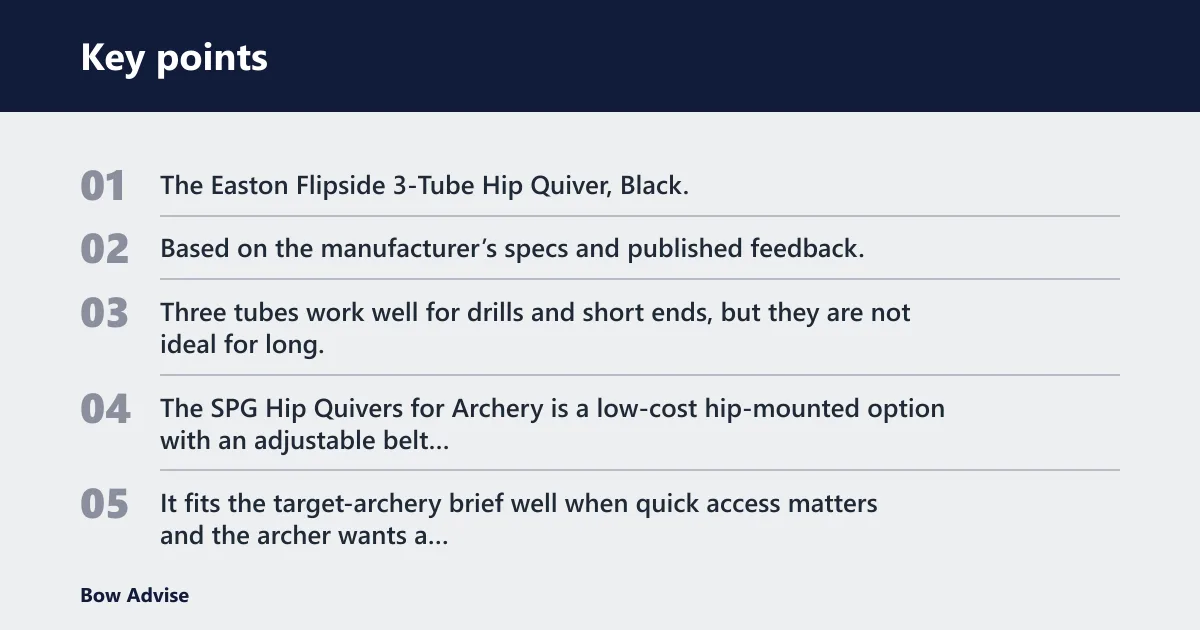
The Easton Flipside 3-Tube Hip Quiver, Black, Left/Right is the cleaner target-first choice of the two products listed here. Based on the manufacturer’s specs and published feedback, the ambidextrous reversible pocket and belt clip suit right- and left-handed archers, and the three tubes keep arrows organized.
The drawback is capacity. Three tubes work well for drills and short ends, but they are not ideal for long, high-volume sessions unless the archer is fine refilling often.
Budget practice fit: SPG Hip Quiver

The SPG Hip Quivers for Archery is a low-cost hip-mounted option with an adjustable belt and a lightweight build for practice sessions. It fits the target-archery brief well when quick access matters and the archer wants a simple waist carry for compound or recurve use.
The honest drawback is that budget quivers can be less refined in fit and pocket layout than higher-end options, so the archer should check clearance, belt security, and arrow spacing before relying on it for a full round.
Mistakes to avoid
The most common mistake is choosing a quiver by look instead of function. Target archery rewards repeatable access, stable carry, and fit. A quiver that photographs well can still move badly on the line.
- Do not ignore arrow length. A fixed pocket or hood can work against shafts that are longer or shorter than expected.
- Do not buy capacity without checking balance. More arrows add weight and bulk, which can change how the quiver sits on the waist.
- Do not overlook noise. Loose arrows or a rattling hood can break concentration during walk-back practice.
- Do not assume back quivers are better because they are traditional. They are slower, and they can alter balance and form.
- Do not match hunting needs to target use. Brush clearance and concealment are not the main targets here.
Picture a club archer using a 12-arrow back quiver for a short indoor round. The arrows may carry fine, but the added reach and shoulder movement can slow every end. A smaller hip quiver would likely keep the routine tighter.
Frequently asked questions
What type of quiver is best for recurve target archery?
A slim hip quiver is usually the best match for recurve target archery. It keeps arrows accessible without crowding the bow arm or draw side, and it supports a clean, repeatable routine. Ground quivers also work well for fixed-lane practice.
What type of quiver is best for compound target archery?
A hip quiver or crossbody quiver usually works best for compound target archery. The main goal is to keep arrow access smooth while avoiding interference with the release aid, anchor, and draw cycle. Back quivers are usually a weaker fit because of slower retrieval.