How Many Arrows in a Competition Archery Round?
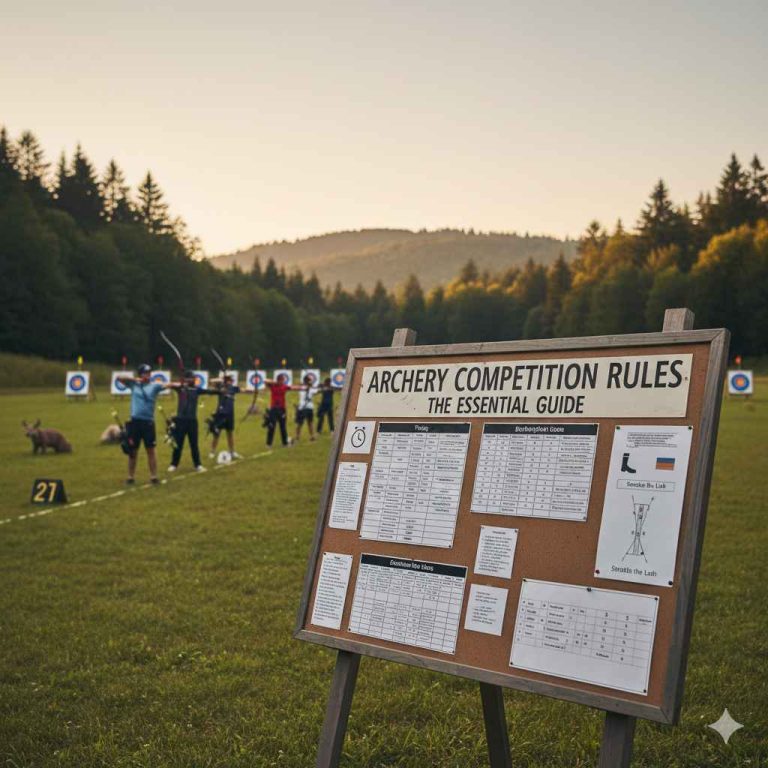
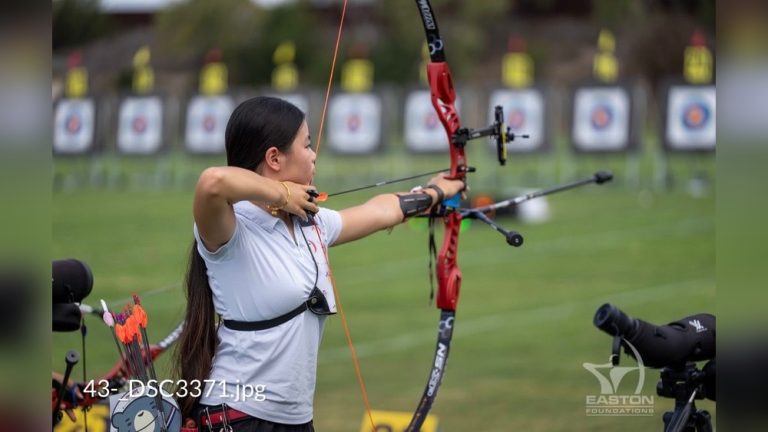
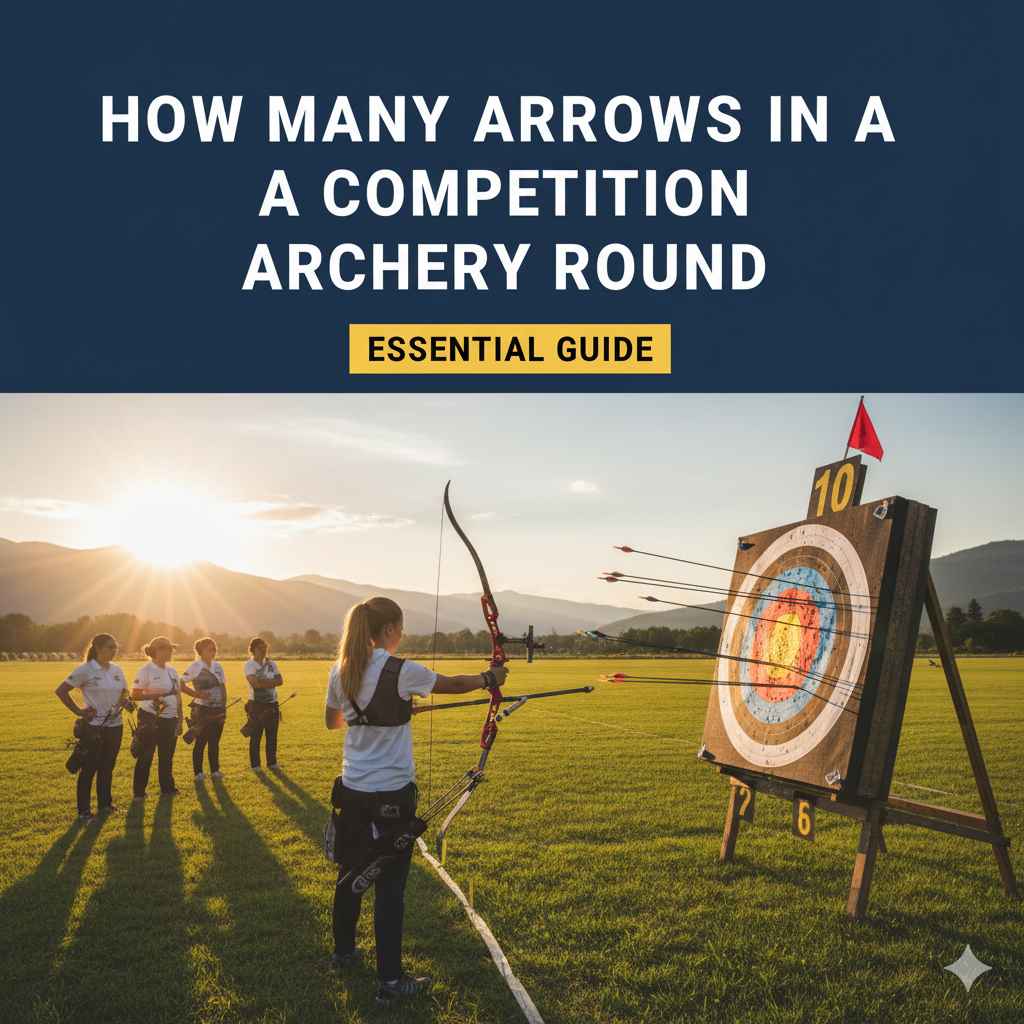
In competition archery, the number of arrows shot per scoring round varies by discipline. A common outdoor round involves 36 arrows, while indoor rounds might have 30 or 60. Always check the specific rules of your chosen competition to know exactly how many arrows to prepare for.

TIGER ARCHERY
TIGER ARCHERY 30" Carbon Arrows for Compound…
- Length:30", Outer diameter: 0.309 inch. Fletching with 2 orange 1 white vanes. For draw weight 35-60 pounds recurve, compound, or…
- They are solid & well made. Precision carbon hunting arrows made for extended durability and long lasting target practice.
- Colored plastic fletching make flight always pointed the right way. The tips are nickel plated stainless steel which is perfect fo…
As an Amazon Associate I earn from qualifying purchases.
As you step onto the archery range, ready for your first competition, a question might pop into your mind: “How many arrows will I actually shoot?” It’s a common question, and the answer isn’t always a simple number. Different archery styles and competitions have different formats, which can be a bit confusing when you’re just starting out. Don’t worry, though! Understanding these formats is key to feeling prepared and confident on the line. This guide will break down the typical number of arrows you’ll shoot in various competition settings, helping you focus on what matters most – hitting that target!
Understanding Archery Competition Formats
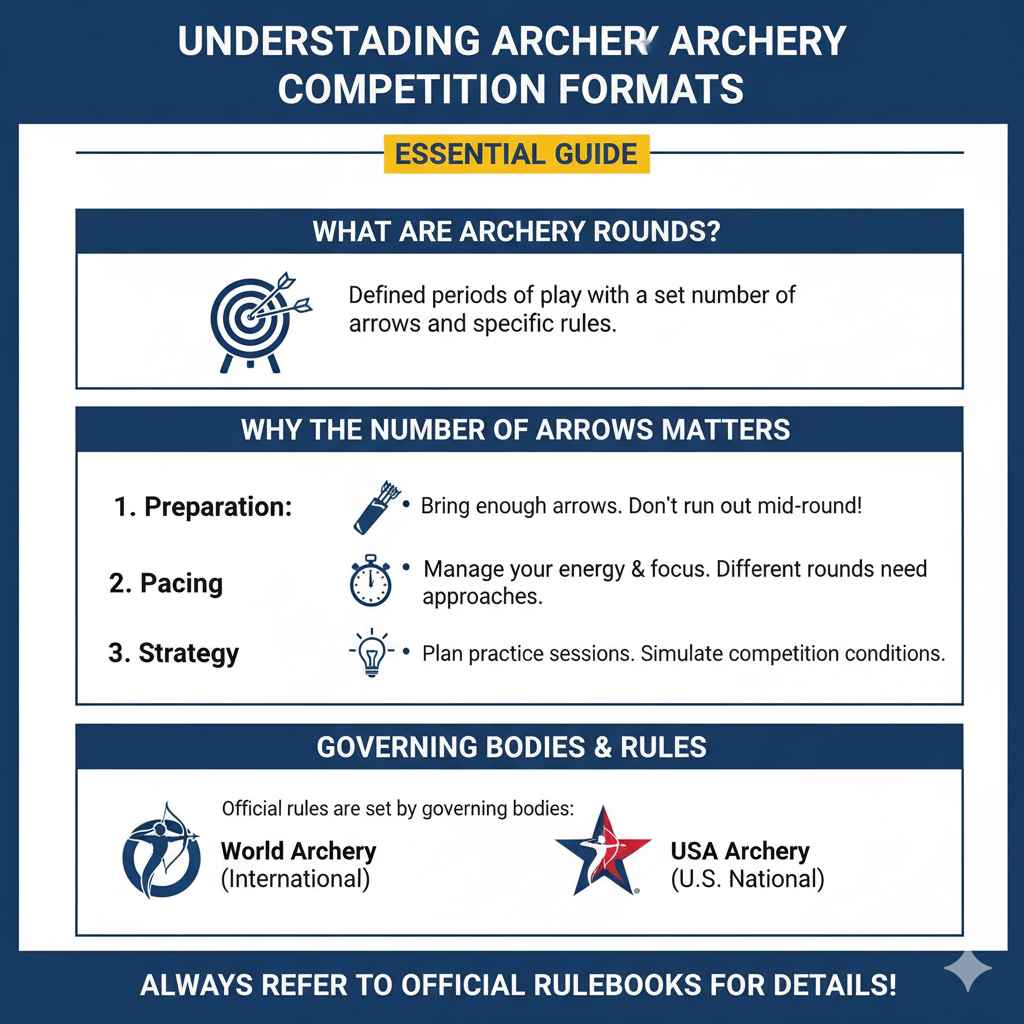
Archery, at its core, is about shooting arrows accurately at a target. But in a competitive setting, it’s organized into specific formats that dictate everything from the distance to the target to how many arrows you get to shoot. These formats ensure fairness and provide a clear benchmark for skill. The number of arrows in a “round” is one of the most fundamental aspects of these formats.
Think of an archery round like a game in tennis or an inning in baseball. It’s a defined period of play where you get a certain number of opportunities to score. Knowing this number is crucial for several reasons:
- Preparation: You need to bring enough arrows for the entire competition. Running out mid-round is a quick way to get a low score!
- Pacing: Understanding the round length helps you manage your energy and focus. A 36-arrow round requires a different mental approach than a 120-arrow tournament.
- Strategy: Knowing the number of arrows allows you to plan your practice sessions effectively, simulating competition conditions.
We’ll dive into the specifics of different types of archery competitions, but it’s important to remember that governing bodies like World Archery (for international events) and USA Archery (for national events in the U.S.) set the official rules. Always refer to their latest rulebooks for the most accurate and up-to-date information, as rules can evolve.
How Many Arrows in an Outdoor Competition Round?
Outdoor archery competitions are often characterized by longer distances and are typically shot in specific formats. The most iconic outdoor archery competition is the FITA (Fédération Internationale de Tir à l’arc) Round, now officially known as the “World Archery 1440 Round” or simply the “72-Arrow Round” when discussing Olympic-style recurve archery.
The World Archery 1440 Round (72 Arrows)
This is a very popular and demanding format, especially for Olympic recurve archers. It’s named the 1440 round because it uses four different distances common in field archery and the Olympics: 90m, 70m, 50m, and 30m. For each distance, an archer shoots a set number of arrows to total 72 arrows for the entire round.
Here’s the breakdown:
- 90 meters: 12 arrows
- 70 meters: 12 arrows
- 50 meters: 12 arrows
- 30 meters: 12 arrows
So, if you’re competing in an Olympic Recurve event that uses the World Archery 1440 Round, you will shoot a total of 72 arrows in the main scoring portion of the round. However, it’s important to note that this is often just one part of a larger tournament. Many outdoor tournaments consist of multiple rounds or elimination matches. For example, a qualification round might be a 72-arrow round, followed by head-to-head elimination matches where the format can change.
The WA 50 Meter Round (60 Arrows)
Another common outdoor format, particularly used in various national and international tournaments as a qualification or ranking round, is the WA 50 Meter Round. This format simplifies the distances and focuses on one primary scoring distance.
- 50 meters: 60 arrows
In this format, archers shoot 60 arrows at a 50-meter distance. This round is often used as a basis for seeding archers into match play or for ranking purposes.
Field Archery Rounds (Variable)
Field archery takes place outdoors in natural terrain, with targets placed at varying distances and sometimes uphill or downhill shots. The number of arrows per round in field archery can differ significantly based on the specific competition rules or course layout.
- Traditional Field Rounds: Often consist of shooting at 24 targets. For each target, an archer typically shoots 3 arrows. This totals 24 targets * 3 arrows/target = 72 arrows for a complete Field Archery round.
- Hunter Rounds: Similar to Field Rounds, often with 24 targets and 3 arrows per target, totaling 72 arrows.
- Scout Rounds: These might have fewer targets or a different arrow count per target, so checking the specific event rules is crucial.
World Archery also has specific Field Archery rules that dictate the number of arrows and distances. For official World Archery Field Championships, a typical round involves shooting at 24 different targets set up over a field course. Archers usually shoot 4 arrows per target, leading to a total of 96 arrows per day for a full course. However, many introductory or club-level field archery events might use the 3 arrows per target rule, totaling 72 arrows.
Simpler Outdoor Formats
Beyond the major international formats, many local clubs and recreational shoots use simpler scoring systems. These might involve shooting a set number of arrows, such as:
- 30 arrows at various distances.
- 36 arrows, often broken into two ends of 6 arrows each, shot at one or more distances.
These are excellent for beginners to get a feel for competition without the pressure of longer, more complex rounds.
How Many Arrows in an Indoor Competition Round?
Indoor archery is typically shot at closer distances and is often faster-paced than outdoor archery. The formats are generally more standardized and focus on a consistent scoring experience.
The World Archery Indoor Round (60 Arrows)
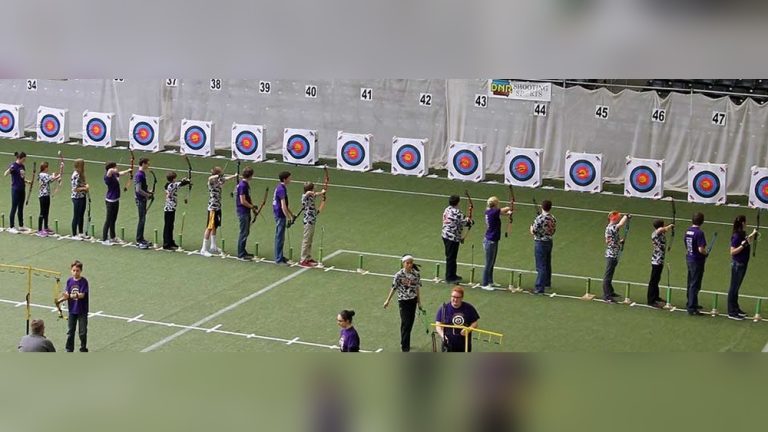
This is the most common format for indoor championships and many national-level indoor events. Archers shoot at targets placed at a single distance, usually 18 meters (about 20 yards).
- 18 meters: 60 arrows
These 60 arrows are shot as 20 ends of 3 arrows each, with roughly 2 minutes allowed per end. The 3-arrow end is the World Archery standard for indoor competition, not just for this round but for outdoor target rounds too.
This format tests an archer’s ability to maintain consistency under potentially challenging lighting conditions and with the added psychological pressure of shooting fewer arrows per “set” with less time to adjust between them. You can find more about World Archery’s indoor rules on their official site.
The FITA Indoor Round (60 Arrows with different targets)
While similar to the World Archery Indoor Round, the FITA Indoor Round (older terminology, often now encompassed by World Archery rules) can sometimes involve shooting at different target faces. For example, a 60-arrow round might be split:
- 30 arrows shot at a larger 40cm target face.
- 30 arrows shot at a smaller 20cm target face.
Both are shot at the same distance (typically 18 meters), and it’s still a total of 60 arrows for the round.
Other Indoor Formats
Some local clubs or events might use variations:
- 30 Arrow Rounds: A shortened version, useful for practice or beginner events.
- Compound Specific Rounds: Compound archers might shoot at different scoring zones or distances, but the total arrow count for a round remains standardized within a given competition type.
Putting it Together: A Comparison Table
To help you visualize the differences, here’s a table summarizing the most common competition arrow counts:
| Competition Type | Typical Distance(s) | Arrows Per Round | Notes |
|---|---|---|---|
| World Archery 1440 Round (Olympic Recurve) | 90m, 70m, 50m, 30m | 72 arrows | Four different distances, 12 arrows per distance. Considered a full qualification round. |
| WA 50 Meter Round | 50 meters | 60 arrows | Common outdoor qualification/ranking round. |
| Field Archery (Traditional) | Variable (10-60 yards) | 72 arrows | Usually 24 targets, 3 arrows per target. |
| Field Archery (World Archery Rules) | Variable (10-80 yards) | 96 arrows | Usually 24 targets, 4 arrows per target. |
| World Archery Indoor Round | 18 meters | 60 arrows | Standard indoor competition format: 20 ends of 3 arrows. |
| Simplified Outdoor / Club Round | Variable | 30 or 36 arrows | Good for practice and beginner events. |
Beyond the Round: Tournament Structures
It’s important to understand that while “a round” refers to a specific string of arrows shot for scoring, competitions often consist of more than one round. Here’s how it usually works:
Qualification Rounds
Most major archery tournaments begin with a qualification round. This is where the “number of arrows in a round” we’ve discussed comes directly into play. You’ll shoot a set number of arrows (e.g., 60 or 72) to establish your ranking. Your score from this round determines your place in subsequent match play.
Match Play / Elimination Rounds
After the qualification, tournaments often move into elimination rounds, also known as head-to-head matches. The format here can vary significantly:
- Traditional Elimination: One archer shoots at a time, with the winner advancing. The number of arrows per match can be fixed (e.g., 3 ends of 3 arrows) or based on a set number of points.
- Set System (Olympic Style): Archers shoot a set number of arrows (usually 3 per archer per set) and win “sets” based on who has the higher score in that set or match. A match can consist of multiple sets.
- Archery Games / Fun Shoots: Some non-traditional competitions might use even simpler formats for elimination, like speed rounds or shooting specific scoring zones.
The key takeaway is that while qualification rounds are standardized by arrow count, match play can be much more fluid. Always check the specific tournament’s rules for the match play format.
Practical Tips for Competition Archery
Now that you know how many arrows to expect, here are some tips to help you prepare and perform your best:
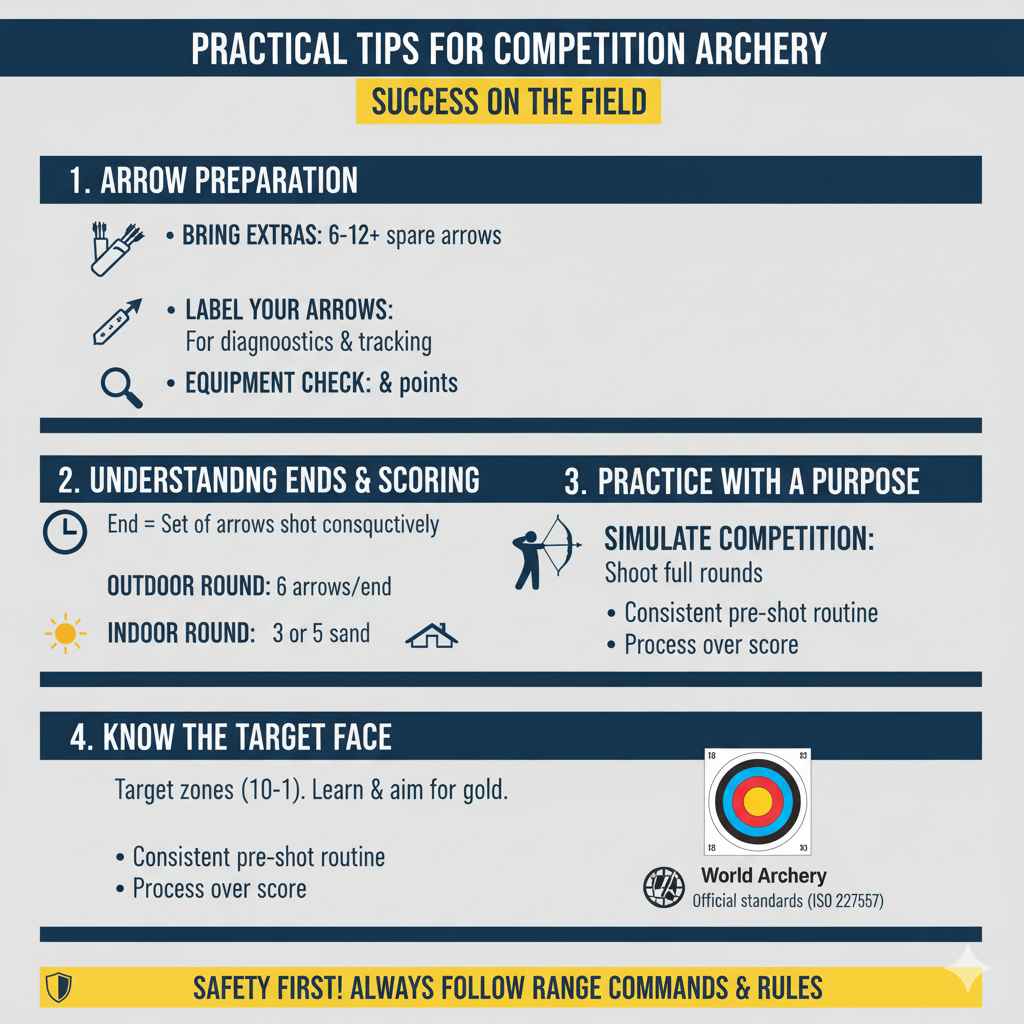
1. Arrow Preparation
- Bring More Than You Need: Never bring just enough arrows for the round. Always bring a few extra arrows (at least 6-12) to account for the possibility of fletching damage, a bent shaft, or simply needing a spare. A good rule of thumb is to have enough arrows for one extra round, or at least 12-24 extra arrows.
- Label Your Arrows: Consider numbering your arrows. This helps if you need to do arrow diagnostics later or if you need to keep track of any that might get damaged.
- Check Your Equipment: Before the competition, inspect every arrow for damage. Check the nocks, shafts, and points to ensure they are secure. A pre-competition equipment check is vital.
2. Understanding Ends and Scoring
An “end” is a set number of arrows shot consecutively before archers walk up to the target to score and retrieve them. Knowing how your arrows are grouped into ends will help you manage your shooting pace and mental game.
- Outdoor Rounds: Often use ends of 6 arrows. For a 72-arrow round, this means 12 ends.
- Indoor Rounds: Most commonly use ends of 3 or 5 arrows. For a 60-arrow round, this could be 20 ends of 3 arrows or 12 ends of 5 arrows.
Understanding this rhythm helps in managing your mindset between shots.
3. Practice with a Purpose
Simulate competition conditions during your practice sessions. Shoot the number of arrows and ends that will be expected in your competition. This helps build stamina and focus.
- Practice shooting your planned number of arrows without taking extended breaks.
- Develop a consistent pre-shot routine that you can perform for every arrow.
- Focus on your process, not just the score, especially when learning.
4. Know the Target Face
Target faces differ by distance and discipline. For Olympic archery, the target zones range from 10 down to 1. Learn what each ring signifies and practice shooting for the higher scores. Information on target faces can be found on World Archery’s equipment standards, which adhere to ISO 22757 standards.
For example, a World Archery outdoor target face has 10 scoring zones. The inner gold ring (X, 10) has a diameter of 12.2 cm. The outer gold ring (9) is larger, and so on, down to the outer white ring (1). Indoor targets are typically smaller and have fewer rings, often scoring 10 down to 6, or just 10 down to 7 depending on the event.
5. Safety First
Always follow range commands and safety rules. Never draw your bow unless you are on the shooting line and have confirmed the area is clear. When retrieving arrows, ensure everyone is clear of the shooting line. Safe practices are non-negotiable in any archery event.
FAQs about Arrows in Competition
Q1: What is the most common number of arrows in an outdoor archery competition?
A1: The most common format for a full outdoor qualification round, especially in Olympic archery, is the World Archery 1440 Round, which consists of 72 arrows shot at four different distances. However, other rounds like the WA 50 Meter Round (60 arrows) and Field Archery rounds (often 72 or 96 arrows) are also prevalent.
Q2: How many arrows are typically used in an indoor archery competition?
A2: The standard for most indoor archery competitions, such as those sanctioned by World Archery, is 60 arrows shot at a distance of 18 meters. These are divided into 20 ends of 3 arrows each.
Q3: Do I need to bring spare arrows for a competition?
A3: Absolutely! It’s highly recommended to bring at least 6-12 extra arrows beyond the number required for the round. This accounts for accidental damage, lost arrows, or equipment malfunctions, ensuring you can complete the competition.
Q4: What is an “end” in archery competition?
A4: An “end” is a set number of arrows shot consecutively before archers retrieve them from the target. Outdoor rounds often have ends of 6 arrows, while indoor rounds typically use ends of 3 or 5 arrows.
Q5: How does the number of arrows change during elimination or match play rounds?
A5: Elimination rounds, or match play, can have different arrow counts and formats than qualification rounds. For example, a match might be decided by who wins a set number of “sets,” with each set consisting of only 3 arrows per archer. The exact number of arrows per match varies by competition rules.
Related pick: Check today's price on Amazon