How Much Does an Arrow Fletching Jig Cost?
Premium magnetic or adjustable arrow fletching jigs often land at about $120 to $250+. Buy the wrong one and you may waste money on weak clamps, poor vane alignment, or settings that are hard to repeat. This guide breaks down price by jig type, which features are worth paying for, and which extras are mostly upsells.
Price ranges for fletching jigs by clamp type
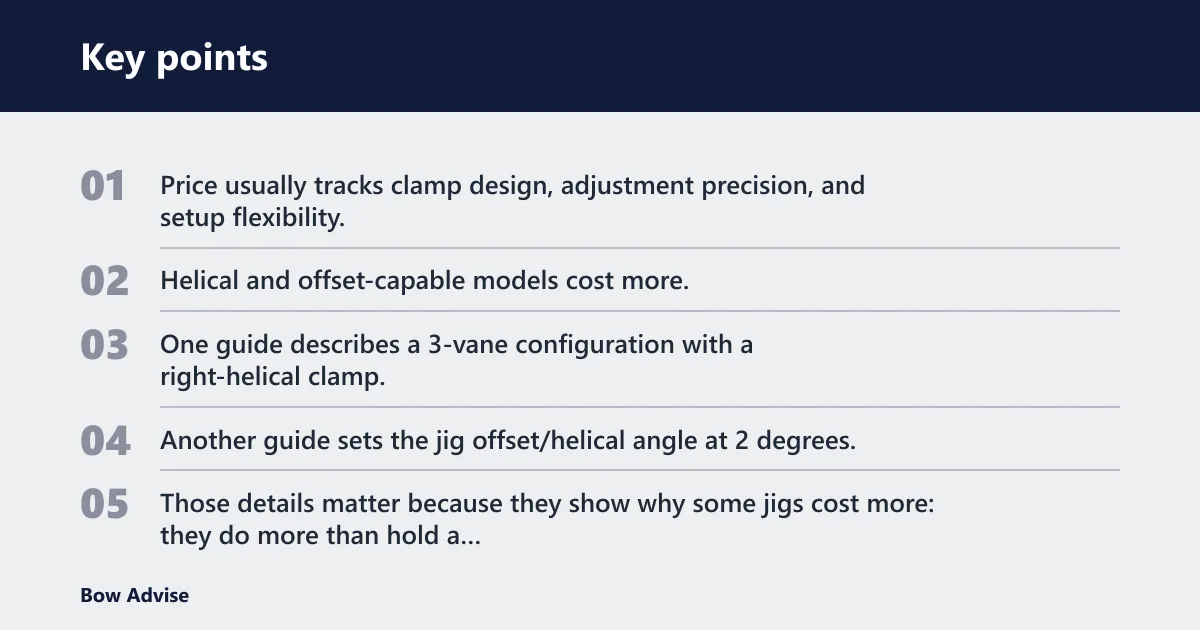


Price usually tracks clamp design, adjustment precision, and setup flexibility. Straight-clamp jigs sit at the low end. Helical and offset-capable models cost more, and the price rises again when the jig supports multi-arrow setups, stronger alignment hardware, or extra adapters for different fletch counts.
Fletching jig price table
| Price tier | Typical jig-only cost | Feature set usually included | Best fit |
|---|---|---|---|
| Budget | $25 to $60 | Basic straight clamp, simple screw-clamp or basic magnetic hold, 3-fletch setup, limited repeatability controls, mixed shaft compatibility depending on adapter | Beginners, low-volume builders, target arrows |
| Mid-range | $60 to $120 | Better clamp pressure, straighter vane indexing, straight and helical clamp options, better vane spacing marks, broader shaft compatibility, some 4-fletch support | DIY archers who want consistent results |
| Premium | $120 to $250+ | Stronger repeatability, more adjustment range, helical or offset clamp options, extra adapters, better indexing for 3-fletch and 4-fletch work, easier switching between shaft types | Bowhunters, frequent builders, small shop use |
One guide describes a 3-vane configuration with a right-helical clamp, and the same guide says the jig can include adapters for a 4-fletch setup. Another guide sets the jig offset/helical angle at 2 degrees. Those details matter because they show why some jigs cost more: they do more than hold a vane in place.
What makes a jig cost more?
Three features usually push price upward. The first is clamp design, especially when a jig includes a helical clamp instead of only a basic straight clamp. The second is the adjustment method. The third is repeatability, meaning how well the jig returns the same vane position and spacing after repeated use.
Clamps with clearer markings and tighter indexing are worth money because they cut guesswork. Clamp markings that cover 2- to 5-inch feathers, which is useful because vane length affects what the jig can handle. A jig that looks cheap can become expensive if it wastes vanes through poor alignment.
Multi-arrow setups also raise the total. Extra clamps, extra holders, and 4-fletch adapters add cost fast. If a builder only needs one arrow at a time, paying for a multi-arrow layout can be wasted money. If a small shop builds many arrows, that extra speed can justify the higher price.
Repeatability and vane spacing
Repeatability is the best measure of quality. A better jig places each vane in the same spot every time, which matters more than flashy hardware. The common spacing for a 3-fletch setup is 120-degree spacing, and a good jig should let the user return to that layout without rechecking every arrow.
That repeatability matters most for broadhead setups and for archers who want every shaft to behave the same way. A jig that drifts even a little can leave one vane higher, lower, or rotated differently from the others. That kind of inconsistency shows up at the target.
Should you buy straight or helical?
A straight clamp is the lowest-cost choice in many jigs, and it is the easiest to set up. It suits field points and target use well because it is simple to align and simple to repeat. A helical clamp costs more, adds spin, and is a stronger choice for fixed-blade broadheads when steering and stabilization matter more.
Straight clamps
Straight clamps keep the vane aligned with the shaft in the simplest way. They are common in budget jigs because they reduce parts count and keep setup simple. The trade-off is less spin than a helical clamp, which is fine for many target arrows and basic practice shafts.
If the goal is clean, repeatable 3-fletch work for field points, a straight clamp is usually the cheaper choice. It is also easier for new builders to understand. There is less to adjust, and fewer angle settings mean fewer chances to misread the clamp.
Helical clamps
Helical clamps cost more because they add wrap and spin to the vane. That extra rotation can help with arrow stabilization, especially when fixed-blade broadheads are part of the setup. They are often sold as right-helical or offset variants, and that distinction matters when buying replacement clamps or choosing a jig.
Helical is not automatically better for every build. It can be more useful, but it also asks for better vane fit and more careful setup. If the shaft or vane combination is awkward, a straight clamp may be the more practical choice.
Offset and right-helical options
Offset and helical settings are often grouped together in product listings, but they are not the same thing. A guide may describe straight, helical, and offset fletching styles separately, which is exactly how buyers should think about them. Do not assume a jig that says “helical” gives every angle you want.
For a simple decision, pick straight for low cost and easier setup. Pick helical if the use case justifies the added price and the jig clearly supports the vane length and shaft type you plan to build.
3-fletch vs 4-fletch: what changes the price?
A 3-fletch setup is usually cheaper and simpler because it uses fewer vanes and standard 120-degree spacing. A 4-fletch setup can add stability, but it often needs better jig support, more careful spacing, and more time at the bench. That means the total cost can rise even when the jig itself does not change much.
Why 3-fletch is usually simpler
Three vanes are the most common setup because the layout is straightforward and efficient. The jig only needs to place three vanes evenly, and that keeps the process cleaner for beginners. It also reduces consumable cost because one fewer vane is used per arrow.
For someone building a first practice batch, 3-fletch is usually the better starting point. It is easier to repeat and usually cheaper to tune. That matters when the goal is learning the process instead of chasing a specialty setup.
When 4-fletch makes sense
Four vanes can make sense when extra stability matters or when the builder wants a different arrow behavior. The trade-off is more material, more time, and often a jig that needs an adapter or a more advanced clamp arrangement. The same guide that mentions a 4-fletch adapter shows why not every budget jig is enough.
Say your arrows are 30-inch carbon shafts with fixed-blade heads and you want a cleaner stabilization feel. A 4-fletch setup may be worth the extra vanes and setup time. If the arrows are for field points only, that extra cost may not buy much.
Cost impact from vanes and setup time
Four-fletch raises the full setup cost because the arrow takes one extra vane, and the jig may need more careful indexing. Vanes themselves are consumables, so the price difference is not just the jig. It is also the ongoing material cost every time a new shaft is fletched.
That is why the cheapest jig is not always the cheapest path. If it cannot hold the 4-fletch layout you want, the savings disappear fast.
What does the full first-time setup cost?
The full first-time setup costs more than the jig alone because glue, wraps, and vane packs are part of the purchase. A realistic first buy should include the jig, at least one extra clamp, a fletching glue, arrow wraps if you want them, and a starter vane pack. The total is usually more than the headline price on the box.
First-time buyer total
| Item | Typical add-on cost | Notes |
|---|---|---|
| Jig | $25 to $250+ | Depends on tier and clamp type |
| Extra clamp | $15 to $50 | Helical and specialty clamps usually cost more than straight clamps |
| Fletching glue | $5 to $15 | Fast-drying or slow-cure versions may cost differently |
| Arrow wraps | $8 to $20 | Optional, but useful for a cleaner bonding surface |
| Starter vane pack | $10 to $25 | Cost depends on vane count, length, and brand |
| First-time total | $63 to $360+ | Jig plus common starter supplies |
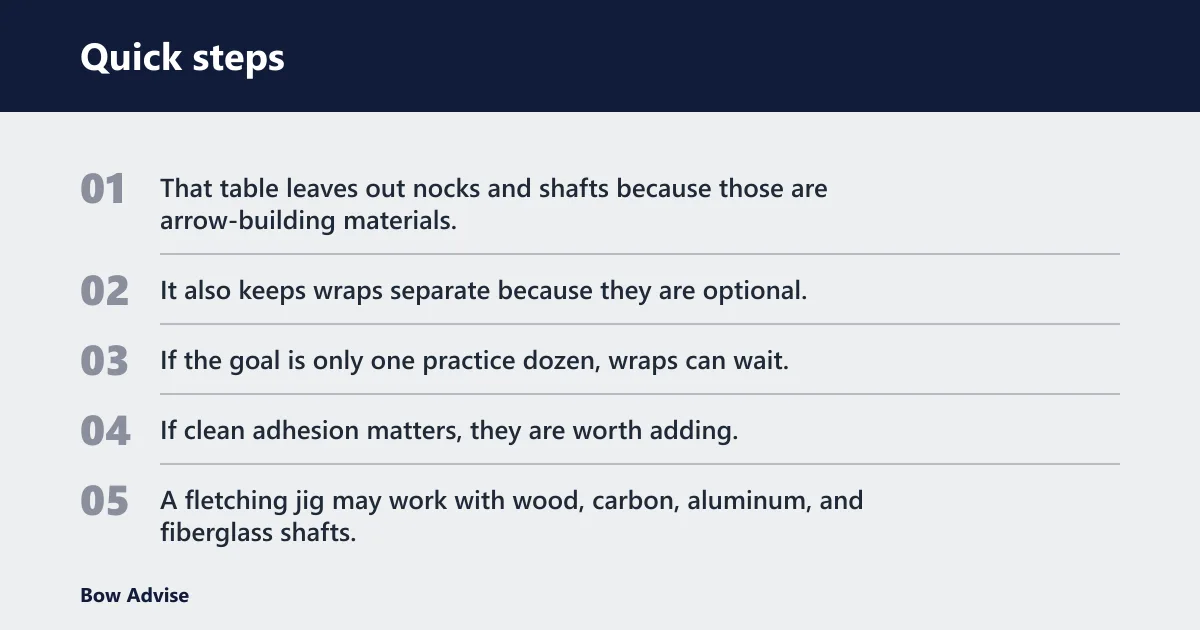
That table leaves out nocks and shafts because those are arrow-building materials, not jig costs. It also keeps wraps separate because they are optional. If the goal is only one practice dozen, wraps can wait. If clean adhesion matters, they are worth adding.
Shaft compatibility and vane length
A fletching jig may work with wood, carbon, aluminum, and fiberglass shafts, but not every jig handles every material equally well. A cost-adjacent guide lists those four shaft materials, which is useful because compatibility is one of the first things to check before buying. A jig that handles carbon well may still need a different setup for wood or fiberglass.
Vane length also matters. Product descriptions commonly mark clamp coverage from 2 to 5 inches, so buyers should check that range before assuming a jig fits their vanes. Short target vanes and longer hunting vanes do not always sit the same way in the clamp.
What should you pay for as a beginner?
A beginner should aim for the lowest workable budget, then pay extra only for clamp quality and repeatability. For most first-time builders, a mid-range jig is the safer buy because it reduces alignment problems without jumping into premium pricing. Cheap jigs can be fine, but only if the clamp holds firmly and the spacing is easy to repeat.
Are cheap fletching jigs worth it?
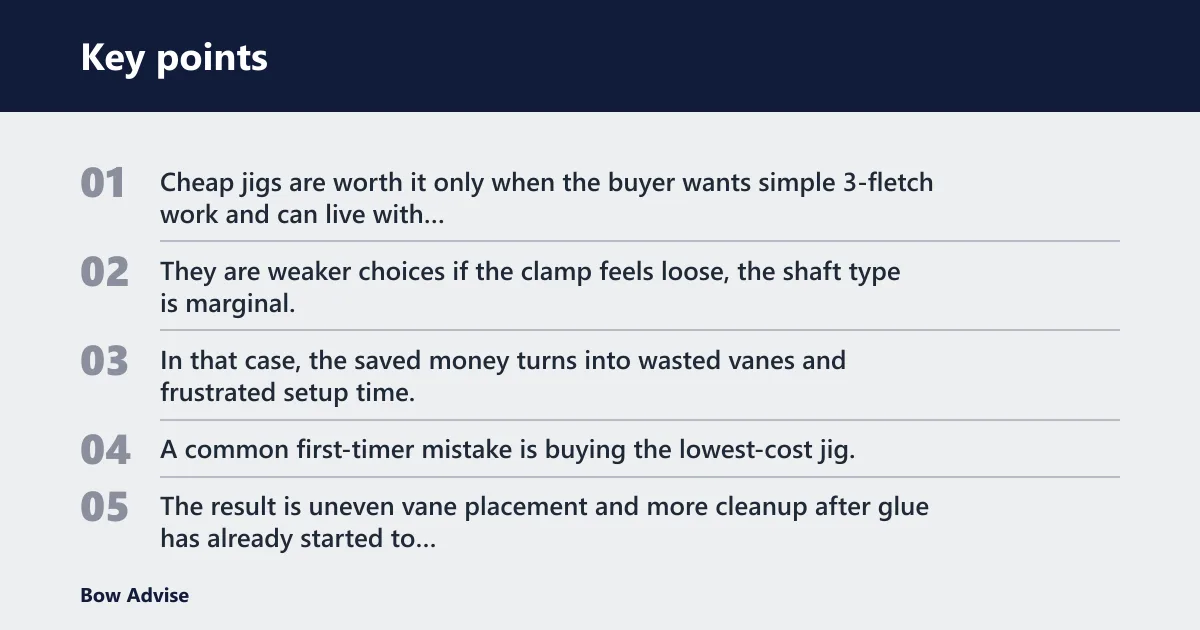
Cheap jigs are worth it only when the buyer wants simple 3-fletch work and can live with fewer adjustments. They are weaker choices if the clamp feels loose, the shaft type is marginal, or the vane spacing is hard to repeat. In that case, the saved money turns into wasted vanes and frustrated setup time.
A common first-timer mistake is buying the lowest-cost jig, then finding that it does not hold a carbon shaft consistently. The result is uneven vane placement and more cleanup after glue has already started to set. That is why the clamp should matter more than the box price.
Features worth paying
Pay for stronger clamp pressure, clear spacing marks, and proven straight or helical options. Pay for 4-fletch support only if that setup is actually needed. Pay for extra adapters when the jig will be used across different arrow builds, not because the feature list looks longer.
For a beginner, a mid-range jig with a straight clamp and the option to add a helical clamp later is often the best value. It keeps the first setup simple while leaving room to move up. That is usually the better spend than a bargain jig with vague indexing.
Features you can skip
Skip extra complexity if the arrows are for target use, field points, or a first learning batch. Skip multi-arrow hardware unless a lot of arrows need to be built. Skip premium styling, because that does not place a vane any straighter.
Picture a beginner building six carbon shafts for target practice with 2-inch vanes. A basic straight-clamp jig is enough if the alignment is consistent and the glue cures cleanly. The extra cost of a premium helical model would not buy much in that case.
How do you fletch arrows without a jig?
It can be done by hand with careful marking, clamp-free alignment, and patient glue work, but the result is harder to repeat. Without a jig, the builder must measure vane spacing, keep the shaft clean, and hold each vane in place while the glue sets. That is slower and less consistent than using a jig.
The adhesive typically needs about 24 hours to cure, and it also says to press the clamp for about 10-15 seconds. Those numbers show the trade-off clearly: a jig helps hold alignment during a process that still needs patience. Without the jig, the same patience is needed, but the alignment burden shifts entirely to the builder.
- Clean the shaft before any glue touches it.
- Mark vane spacing carefully, especially for 3-fletch at 120-degree spacing.
- Apply glue in a thin, even line.
- Hold the vane steady until it bonds.
- Leave the arrow undisturbed until the adhesive cures.
Frequently asked questions
How much does an arrow fletching jig cost?
Most buyers will see basic jigs around $25 to $60, mid-range models around $60 to $120, and premium jigs around $120 to $250+. The biggest price jumps usually come from better clamps, better repeatability, and more adjustment options rather than from simple branding.
What is a good price for a beginner arrow fletching jig?
A good beginner price is usually in the $60 to $120 range if the goal is reliable setup without trial-and-error frustration. That range often buys a better clamp, clearer alignment, and more shaft compatibility than the cheapest models, while staying far below premium pricing.
What features should I look for in a fletching jig?
Look for clamp strength, clear vane spacing, shaft compatibility, and the clamp style you actually plan to use. A straight clamp is simpler and cheaper. A helical clamp costs more but adds spin. If 4-fletch is on the plan, confirm that the jig supports it before buying.
What is the difference between a budget and premium fletching jig?
A budget jig usually keeps the setup simple with fewer adjustment points and a basic clamp. A premium jig usually gives better repeatability, stronger indexing, and more options for straight, helical, or 4-fletch work. The premium price buys control and consistency, not a different job.