Carbon Express Arrow Saw Review: Is It Worth It?
The Carbon Express Arrow Saw is a practical bench cutter for carbon, aluminum, and hybrid shafts. It fits archers who cut enough arrows to care about square ends, dust control, and repeatable length; for occasional builders, a manual saw may be cheaper. Bad cuts hurt point-of-impact consistency, waste shafts, and can damage inserts or nocks. This review covers setup, cut quality, cleanup, blade wear, and whether the time saved justifies the price.
This guide is part of our Arrow making guide: tools, materials, and methods series.
Verdict
Verdict in one line: buy it for regular arrow building, not for one-off trimming. At $158.99 against an MSRP of $249.99, the current price is easier to justify for a home builder who keeps a small bench setup or for a shop that cuts shafts often.
Pros and cons
- Pros: 10K RPM micro-blade design for clean, square cuts; adjustable measuring scale; dust and shavings collection; replacement blades available; suitable for home or pro shop use.
- Cons: Setup and alignment matter; dust collection still needs buyer verification; blade wear adds recurring cost; off-square cuts are a real risk if clamping or measuring is sloppy.
Specs at a glance
| Spec | Carbon Express Arrow Saw |
|---|---|
| Intended use | Home or pro shop use |
| Speed | 10K RPM |
| Blade type | Micro-blade design for precision cuts |
| Dust handling | Collects shavings and dust while cutting |
| Length control | Adjustable measuring scale for precise lengths |
| Compatible shafts | Carbon, aluminum, and carbon aluminum hybrid arrows |
| MSRP | $249.99 |
| Current price | $158.99 |
| Replacement blades | Sold separately; designed to maintain precise cutting performance |
Who it
The Carbon Express Arrow Saw fits DIY archers who build a few dozen shafts a year, club shooters who help friends with setup, and small shops that want a dedicated cutter instead of a general-purpose tool. It is less appealing for a shooter who trims arrows rarely, because the machine cost and blade replacements can outrun the savings.
Say your home bench sees a batch of six carbon shafts before season. A dedicated saw makes more sense than improvising with a hand tool, especially when a short mistake can ruin a shaft and shorten insert life. Suppose a club pro shop cuts mixed aluminum and carbon shafts for members every week; repeatable length and less cleanup start to matter more.
DIY arrow builders
DIY builders get the clearest benefit. The adjustable measuring scale helps keep repeat lengths consistent, and the micro-blade setup is built for cleaner cuts than a rough cutoff wheel. The tradeoff is that the user still has to measure carefully, clamp squarely, and confirm the cut end before moving on.
Club archers
Club archers who build for themselves and a few teammates may like the repeatability, but only if the saw sees steady use. If the tool sits idle most of the year, blade aging and storage matter almost as much as cutting performance. A manual saw can be enough for a low-volume setup.
Small pro shops
Small pro shops are the best fit when turnaround time matters. The saw’s stated home-or-pro-shop positioning, dust collection, and adjustable scale make it more practical than a one-off cutting tool. Shops should still budget for replacement blades and a clear clamping routine, because speed without square cuts creates rework.
What arrows can the Carbon Express Arrow Saw cut?
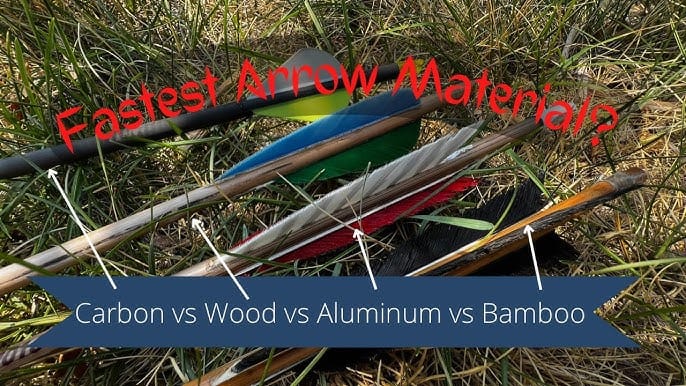
It can cut carbon shafts, aluminum shafts, and carbon aluminum hybrid shafts. The product listing also says it cuts through carbon, aluminum, fiberglass, and more, which broadens the material claim beyond the core arrow types most buyers care about. The main point is simple: it is built for common arrow-building materials, not only one shaft family.
Compatibility still needs a buyer check at the bench. Shaft diameter, wall thickness, and the blade condition all affect how cleanly a cut finishes. A saw can be listed for hybrid shafts and still need a careful setup to avoid chipping at the edge or leaving an uneven end.
Carbon shafts
Carbon shafts are the main reason many buyers look at an electric arrow saw. Carbon is sensitive to poor cutting technique, so a dedicated micro-blade cutter is useful when square ends matter for inserts and nocks. The risk to watch is splintering at the cut line if the shaft is not supported and measured correctly.
Aluminum shafts
Aluminum shafts are also within scope. That matters for older setups, indoor builds, or mixed inventory where one cutter needs to handle more than carbon. Clean deburring after the cut still matters, because a smooth cut is not the same thing as a finished shaft end.
Carbon aluminum hybrid shafts
Hybrid shafts are a useful test of whether a saw is versatile or just marketed that way. The Carbon Express unit is listed for carbon aluminum hybrid arrows, so it should suit mixed-material builders who do not want separate tools. Buyers should still verify the cut end and watch for edge cleanup needs on the aluminum portion.
What works well
The strongest case for this saw is workflow. It brings together 10K RPM cutting, an adjustable measuring scale, and dust-and-shavings collection in one bench tool, which means less handling and fewer steps than a loose manual setup. That matters most when repeatability is more valuable than the lowest possible ownership cost.
Another plus is blade replacement availability. Replacement blades are sold separately and are described as designed to maintain precise cutting performance, which is important for any cutter that sees regular use. A dull blade turns a precise tool into a frustration quickly.
Precision cutting
The micro-blade design is the feature buyers should focus on first. Precision cutting is what protects shaft ends, insert fit, and repeatable length. The adjustable measuring scale supports that goal by giving the user a fixed reference instead of eyeballing every shaft.
Measured repeat cuts
Measured repeat cuts matter when building a dozen arrows to the same length. Once the stop is set correctly, the saw should make that part of the workflow more consistent than a hand-cut routine. That consistency is where time savings come from, not from raw speed alone.
Dust and shavings collection
The saw collects shavings and dust while cutting, which is better than throwing debris across the bench. That said, buyers should treat collection as a feature to inspect, not a promise of perfect cleanup. A small shop with multiple cuts a day will still want a vacuum plan and routine wipe-downs.
What does not?
The main drawback is that the tool rewards careful setup. If the shaft is not clamped square, if the measuring scale is misread, or if the stop is set loosely, the result can be an off-square cut that wastes the shaft and causes downstream fit issues. The saw does not remove the need for basic bench discipline.
There is also a cost curve. Blade wear is part of ownership, and replacement blades are not free. For a low-volume builder, that recurring expense can make a manual cutter more sensible even if the electric saw looks attractive at first glance.
Setup learning curve
Beginners need to spend time on clamping, alignment, and verifying the cut length before they start a full batch. A common first-timer mistake is rushing the first shaft, then finding the stop was set for the wrong nock-to-end length. That kind of error is small in minutes and large in wasted material.
Dust cleanup limits
Dust collection helps, but it does not make the bench maintenance-free. Carbon dust and fine shavings still need to be managed, especially if the saw is used in a home space. Buyers should expect cleanup after use, not zero cleanup.
Off-square cut risk
Off-square cuts are the failure case to prevent. A shaft that is not seated properly can look fine until the insert fit or nock alignment exposes the angle problem. If the end looks chipped, tilted, or rougher than expected, that shaft should be rechecked before assembly.
Blade wear and replacement cost
Blade wear shows up as slower cutting, rougher edges, more dust, and a need to push the shaft through less cleanly than before. Replacement blades cost $15.99, so the recurring expense is modest per blade but meaningful over a year if the saw sees frequent use. That is why volume matters.
Arrow saw checklist
This checklist is the practical ownership test. It helps separate a clean, repeatable setup from a saw that is only convenient in theory.
| Check | What to confirm | Why it matters |
|---|---|---|
| Setup steps | Blade installed correctly, stop set to target length, shaft supported and clamped square | Prevents crooked cuts and wasted shafts |
| Square-cut check | Cut face looks even all the way around; no visible tilt or chipped edge | Protects insert fit and arrow consistency |
| Dust management | Collector engaged, bench cleaned, fine dust removed after the session | Limits mess and keeps the workspace safer |
| Blade wear signs | Slower cut, rougher finish, more pressure needed, more edge cleanup | Tells you when to replace the blade |
| 12-month cost model | Saw price plus blade changes over a year | Shows whether the tool pays off for your volume |
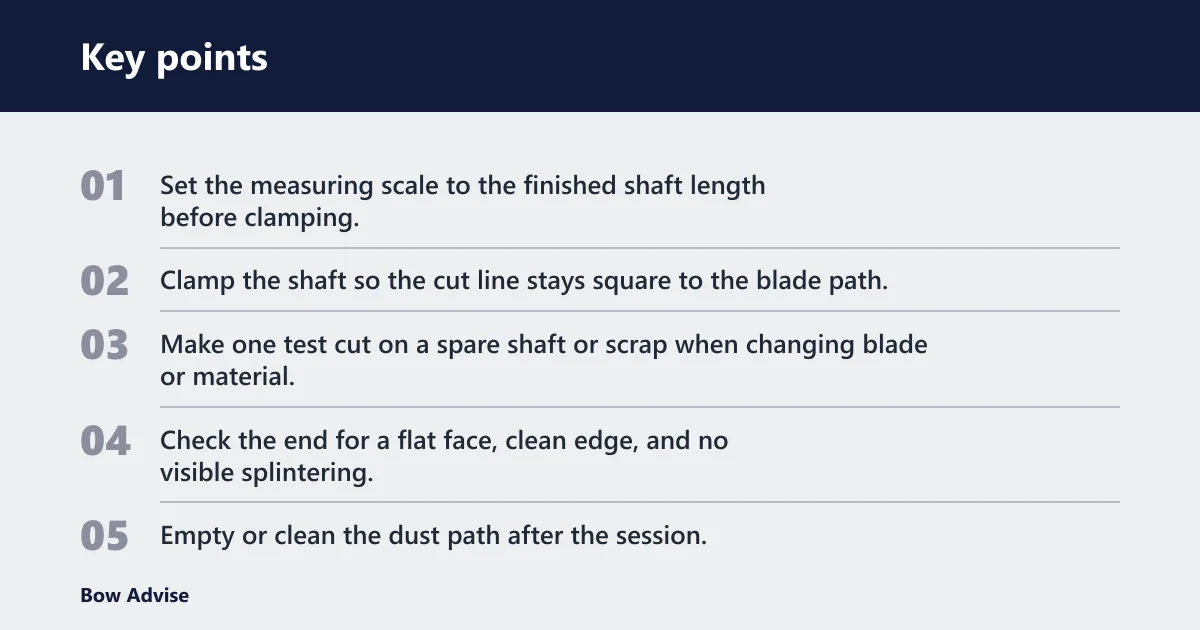
- Set the measuring scale to the finished shaft length before clamping.
- Clamp the shaft so the cut line stays square to the blade path.
- Make one test cut on a spare shaft or scrap when changing blade or material.
- Check the end for a flat face, clean edge, and no visible splintering.
- Empty or clean the dust path after the session.
- Replace the blade when cuts get slower, rougher, or less consistent.
12-month cost model
Here is a plain ownership model using only the posted saw price and replacement blade price. It is a simple estimate, not a lab test. The point is to show how volume changes the value case.
| User type | Starting saw cost | Assumed blade changes in 12 months | Blade cost total | Estimated 12-month total |
|---|---|---|---|---|
| DIY builder | $158.99 | 1 | $15.99 | $174.98 |
| Small shop | $158.99 | 4 | $63.96 | $222.95 |
For a DIY builder, one blade change in a year is a modest add-on. For a small shop, several blade changes are more likely, and the tool still may pay for itself if it replaces slower setup and rework. The model does not include consumables beyond blades, because no other prices are stated here.
Should you buy it?
Buy it if you build arrows often enough to care about repeatable lengths, clean cuts, and a dedicated bench cutter. The Carbon Express Arrow Saw makes the most sense for home builders who cut regularly and for small shops that want a focused arrow-cutting tool instead of a general-purpose workaround.
Skip it if you only trim arrows once in a while. In that case, the saw’s price, blade cost, and setup discipline can be more than you need. An alternative makes more sense when volume is low, when you do not want another powered tool on the bench, or when you prefer a lower-cost manual cutter.
Alternatives

- 3-in-1 arrow-building solution
- Modular arrow cutter design
- Vacuum attachment included
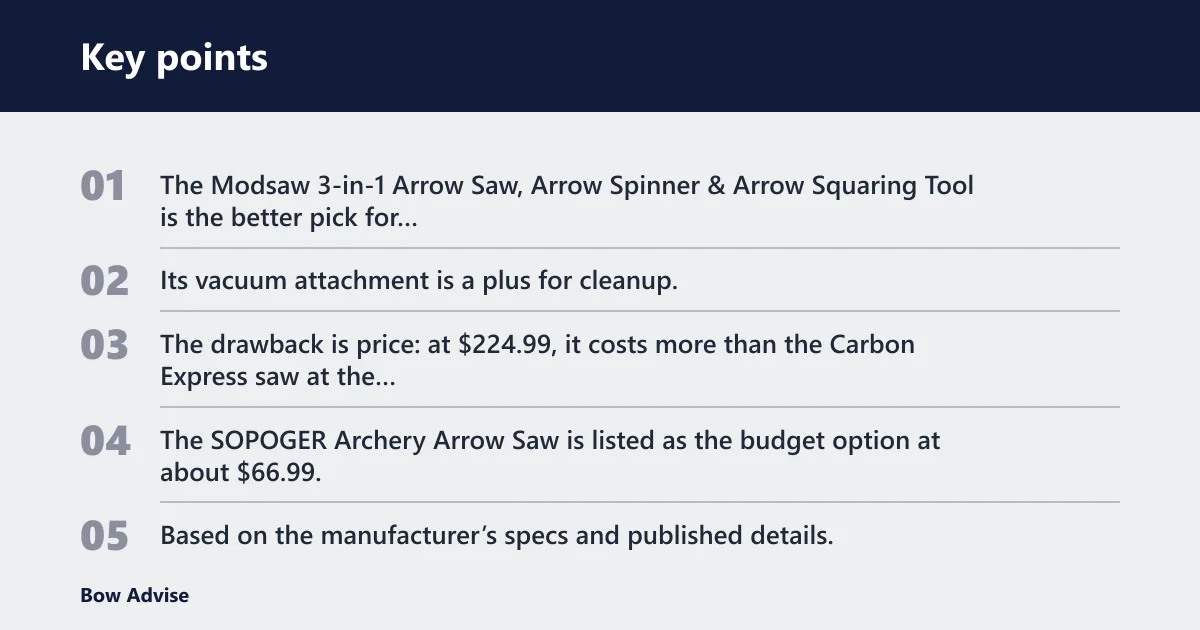
The Modsaw 3-in-1 Arrow Saw, Arrow Spinner & Arrow Squaring Tool is the better pick for buyers who want a more modular arrow-building station. Its vacuum attachment is a plus for cleanup, and the 3-in-1 format helps if you want one tool to do more than cut. The drawback is price: at $224.99, it costs more than the Carbon Express saw at the current listed price.

The SOPOGER Archery Arrow Saw is listed as the budget option at about $66.99. Based on the manufacturer’s specs and published details, it is aimed at carbon and fiberglass shaft users who want a low-cost electric cutter. The drawback is that it is a narrower, less fully featured solution than the Carbon Express unit, especially for buyers who want a clearly stated dust-collection and measuring-scale package.

The AISANJAN 12000RPM Electric Arrow Saw is listed as the speed-focused alternative at about $64.59. The higher stated RPM may appeal to buyers who think more speed equals more utility, but speed alone does not replace careful square cutting or good clamping. The drawback is the same one common to many budget cutters: low purchase price can still mean more setup discipline and less confidence in long-term refinement.
Frequently asked questions
Is the Carbon Express Arrow Saw worth it for home use?
Yes, if you cut arrows often enough to value repeatable length, square ends, and cleaner bench work. The current price of $158.99 makes more sense for a steady home builder than for someone who trims a handful of shafts each year. Rare users may be better off with a manual saw.
How fast is the carbon express arrow saw?
It runs at 10K RPM. That figure tells buyers the saw is built for fast cutting, but speed alone does not guarantee a good result. Measuring, clamping, and blade condition still decide whether the cut is clean and square.
Does the Carbon Express Arrow Saw collect dust and shavings?
Yes. The product details say it collects shavings and dust while cutting. Buyers should still treat that as a feature to inspect rather than a promise of zero cleanup, because any arrow-cutting bench will still need dust control and routine cleaning.
How much does the Carbon Express Arrow Saw cost?
The MSRP is $249.99, and the listed current price is $158.99. That spread matters because the value case is much stronger near the current price than at full MSRP. For high-volume use, the lower price is easier to justify.
Are replacement blades available for the Carbon Express Arrow Saw?
Yes. Replacement blades are sold separately, and they are designed to maintain precise cutting performance. That matters for long-term ownership because blade wear affects edge quality, cut speed, and cleanup. The listed replacement blade price is $15.99.
Who makes Carbon Express arrows?
Carbon Express is the brand name on the arrows and on the saw line. For buyers, the more important question is usually function rather than branding history: whether the shaft, broadhead, and cutter all fit the job. A trusted brand still does not remove the need to match the tool to your material and volume.