Wood vs Carbon Arrows: Which Is Easier to Make?
Wood arrows are easier to make from raw stock because you can shape, straighten, and finish the shaft by hand. Carbon arrows are easier when you are assembling purchased shafts, inserts, fletching, and points, because carbon itself is not hand-shaped. If the workflow goes wrong, you waste shafts, get poor spine match, and can end up with unsafe arrows. This guide compares the actual building steps for wood and carbon, so beginners can choose the simpler path for their setup.
Wood vs carbon at a glance
The trade-off is plain. Wood asks for more shaping and correction, while carbon asks for more careful selection and cleaner assembly. If the question is “which one is easier to make,” wood usually wins for raw-shaft work; if the question is “which one is easier to finish from purchased parts,” carbon arrows usually win.
| Factor | Wood | carbon arrows | Winner |
|---|---|---|---|
| Material sourcing | Species choice, ring consistency, and shaft-to-shaft variation matter a lot. | Buy by spine, diameter family, and component compatibility. | carbon arrows |
| Straightness work | May need heat straightening and frequent correction. | Usually arrives straight enough to assemble; damaged shafts are replaced, not hand-shaped. | carbon arrows |
| Cutting and end prep | Cutting is simple, but care is needed to avoid splitting and crush damage. | Clean cuts and squaring matter more, with dust-control precautions. | tie |
| Nock and point installation | Simple if the shaft is tapered or prepped well; glue choice matters. | Insert fit and point fit must match the shaft diameter precisely. | tie |
| Repeatability | More hand variation from shaft to shaft. | More consistent once the correct spine and diameter are chosen. | carbon arrows |
| Beginner difficulty | More forgiving for traditional handwork, but more variable. | Easier to assemble, but less forgiving of wrong-size parts. | tie |
Material sourcing
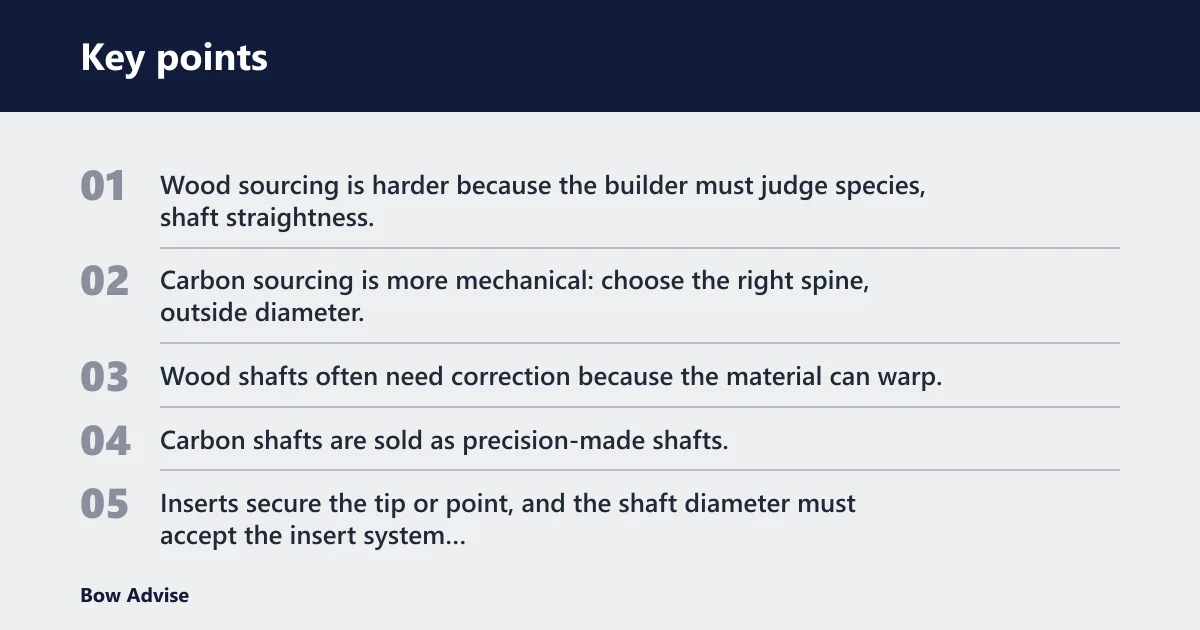
Wood sourcing is harder because the builder must judge species, shaft straightness, and how uniform the grain looks across the full length. Carbon sourcing is more mechanical: choose the right spine, outside diameter, and component family first, then buy shafts that match those specs.
Straightness work
Wood shafts often need correction because the material can warp, especially if storage is poor or moisture changes. Carbon shafts are sold as precision-made shafts, so the builder is less likely to spend time straightening them and more likely to reject a damaged shaft outright.
Assembly fit
Carbon arrows depend on exact component fit. Inserts secure the tip or point, and the shaft diameter must accept the insert system cleanly. Wood can also need careful fit, but the parts are usually simpler and more traditional in layout.
Repeatability
Carbon arrows are easier to repeat once the correct setup is known because the shafts come with predictable dimensions and spine options. Wood arrows vary by species, diameter, and individual shaft, so two pieces from the same bundle can still feel different during build and tuning.
Which is easier to source and select?
Carbon shafts are easier to select if the builder already knows the required spine, length, and diameter family. Wood shafts are easier to choose only if the goal is traditional arrows and the builder is comfortable judging grain, ring quality, and straightness by eye.
Wood shafts
Wood shaft quality depends on species-specific stock, and the common labels hardwood and softwood are a misnomer. Hardwoods are angiosperms such as maple, oak, or rosewood; softwoods are conifers such as pine, spruce, or fir. Sapwood is the younger, live outer wood, while heartwood is older inner wood, and both can affect how the shaft behaves.
Growth rings matter too. Earlywood and latewood differ in density, and slower growing softwoods tend to be stronger because weaker earlywood zones are narrower. Some tropical woods may lack discernible rings, which makes visual selection less straightforward.
Carbon arrows
Carbon selection starts with the manufacturer spine chart, not with a guess about the shaft material. Common carbon spine options listed are 300, 400, 500, and 600, and straightness examples are ±0.001, ±0.003, and ±0.006. Those numbers matter because the shaft must fit the bow, the point mass, and the intended use.
Diameter choice matters just as much. Builders must match inside diameter, outside diameter, and component fit, especially across micro 4MM, 5MM, and standard-diameter families. A shaft that looks correct can still fail if the insert and point system do not match the shaft diameter.
Arrow build matrix
| Task | Wood | carbon arrows | Winner |
|---|---|---|---|
| Material sourcing | More sorting by species, rings, and straightness. | More sorting by spine, diameter, and component family. | carbon arrows |
| Straightness correction | Often needed. | Usually not a shaping task. | carbon arrows |
| Cutting | Straightforward, but split risk exists. | Possible by hand, but best done with a suitable cutter and dust control. | tie |
| Nock and point installation | Often simpler hardware, but taper and fit still matter. | Insert and point system must match the shaft precisely. | tie |
| Fletching | Very manageable once the shaft is straight and sealed. | Very manageable once the shaft is clean and square. | tie |
| Sealing and inspection | Needs sealing and regular checks for moisture changes, warps, and splits. | Needs inspection for splintering, cracks, and end damage. | carbon arrows |
| Tools required | Simple hand tools can cover more of the build. | Fewer shaping tools, but better cutting and measuring tools matter. | carbon arrows |
| Time required | More time for sorting, straightening, and sealing. | Less time if the shafts and components already match. | carbon arrows |
| Likely failure points | Warp, split, bad grain, moisture damage. | Splintering, dust issues, wrong insert fit, wrong spine choice. | tie |
How do wood and carbon differ in the build steps?
Wood takes more shaping from the start. Carbon takes more measurement before the first cut, then more care during clean assembly. In practical terms, wood rewards handwork; carbon rewards planning and part compatibility.
Wood workflow
A wooden shaft usually gets straightened first, then sealed, then cut to length, then tapered if the setup needs it, and finally fletched and finished. The builder must keep an eye on sapwood, heartwood, and ring consistency because those details affect shaft behavior and split risk.
Say your shaft bends slightly after storage in a damp garage. With wood, that bend can become part of the work, because the shaft may need heat straightening or rejection before any nock or point is installed. That extra step is why wood demands more hands-on judgment.
Carbon workflow
A carbon shaft is usually measured, cut cleanly, squared at the ends, fitted with the correct insert, and then fletched and inspected for splits. The material is not shaped by hand in the same way wood is, so the build depends more on correct parts than on straightening skill.
Picture a beginner building three hunting arrows from a new pack of shafts. If the spine chart, point mass, and shaft length are matched before cutting, the work becomes a repeatable assembly job rather than a correction job. If those choices are wrong, the finished arrows may be unsafe or poor in flight even if the glue work looks neat.
What tools do I need to make wood arrows at home?
Wood arrow building can be done with a modest bench setup, but it still needs more shaping tools than many beginners expect. Carbon arrow building can use fewer shaping tools, yet it asks for better measuring and safer cutting practices. The easiest setup is the one matched to the material, not the one with the most tools.
Basic wood arrow tools
- Straightedge or shaft spinner for checking runout
- Knife or shaft cutter for trimming wood cleanly
- Sandpaper for smoothing and fit work
- Heat source for minor straightening, used carefully
- Glue suitable for nocks, points, and feather work
- Sealer or finish for moisture protection
Basic carbon arrow tools
- Measuring tool for shaft length
- Arrow cutter or fine saw with a clean cutting setup
- End squaring tool or careful sanding block
- Glue suited to inserts and nocks
- Fletching jig
- Inspection light for end cracks and splintering
Safety and dust-control notes for carbon cutting
Carbon dust should not be treated casually. Cutting carbon shafts needs dust control, eye protection, and a cleanup plan so fibers do not spread across the bench. A damaged carbon end can also splinter, so the cut must be clean and the shaft inspected before assembly continues.
What does arrow spine mean for wood and carbon arrows?
Arrow spine means shaft stiffness, and it must match draw weight, arrow length, and point mass. That matters for both materials. Material alone does not tell the whole story, because a short heavy-point arrow behaves differently from a longer light-point arrow even if the shaft material is the same.
Why spine choice changes the build
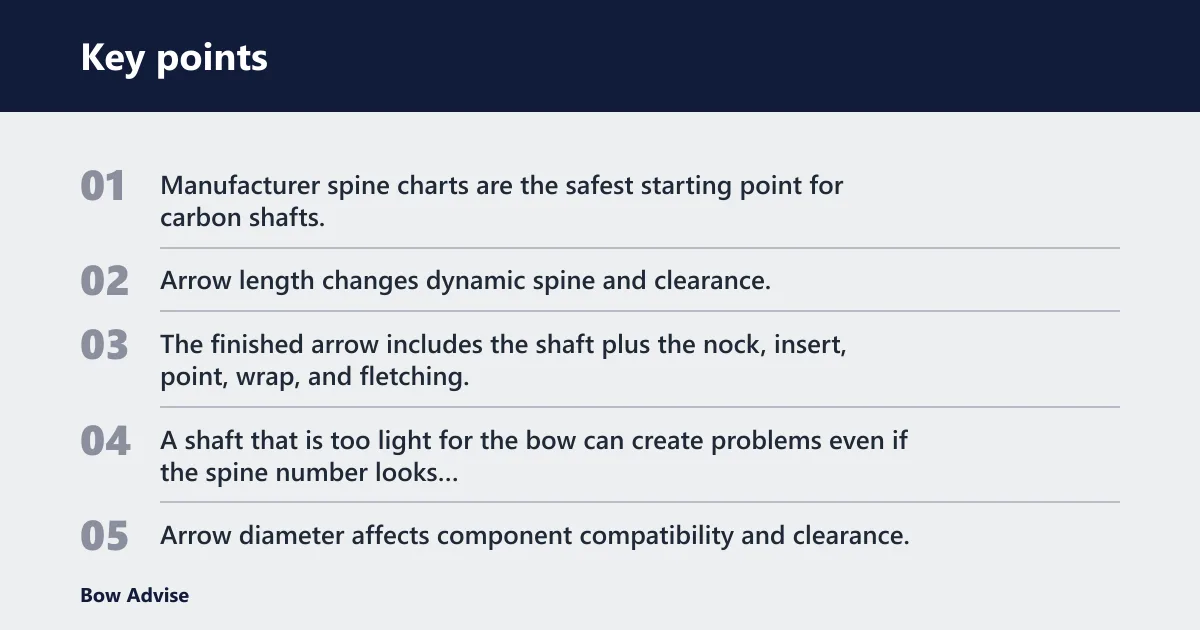
Manufacturer spine charts are the safest starting point for carbon shafts, and they are useful for wood too when a chart is available. Arrow length changes dynamic spine and clearance, so the common building convention is to measure from the nock throat to the shaft end when setting cut length.
Finished arrow weight also matters. The finished arrow includes the shaft plus the nock, insert, point, wrap, and fletching, and that total affects performance and safety. A shaft that is too light for the bow can create problems even if the spine number looks close on paper.
How diameter changes the build
Arrow diameter affects component compatibility and clearance. Micro 4MM, 5MM, and standard-diameter shafts each accept different inserts, points, and nocks, so the builder must check fit before cutting. A wrong diameter can create a problem that looks like a spine issue but is really a component mismatch.
Choose Wood if… / Choose carbon arrows if…
Wood wins if the goal is traditional arrow making, hand-shaped work, and a build process that tolerates more craft variation. Carbon arrows win if the goal is faster assembly, repeatable shaft selection, and fewer correction steps. The simpler material depends on whether the builder wants more shaping or more fitting.
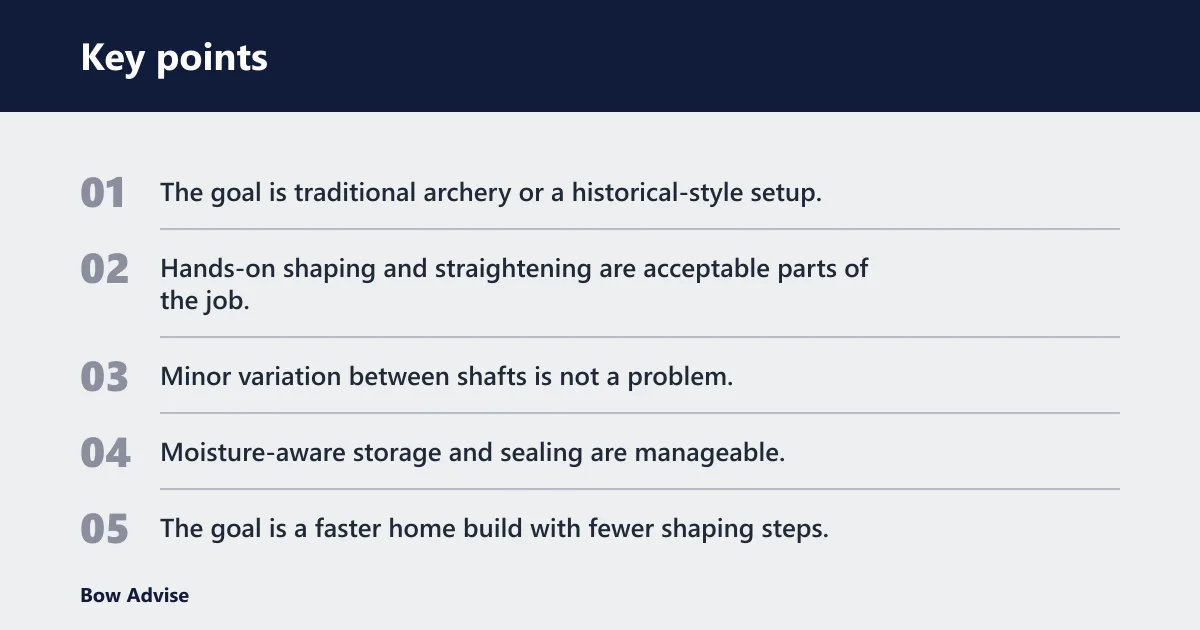
Choose Wood if…
- The goal is traditional archery or a historical-style setup.
- Hands-on shaping and straightening are acceptable parts of the job.
- Minor variation between shafts is not a problem.
- Moisture-aware storage and sealing are manageable.
Choose carbon arrows if…
- The goal is a faster home build with fewer shaping steps.
- Spine charts, diameter families, and component fit can be checked carefully.
- Repeatability matters more than hand-crafted variation.
- The builder wants a shaft that is light weight, durable, and precision-made.


Frequently asked questions
Is it easier to make wood arrows or carbon arrows?
Wood arrows are easier to make from raw stock because the builder can shape, straighten, and finish the shaft by hand. Carbon arrows are easier only when the task is assembling purchased shafts and matching parts. If the source material must be created, wood is the simpler path.
Can I cut carbon arrows by hand?
Yes, but cutting carbon by hand should be done with care, clean support, and dust control. The cut must stay square and the ends must be inspected for splintering. A poor cut can damage the shaft and create a safety problem that may not show up until later.
Which arrow material is easier for beginners to build?
Beginners usually find carbon easier if they want a predictable assembly job, because the shafts are precision-made and the work is mostly measurement, cutting, and fitting. Beginners usually find wood easier if they want to learn traditional handwork and accept more shaft-to-shaft variation.
How do wood and carbon arrows differ in durability and moisture resistance?
Carbon arrows are generally more durable and moisture resistant, while wood arrows need weather-aware storage and more frequent inspection. Wood can warp or split if moisture changes or grain quality is poor. Carbon is less sensitive to moisture, but it can still splinter or crack after hard impact.
What should I check before choosing carbon or wood shafts?
Check the bow’s draw weight, the intended arrow length, the point mass, and the shaft diameter family before buying anything. Also check the manufacturer spine chart, because spine must match the full setup rather than the shaft material alone. For wood, inspect rings and straightness; for carbon, inspect fit and end condition.
For traditional bows, wood arrows are often the easier choice because the material and the build process fit the style of the bow. Carbon arrows can work with recurve bows and other setups, but the builder still has to match spine, length, and point mass carefully. Traditional use does not remove the need for correct tuning.
The Dura-Europos archival photograph, YUAG Negative number 1933’445c~01, is a reminder that arrows have long been built from materials shaped by their era. That history does not make one material easier to make today. For many beginners, the practical takeaway is similar: wood is often easier to shape from raw stock, while carbon arrows are often easier to assemble from precision-made parts.