Best Wood for Arrow Making for Traditional Archers
For most traditional bows, choose cedar for light to moderate draw weights, sitka spruce for stiffer hunting arrows, and pine for budget target shafts; match wood stiffness to your bow weight and tuning room, not to the way the shaft looks on the rack. Pick wrong, and I see fishtailing arrows, weak groups, and shafts that break or refuse to tune cleanly. I’ll compare the main arrow woods by bow weight, hunting or target use, straightness, durability, and how forgiving each one is to build and tune.
What is the best wood for traditional arrow making?


Port Orford cedar is still the benchmark in my shop, but the best wood is the one that fits your bow weight, your point weight, and the amount of tuning you can still do. For a light to moderate bow, cedar is hard to beat. For stiffer bows, fir or spruce often makes more sense.
Port Orford cedar was historically the standard arrow shaft wood, and that matters because a lot of traditional setups were built around what cedar does well. It is light to moderate in physical weight, generally pretty straight grained, and it comes in common sizes like 5/16, 11/32, and 23/64.
Why I start with bow weight and use case
I do not pick shaft wood by nostalgia. I start with bow poundage, then ask whether the arrow is for target work, stump shooting, or hunting. A target shaft can be lighter and a little fussier, while a hunting shaft often needs more mass and more durability.
Why straightness and spine matter more than brand lore
Straightness is a purchase filter, not a nice extra. Spine is the other one. If a shaft is badly out of straight or too weak for the bow, the wood species does not save it. I have seen budget hardwood dowels look fine until I rolled them on a bench and found a wobble I would never trust in a hunting arrow.
Wood density changes the final arrow mass, and that changes speed and point-weight tuning. Heavier shafts usually like more point weight to tune cleanly, but they also slow the arrow. Lighter shafts fly faster, yet they can become too weak or too picky about form.
How I judge wood shafts before I buy them
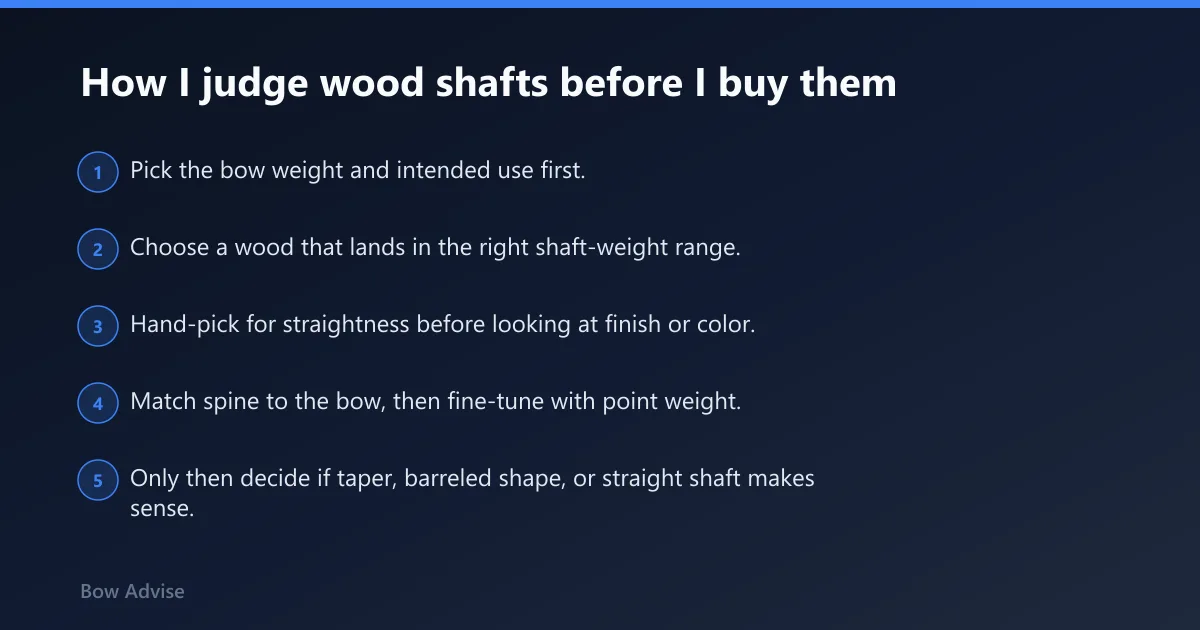
I judge wood shafts by straightness, weight, spine, and how much correction work I am willing to do. If a shaft needs a lot of heat straightening before I even start, I pass unless it is a wood I know I can rescue easily. Good shafts should save time, not create it.
Straightness checks I use on the bench
I roll every shaft on a flat surface and sight down the length under strong light. I look for runs, dips, and spots where the grain twists hard. Budget dowels, especially some hardware-store options, can be straight enough for shop projects and still be poor arrow stock.
Some woods are harder to straighten or stain. Maple gives me the cleanest, most uniform look, but it is also hard to straighten and hard to stain. Douglas fir can be hard to straighten too, even though the grain can look great.
Spine match for recurves and longbows
Spine is critical on recurves and longbows because those bows are less forgiving than many people expect. A shaft that is too weak will kick left for a right-handed shooter and often group erratically. A shaft that is too stiff can feel dead and refuse to settle in.
For my own shooting, I treat wood shaft selection like tuning a system. Bow weight, shaft weight, and point weight all shape the same arrow. If one part is off, I do not blame the wood first. I check the match first.
Weight, diameter, and point weight as one system
Heavier wood usually means more finished arrow mass. That helps some hunting setups, but it can drag down speed and force point-weight compromises. Diameter matters too. Port Orford cedar in 5/16, 11/32, and 23/64 gives you room to choose between lighter target arrows and heavier hunting builds.
- Pick the bow weight and intended use first.
- Choose a wood that lands in the right shaft-weight range.
- Hand-pick for straightness before looking at finish or color.
- Match spine to the bow, then fine-tune with point weight.
- Only then decide if taper, barreled shape, or straight shaft makes sense.
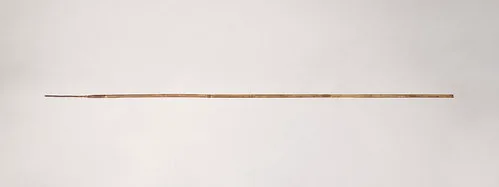
What wood arrow shaft is best for a 45 lb recurve?
For a 45 lb recurve, I usually start with Port Orford cedar if I want a balanced target or light hunting shaft. If I need a stiffer, more durable arrow for heavier points or rough field use, sitka spruce or Douglas fir can make more sense. Very heavy woods often become too much mass.
What usually works in Port Orford cedar
A 45 lb recurve sits in the sweet spot for cedar in many setups. The wood is light enough to keep the arrow lively, but not so light that it becomes impossible to tune. I still inspect every shaft for straightness, because a bad cedar shaft is still a bad shaft.
Cedar also helps when you want a broader choice of diameters. 5/16, 11/32, and 23/64 sizes let you fit the shaft to your point weight, brace height, and clearance needs.
When fir or spruce makes more sense
Douglas fir shafts are heavier than Port Orford cedar, and moderately durable. That can help if your recurve likes a more substantial shaft or if you are shooting broadheads and want extra margin. Sitka spruce is another traditional shaft material I keep in the mix when cedar feels too soft for the bow.
Fir and spruce usually make sense when I want a stiffer feel and a little more tolerance for hunting use. The tradeoff is speed and, in fir’s case, a harder time getting a stubborn shaft perfectly straight.
When heavier woods become too much arrow mass
Maple can be too heavy for many 45 lb recurves unless the archer wants a very solid hunting arrow and does not care about flat trajectory. Maple shafts are very heavy, even though they are very smooth and uniform and very durable.
I have seen archers chase durability and end up with arrows that tune only with a lot of point weight. If you want easy cast and simpler tuning, maple is rarely my first pick at this draw weight.
How do cedar, fir, pine, maple, and ramin compare?
Port Orford cedar is the easiest all-around reference point, but each wood changes the arrow’s weight, stiffness, and tuning behavior. Fir and spruce run stiffer and heavier than cedar. Pine can be a good budget choice. Maple and ramin sit heavier and demand more from the bow or the tuner.
Port Orford cedar
Cedar is my benchmark for traditional arrows because it hits a useful middle ground. It is light to moderate, usually straight grained, and easy to source in traditional diameters. The aroma is a pleasant extra, but the real reason I keep buying it is how well it shoots when the spine is right.
Not every cedar shaft is equal. Maker quality and supplier sorting matter a lot. I have had batches that were excellent and others that needed too much sorting for straightness.
Douglas fir, sitka spruce, and pine
Douglas fir gives me more mass and moderate durability, with weight above cedar. Sitka spruce is one of the old traditional shaft woods and belongs in the same conversation when you want a lighter feel than fir but more stiffness than a soft cedar shaft. Pine is a practical alternative, especially for target work and budget builds.
Pine can also be laminated with cedar in some shaft constructions. That hybrid idea works when I want a familiar feel with a little added stiffness or a better price point, but I still test straightness carefully.
Ramin, maple, ash, and hickory
Ramin is a hardwood from Malaysia, moderately heavier than Port Orford cedar, and I have seen enough straightness complaints that I would not buy it without a careful roll test. Some compressed 5/16 shafts show up in the market, but I treat them like any other budget shaft: inspect first, shoot later.
Ash and hickory are traditional shaft materials worth evaluating for straightness, weight, and spine rather than reputation. Hickory can be tough, but toughness alone does not make a good arrow. Ash often lands in the same category for me: promising, but only if the shaft stock is sorted well.
Maple is the opposite. It is clean, dense, and durable, but that weight can work against speed and easy tuning.
Which arrow wood is most durable for hunting?
For hunting, the most durable wood is usually the one that keeps its spine and survives real handling, not the one that merely looks tough. Maple is the hardest wearing of the common woods I use, but fir and some ash or hickory shafts can also hold up well when selected carefully. Durability always trades against speed.
Durability versus speed on real game arrows
A hunting arrow needs enough mass to carry a broadhead well and enough stiffness to stay honest in flight. Heavier woods often help with durability, especially when arrows hit brush, targets, or the ground. The cost is slower speed and sometimes more bow noise.
I hunt whitetail every fall, so I pay attention to that balance. A shaft that survives the field but loses tune is not a win. A shaft that flies fast but breaks on the first bad hit is not a win either.
When repairability matters more than raw speed
Repairability matters when you shoot a lot of wood arrows. Shafts that can be straightened, re-checked, and put back into service save money and time. Cedar is easier for me to work with in that way than many harder woods, which is one reason it stays popular.
Lancaster Archery lists Arrow Building & Repair as a product category, and that tracks with the reality of wood arrows today: you often need to build, sort, repair, and re-check instead of just buying a finished shaft and forgetting about it.
Tapered shafts, barreled shafts, and diameter options
Tapered shafts can help riser clearance and improve arrow flight when the setup benefits from a smaller nock-end profile. I do not use them because they sound traditional. I use them when the bow and center shot behave better with that geometry. Straight shafts still win when simplicity and availability matter more.
Why some archers choose 11/32 to 5/16 tapers
Some suppliers offer tapered shafts with about 9 inches of nock-end taper, and they are said to clear the bow riser for better arrow flight. The 11/32 to 5/16 transition is common enough to matter, especially on bows that like a cleaner release around the shelf.
I like tapers when I need help with clearance or when I want a little more forgiveness from the setup. They are not magic. They are another tuning tool.
When straight shafts are still the better buy
Straight shafts are still the better buy when you want easier sourcing, simpler matching, and fewer surprises. They are also easier to build in quantity. If your bow already tunes well with a standard shaft, I would not complicate the setup just to chase a tapered profile.
| Wood | Bow poundage range | Typical use | Expected shaft weight | Spine sensitivity | Straightness tolerance | Repairability |
|---|---|---|---|---|---|---|
| Port Orford cedar | Light to moderate | Target, general-purpose, light hunting | Light to moderate | High | Low; hand-pick carefully | Good |
| Douglas fir | Moderate to heavier recurves and longbows | Hunting, heavier points | Moderate to heavy | Moderate | Low to moderate | Good |
| Sitka spruce | Light to moderate hunting setups | Traditional hunting, smoother cast | Light to moderate | High | Low | Good |
| Pine | Light target, budget traditional use | Target, practice | Light to moderate | Moderate | Moderate | Fair |
| Ramin | Moderate, only after careful testing | Budget shafts, mixed results | Moderate to heavy | Moderate to high | Low | Fair |
| Maple | Heavier bows and hunting setups | Durable hunting arrows | Heavy | Moderate | Low | Good |
| Ash | Moderate to heavier traditional bows | General traditional use | Moderate | Moderate | Moderate | Fair |
| Hickory | Heavier bows, rough field use | Durable hunting arrows | Moderate to heavy | Moderate | Moderate | Good |
Frequently asked questions
Is Port Orford cedar still the best arrow wood?
It is still the benchmark wood for traditional arrows, but not the answer for every bow. Cedar is light to moderate, generally straight grained, and easy to size in common diameters. I still inspect every shaft, because cedar quality varies by supplier and bad shafts do turn up.
How do pine, cedar, maple, and fir arrow shafts compare?
Pine is a practical budget choice for target work. Cedar is the clean all-around benchmark. Fir is heavier than cedar and useful when I want more mass and moderate durability. Maple is the heaviest and most durable of this group, but it is less forgiving if you want speed.
What spine and straightness should I look for in wood shafts?
Match spine to the bow first, then sort for straightness. A shaft that is not straight enough or not close enough in spine will make tuning harder than it should be. I hand-select every shaft I can, and I reject budget dowels that wobble or show bad grain runout.
Are tapered wooden arrow shafts better than straight shafts?
They can be, if your bow likes the clearance and the smaller nock-end shape.Straight shafts are simpler and often easier to source, so I do not treat taper as an automatic upgrade.
What are the lightest and heaviest wood arrow shaft options?
Among the woods I see most often, Port Orford cedar and Sitka spruce sit toward the light end. Douglas fir is heavier than cedar, and maple is very heavy. Ramin also runs heavier than cedar. For me, lightest and heaviest only matter when they fit the bow and the point weight plan.