DIY Arrows vs Store-Bought Arrows: Which Fits You?
Buy store-bought arrows if you change setups often or want the simplest match to a bow. Build DIY arrows if you often cut shafts, swap inserts, and tune regularly, because spine or length that is off can hurt accuracy and broadhead flight. Pick the wrong path and you spend money twice, first on arrows, then on fixes. This guide compares cost, fit, repair needs, and setup changes so beginners can choose the better path.
DIY arrows vs store-bought arrows: the real trade-off
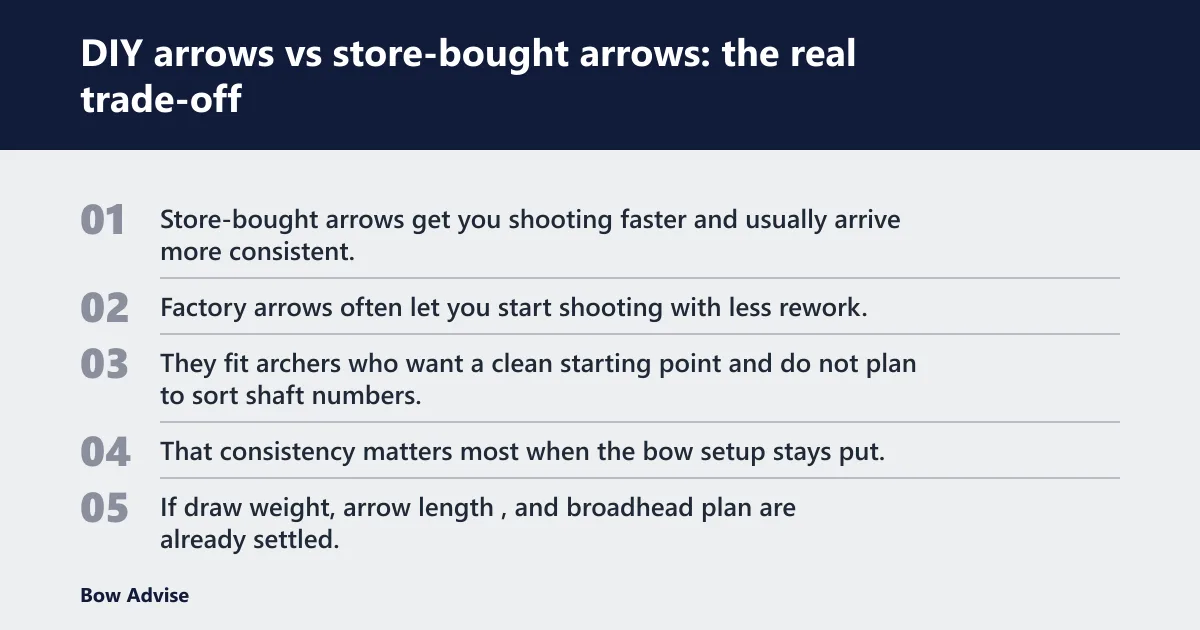
The core trade-off is speed versus control. Store-bought arrows get you shooting faster and usually arrive more consistent, while DIY arrows take more time but give tighter control over shaft choice, point weight, finished weight, and part replacement.
| Decision factor | DIY Arrows | Store-Bought Arrows | Winner |
|---|---|---|---|
| Setup speed | Requires cutting, assembly, and checking fit | Often ready to shoot sooner with less rework | Store-Bought Arrows |
| Tuning control | High control over spine, point weight, and finished weight | Limited to the factory build you buy | DIY Arrows |
| Repairability | Individual parts can often be replaced | Damage can push the archer toward replacing the whole arrow | DIY Arrows |
| Consistency out of the box | Depends on build quality, sorting, and assembly | Usually more consistent out of the box | Store-Bought Arrows |
| Best fit for frequent setup changes | Good when shafts, inserts, or point weights change often | Works best when the bow setup stays stable | DIY Arrows |
Speed and consistency from finished arrows
Factory arrows often let you start shooting with less rework. They fit archers who want a clean starting point and do not plan to sort shaft numbers, trim lengths, or adjust component weight often.
That consistency matters most when the bow setup stays put. If draw weight, arrow length, and broadhead plan are already settled, buying removes a lot of trial and error.
Control, repairability, and setup changes from DIY builds
DIY arrows put you in charge of the parts that shape flight: shaft material, straightness tolerance, cut length, grains-per-inch, spine, point weight, nock fit, and fletching. Building also improves repairability after damage because you replace parts instead of whole arrows.
That matters most for archers who change setups or tune carefully. A recurve shooter who keeps changing point weight or string setup gets more value from a build that can move in small steps.
How bow type changes the decision
Bow type changes how much tuning matters. Building can matter more for recurves that are sensitive to tune, while compounds often reward clean component matching and repeatable arrow specs.
For hunting, bowhunting setups also need broadhead compatibility. If field points fly well but broadheads do not, the arrow build itself may need changes in spine, length, or point weight rather than a new brand name.
What you get when you buy finished arrows
Finished arrows give a fast start and usually better out-of-the-box consistency. The trade-off is less control over shaft choice, point weight, and fine-tuning, so the arrow has to fit the bow as sold instead of being built around the bow.
Factory straightness tolerance and sorting
Straightness tolerance is one of the first things buyers usually get from a factory system. The arrows are typically sorted before sale, so the archer does not need to check every shaft for matching numbers or rework a batch before shooting.
That matters because straightness tolerance, cut length, and grains-per-inch affect finished arrow performance. A factory arrow that is close to the needed spec can save time, even if it is not the most adjustable choice.
What is already matched: shaft, spine, point, fletching, and nock
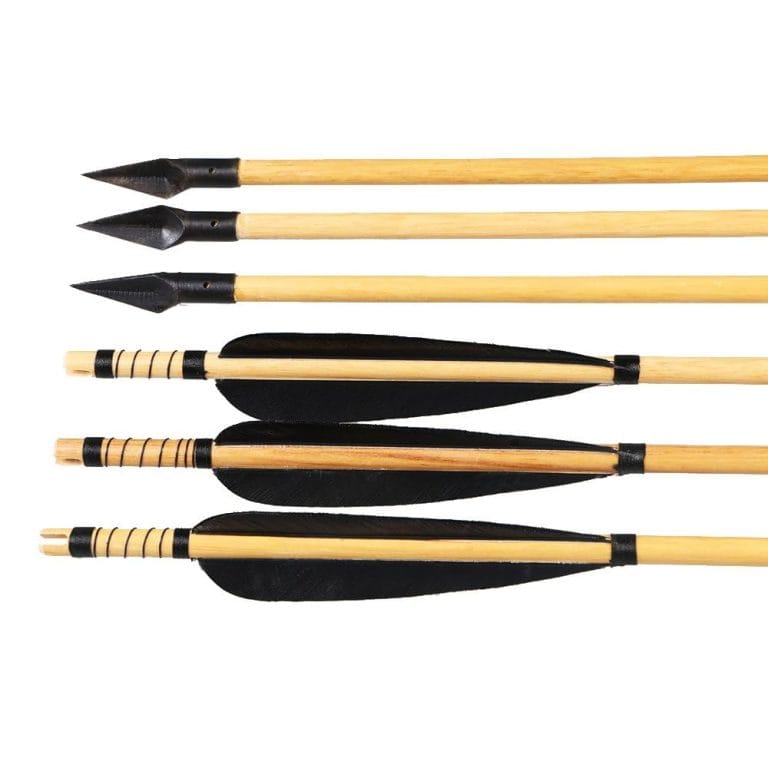
Store-bought arrows often come with a shaft, point, fletching, and nock already matched in a workable package. That helps beginners avoid compatibility mistakes between shaft type and insert or outsert choice.
It also means less setup math. For a new archer, fewer moving parts usually means fewer assembly errors.
Where ready-made arrows usually fall short
Ready-made arrows are weaker when the bow setup changes. If draw weight changes, point weight changes, or a broadhead setup needs a different spine, a factory package may no longer fit well.
They can also be less repair-friendly. A damaged nock or insert may be fixable, but the arrow is often less flexible than one built from separate parts.
What you gain by building your own arrows
Building arrows gives more control over the variables that actually affect flight. It is not only a craft choice. It is a tuning choice, a repair choice, and sometimes a cost choice for archers who replace parts often.
Shaft selection by carbon, aluminum, wood, or bamboo
A shaft may be carbon, aluminum, wood, or bamboo. That choice affects weight, stiffness options, durability, and how easy the arrow is to match to a bow.
Straightness tolerance, cut length, and grains-per-inch matter here too. A heavier or lighter shaft changes finished arrow weight, so the build has to be planned around the bow instead of guessed by brand label alone.
Tuning control through spine, point weight, and finished arrow weight
Arrow spine is the stiffness match between the shaft and the bow’s draw weight and launch style. Spine matching gets more sensitive as the setup gets more tuned, especially when a recurve setup is in play.
Point weight changes front-of-center balance and can alter how the arrow behaves through the shot. Broadhead compatibility also depends on that balance, so a build with the right spine and point weight can solve problems a ready-made arrow cannot.
Repairability: replacing fletching, inserts, and nocks instead of the whole arrow
Building improves repairability because the wear parts can be replaced one at a time. Fletching, nocks, inserts, and wraps are all service items on a well-planned build.
That lowers replacement waste after damage. If the shaft survives but the nock breaks or a vane peels, the arrow can often be put back into service without buying a full replacement.
How much do DIY arrows cost compared with store-bought arrows?
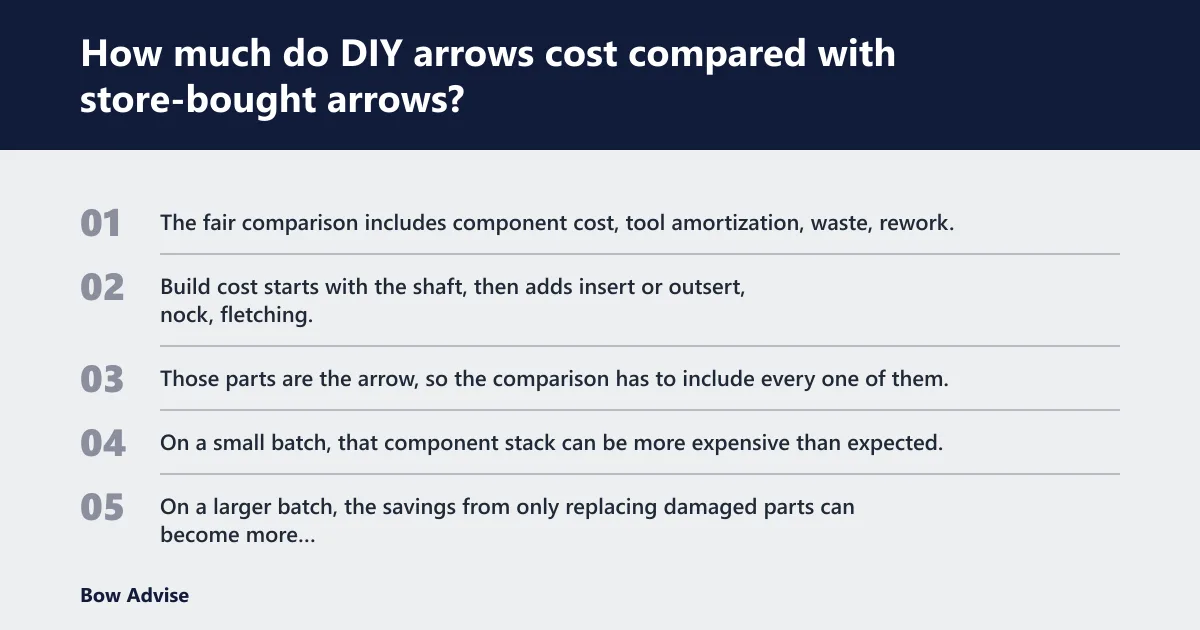
DIY cost is not just shaft price. The fair comparison includes component cost, tool amortization, waste, rework, and replacement rate, because small mistakes and unused parts change the real price of a finished arrow.
| Batch size | DIY cost profile | Store-bought cost profile | Break-even note |
|---|---|---|---|
| 6 arrows | Tool cost is heavy per arrow; waste hurts more | Lower setup burden; pay only for finished arrows | Buying is usually easier to justify |
| 12 arrows | Tools spread out better; rework still matters | Still simple, but less adjustable | Close call if tuning and repairs are frequent |
| 24 arrows | Tool spend is spread farther; custom control pays back faster | Convenient, but repeated buying adds up | DIY often wins for active tuners |
Component cost: shafts plus parts
Build cost starts with the shaft, then adds insert or outsert, nock, fletching, point or broadhead, wraps, and adhesive. Those parts are the arrow, so the comparison has to include every one of them.
On a small batch, that component stack can be more expensive than expected. On a larger batch, the savings from only replacing damaged parts can become more meaningful.
Tool cost, waste, and rework
The hidden cost is tooling and rework. A jig, cutter, and spine-matching effort are not free, and mistakes from poor glue, bad cut length, or crooked assembly create waste.
Small batches make tools expensive per arrow; larger batches spread that spend out faster. That is why a six-arrow build often looks poor on paper while a twenty-four-arrow batch can make more sense.
Break-even by 6, 12, and 24-arrow batches
At a small number of arrows, store-bought usually wins on convenience and often on total cost. At twelve, the answer depends on how much tuning control and repairability matter.
At a larger batch, DIY has a better chance to pay back because the tool cost is spread out and repeated repairs can be cheaper than replacing full arrows. That is especially true for archers who expect seasonal wear, broadhead use, or recurring nock and fletching damage.
Decision matrix by archer type
The best path depends on use case. Beginner target archers, recurve tuners, and bowhunters do not need the same level of control, repairability, or batch size.
| Archer type | Cost | Time | Tuning control | Repairability | Winner |
|---|---|---|---|---|---|
| Beginner target archers | Store-bought is usually better for a first setup | Store-bought is faster to start | DIY is useful only after the bow is stable | DIY repairs are nice, but not usually the first priority | Store-Bought Arrows |
| Recurve tuners | DIY can pay off over repeated changes | DIY takes longer, but reduces later rework | DIY wins on spine matching and point weight | DIY wins when parts need regular replacement | DIY Arrows |
| Bowhunters | Depends on replacement rate and broadhead setup | Store-bought is simpler before season | DIY wins if broadheads need careful tuning | DIY wins when field repairs matter | DIY Arrows |
Beginner target archers: cost, time, and simplicity
Beginners usually benefit from buying. The setup is simpler, the arrows are ready sooner, and the first learning curve should be shooting form, not component choice.
DIY becomes more useful later, after the archer can recognize nock fit issues, spine mismatch, and the effect of point weight on flight.
Recurve tuners: spine matching and repairability
Recurve shooters are often the best case for building. Building can matter more for recurves that are sensitive to tune, and small changes in spine or point weight can show up quickly.
If the setup changes often, a custom arrow makes those changes easier to manage. Repairability also matters because repeated tuning work tends to create repeated wear.
Bowhunters: broadhead compatibility, durability, and field repair
Bowhunters need broadhead compatibility and predictable front-of-center balance. That makes spine matching and finished arrow weight more important than a simple factory label.
DIY can also reduce waste after field damage. Replacing a nock, insert, or fletching is often easier than replacing a whole hunting arrow.
What can go wrong when you build arrows at home?
The most common mistakes are bad glue, wrong spine, bad cut length, and mismatched components. Those errors do not only waste materials; they change how the arrow leaves the bow and how it handles broadheads.
Bad glue or poor bond reliability
Adhesive choice matters because a weak bond can let inserts, nocks, or wraps fail under stress. A poor bond also creates rework, which adds time and pushes the real cost of the arrow higher.
Assembly errors are often simple: too little adhesive, too much adhesive, or parts not seated squarely before the glue sets.
Wrong spine, bad cut length, or mismatched components
Wrong spine is usually a tuning problem, not necessarily a brand problem. If the shaft is too stiff or too weak for the bow draw weight and point weight, flight suffers and broadheads usually make the problem more obvious.
Cut length errors do the same thing. A shaft cut too short can stiffen the arrow more than planned, while mismatched inserts or outserts can change the front-end weight enough to alter tune.
Fletching alignment, wrap weight, and nock fit mistakes
Fletching is a repairable wear item, but it still has to be lined up well. A jig dependency is part of the process, and poor vane or feather placement can create flight issues that look like spine problems.
Wraps help with identification and customization, yet they add a small but real weight change. Nock fit also matters by shaft type, because a poor fit can create release issues or failure replacement cost later.
Choose DIY arrows if… / Choose Store-Bought Arrows if…
Choose DIY arrows if the bow is tuned regularly, the setup changes often, or the archer wants control over spine, point weight, and finished weight. Choose store-bought arrows if the goal is to start fast, keep the setup simple, and avoid assembly mistakes.
Choose DIY Arrows if…
- The bow is a recurve or another setup that is sensitive to tune.
- Arrow damage is common enough that part replacement will save money.
- Point weight, spine, or broadhead setup changes through the season.
- Batch size is large enough to spread tool cost and rework across many arrows.
Choose Store-Bought Arrows if…
- The bow setup is still changing.
- The archer wants the simplest path to shooting.
- There is little interest in cutting shafts, sorting components, or replacing parts.
- The first priority is getting a matched set without assembly risk.
A quick decision checklist for your bow and budget
- Check whether the bow’s draw weight and arrow length are already settled.
- Decide how often spine, point weight, or broadhead setup will change.
- Estimate how often nocks, fletching, or inserts need replacement.
- Compare the full cost of components, tools, waste, and rework against a ready-made set.
- Choose the path that fits your repair rate, not just your first purchase price.
What does an archer make his own arrows for?
An archer makes his own arrows to control fit, tune, and repair costs. The goal is not only customization. It is also replacing damaged parts, matching spine to bow draw weight, and dialing in point weight and finished arrow weight for the way the bow actually shoots.
What is the best arrow to use for my bow?
The best arrow is the one that matches the bow’s draw weight, intended point weight, and expected use. Carbon, aluminum, wood, and bamboo all have a place, but the right choice depends on spine match, cut length, straightness tolerance, and whether the setup will use field points or broadheads.
how do I know if I should build or buy arrows?
Buy if the setup is new, the budget is tight, or the main goal is simple consistency. Build if the bow is already tuned, the archer changes components often, or repairability matters enough to justify the extra time and setup work.
Frequently asked questions
Are DIY arrows better than store-bought arrows?
DIY arrows are better when the archer needs tuning control, repairability, or custom weight choices. Store-bought arrows are better when speed, factory consistency, and low setup effort matter more. The right answer depends on how often the bow and arrow setup changes.
how much do arrows cost to make versus buy?
Making arrows costs the sum of shafts, parts, tools, waste, and rework. Buying arrows avoids most of the tooling burden and often costs less for a small batch. DIY becomes more attractive as batch size grows and replacement parts can be reused.
how much are arrows ready-made for a beginner?
Ready-made beginner arrows are usually the simplest purchase because they arrive matched and usable sooner. The exact price varies by shaft material, straightness tolerance, and included parts, but the buyer is paying for convenience and factory sorting as much as for the components themselves.
how are arrows made at home?
Home arrow building usually means selecting a shaft, cutting it to length, adding an insert or outsert, fitting the nock, fletching the shaft, and setting the point or broadhead. The build depends on glue choice, component fit, and whether the shaft type is carbon, aluminum, wood, or bamboo.
what do you store arrows in
Arrows should be stored in a way that keeps the shafts straight and protects the fletching and points. A rigid container or dedicated case is better than loose storage, because nocks, wraps, and fletching can be damaged if arrows shift against each other.
can I repair DIY arrows more easily than store-bought ones?
Yes, because DIY arrows are built from separate parts that can often be replaced one at a time. A broken nock, damaged fletching, or worn insert does not always mean the shaft is done, which lowers replacement waste over time.