Arrow Building vs Buying: Which Option Fits You Best?
Buy finished arrows if your setup stays steady; build your own only when you tune often, need exact point weight, or want easy repairs. Pick the wrong path and you waste money on shafts, point changes, and arrows that fly badly or do not match your bow. I’ll compare cost, consistency, tuning, and the cases where building beats buying for beginners, recurves, and bowhunters.
Arrow building vs buying: the core trade-off
The trade-off is plain: buying is faster and usually more consistent out of the box, while building pays off when customization, repairability, and weight control matter enough to justify the tools and time. I treat this as an ownership decision, not a hobby vote.
| Decision factor | Arrow Building | Buying | Winner |
|---|---|---|---|
| Speed to first usable arrow | Slower; you have to cut, square, glue, and verify | Fast; usually ready after minor setup checks | Buying |
| Weight and spine control | High; you control shaft choice, point weight, and finished weight | Moderate; you work within the factory build | Arrow Building |
| Repeatable consistency | Depends on your process and tools | Usually better straight from a decent factory batch | Buying |
| Repairability after damage | High; you can replace inserts, nocks, fletching, or points one part at a time | Lower; replacement often means buying another finished arrow | Arrow Building |
| Learning curve | Steeper; mistakes show up in flight and group size | Lower; sorting and shooting are simpler | Buying |
Speed to first usable arrow
Buying wins here because you skip the cut-and-glue process. That matters for a new archer who wants to shoot this week, not after a tool order, a learning session, and a pile of test pieces.
Weight and spine control
Building wins when I want exact control over finished-arrow weight, insert choice, point weight, and wrap use. That level of control matters more on a recurve that is sensitive to tune, or on a bowhunter who wants a very specific front-of-center balance.
Repeatable consistency
Buying usually wins for raw repeatability because factory arrows come off fixed processes. I still sort bought arrows by straightness and weight, but a good factory batch often gets me shooting sooner with less rework.
Repairability after damage
Building wins if you break arrows often enough that replacement costs add up.
According to Build vs. Buy an AR-15: Which Route Is Right for You? — The AR-15 build-vs-buy article says both paths end in a functioning, personalized rifle.
What does buying arrows give you?
Buying gives you factory consistency, faster setup, and less room for assembly errors. It also removes the cutting, gluing, and component-matching mistakes that can waste time and money, which is why I often send new shooters there first.
Factory consistency and sorting quality
Store-bought arrows are not magic, but decent ones are often straight enough and close enough in weight that you can start shooting. I still check straightness tolerance, shaft length, and finished weight, because even bought arrows can need sorting before they group well.
Speed to first usable arrow
Buying gets an archer on the line faster. That matters if you are trying to tune a compound before deer season or trying to get a beginner through their first club night without turning the session into a workshop.
Warranty, replacement, and hassle factors
Buying also cuts down on mistake costs. In the firearm comparison I’ve read, buying removes assembly errors from the process and many major manufacturers include a warranty covering defects; the arrow world is not identical, but the same idea holds when you want less hassle and fewer variables.

What does building arrows give you?
Building gives you control over shaft material, spine, point weight, wraps, and repairs. It also teaches you how your bow reacts to changes, which is valuable when tune matters more than speed or when you change setups often.
Custom shaft selection, spine choice, and finished weight control
A shaft may be carbon, aluminum, wood, or bamboo, and each type can behave differently in weight, straightness, and durability. Shaft straightness tolerance, cut length, and grains-per-inch all affect the finished arrow, so building lets me choose the exact trade-off instead of accepting a preset factory mix.
Repairability and component replacement after damage
Arrow build components are simple: shaft, insert or outsert, nock, fletching, point or broadhead, wraps, and adhesive. If one part fails, I can often replace just that piece, which is one reason building makes sense for high-use target arrows and hunting arrows alike.
Why builders learn more about their bow setup
The process forces you to understand arrow spine, point weight, and how your bow reacts to change.
How much does each path cost per arrow?
Cost is not just the shaft or the finished box price. It is component cost, tool amortization, waste, rework, and replacement rate, and the winner changes with batch size. Small batches make tools expensive per arrow; larger batches spread that spend out fast.
Component cost versus finished-arrow price
Buying is often cheaper for a small number of arrows because the factory already absorbed labor and tooling. Building can win once you already own the tools and buy enough shafts in one batch to spread those costs across many finished arrows.
Tool amortization, batch size, and waste
The first time you buy a fletching jig, arrow saw, square cut tool, and grain scale, your per-arrow cost jumps. If you build six arrows once a year, that tool spend hurts; if you build two dozen arrows and repair them over time, the math starts to move in your favor.
Real cost drivers: inserts, fletching, points, wraps, and rework
The parts that surprise people are the small ones. Inserts and outserts, adhesive, vane replacement, wraps, and a ruined shaft from a crooked cut or a bad spine match can erase the savings fast, especially if your first batch has rework.
Can custom-built arrows improve tuning for recurves and compounds?
Yes, if the arrows are matched to the bow. Static spine is the shaft’s stated stiffness, while dynamic spine is how that shaft behaves once you add point weight, draw length, release quality, and cam reaction, and that is where custom building earns its keep.
Static spine versus dynamic spine
Static spine tells you the bare shaft’s stiffness. Dynamic spine changes with the actual bow setup, so a shaft that looks right on paper can still kick left or right if the point weight, length, or release style changes the way it flexes in flight.
Matching spine to draw weight, draw length, and cam tune
A spine that works on one bow may fail on another with the same draw weight because draw length and cam tune shift the load. Left- and right-hand shooting also matter, and compound cam tune can make a weak or stiff shaft act worse than the chart suggested.
Bow type differences: recurve, compound, traditional, hunting, and target
Recurve and traditional bows tend to reward careful spine matching because they are less forgiving of mismatch. Compounds give me more tuning range, but they still punish bad arrow choices; hunting setups care about broadhead flight and durability, while target setups care more about repeatable groups and exact weight control.
Decision matrix: who should build and who should buy?
The right path changes by archer type. A beginner target archer usually benefits from buying first, a recurve traditional archer often gains more from building sooner, and a compound bowhunter has to weigh repairability, field consistency, and time to tune before deciding.
| Scenario | Path | Estimated first-year cost | Tool spend | Time to first usable arrow | Top three failure risks |
|---|---|---|---|---|---|
| Beginner target archer | Buy | Lower overall for the first batch; building usually costs more once tools are counted | Low | Fastest | Bad spine match, overpaying for tools, crooked first setup if you start building too soon |
| Beginner target archer | Build | Higher in year one because tools dominate | Moderate to high | Slowest | Inconsistent cut length, uneven glue, finished-weight drift |
| Recurve traditional archer | Buy | Moderate; good if you want a known baseline | Low | Fast | Limited spine options, less repair flexibility, poor match to a changed setup |
| Recurve traditional archer | Build | Moderate after the first batch if you reuse tools | Moderate | Medium | Wrong dynamic spine, crooked square cut, fletching inconsistency |
| Compound bowhunter | Buy | Moderate to high depending on broadhead needs | Low | Fast | Broadhead flight mismatch, weak repair options, mixed finished weight |
| Compound bowhunter | Build | Can be lower over repeated repairs and replacement shafts | Moderate to high | Slow | Broadhead tuning errors, bad insert alignment, unsafe adhesive or dust cleanup |
What tools do I need to build arrows at home?
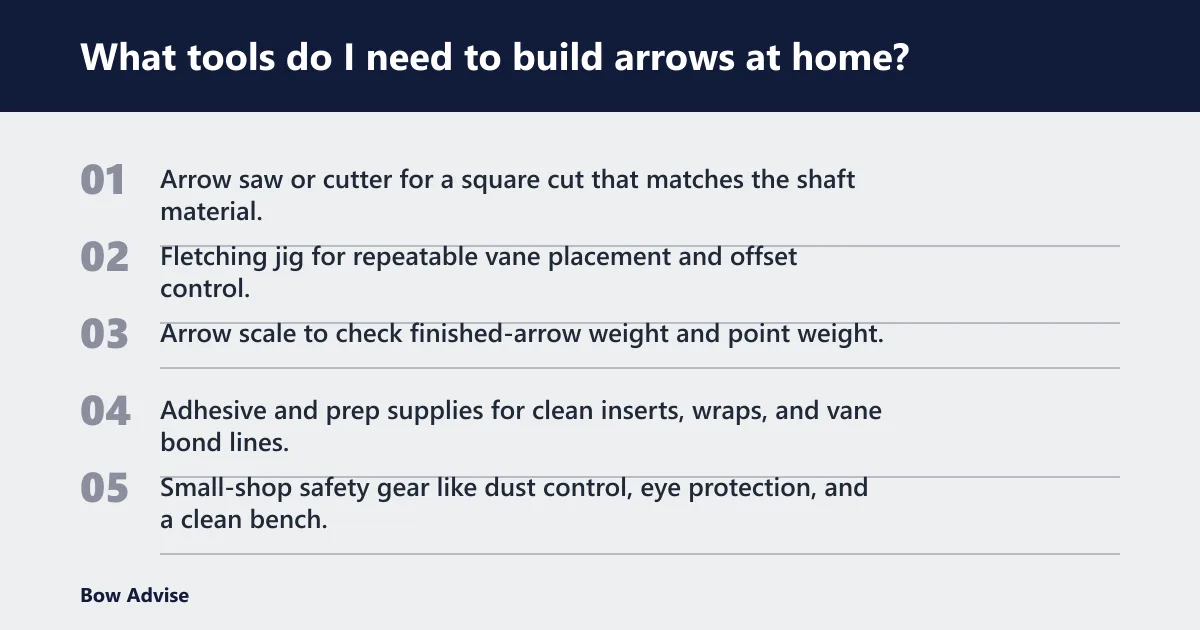
You need fewer tools than most people think, but every one has a job. At minimum, I want an arrow saw or cutter for a square cut, a fletching jig, an arrow scale or grain scale, adhesive, and basic cleaning gear for dust and glue work.
- Arrow saw or cutter for a square cut that matches the shaft material.
- Fletching jig for repeatable vane placement and offset control.
- Arrow scale to check finished-arrow weight and point weight.
- Adhesive and prep supplies for clean inserts, wraps, and vane bond lines.
- Small-shop safety gear like dust control, eye protection, and a clean bench.
Fletching jig details that matter
A 3-vane setup is common and simple; a 4-vane setup can sometimes help with stabilization, especially for some hunting arrows or broadhead work. I look for repeatability first, then decide between helical and straight clamp, plus left or right offset based on the arrow’s flight needs and my bow’s behavior.
Arrow saw or cutter details that matter
Square cut quality matters because a bad end face can hurt insert alignment and finished consistency. Material compatibility matters too, since carbon, aluminum, wood, and bamboo do not all cut the same way, and dust control matters because carbon dust and shop mess are not things I want in my lungs or on my glue joints.
Arrow scale or grain scale details that matter
I check finished-arrow weight, point weight, and consistency tolerance before I shoot a batch. A small weight spread may seem minor, but it can change front-of-center balance and show up in tuning, especially when I move between field points and broadheads.
Choose Arrow Building if… / Choose Buying if…
Build if your setup changes often enough that customization, repairability, and weight control beat the time spent making each arrow. Buy if you want repeatable consistency, a lower learning burden, and faster access to arrows that are close enough to shoot right away.
Choose Arrow Building if…
Choose building when you change draw weight, point weight, or shaft length often. Choose it when you repair arrows a lot, when you want exact finished weight, or when you tune recurves, traditional bows, or hunting setups that react strongly to spine changes.
Choose Buying if…
Choose buying when you are new, when you shoot only a little each month, or when your bow setup is stable and you care more about speed than tinkering. For many beginners, buying also keeps the first season simpler while they learn form, sight marks, and basic tune.
Frequently asked questions
Is it cheaper to build arrows or buy them?
Buying can be cheaper for a small quantity because the tool cost is already built into the finished price. Building can become cheaper after enough arrows and repairs spread the tool spend across a larger batch, but waste, rework, and failed first builds can erase that advantage.
How many arrows do I need to build before it pays off?
There is no single number that fits every shop, but the break-even point depends on how many arrows you make, how often you repair them, and whether you already own the tools. If you only need a few arrows a year, buying usually stays ahead.
Are store-bought arrows more consistent than DIY arrows?
Usually yes, at least at the start, because a factory batch is made with fixed processes. DIY arrows can match or beat that consistency if your cuts, glue, and weight checks are disciplined, but the first batch often shows beginner error in spine choice or finished weight.
When should a beginner buy arrows instead of building them?
A beginner should buy when the bow setup is still changing, when the draw weight feels new, or when the goal is to shoot sooner with fewer variables. I recommend buying first for most new archers because it keeps the learning load lower while form and anchor point settle.
What are the biggest mistakes when building your own arrows?
The biggest mistakes are bad spine matches, crooked cuts, uneven glue, and inconsistent finished weight. I also see people skip shaft sorting and then wonder why one arrow tunes differently from the rest, which is a fast way to waste money and time.
Is it worth building arrows if I only shoot a few times a month?
Usually no, unless you value the learning process or need a very specific setup. Low-volume shooters rarely use enough arrows to pay back the tools, and buying keeps the routine simple while still giving you decent consistency and replacement support.
building arrows vs buying
Use building arrows vs buying as a tuning question, not a pride question. If your setup stays steady and you want fast, repeatable arrows, buy them. If you change bows, hunt with tight weight targets, or want repairability, build them.