Best Arrow Building Software for Custom Arrow Design
For many DIY builders, Archer’s Advantage is a strong option for custom arrow design; small shops that need repeatable spine, FOC, and cut lists may prefer a shop-grade system like Pinwheel. Bad arrow math wastes shafts, weakens groups, and sends hunters into the field with a setup that misses tune. Software that matches real bow data to a build you can cut, assemble, and tune ensures reliable results on the range. This guide compares the top options by workflow, accuracy, output, and fit for beginners, serious hobbyists, and small arrow shops.
Best arrow building software for custom arrow design


My top pick is Archer’s Advantage because it covers the core build steps in the right order: shaft length, spine choice, finished weight, and FOC, without forcing you into full CAD work. I like software that starts with real archery inputs and ends with a build I can actually cut, assemble, and tune on the range.
What the best pick does for a custom build
Good arrow design software should let me enter bow type, draw weight, draw length, arrow length, shaft material, point weight, insert or outsert choice, and fletching. From there, it should estimate static spine fit, approximate dynamic behavior, calculate finished arrow weight, and give me exportable build notes I can use at the bench.
How I separate a calculator from a full design tool
A calculator gives me a spine suggestion and maybe FOC. A full design tool keeps the component library, stores build templates, and lets me print or export a cut list. That difference matters when I am building one hunting arrow versus setting up twenty matched shafts for a club member or shop order.
Who should use software and who should not
If you are cutting your first dozen arrows, software helps a lot. If you already know your bow, shaft family, and point weight range, the software saves time and reduces bad guesses. If you expect it to replace paper tuning, bare shaft testing, or broadhead tuning, it will disappoint you fast.
Quick picks by builder type
The best tool depends on your workflow. I would not give the same program to a beginner with a recurve and a shop that builds repeat orders for five customers a week.
- Best for beginners: Archer’s Advantage for simple spine and finished weight checks.
- Best for small shops: Pinwheel for repeat templates, output sheets, and customer-specific builds.
- Best for recurve and traditional builds: Arrow calculator tools that handle wood, bamboo, and simple point-weight changes cleanly.
- Best for compound hunting setups: Archer’s Advantage or a shop-grade system with dynamic spine and FOC tracking.

What features matter most in arrow design software?
The best software for custom arrow design needs more than a spine number. I want it to model the actual build, catch obvious mismatches, and help me get from idea to cut shaft without rewriting everything by hand.
Spine calculator depth
Good spine calculators account for bow type, draw weight, draw length, point weight, arrow length, and shaft material. Better ones separate static spine from dynamic spine behavior so I can see why a shaft that looks correct on paper still feels weak or stiff once I shoot it.
FOC support and weight estimates
FOC, or front-of-center, is a way to describe how much of an arrow’s mass sits in front of the balance point. A common formula compares the balance point to about half the shaft length. I want software that calculates it after I change point weight, insert weight, or outsert weight, because broadheads often shift the balance more than field points do.
Component library and output formats
A useful arrow component library includes shaft brands, point weights, nocks, fletching, inserts, outserts, and sometimes wraps. Export matters too. I look for PDF cut sheets, CSV export, label printing, and a shop order sheet that another person can read without calling me back.
Bow type and shaft material coverage
The tool should cover recurve, compound, traditional, hunting, and target setups. It also should handle carbon, aluminum, wood, and bamboo. A program that only handles carbon hunting arrows is not enough if I am building cedar shafts for a self bow one week and aluminum target shafts the next.
How do spine, length, and FOC work together?
Arrow spine, length, and FOC all pull on each other. Change one variable and the others move. That is why a shaft that looks perfect in a catalog can still shoot weak, stiff, nose-heavy, or inconsistent once I cut it and add real components.
Static spine versus dynamic spine
Static spine is the shaft’s measured stiffness. Dynamic spine is how that shaft behaves from the shot, once draw weight, point weight, insert weight, string speed, and arrow length all hit it at once. A heavier point usually makes the dynamic spine weaker, while a shorter shaft usually makes it stiffer.
Why arrow length changes the result
Arrow length is typically measured from the nock groove to the end of the shaft, rather than to the end of the point. Cut length matters because it changes both spine behavior and clearance. If the shaft is too long, dynamic spine weakens. If it is too short, you can create broadhead or rest clearance problems.
How point weight shifts FOC and tune
Adding point weight moves the balance point forward, which raises FOC. That can help stability, especially with broadheads, but too much can make a setup feel sluggish or push a marginal shaft into weak dynamic behavior. Software helps estimate this, but the bow tells the truth at the target.
Decision matrix: which software fits your workflow?

Here is the part most review pages miss: the right software depends on how you build arrows, not just how many features it has. I judge each tool by spine depth, FOC support, material coverage, output options, and whether it helps me validate the build before I cut anything.
| Persona | What they need | Best-fit software type | Spine calculator depth | FOC support | Material coverage | Export/output | Tuning validation |
|---|---|---|---|---|---|---|---|
| Beginner DIY archer | Simple inputs, clear spine suggestion, no clutter | Beginner calculator | Moderate | Basic | Carbon, aluminum | PDF or print summary | Paper tune and bare shaft check |
| Bowhunter building one season setup | Draw weight, point weight, broadhead impact, finished weight | Advanced calculator | Deep | Strong | Carbon, aluminum | Cut list, labels | Paper tune, broadhead tune, field check |
| Traditional archer using wood shafts | Wood or bamboo support, simple spine logic, length control | Traditional-focused tool | Moderate | Helpful but not fancy | Wood, bamboo | Printable build sheet | Bare shaft and short-range tuning |
| Small shop filling repeat orders | Templates, inventory, repeat builds, order history | Shop-grade system | Deep | Strong | All major shaft types | Shop order sheet, CSV, PDF | Paper, bare shaft, broadhead, final QC |
Best choice for beginners
If you are new, I would pick a calculator that explains why the shaft fits instead of hiding the logic. You want custom shaft length inputs, a spine suggestion, finished weight estimate, and a simple FOC result. If the screen looks like accounting software, it is too much for your first build.
Best choice for small shops
Small shops need repeatable output. Pinwheel-style systems make more sense because they support customer records, cut sheets, shop labels, and repeat-order templates. I care less about flashy displays and more about whether I can reproduce the same arrow six months later without guessing at the component list.
Best choice for recurve and traditional builds
For recurve and traditional archery, I want a tool that respects lower arrow speeds, longer shafts, and wood or bamboo material options. Traditional builds often live or die on clean spine selection and consistent length, so a simple, clear calculator can beat a bloated system that was built for compounds first.
Best choice for compound hunting setups
Compound hunting setups need stronger dynamic spine handling, accurate point-weight changes, and better FOC tracking. Broadhead tuning matters here. I want software that helps me predict a stiff or weak setup before I start cutting shafts and buying inserts I may not use.
Can CAD software design arrows for recurve or compound bows?
CAD can draw an arrow, but it is usually the wrong primary tool for arrow building. I use CAD when I need a part drawing, a fixture, or a shop template. For actual arrow selection, a dedicated arrow calculator is faster because it already knows about spine, length, point weight, and bow type.
Where CAD helps
CAD helps if you are designing custom labels, a rack, a layout board, or a jig for cutting and sorting shafts. It also helps if your shop builds branded order sheets or wants a visual cut template. It is useful as a support tool, not as the main spine engine.
Where CAD is the wrong tool
CAD software usually does not calculate dynamic spine, FOC, or bow-specific arrow behavior right out of the box. You can model a shaft, but that does not tell you whether a 100-grain point or a 125-grain broadhead will tune better from a 29-inch carbon shaft on a 65-pound compound.
When a dedicated arrow calculator is faster
If I am choosing between two shafts, I open a dedicated calculator. I enter bow type, draw weight, shaft material, arrow length, and point weight, then check the output against my own tuning notes. That gets me to a usable build much faster than building the same logic by hand in CAD.
How accurate is arrow design software in real tuning?
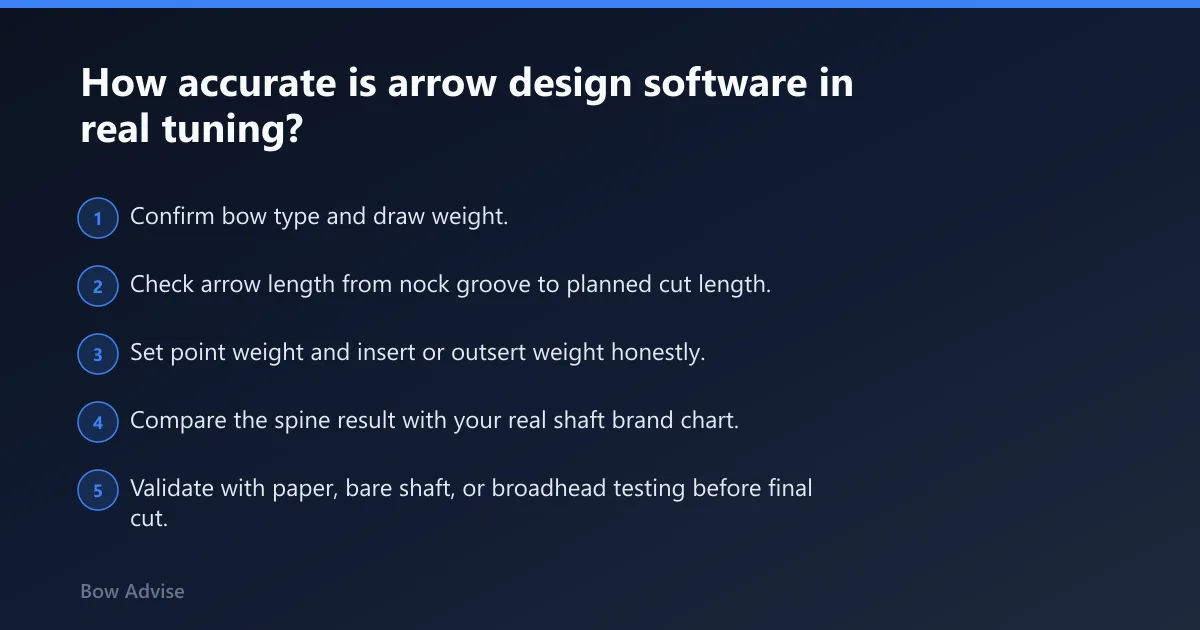
Arrow software is accurate enough to narrow choices, not accurate enough to skip tuning. It predicts the build window well when inputs are honest, but shaft variance, rest setup, brace height, release quality, and broadhead behavior still decide how the arrow flies.
Paper tuning checks
Paper tuning is often my first sanity check for compound setups. It tells me quickly if the software got me close on dynamic spine and nock travel. A clean tear does not prove the build is perfect, but a bad tear tells me I should stop trusting the calculator and inspect the setup.
Bare shaft checks
Bare shaft testing is often especially useful for many recurve and traditional builds. A bare shaft shows whether the arrow is reacting stiff or weak in the real world. If the software and the bare shaft disagree, I trust the bare shaft more than the screen.
Broadhead tuning
Broadhead tuning is where bad FOC guesses show up. A field point can mask problems that a fixed blade will expose. I always verify that the arrow stays consistent at distance before I cut a pile of shafts to the same length.
What to verify before cutting a shaft
- Confirm bow type and draw weight.
- Check arrow length from nock groove to planned cut length.
- Set point weight and insert or outsert weight honestly.
- Compare the spine result with your real shaft brand chart.
- Validate with paper, bare shaft, or broadhead testing before final cut.
What should I check before buying custom arrow software?
Before I pay for arrow design software, I check whether it fits my actual build process. The best program in the world is useless if it cannot export a cut list, handle my shaft materials, or store the component library I use every week.
Export and print options
Look for PDF export, CSV export, cut sheets, labels, and shop order sheets. If you build arrows for other people, repeatable output matters almost as much as the spine math. I want to print the build, hand it to a helper, and know they can follow it.
Free trial or pricing model
Free software is useful when you are learning, but paid tools usually handle more of the workflow. I would rather test a program on one real build than trust marketing claims. If there is a trial, use it to enter the same shaft and compare the output with a known-good arrow.
Component inventory fit
Make sure the database includes the shaft brands, nocks, points, fletching, inserts, and outserts you actually buy. A database that misses your favorite components forces guesswork. That is how bad builds start.
Shop order and repeat-build support
If you build arrows for a club, family members, or customers, repeat-build support matters. The software should save prior setups, store notes on tuning changes, and let you rebuild the same arrow without re-entering every field. That is where shop-grade systems earn their keep.
Frequently asked questions
Is there software for designing custom arrows with spine and weight calculations?
Yes. Good arrow design software calculates spine, finished weight, and usually FOC too. The better tools also let you enter bow type, draw weight, shaft length, point weight, and component choices so the recommendation matches the build you plan to cut.
Can I use CAD software to design arrows for recurve or compound bows?
You can model arrows in CAD, but it is usually overkill for actual build decisions. CAD helps with templates and shop layouts, while dedicated arrow software is much faster for spine, length, weight, and FOC decisions tied to recurve or compound setups.
Which arrow design software is easiest for beginners?
The easiest tools are the ones that ask for a short list of inputs and return a clear build recommendation. Beginners should look for custom shaft length, spine suggestion, weight estimate, and a simple export or print summary instead of a complex shop system.
Does any arrow software let me calculate arrow spine, FOC, and finished weight?
Yes, and that is the minimum I would want before trusting a program. The useful tools estimate spine fit, finished arrow weight, and FOC together so you can see how point weight, insert weight, and cut length affect the final setup.
What software do small archery shops use for custom arrow builds?
Small shops usually want a system that stores customer builds, prints cut lists, and supports repeat orders. They need component libraries, export options, and a way to document tuning notes so the same arrow can be rebuilt later without starting from scratch.