Cutting Arrows by Hand vs Arrow Saw for Carbon Shafts
Use an arrow saw for carbon shafts and any repeat build. Hand cutting is acceptable for aluminum or wood only if the cut stays square and cleanup is simple. Bad cuts splinter carbon, crush aluminum ends, and waste shafts fast. This guide compares both methods by shaft material, build volume, and cleanup tolerance, then points to the best substitute tool for each case.
This guide is part of our Arrow making guide: tools, materials, and methods series.
| Decision factor | Cutting Arrows by Hand | Using an Arrow Saw | Winner |
|---|---|---|---|
| Up-front cost | Low. A hacksaw, tape, and a guide are cheap. | Higher. A dedicated saw costs more before the first cut. | Cutting Arrows by Hand |
| Square-cut consistency | Depends on the guide and the operator. | Best for repeatable square cuts. | Using an Arrow Saw |
| Carbon safety and cleanup | Higher dust and fray risk if the cut drifts or chips. | Cleaner control, less wandering, easier to square. | Using an Arrow Saw |
| Batch speed | Slow, especially on full dozen builds. | Faster for repeated cuts. | Using an Arrow Saw |
| Best fit | One-off aluminum cuts, low volume, simple cleanup. | Carbon shafts, hunting batches, target sets, repeat builds. | Using an Arrow Saw |
Cutting arrows by hand vs using an arrow saw: the real trade-off
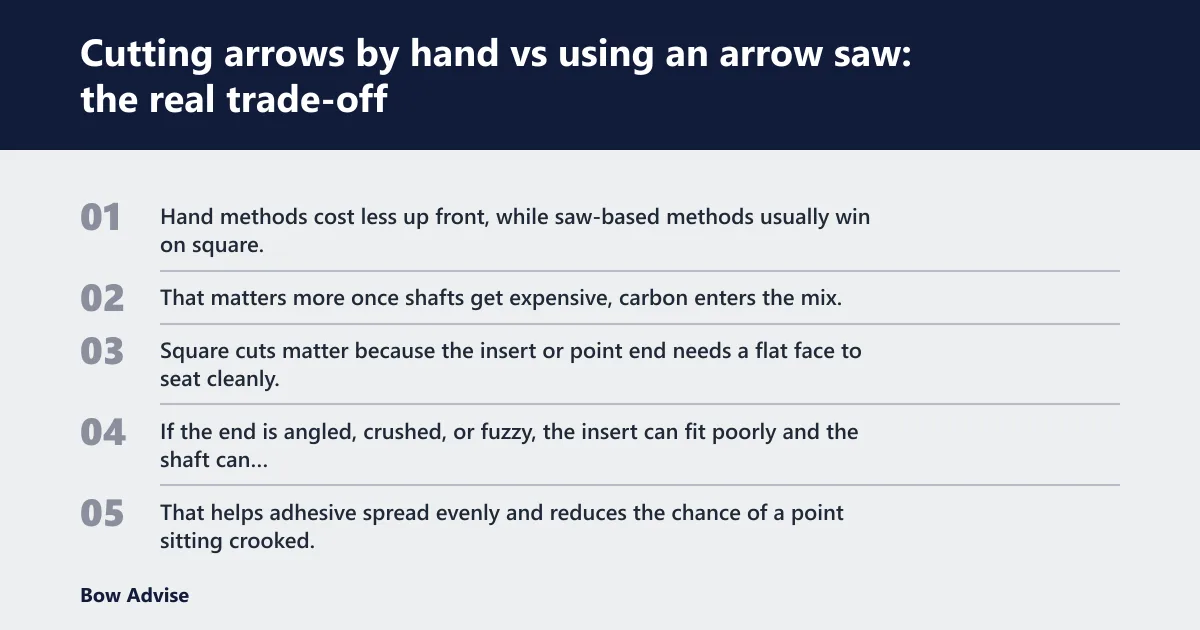

The trade-off is simple. Hand methods cost less up front, while saw-based methods usually win on square, repeatable cuts and batch speed. That matters more once shafts get expensive, carbon enters the mix, or the build includes several arrows instead of one.
Square cuts matter because the insert or point end needs a flat face to seat cleanly. If the end is angled, crushed, or fuzzy, the insert can fit poorly and the shaft can open up during assembly.
Why square cuts matter for insert fit and consistency
A square end gives the insert full contact. That helps adhesive spread evenly and reduces the chance of a point sitting crooked. On carbon shafts, the end also needs to be squared after cutting because the cut face often needs a final cleanup pass.
Wandering cuts create two problems at once, wasted shaft length and a poor seating surface. That is why a guide, box, or jig matters even when the tool itself is simple.
📊 The mini miter saw method recommends an 80 to 100 tooth blade. Source: How to Cut Arrows Without an Arrow Saw: 6 Methods Compared.
Which cutting method fits your shaft material best?
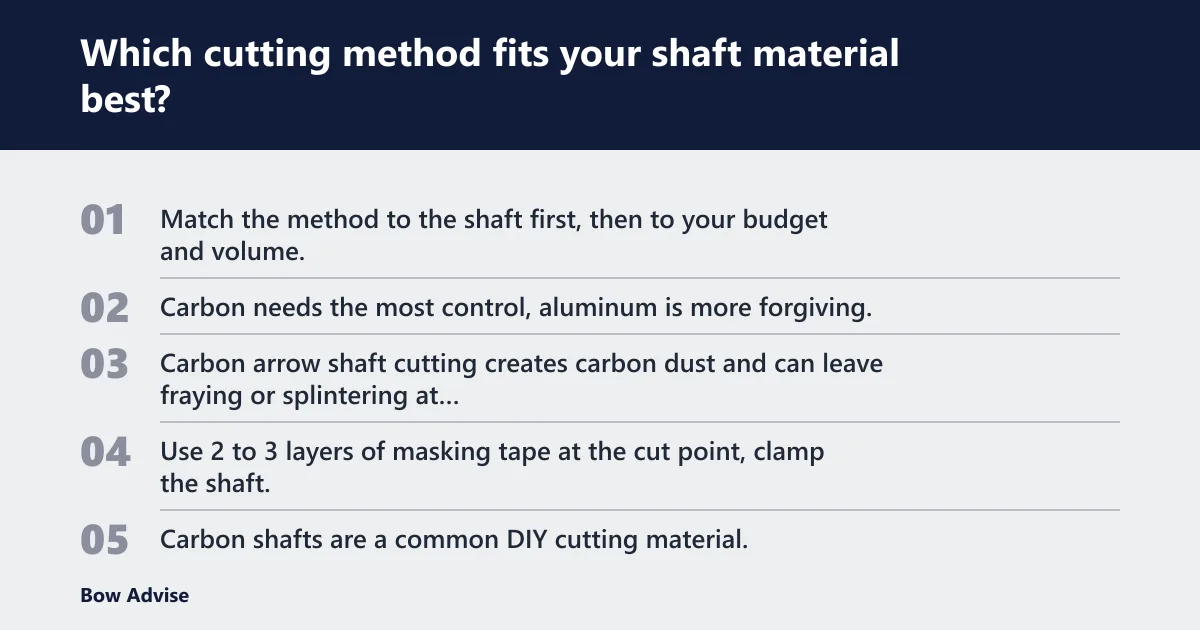
Match the method to the shaft first, then to your budget and volume. Carbon needs the most control, aluminum is more forgiving, and mixed builds usually justify one better setup rather than three weak ones.
Carbon arrow shafts: dust control, masking tape, and splintering risk
Carbon arrow shaft cutting creates carbon dust and can leave fraying or splintering at the cut end. Use 2 to 3 layers of masking tape at the cut point, clamp the shaft, and support it with a miter box or V-groove jig so the cut does not wander.
Carbon shafts are a common DIY cutting material, but they are also among the least forgiving. After the cut, deburring and squaring are not optional if the shaft will carry an insert cleanly.
Aluminum shafts: where hand tools are usually more forgiving
Aluminum is generally more tolerant of hand tools because it does not fray the way carbon does. A fine-tooth hacksaw or a mini miter saw can work well if the shaft is guided and the end is cleaned up afterward.
Even here, a rough cut can leave a crushed lip or a burr that interferes with insert fit. Cleanup still matters, just less aggressively than on carbon.
Mixed-material build plans: when one tool does not fit every shaft
If the bench sees carbon hunting arrows, a few aluminum practice shafts, and the occasional recurve set, one universal shortcut usually disappoints. The better choice is a saw or shop service that handles the hardest material cleanly.
That avoids buying a cheap tool for aluminum and then finding it is too crude for carbon. It also cuts waste when shaft cost is high.
Which tool should you use if you do not own an arrow saw?
The right substitute depends on setup discipline, not only on tool shape. A Dremel, hacksaw, or mini miter saw can work, but each one fails in a different way if the shaft is unsupported, freehanded, or rushed.
Dremel with cut-off disc: best setup, RPM range, and where it fails
A Dremel with a reinforced cut-off wheel or diamond disc works on carbon and aluminum. The recommended range is 20,000 to 25,000 RPM, and the shaft should be held in a V-groove jig so the disc enters squarely.
This method can be tidy on small batches, but the wheel can overheat the end if the cut is forced. Freehand use invites wandering, edge chipping, and a crooked face that still needs squaring.
Fine-tooth hacksaw: blade choice, guide block, and slow-cut reality
A fine-tooth hacksaw is the slow method, but it is cheap and workable. Use a 32-TPI blade or finer, and keep the shaft in a miter box or guide block so the cut stays aligned.
The trade-off is time. The hacksaw method takes 3 to 5 minutes per arrow, so it makes sense for one or two shafts, not a dozen.
Mini miter saw: blade count, carbon setup, and why freehand is off-limits
A mini miter saw can produce clean results when set up correctly. Use an 80 to 100 tooth fine-finish blade, keep the shaft clamped, and do not use it freehand.
It is strongest on aluminum, though it can be used on carbon with proper setup and dust control. The main risk is a fast, crooked pass that chips the end or throws dust where it does not belong.
How do you keep carbon shafts from fraying or splintering?
Stop the fibers from moving before the cut starts. That means masking tape at the cut line, rigid support under the shaft, and a controlled tool path that does not pry the wall apart at the end of the cut.
Masking tape at the cut line
Wrap 2 to 3 layers of masking tape at the cut point. The tape helps support the carbon fibers and reduces splintering as the blade or wheel exits the wall.
It is not a cure for a bad cut. It is a support step that works best when the shaft is clamped and the tool is kept square.
Miter box or V-groove jig for alignment
A miter box or V-groove jig keeps the shaft aligned and prevents drifting. That matters because carbon does not forgive freehand wobble the way a soft hobby cut might.
For Dremel, hacksaw, or mini miter saw work, the guide is doing part of the quality control. Remove the guide and the cut quality drops fast.
Deburring and squaring after the cut
Deburring removes loose material and squared ends correct the face so the insert seats properly. This final cleanup step protects fit, helps adhesive coverage, and reduces the chance of a point sitting off-axis.
Most non-saw methods need it. With carbon especially, skipping this step is how a cheap cut turns into a ruined shaft.
Decision matrix: cost per cut, setup time, dust risk, cut quality, and batch speed
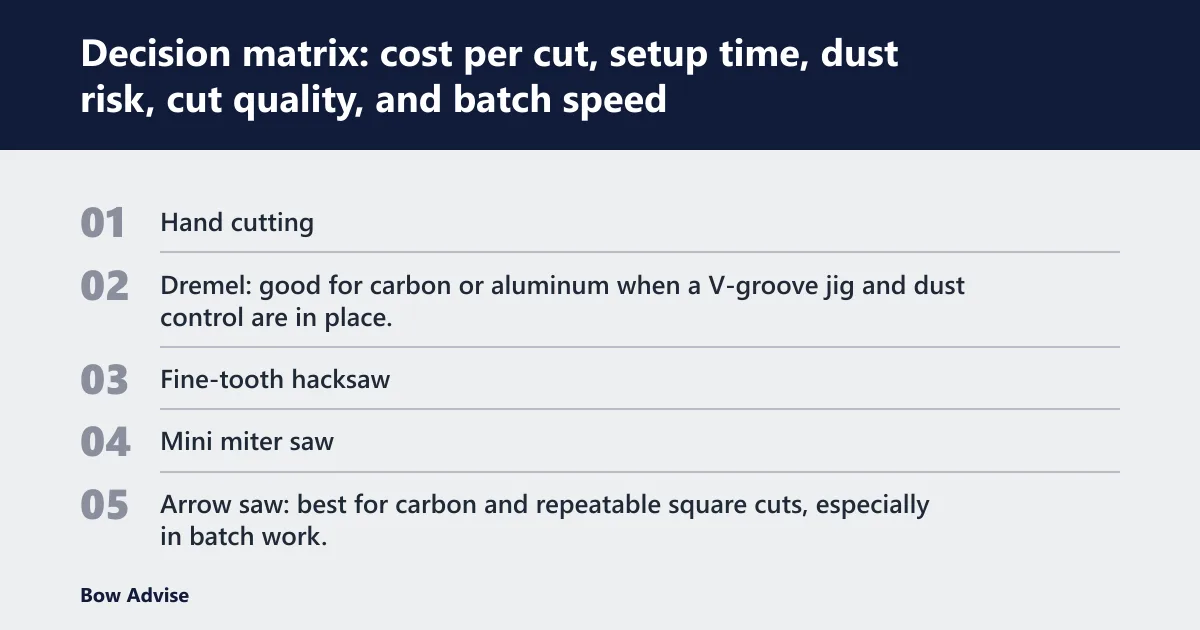
This matrix uses five criteria: lower cost per cut, lower setup time, lower dust risk, better cut quality, and faster batch speed. Scores are on a 1 to 5 scale, with higher scores indicating better performance. The point is not to crown one universal winner; it is to match the tool to the shaft and build volume.
| Method | Cost per cut | Setup time | Dust risk | Cut quality | Batch speed | Best shaft/material fit |
|---|---|---|---|---|---|---|
| Hand cut with hacksaw | 5 | 4 | 3 | 2 | 1 | Aluminum or wood, low volume |
| Dremel with cut-off disc | 3 | 3 | 2 | 3 | 3 | Carbon or aluminum, occasional home builds |
| Fine-tooth hacksaw | 4 | 4 | 3 | 2 | 1 | Carbon or aluminum, one-off cuts with patience |
| Mini miter saw | 2 | 3 | 2 | 4 | 4 | Aluminum first, carbon with proper setup |
| Arrow saw | 3 | 4 | 4 | 5 | 5 | Carbon shafts and repeat builds |
| Pro shop cutting | 5 | 5 | 5 | 5 | 4 | Any shaft when finish matters most |
Scoring method and what each score means
Cost per cut reflects consumables and setup, not just the tool price. That means blades, discs, tape, masks, and jig materials all matter. A cheap tool can still be expensive if it burns through wheels or ruins shafts.
Cut quality matters more on carbon than on aluminum. If the end is not square and clean, the insert fit suffers, and the shaft may need more cleanup than expected.
One-line recommendation by method and shaft material
- Hand cutting: best for aluminum or wood, one shaft at a time, when cleanup is simple.
- Dremel: good for carbon or aluminum when a V-groove jig and dust control are in place.
- Fine-tooth hacksaw: acceptable for low-volume carbon or aluminum if patience matters more than speed.
- Mini miter saw: best for aluminum and mixed DIY builds; usable on carbon only with proper setup.
- Arrow saw: best for carbon and repeatable square cuts, especially in batch work.
- Pro shop cutting: best overall finish for one-off shafts or when you do not want cleanup work.
When the pro shop cut service wins on total value
A pro shop cut service is often the lowest-friction choice for a few shafts. The comparison table lists pro shop cutting at $1 to $5 per arrow, which is hard to beat once tool cost, dust control, and cleanup are counted together.
That is especially true for a hunter who needs three shafts trimmed cleanly before season, or a beginner who would rather avoid ruined carbon ends than buy a tool for one job.
Choose hand cutting if… / Choose an arrow saw if…
Hand cutting is acceptable when the shaft material is forgiving, the build count is low, and the cleanup standard is simple. An arrow saw makes more sense when the build is repeated, the shafts are carbon, or the tolerance for a crooked end is close to zero.
Choose hand cutting if…
- You are trimming a small number of aluminum shafts.
- You already have a fine blade and a proper guide block or miter box.
- You can accept slower progress and post-cut cleanup.
- The shaft is not so valuable that one mistake feels expensive.
Choose an arrow saw if…
- You cut carbon shafts often.
- You build full sets for hunting or target use.
- You want square, repeatable cuts with less drift.
- You want less waste when shaft price is high.
Choose a pro shop if…
Pick the shop when you only need a few shafts, want the best finish without buying tools, or need carbon done cleanly with no setup burden. That is the best total-value answer for many DIY archers.
Frequently asked questions
Is it okay to cut arrows by hand instead of using an arrow saw?
Yes, but only when the shaft material and volume make sense. Hand cutting is often most reasonable for aluminum or wood, lower-volume work, and situations where a guide helps keep the cut square. For carbon and repeat builds, a saw or shop service is usually the safer choice.
What is the cleanest way to cut carbon arrows without a saw?
A Dremel with a reinforced cut-off wheel or diamond disc is the cleanest common home substitute when used with a V-groove jig. Keep the shaft taped with 2 to 3 layers at the cut point, clamp it securely, and finish with deburring and squaring.
How do I keep carbon shafts from splintering when hand cutting?
Use 2 to 3 layers of masking tape at the cut point, support the shaft in a miter box or V-groove jig, and avoid forcing the blade. Splintering usually comes from sideways pressure, a wandering cut, or an unsupported exit at the end of the cut.
Which tools can replace an arrow saw at home?
A Dremel, a fine-tooth hacksaw, and a mini miter saw can all work at home. The Dremel runs at 20,000 to 25,000 RPM, the hacksaw should use a 32-TPI blade or finer, and the mini miter saw should use an 80 to 100 tooth blade.
When does buying an arrow saw make more sense than hand cutting?
Buy one when you build in batches, trim carbon regularly, or want repeatable square cuts without spending time on cleanup. If the cost of ruined shafts or repeated cleanup starts to exceed the tool price, the saw becomes the better value.
Can I use a hacksaw, Dremel, or mini miter saw on arrows?
Yes, with the right setup. A hacksaw needs a 32-TPI blade or finer and a guide block. A Dremel needs a reinforced cut-off wheel or diamond disc at 20,000 to 25,000 RPM. A mini miter saw needs an 80 to 100 tooth blade and must not be used freehand.
Do hand-cut arrows need to be squared and deburred afterward?
Yes. Deburring and squaring protect insert fit and help the shaft seat cleanly. That step matters after most non-saw methods, and it matters most on carbon because frayed or angled ends can cause poor fit and extra cleanup later.
What is the safest way to cut carbon arrows in a home workshop?
The safest home setup uses a clamp, a miter box or V-groove jig, eye protection, respiratory protection for carbon dust, and a controlled cutting tool. For most archers, a pro shop or an arrow saw is safer than freehand cutting, especially on carbon shafts.