How to Build Hunting Arrows vs Target Arrows: What to Change
Convert a target arrow into a hunting arrow by swapping the point for a fixed-blade broadhead, changing insert or shaft weight only if spine calls for it, and aiming for about 10% to 15% FOC for broadhead stability. Miss that, and broadhead planing, poor penetration, and weak arrow recovery can hurt accuracy and recovery. This guide covers each arrow component, what to keep, what to change, and how those changes affect spine, FOC, safety, and forgiveness.
| Decision factor | Hunting Arrows | Target Arrows | Winner |
|---|---|---|---|
| Primary goal | Penetration, broadhead control, and safe clearance | Speed, flat trajectory, and lower drag | tie |
| Front-end weight strategy | Higher point weight, insert, collar, and broadhead mass are common | Often lighter field points and simpler front hardware | tie |
| Dynamic spine tolerance | Usually less forgiving if front weight is high and shaft is too weak | Often set up around field-point tune and a wider practice window | Target Arrows |
| Safety margin | Broadheads need more clearance, front overhang checks, and a longer safe cut margin | Field points are less risky, with fewer blade-clearance concerns | Target Arrows |
| Wind drift and drag | Micro-diameter helps reduce drag and drift, but setup is heavier up front | Lower drag is still a priority, especially for tuned target shafts | Target Arrows |
| Forgiveness window | Needs a stable broadhead tune and proper FOC | Often more forgiving with field points and tuning methods built around them | Target Arrows |
What changes between hunting and target arrows?
Hunting arrows put penetration, broadhead control, and safe clearance first. Target arrows put speed, flat trajectory, and lower drag first. The same shaft can act differently because a field point and a broadhead steer differently, and front-end weight changes dynamic spine.
Speed, drift, and forgiveness
Target arrows usually stay lighter and cleaner up front, which helps speed and wind drift. Hunting arrows usually carry more front weight, so they can hit harder and hold broadheads steadier, but the same setup can feel less forgiving if the shaft is too weak.
A hunting shaft may use a micro-diameter carbon core for better penetration and aerodynamics, and Easton’s hunting lineup includes both carbon and FMJ options. That does not mean every hunter needs a micro shaft. It means the shaft choice should match the bow, the draw weight, and the front-end stack.
Why field points and broadheads do not tune the same
A field point is used for target archery and tuning, and it has less safety risk than a broadhead. A similar grain weight can still tune differently once a fixed blade is installed, because blade drag and overhang change how the arrow reacts in flight.
That is why a target setup can look perfect with field points and still plane, kick, or group poorly with broadheads. Judge the setup as one system, not by point weight alone.
How should you set arrow length?
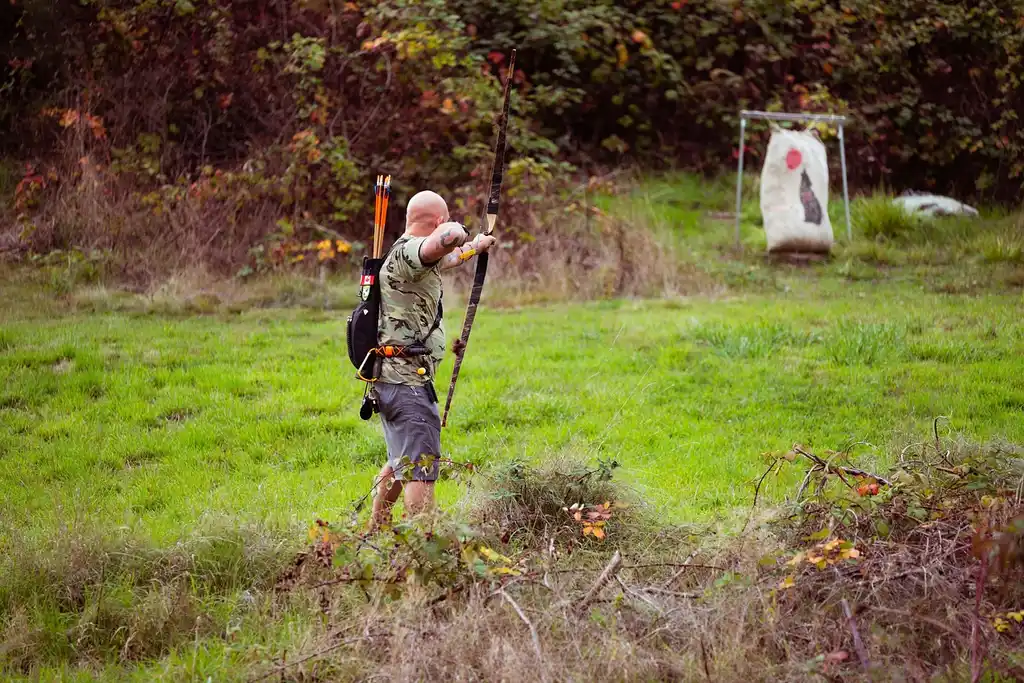
Use full-draw shaft length, not a bench guess. For hunting arrows, the cut length should match the actual setup at full draw and leave a safety margin that accounts for the rest, the front hardware, and broadhead overhang. Broadheads demand more margin than field points.
Use the actual full-draw setup
Nock On recommends a safety-first arrow length based on the front edge of the riser, and also says the broadhead should be in front of the bow hand at full draw. That is a safety check, not a substitute for measuring the real shaft length needed for the bow, the rest position, and the front-end stack.
GOHUNT notes that a 30-inch draw may still use a shaft cut around 29 to 29.25 inches. The point is simple: draw length alone is not the final cut length. The finished arrow has to match the actual bow setup and leave enough safe clearance.
Why shortening the shaft changes tune
Shorter arrows are often faster and dynamically stiffer. Longer arrows are weaker dynamically. That means a shaft cut from the rear behaves stiffer, which can help if a target shaft becomes too weak after a heavy point or broadhead is added.
Cutting from the rear also affects broadhead clearance planning. Easton says more care is needed when gluing components on small-diameter arrows, and that matters even more when the finished shaft is cut close to the limit.
What to check before any cut
- Set the bow at the real full-draw setup.
- Confirm the rest position and front hardware are installed.
- Check that the broadhead, when installed, will sit with safe clearance at full draw.
- Plan finished length before cutting, not after.
- Verify the final tune with a paper tune or walk-back test.
Say your compound has a 29-inch draw and the target shaft already sits close to the safe minimum. If a fixed-blade broadhead and collar are added, the shaft may need to stay full length or move to a stiffer spine rather than being cut shorter.
How spine changes when you change components
Static spine is the shaft rating commonly printed as a number such as 250, 300, 400, 500, or 650. Dynamic spine is what the arrow actually does in the bow. Shortening the shaft makes it stiffer. Adding point weight or front hardware makes it weaker.
Static spine versus dynamic spine
A 300 spine shaft can act very differently from another 300 spine shaft once length, point weight, insert style, and rest setup are changed. Dynamic spine is the real test. That is why a chart or calculator is useful before buying or cutting parts.
The X10 uses three distinct custom spine zones, and Easton says the X10 has a lighter tail section for better clearance and finger release consistency. Easton also says cutting X10 or ACE shafts from the rear makes them effectively stiffer. Those details matter because the shaft does not behave the same from end to end.
When a target shaft becomes too weak
A target shaft that tunes fine with a light field point can become too weak once a heavier hunting point, insert, collar, or broadhead is added. The same source notes that adding weight to the point makes an arrow flex more. If the front stack is heavy enough, the shaft may need to be stiffer rather than simply shorter.
Rear weight can stiffen the arrow slightly, but that is a small correction. It rarely fixes a front-heavy shaft that is already outside its useful spine window.
Target-to-Hunting arrow change matrix
| Component | What to change | Expected effect on dynamic spine | Expected effect on FOC | Safety impact | When to avoid the change |
|---|---|---|---|---|---|
| Shaft length | Keep full safe length for hunting, or trim only after full-draw and clearance checks | Shorter = stiffer | Small increase if the rear is trimmed | Too short can leave poor broadhead clearance and less margin | When the shaft is already near the safe minimum |
| Point weight | Move from light field point to hunting point weight that matches the spine window | Heavier point = weaker | Raises FOC | Heavier points can expose clearance and tune problems | When the shaft is already soft on paper or in bare shaft flight |
| Insert / outsert / collar | Use only the front hardware needed for strength and broadhead support | More front mass = weaker | Raises FOC and finished arrow weight | Can improve front-end durability, but adds blade-clearance and glue-care needs | When added length makes the finished arrow too soft or too long for safe clearance |
| Vane choice | Move from low-drag target vanes to hunting vanes with more steering if needed | Small effect, often slight rear stiffening from added tail weight | Usually lowers FOC a little if heavier at the rear | More steering can help broadheads, but more drag can add noise | When the bow already shows excess drag or vane contact |
| Wrap | Use a wrap only if it helps visibility, vane adhesion, or ident marking | Slight rear stiffening from added rear weight | Can lower FOC slightly | Usually low risk, but it adds finished weight | When every grain matters for target speed or a very light rear build |
| Nock | Keep a nock that fits the string cleanly and releases consistently | Small effect | Minimal change | Fit matters more than weight; poor fit hurts release and safety | When the nock fit is loose or inconsistent |
| Broadhead | Switch from field point to fixed-blade or mechanical hunting head as needed | Fixed blades often demand a cleaner tune | Depends on head weight; usually raises front balance | Highest safety concern because of blade overhang and front clearance | When the bow cannot clear the blade path or the shaft is already too weak |
What should you change first on a target arrow?
Keep the shaft if the spine window still works. Start by changing front weight, then confirm whether the current shaft can still tune with broadheads. If the shaft becomes too weak after that, move to a stiffer spine rather than forcing the setup with rear changes.
Change front weight before everything else
The first useful change is usually the point and front hardware stack. A field-point setup can often move toward hunting use by changing to a hunting point, then checking whether the shaft still bareshafts or tunes cleanly. That keeps the build close to the original target shaft and avoids unnecessary parts changes.
Suppose a target setup uses a 400 spine shaft and tunes well with a field point, but a broadhead pushes the arrow weak. Adding a heavy insert on top of a heavy head may push it farther outside the window. In that case, a stiffer shaft is the cleaner fix.
When to stop modifying and change spine
Stop adding front weight if the arrow is already showing weak flight, poor broadhead grouping, or unstable recovery. A shaft selector or calculator can help narrow the starting spine, but the final answer still comes from full-draw length, front mass, and real tune checks.
For recurve setups, the margin is often narrower because finger release and string travel can make the tune less forgiving. Compound setups usually tolerate setup changes a bit better, but broadheads still expose weak spine quickly.
How do inserts, collars, and broadheads affect hunting setup?
These parts matter because they change finished arrow weight, FOC, and front-end stiffness. They also change how much care is needed during assembly. On small-diameter arrows, component glue-up matters more, and front hardware can move the setup from tuneable to too soft very quickly.
Front-end weight and finished arrow weight
An insert or outsert adds front length and weight. A collar adds support and weight near the front of the shaft. All three increase finished arrow weight, and all three can shift the dynamic spine weaker because they load the front end.
That is useful for hunting because a heavier front can help FOC and broadhead stability, but it is not free. Too much front mass can make a once-safe target shaft too weak for accurate broadhead flight.
Fixed-blade versus mechanical broadheads
Fixed-blade broadheads usually ask more from the tune because the blades are exposed in flight. Mechanical broadheads often create less steering in the air, but they still need safe fit, dependable deployment, and proper clearance. Neither removes the need to verify front-end clearance.
Blade overhang is a real safety issue. A broadhead that sits too far forward, or that sweeps too close to the riser or rest path, should be rechecked before use.
Clearance checks before hunting use
- Inspect the rest path for blade or ferrule contact.
- Check the broadhead at full draw, not only at rest.
- Confirm the broadhead clears the front of the riser and the shooter’s bow hand position.
- Check finished length after all front components are installed.
- Paper tune or walk-back test after the final build.
How do wraps, vanes, and nocks change tune?
Wraps, vanes, and nocks change tune mostly at the rear of the arrow. Their effect is smaller than point weight, but it is not zero. Rear weight can stiffen the arrow slightly, and vane choice changes drag, noise, and steering.
Rear weight and small spine shifts
A wrap adds rear weight. A heavier vane adds rear weight. A different nock can also shift balance a little. These changes can slightly stiffen the arrow dynamically because the balance point moves rearward.
That effect is modest compared with point weight or shaft length. It can help fine-tune a near-perfect build, but it should not be used to rescue a front-heavy setup that is already too weak.
Drag, noise, and vane choice
Target arrows often use lower-drag vane setups because speed and wind drift are priorities. Hunting arrows may use vanes that steer broadheads more consistently, even if they add a little drag. The right choice depends on rest clearance, broadhead style, and the amount of steering the head needs.
Wraps are worth the added weight when they improve vane adhesion, arrow visibility, or quick sorting. They are less useful when every grain counts for a very light target setup.
Choose hunting Arrows if…
Choose Hunting Arrows if the bow will carry broadheads, the front-end stack needs better penetration and FOC, and the setup can pass full-draw clearance checks. This is the right pick when safety margin, broadhead control, and finished hunting weight matter more than pure speed.


Choose Target Arrows if…
Choose Target Arrows if the main goal is speed, flat trajectory, and a simpler field-point tune. This is the better pick when you want lower drag, more forgiving practice tuning, and less concern about blade clearance.
Frequently asked questions
How do I change my arrow setup for hunting vs target shooting?
Start by deciding what the front end must do. Hunting arrows usually move toward a fixed-blade broadhead, more front weight, and a safer cut length. Target arrows usually stay lighter, cleaner, and tuned around field points. Then verify the final build with paper tune or walk-back testing.
What arrow length should I use for hunting arrows?
Use the actual full-draw setup, not a generic draw-length guess. The shaft must be long enough for safe clearance with the rest, broadhead, and front hardware in place. Nock On’s advice is to base the length on a safety-first check from the front edge of the riser, then confirm with full-draw fit.
Should hunting arrows be heavier than target arrows?
Usually yes, because hunting arrows put penetration and broadhead stability first. A heavier finished arrow can help with front-end balance and terminal performance, while target arrows often stay lighter for speed and flatter flight. The spine still has to match the extra front weight, or the arrow can become too weak.
How does broadhead weight affect arrow spine?
Heavier broadheads make the arrow act weaker dynamically. The same source notes that adding weight to the point makes an arrow flex more. If the shaft was already close to weak with a field point, a heavier hunting head can push it beyond a useful tune window.
Can I cut target arrows shorter than hunting arrows?
Sometimes, but only if the final hunting setup still leaves safe clearance and the shaft still fits the spine window. Shortening the shaft makes it stiffer, which can help recover from added front weight. If the shaft is already short or too stiff, cutting it more can make tuning worse.
What components change when switching from field points to broadheads?
The main changes are the point, the insert or outsert stack, and sometimes the vane choice or shaft spine. A field point usually tunes more easily and carries less safety risk. A broadhead adds blade drag and safety concerns, so the finished setup needs a stricter clearance check and a more careful tune.
How much arrow length do I need for safety with broadheads?
Enough length to keep the broadhead and ferrule clear at full draw, with the arrow matched to the real bow setup. Do not guess from a bench measurement alone. Check the bow at full draw, confirm the front hardware stack, and keep a margin that protects against blade overhang and contact.
Do arrow wraps, inserts, and vanes change tune?
Yes, but not equally. Inserts change tune the most because they add front weight and affect dynamic spine. Wraps and vanes mainly change rear weight, which can stiffen the arrow slightly and alter drag. Those rear changes are fine-tuning tools, not a fix for the wrong spine.