How Points in Archery Target Determine Your Best Score Effortlessly
Archery target points usually run 10 to 1 from the center out, and the best scoring rule is simple: protect the 8-ring first, then chase 10s only when your group already lives there. Get scoring wrong and you can drop points on line calls, read a round badly, and practice the wrong fix for your misses. I’ll break down ring values, line-cutters, indoor and outdoor scoring, set systems, and the score-first decisions I use in practice and club competition.
The World Archery target face and what the rings actually tell you
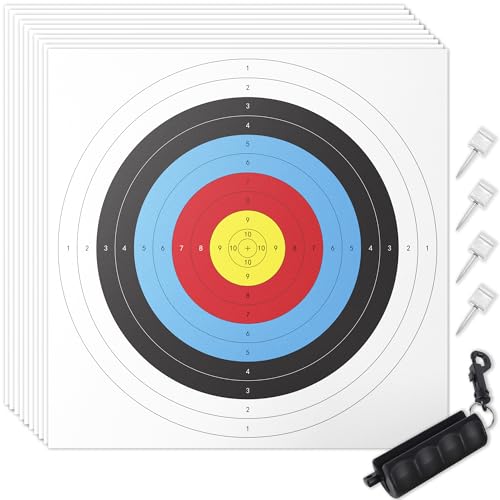


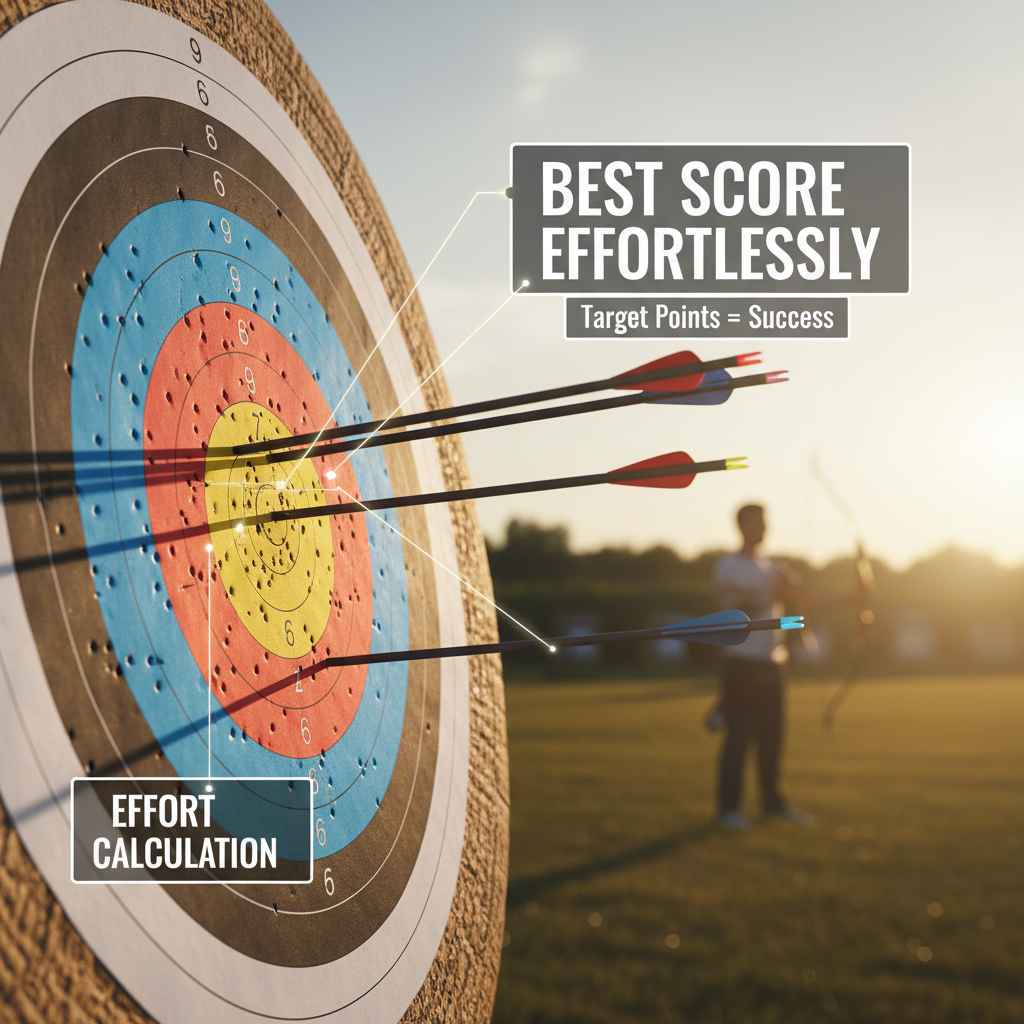
The five-colour face and the 10 scoring zones
The standard target face is split into five color bands, gold, red, blue, black, and white, and each band carries two scoring rings, giving you 10 zones from the center out. On the World Archery face, the colors run gold, red, blue, black, white from the middle out. World Archery scores the inner ring as 10 points and the outer ring as 1 point.
| Ring color band | Zone values |
|---|---|
| Gold | 10, 9 |
| Red | 8, 7 |
| Blue | 6, 5 |
| Black | 4, 3 |
| White | 2, 1 |
Anything outside the scoring rings is a miss and scores zero. Beginners often stare at the center and miss the real lesson: every arrow location is feedback. A loose low-left 6 tells me more than a lucky 10 ever will.
Target sizes you’ll actually see
Recurve archers shoot 70 metres at a 122 cm target face. Compound archers shoot 50 metres at an 80 cm target face. Compound target faces often remove the outer four rings, which changes what you see more than it changes the basic scoring logic.
At club level, I usually see full outdoor faces for recurve, reduced or compound-specific faces for compound, and then single-spot or multi-spot indoor targets once everyone moves inside for winter.
According to Scoring Guide — The Worcester round uses a special black-and-white face with 1-5 scoring. (source)
How many points is each ring in archery?
In standard metric scoring, each ring is worth one point less as you move outward: 10 in the middle, then 9, 8, 7, 6, 5, 4, 3, 2, and 1. The score itself is simple. The useful part is reading what those values say about your group and your next adjustment.
Metric scoring from 10 to 1
If an arrow lands clean in the gold, it is either a 10 or a 9 depending on which gold ring it hits. Then the red rings are 8 and 7, blue is 6 and 5, black is 4 and 3, white is 2 and 1.
That part is easy to memorize. What matters more is your scoring floor. For a recurve beginner, keeping every shot in the red and blue usually builds points faster than forcing center-hold shots that create misses — three steady 7s already total 21 points, more than a single 10 paired with two misses.
What 10s and Xs mean on the scorecard
Metric scoring can use Xs as tiebreakers. An X is still a 10 for score value, but it is counted separately for tie situations. That is where many beginners get mixed up: a 10 and an X both score 10, but they do not mean the same thing on the card.[5]
Why the same arrow matters differently in recurve and compound rounds
A recurve archer learning to keep six arrows inside the 8-ring is buying easy points. A compound archer with a tight group may already own the 9-ring and be deciding whether tiny centering gains are worth more 10s or more Xs. Same paper. Different decision.
What happens if an arrow touches the line in archery scoring?
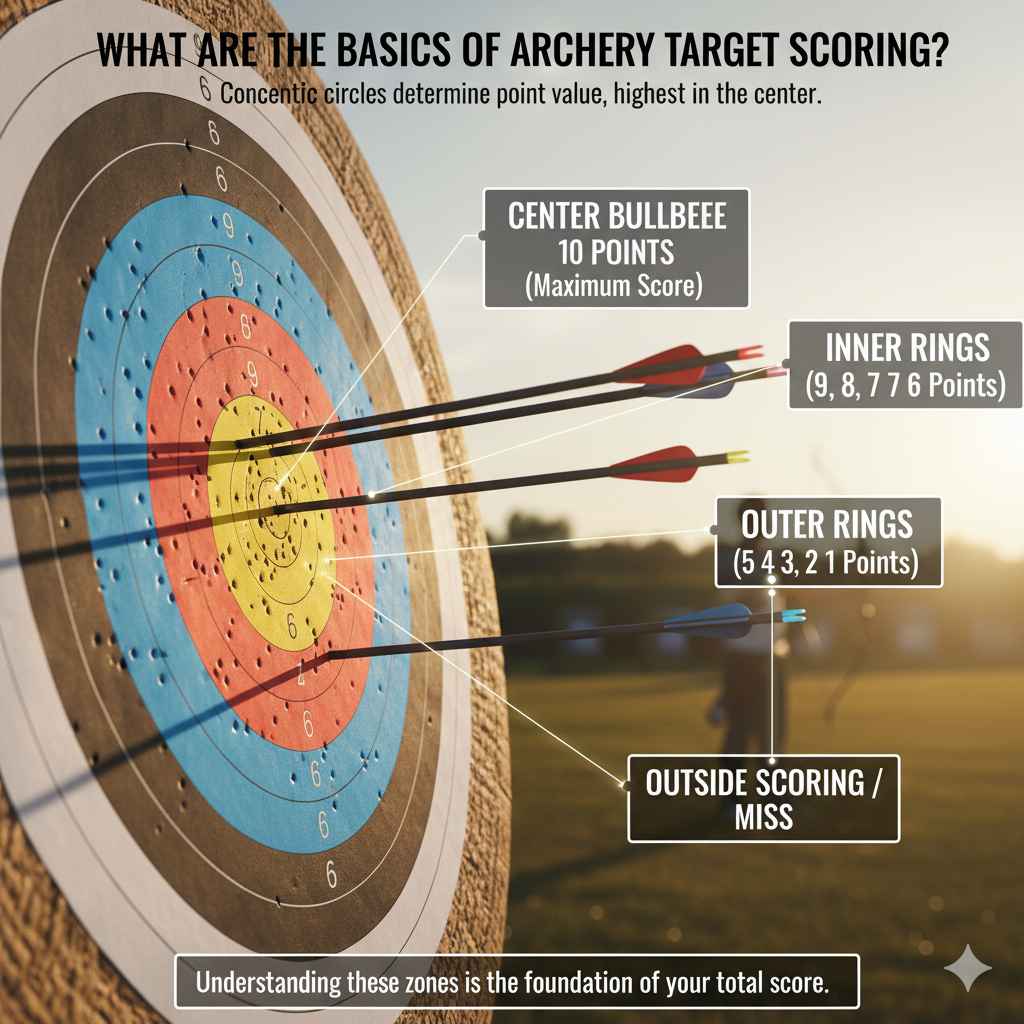
An arrow touching a scoring line gets the higher score. In plain terms, if the shaft breaks the ring between 9 and 10, it scores 10, and if it clips the ring between 7 and 8, it scores 8. If you cannot clearly agree on the call, stop and get a judge before pulling arrows.
The line-cutter rule
An arrow touching a line gets the higher score. That is the full rule. If the shaft breaks the line between 8 and 9, you score 9. If it only looks close from an angle, do not guess.
Common mistakes on close arrows
- Looking from one side only and calling a higher value too quickly.
- Scoring the hole instead of the shaft position.
- Mixing up a 10 and an X on indoor compound faces.
- Pulling arrows before both scorers agree.
Beginners should step in square, check ring contact carefully, and say the value out loud before touching the target. That alone cuts a lot of scorecard mistakes.
When a judge should step in
Disputed arrows need a judge, called before anyone reaches for the target. In head-to-head formats, or anytime the value affects ranking, that call is worth slowing down for. Once the arrow is pulled, the evidence is gone.
How do indoor and outdoor archery scoring differ?
Outdoor scoring usually means full 122 cm or 80 cm metric faces shot at 70 metres for recurve or 50 metres for compound, while indoor scoring uses smaller single-spot or multi-spot faces at much shorter range. The points may still read 10 to 1, but indoor compound often uses a smaller 10-ring, so center hits that would be 10 outdoors may score 9 indoors.
Outdoor metric scoring
Outdoor target rounds keep the standard 10 to 1 logic. Recurve archers shoot 70 metres at a 122 cm target face, while compound archers shoot 50 metres at an 80 cm target face.
Outdoors, I pay attention to vertical spread first. Wind and pace can tempt archers to chase every arrow, but a repeating high-low pattern usually gives away more points than a slight left-right drift.
Indoor single-spot and multi-spot scoring
Indoors, you may shoot one large face or a multi-spot face. Multi-spot layouts spread arrows across separate aiming marks so accurate shooters do not destroy arrows with Robin Hood shots.
Compound indoor scoring and the smaller 10-ring
Compound indoor scoring often uses a smaller 10-ring, which makes 10s harder to earn. X-count then becomes a finer separator among archers already scoring very high. If you score the wrong ring on the wrong face, your card can go bad by more than one point in a hurry.
What is the difference between metric and imperial archery scoring?
Metric scoring uses 10 to 1 rings and often tracks 10s and Xs, while imperial scoring uses 5 zones with values 9, 7, 5, 3, 1 and may also record hits and golds. At club level, metric usually means modern target rounds; imperial usually appears in yards-based rounds and traditional club formats.
Metric scoring
Metric is the system most beginners meet first. You record arrow values, total the end, then build the round total. Xs may be counted as tiebreakers, but they still score as 10s.
Imperial scoring
Imperial scoring uses 5 zones with values 9, 7, 5, 3, 1. It also tracks hits and golds in some rounds. Hits means scoring arrows. Golds means arrows in the gold center area.
Worcester is its own indoor example. The Worcester round uses a special black-and-white face with 1-5 scoring, and indoor Worcester is shot with 5 arrows per end.
Quick decision aid for club nights and competitions
- If the face shows 10 scoring rings in five colors, think metric first.
- If the round is described in yards and talks about hits or golds, check for imperial scoring.
- If compound shooters are on small center spots indoors, confirm whether only the inner 10 counts as 10.
- If the face has separate spots, confirm which spot you are assigned for each arrow.
- If in doubt, ask before sighters end, not after your first scoring end.
How do I score a real end step by step?
Score a real end by reading each arrow location, assigning the ring value, writing arrows down in the required order, totaling the end, and then adding that to your running round total. Done properly, scoring shows whether you are losing points to one bad miss or to a wider pattern that keeps leaking points.
Score-conversion worksheet: 10 real arrow locations
Below is a simple worksheet I use with beginners because it turns ring theory into decisions. These are ten actual-style arrow locations described in plain language, then converted for three contexts: recurve on a full metric face, compound indoor with a smaller 10-ring, and standard metric outdoor with X tracked as a tiebreaker.
| Arrow | Arrow location on face | Recurve score | Compound indoor score | Metric outdoor note | Running total |
|---|---|---|---|---|---|
| 1 | Dead center, clearly inside X-ring | 10 | 10 | 10, count as X | 10 |
| 2 | Gold, outside X but inside 10 | 10 | 9 | 10 | 20 |
| 3 | Touches line between 9 and 10 | 10 | 10 if it touches compound 10 line, otherwise 9 | 10, line-cutter | 30 |
| 4 | Clean 9 at high right | 9 | 9 | 9 | 39 |
| 5 | Touches line between 8 and 9 | 9 | 9 | 9, line-cutter | 48 |
| 6 | Clean 8 low | 8 | 8 | 8 | 56 |
| 7 | Wide left in the 7 | 7 | 7 | 7 | 63 |
| 8 | Blue-black line, touching higher ring | 5 | 5 | 5, line-cutter | 68 |
| 9 | White 2 at low left | 2 | 2 | 2 | 70 |
| 10 | Miss off the scoring rings | 0 | 0 | 0 | 70 |
On a standard metric read, those ten arrows total 70. In a compound indoor read, Arrow 2 is the one I use to teach the trap: it looks great, but if it sits outside the smaller 10-ring, it is a 9. On a metric outdoor card, Arrows 1 and 3 could both be 10s, but only Arrow 1 is an X.
How I record an end and a round on the scorecard
An end is the set of arrows shot before scoring. A round is the full series of ends. Scores are often recorded highest to lowest within the end where required, then the end total is added to the running round total.
Example from the worksheet, written highest to lowest for the first six arrows: 10, 10, 10, 9, 9, 8. End total: 56. Next four arrows: 7, 5, 2, 0. Added together, the round sample total becomes 70.
Common beginner scoring mistakes
- Calling a near-line arrow from an angle instead of checking square.
- Writing an X as if it were worth more than 10.
- Scoring the wrong spot on a multi-spot face.
- Losing the running total and carrying the mistake forward.
How do special target faces like Vegas and 5-spot scoring work?
Special target faces keep the same basic idea of center-first scoring, but the round format and face layout matter a lot. A Vegas round uses 3 arrows per end and 10 ends for 300 possible points, while NFAA indoor 300 uses 12 ends of 5 arrows at 20 yards, also for 300 points.
Vegas round scoring
The Vegas round uses 3 arrows per end and 10 ends. A Vegas round has 300 possible points. X-ring counts are then used as tiebreakers among archers with the same point total.
NFAA 300 round scoring
An NFAA indoor 300 round uses 12 ends of 5 arrows at 20 yards. A perfect NFAA 300 score is 300 points. When I’m helping a new compound shooter, I tell them to learn the face before they chase the number because one scoring-face mix-up can spoil an otherwise clean card.
5-spot and multi-spot faces
The indoor 5-spot target gives you separate aiming spots, usually one arrow per spot. Accurate compound shooters use it to prevent Robin Hood shots and keep scoring cleaner. The habit also forces better arrow-by-arrow discipline because each shot gets its own aiming picture.
How can I use scoring to find easier points?
Use scores as a map, not a grade. A pattern of 8s and 7s in one direction tells you where easy points are hiding, because small corrections can turn repeat misses into repeat gains. The fastest scoring jump usually comes from removing one miss pattern, not from chasing perfect centers.
Reading groups for left, right, high, and low misses
If the group is left, I first check alignment and eye dominance before I touch the sight.
If the group is low, I look hard at collapse or bow weight. The scorecard kept showing low 7s and 6s before I admitted the problem.
Best-score strategy for recurve beginners
For most recurve beginners, the easy points often live between the 6 and 8 rings. So I want a round plan built around three questions:
- Can you keep every arrow on the scoring face?
- Can you keep the group inside the blue and red?
- Can you remove one repeating miss before you chase more 10s?
If your arrows are spread from 3 to 9, your best scoring gain is not “aim harder.” It is reducing the throwaway arrow. Turn one 3 into a 7 and you gain four points in a single shot.
Best-score strategy for compound shooters
Compound shooters usually get easier points by protecting 9s first, then centering groups for more 10s, then refining for X-count. If your group already sits around the middle, the question changes from “Can I hit gold?” to “Can I stop leaking one point on almost-good arrows?”
Tiebreak logic you should know during matches
Tiebreak procedures vary by round. They can use hits and golds, or X count in metric scoring. In head-to-head ties, the closest-to-centre arrow may decide it. If a closest-arrow call is disputed, that is judge territory, and nobody should pull anything until it is resolved.
Frequently asked questions
What are hits, golds, 10s, and Xs in archery?
Hits are scoring arrows, usually used in imperial rounds. Golds are arrows in the gold center area. A 10 is the top score ring in metric scoring. An X also scores 10, but it is tracked separately as a tiebreaker instead of being worth extra points.
How do compound bows score differently from recurve bows?
Compound and recurve both use center-out scoring, but compound rounds often use different faces and, indoors, a smaller 10-ring. That makes indoor compound 10s harder to get. Recurve beginners usually gain more from reducing wide misses, while compound shooters often work on converting 9s into 10s and Xs.
How do tiebreaks work in target archery?
Tiebreaks can be decided by X count in metric scoring, or by hits and golds in imperial rounds. In some head-to-head situations, the closest-to-centre arrow wins the tie. If the arrow value or nearest-center call is disputed, a judge should make the ruling before arrows are pulled.
What is an end and how is a round scored in archery?
An end is one set of arrows shot before scoring. A round is the full sequence of ends. You write each arrow value on the scorecard, usually in required order, total the end, then keep a running round total. Errors usually come from bad line calls or simple addition mistakes.
How do you score a Vegas or 5-spot target?
A Vegas round uses 3 arrows per end and 10 ends for 300 possible points, with X-ring count as a tiebreaker. A 5-spot target spreads arrows across separate aiming marks, often one arrow per spot, which helps accurate compound shooters avoid Robin Hoods and score the correct face cleanly.
What target sizes are used for recurve and compound archery?
For standard outdoor target rounds, recurve archers shoot 70 metres at a 122 cm target face, and compound archers shoot 50 metres at an 80 cm target face. Indoors, you will also see single-spot and multi-spot faces, especially for compound shooters using smaller center aiming areas.