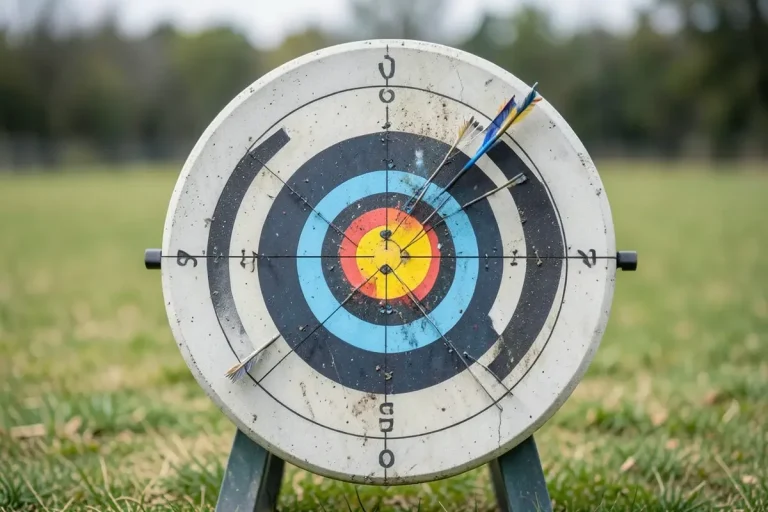
Olympic Archery Scoring: Ring Values & Point System
Olympic archery scoring is a points-based system where archers earn points by hitting rings on a target. The closer an arrow lands to the center (gold ring), the higher the score, with a bullseye earning the maximum 10 points. It’s a straightforward, proven system designed for fairness and excitement.

White Water Archery
White Water Archery 3D Scoring Bi Color…
- Sold in 9 pc packs.
- 3d scoring ring decals are the standard 5″ size for all the major competition with a 1.5″ center bullseye.
As an Amazon Associate I earn from qualifying purchases.
For a closely related bow or archery topic, How to Train for Olympic Archery: A , Essential gives readers a useful next step.
Welcome, fellow archery enthusiasts! Have you ever watched the Olympics and wondered how those archers rack up such impressive scores? It might seem complicated with all those rings and precise shots, but the scoring system in Olympic archery is actually quite straightforward once you break it down. Many beginners find themselves a bit puzzled by it, and that’s totally normal! My goal is to make it crystal clear for you, so you can understand the game and even apply some of these principles to your own practice sessions. For a full breakdown of exactly how many rings a standard target has and what each one is worth, see our guide to archery target rings.
We’ll walk through exactly how the points are awarded, from the outer rings to the bullseye. By the end of this guide, you’ll have a solid grasp of the “proven system” that drives Olympic archery. Get ready to demystify those scores and feel more connected to the sport!
The Heart of Olympic Archery: The Target Face
At the core of understanding Olympic archery scoring is the target itself. It’s not just a big circle; it’s a precisely marked face designed to differentiate scores accurately. The official target used in Olympic archery is a familiar sight: a circular face divided into ten concentric rings. Each ring corresponds to a specific point value, making it clear how well an archer has performed with each shot.
These rings are painted in distinct colors, which helps archers and spectators alike quickly identify where an arrow has landed. The larger rings are typically wider and worth fewer points, while the smaller, inner rings are narrower and offer higher scores. This design encourages precision and rewards those who can consistently aim for the center.
The size and layout of the target are governed by strict international federation rules, ensuring consistency across all competitions. This standardization is crucial for fair play and accurate record-keeping. For instance, the World Archery Federation (formerly FITA) defines the exact dimensions and color zones for the official target faces used in Olympic events.
Understanding the Rings and Their Values
The scoring zones are probably the most important part of the entire system. Let’s break down what each ring means in terms of points:
- Gold Rings (9 and 10 points): The very center of the target is the gold zone. This is the bullseye, and it’s divided into two rings. The inner-most ring, the precise center, is worth 10 points. The ring immediately surrounding it is worth 9 points. Hitting the gold is every archer’s goal!
- Red Rings (7 and 8 points): Surrounding the gold is the red zone, also divided into two rings. The inner red ring scores 8 points, and the outer red ring scores 7 points.
- Blue Rings (5 and 6 points): Next out from the red is the blue zone, again split into two rings. The inner blue ring awards 6 points, and the outer blue ring scores 5 points.
- Black Rings (3 and 4 points): The black zone follows the blue. The inner black ring is worth 4 points, and the outer black ring is worth 3 points.
- White Rings (1 and 2 points): The outermost scoring area is the white zone, also divided into two rings. The inner white ring scores 2 points, and the outermost ring, worth 1 point, is the last scoring area on the target.
Any arrow that misses the target entirely, or lands outside the white ring, scores 0 points. The aim is to get as many arrows as possible into the higher-scoring gold and red zones.
The Target Dimensions
For those who love the specifics, here’s a look at the official target dimensions as set by World Archery, which are used in all Olympic competitions. These measurements are for the standard 122 cm target face:
| Ring Color | Point Value | Diameter (cm) | Width from Inner Edge (cm) |
|---|---|---|---|
| Gold (inner) | 10 | 12.2 cm | 6.1 cm |
| Gold (outer) | 9 | 24.4 cm | 12.2 cm |
| Red (inner) | 8 | 36.6 cm | 12.2 cm |
| Red (outer) | 7 | 48.8 cm | 12.2 cm |
| Blue (inner) | 6 | 61.0 cm | 12.2 cm |
| Blue (outer) | 5 | 73.2 cm | 12.2 cm |
| Black (inner) | 4 | 85.4 cm | 12.2 cm |
| Black (outer) | 3 | 97.6 cm | 12.2 cm |
| White (inner) | 2 | 109.8 cm | 12.2 cm |
| White (outer) | 1 | 122.0 cm | 12.2 cm |
As you can see, each color band is 12.2 cm wide, except for the gold zone, which is divided exactly in half to create the 10 and 9 point rings. This consistent ring width is important for maintaining the difficulty and fairness of the target. You can also find smaller target faces for different distances, like the 80cm or 60cm targets, which have proportionally adjusted ring sizes but the same point values.

The Competition Format: How Scoring is Applied
Olympic archery isn’t just about shooting one arrow; it’s a series of matches and rounds, each with its own way of accumulating scores. The scoring system is applied differently depending on the event type. The two main Olympic archery events are the individual recurve competition and the team recurve competition. Mixed team events are also becoming more prominent.
Understanding these formats helps you see how individual arrow scores turn into winning results. It’s about consistency and performing under pressure, shot after shot.
Individual Recurve vs. Team Recurve
In the individual recurve event, each archer shoots a set number of arrows in a match. The scores from these arrows are tallied to determine the winner of a set or match. Team events involve multiple archers shooting, with their scores often combined.
The Matchplay System (Sets Scoring)
For the elimination rounds of Olympic archery (both individual and team), a “set scoring” system is used. This makes matches more dynamic and potentially quicker to conclude than simply tallying total points. Here’s how it generally works:
- Archers shoot a specific number of arrows (e.g., 3 arrows per archer in an individual match, 6 arrows per team in a team match) per set.
- After each set, the archer or team with the higher score for that set wins the set and earns points towards the match.
- If archers A and B shoot 3 arrows each in a set:
- Archer A scores 9, 8, 10 = 27 points.
- Archer B scores 10, 9, 9 = 28 points.
In this example, Archer B wins the set and gets 2 set points. Archer A gets 0 set points.
- If scores are tied within a set, both archers/teams receive 1 set point.
- The first archer or team to reach a certain number of set points (usually 6 or 7, depending on the round) wins the match.
This set system encourages archers to perform well consistently throughout the match, rather than relying on one huge score. A single bad set doesn’t mean the match is lost, but multiple low-scoring sets can lead to a loss.
The Ranking Round (Total Score)
Before the matchplay begins, there’s the Ranking Round. This is where the scoring system as pure points really comes into play. In this round, archers shoot a total of 72 arrows (spread across two days of shooting for qualification purposes). The total score from these 72 arrows determines the initial rankings for the subsequent elimination rounds.
For example, if an archer shoots 70 arrows for 10 points each and 2 arrows for 9 points, their total score would be (70 10) + (2 9) = 700 + 18 = 718 points. The archer with the highest total score in the Ranking Round gets the top seed.
Tie-Breaking Procedures: Ensuring Fairness
What happens when scores are incredibly close? Olympic archery has a well-defined system for breaking ties, ensuring that every match has a definitive winner. This is particularly important in both the Ranking Round and during matchplay if a tie occurs that needs resolution.
Ranking Round Tie-Breakers
| Scenario | Tie-Breaking Method | Explanation |
|---|---|---|
| Total Score Tie | Number of 10s (including inner 10s/bullseyes) | The archer with more 10-point shots wins. If still tied, move to the next step. |
| Still Tied | Number of 9s | The archer with more 9-point shots wins. |
| Still Tied (rare) | Shoot-off | Both archers shoot one arrow at a designated target. The archer whose arrow is closest to the center wins. Measurement to the center is taken from the closest edge of the arrow hole. |
The “inner 10s” or “X” shots are crucial here. This is a specific mark within the center of the 10-point ring. While it doesn’t award extra points, it acts as a tie-breaker. If two archers have the same total score and the same number of 10s, the one with more inner 10s wins. Find more details on the official rules and scoring at the World Archery website.
Matchplay Tie-Breakers (The Shoot-Off)
In the set scoring system, if a match ends in a tie after the allocated sets, a sudden-death shoot-off occurs. This is pure drama!
- Both archers (or teams) shoot one arrow.
- The archer whose arrow lands closest to the center of the target wins the match.
- If the arrows are equidistant from the center, a second shoot-off arrow is taken. This continues until a winner is determined.
This sudden-death shoot-off is incredibly tense and highlights the archers’ ability to perform under extreme pressure. It’s a fantastic spectacle for viewers and ensures that even the closest matches are resolved decisively.
Key Takeaways for Beginners
So, what does all this mean for you as a beginner archer? The Olympic scoring system, while detailed, offers some great lessons and goals for your own archery journey.
- Aim for the Center: Just like the pros, your goal should always be to hit the highest scoring areas. Even if you’re not hitting the bullseye consistently, every shot towards the gold is a step in the right direction.
- Consistency is King: The matchplay system shows that hitting a solid score repeatedly is often more important than one spectacular shot. Work on developing a consistent shooting form.
- Understand the Target: Familiarize yourself with the rings and their values. This mental picture can help you judge your shots and set realistic goals.
- Practice with Scoring in Mind: Even when you’re just practicing at your local range, try scoring your arrows. This simulates the pressure and focus required in competition and helps you track your progress.
- Don’t Fear the 10 (or X)!: The “X” mark on the target is the inner bullseye. While it doesn’t add points, it’s a clear indicator of excellent precision and a satisfying shot for any archer.
Remember, every Olympic archer started as a beginner, likely feeling a bit confused about the scoring. By breaking it down and focusing on practice, you’ll develop your own understanding and skill. Enjoy the process!

Frequently Asked Questions (FAQ) About Olympic Archery Scoring
Q1: What is the highest score possible in Olympic archery?
A1: The highest score for a single arrow is 10 points, achieved by hitting the inner gold ring (the bullseye). In the Ranking Round, where archers shoot 72 arrows, the theoretical maximum score is 720 points (72 arrows x 10 points each). In matchplay, scoring is based on winning sets, so there isn’t a single “total score” to win the match, but rather winning sets (usually 6 sets to win).
Q2: What is the ‘X’ ring in archery scoring?
A2: The ‘X’ ring, officially called the inner 10 ring, is a smaller circle within the center 10-point gold ring. It doesn’t award extra points but is used as a tie-breaker. If two archers have the same total score and the same number of 10s, the archer with more ‘X’s wins.
Q3: How many arrows do archers shoot in the Olympic Ranking Round?
A3: In the Olympic Ranking Round, each archer shoots a total of 72 arrows. This is typically done over two days to ensure fair conditions.
Q4: How is a winner determined in an Olympic archery match?
A4: Olympic archery matches (after the Ranking Round) use a set system. Archers/teams win sets by scoring higher than their opponent in a given set of arrows. The first to reach a target number of set points (usually 6 or 7) wins the match. If scores are tied, a shoot-off occurs.
Q5: What happens if an arrow hits the line between two rings?
A5: If an arrow hits the line between two scoring rings, it is always awarded the higher of the two scores. This rule ensures that precisely shot arrows on the edge of a ring are fairly rewarded.
Q6: Do teams in the team event have a different scoring system than individuals?
A6: The scoring system itself (points per ring) is the same. The difference is how the arrows are shot and counted. In a team match, each team member shoots a certain number of arrows per set (e.g., 6 shots total per team per set, with each archer shooting 3). The total score for the team in that set is then compared to the opponent’s team score to determine who wins the set point.
Conclusion: Your Path to Understanding Olympic Archery
We’ve journeyed through the detailed world of Olympic archery scoring, from the distinct rings on the target face to the dramatic set-scoring system and precise tie-breakers. It’s a system built on clarity, fairness, and the pursuit of perfect precision. Whether you’re watching the next Games or just starting your own archery adventure, understanding how scores are earned brings a whole new level of appreciation to the sport.
Remember that at its heart, Olympic archery scoring is about rewarding the archer who demonstrates the greatest accuracy and consistency. Each ring represents a challenge, and the cumulative scores tell a story of skill, focus, and nerve. For beginners, this translates into invaluable lessons: prioritize accuracy, build consistency, and always strive for improvement. Embrace the practice, understand the target, and most importantly, enjoy the satisfying thwack of an arrow hitting true. Keep shooting, keep learning, and you’ll find your own scores improving with every practice session!
Related pick: Check today's price on Amazon