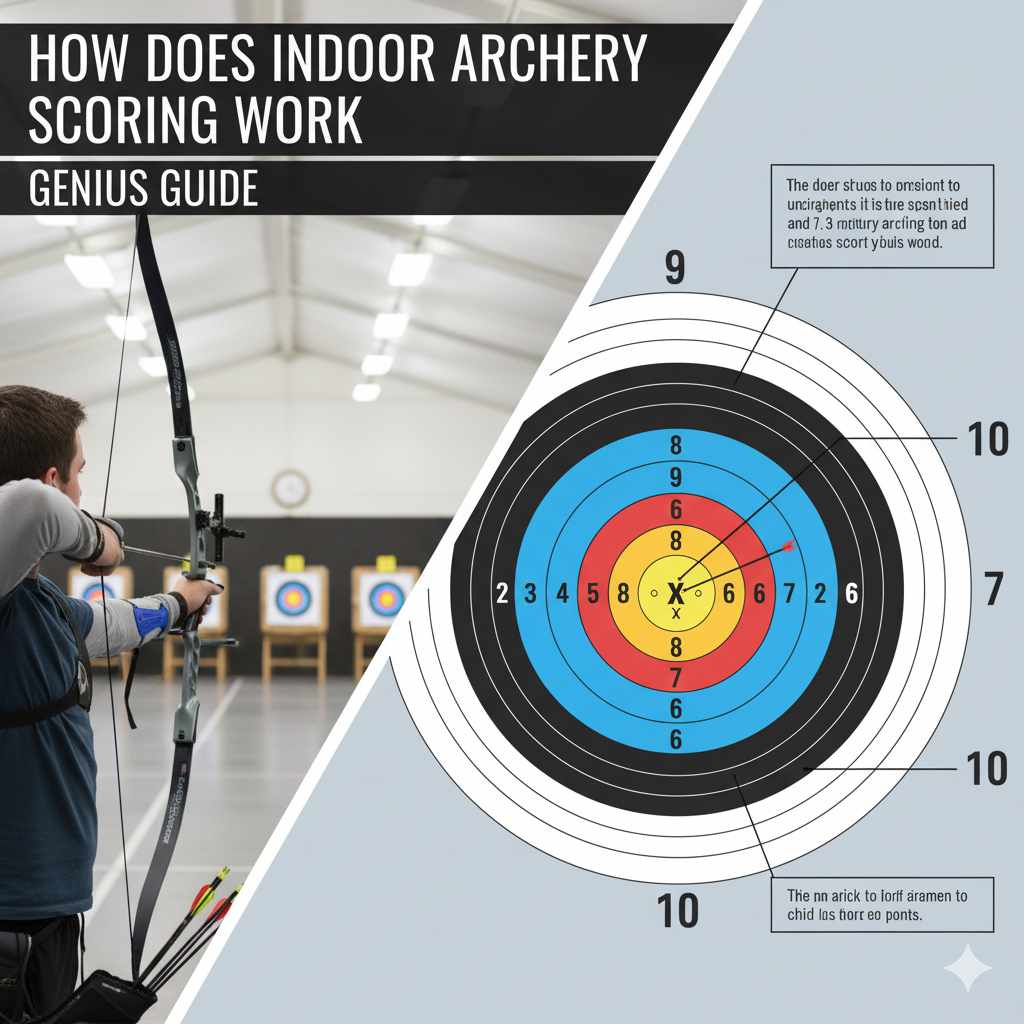
How Does Indoor Archery Scoring Work? The Full Rules
Indoor archery scoring is straightforward once you know the target rings and how points are awarded. You simply count the arrows that hit the scoring zones, assigning points based on the ring color and position. The highest scores come from hitting the center gold rings, with points decreasing as you move outward to red, blue, black, and white.
For a closely related bow or archery topic, How To Have Indoor Archery Contest Kids gives readers a useful next step.
Welcome, fellow archers! Ever wondered how those scores on the indoor range are tallied up? It can seem a bit mysterious at first, with all those colorful rings on the target face. But don’t let it worry you! Understanding indoor archery scoring is actually quite simple and opens up a whole new level of fun and competition for your practice sessions.
Knowing how scoring works helps you set realistic goals, track your progress, and even understand the results when you watch professional tournaments. It turns a casual shoot into a rewarding challenge. We’ll break it down step-by-step, so you can confidently track your shots and celebrate your improvements.
Ready to decode the target and master your indoor archery score? Let’s get started!
Understanding the Indoor Archery Target Face
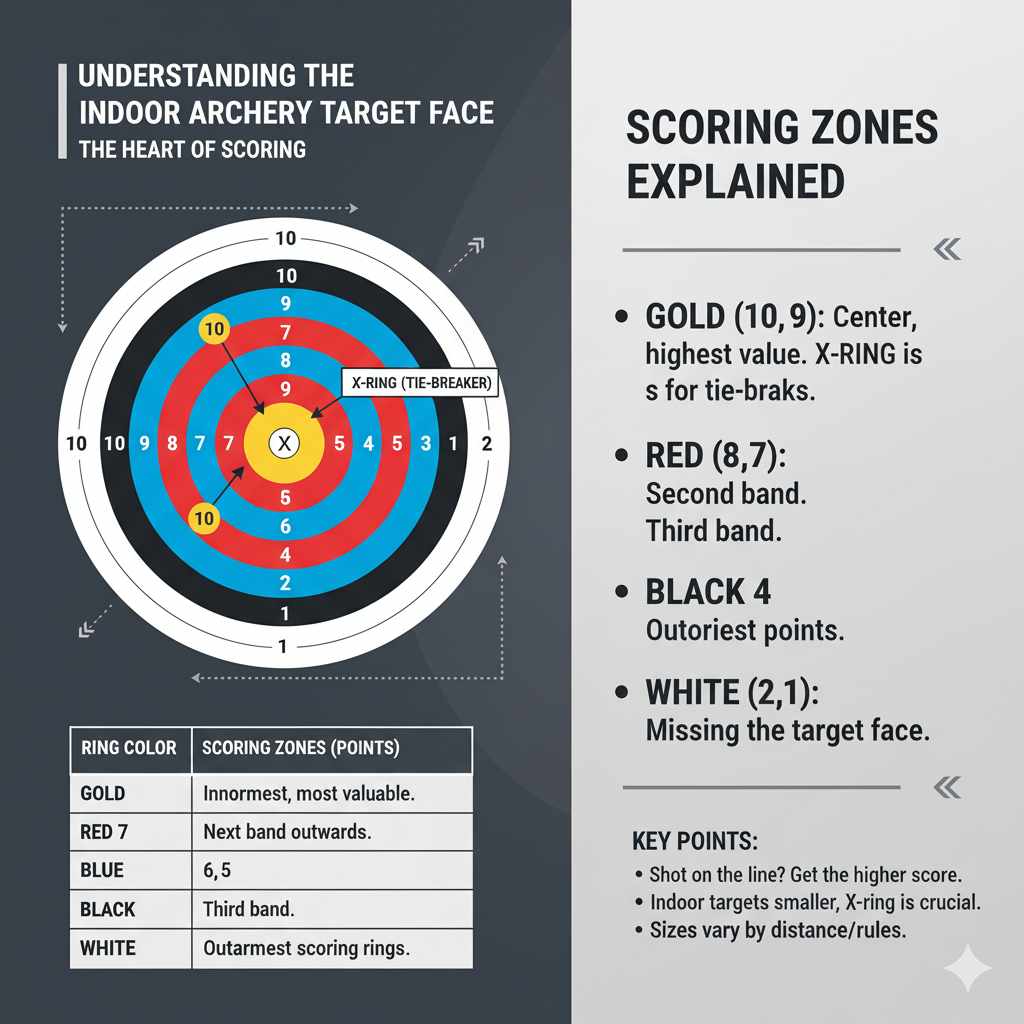
The heart of indoor archery scoring is the target face itself. Think of it as a bullseye with layers, each layer representing a different score. These targets are standardized to ensure fair competition, whether you’re shooting at your local club or in a major event.
Indoor archery targets are typically round and divided into concentric rings. These rings are colored in a specific order, moving from the center outwards. Each color represents a different point value. The outermost rings might seem less important, but every arrow counts towards your final score!
The standard FITA (now World Archery) target face for indoor use has 10 scoring zones. These zones are arranged in bands: a central gold area (10 and 9 points), followed by red (8 and 7 points), blue (6 and 5 points), black (4 and 3 points), and finally white (2 and 1 point).
| Ring Color | Scoring Zones (Points) | Description |
|---|---|---|
| Gold | 10, 9 | The innermost rings, closest to the absolute center. These are the most valuable. |
| Red | 8, 7 | The next band outward from the gold. |
| Blue | 6, 5 | The third band from the center. |
| Black | 4, 3 | The fourth band from the center. |
| White | 2, 1 | The outermost scoring rings on the target. |
The exact size of these rings depends on the specific distance and competition rules, but the point value associated with each ring remains consistent. For instance, a shot landing precisely on the line between a 9 and a 10 is typically awarded the higher score of 10. This is a common point of discussion among archers!
What About the X-Ring?
You might also hear about an “X-ring.” This is a smaller, inner circle within the 10-point gold ring. While it doesn’t add extra points to your score (it’s still a 10), it’s used as a tie-breaker. If two archers have the same total score, the one with more X’s wins. It signifies a shot very close to the absolute center.
| Location on Target | Points Awarded |
|---|---|
| Innermost Gold (X-Ring) | 10 (used for tie-breakers) |
| Outer Gold | 10 |
| Inner Red | 9 |
| Outer Red | 8 |
| Inner Blue | 7 |
| Outer Blue | 6 |
| Inner Black | 5 |
| Outer Black | 4 |
| Inner White | 3 |
| Outer White | 2 |
| Very Edge of White Ring / Missing Target | 0 |
The Difference Between Indoor and Outdoor Targets
It’s important to note that indoor targets often differ slightly from outdoor targets. Indoor targets are generally smaller, and the “11-ring” (or X-ring) is a more critical tie-breaker. Outdoor targets might have more rings or different color distributions depending on the discipline.
For indoor archery, the target face size is usually specified by the rules of the governing body holding the competition. For example, World Archery specifies a 40cm target face for indoor recurve at 18 meters, with 10 scoring zones plus the X-ring.
The Scoring Process Step-by-Step
Now that you understand the target, let’s walk through how scoring actually happens during an indoor archery session. It’s a methodical process designed for accuracy and fairness.
1. Firing the Arrows
Archers typically shoot in “ends,” which are specific numbers of arrows shot at a time. For indoor competitions, an end is usually three or six arrows. You’ll shoot your end, and then your group will advance to the target to score.
2. Identifying Hits and Misses
Once all arrows for an end have been shot, archers (or designated scorers) approach the target carefully. The first step is to note any arrows that completely missed the scoring area. These arrows score zero points.
3. Reading the Scores
For arrows that hit the target, the scoring is done by identifying the ring each arrow has penetrated. An arrow is awarded the score of the highest value ring it touches. This is crucial: if an arrow is touching the line between a 9 and a 10, it scores a 10.
To avoid confusion and ensure accuracy, archers often have specific ways to check. If an arrow is on a line, it’s common practice for the archer closest to it to call out the score, and then other archers verify. Sometimes, a special tool called an “arrow gauge” or “marker” is used to indicate the scored ring without dislodging the arrow. This tool is often a small, pointed device that rests against the arrow shaft to show which ring it scored in.
The X-ring is marked separately using the same method. An ‘X’ is typically noted next to the score of 10 if the arrow is within the X-ring.
4. Recording Scores
Each archer or team has a score sheet. After discussing and agreeing on the score for each arrow in an end, the scores are recorded. For example, if you shot six arrows and they landed in the 7, 8, 9, 10, X (which counts as 10), and 7 rings, your score for that end would be 7 + 8 + 9 + 10 + 10 + 7 = 51.
5. Totaling the Score
This process is repeated for all the ends shot during the session or competition. At the end of shooting, all the end scores are added together to give a total cumulative score. This final number is what determines your ranking.
Key Aspects of Indoor Archery Scoring
Beyond the basic ring values, a few other elements are important to understand about indoor archery scoring. These details ensure fairness and contribute to the organized nature of the sport.
Judging Ring Contacts
As mentioned, when an arrow touches a line, it gets the higher score. This is a fundamental rule. Scorers are trained to be precise. If there’s any doubt, a ruler or a specialized scoring tool might be used. Officials are usually present to make final decisions in official competitions.
The Role of the X-Ring
The X-ring is exclusively for tie-breaking. It’s a mark of exceptional accuracy. If you and another archer tie for the highest score, the archer with more X’s is ranked higher. This incentivizes shooting for the absolute center, even when a 10 is already secured.
Arrow Removal and Scoring Order
In many settings, arrows are removed sequentially, starting from the highest scoring end, to prevent accidental scoring errors. This often happens after all arrows have been counted. Some rules might stipulate that arrows must remain in the target until all scoring for an end is complete and verified.
“Touching” vs. “Entering”
An arrow technically “enters” a ring if any part of its body has penetrated that ring’s scoring area. This is why a slight touch on the line counts for the higher score. The arrow’s shaft is the part that determines the score in most cases.
Equipment Checks
While not directly about scoring, it’s worth noting that in official competitions, equipment checks (like bow weight and arrow specifications) happen beforehand. This ensures everyone is competing under the same conditions, making the scoring truly about skill.
Common Scoring Systems and Variations
While the core principle of rings and points is universal, different organizations and types of archery might have slight variations in their scoring systems. For beginners, understanding the most common system is key.
World Archery (Olympic Style)
This is the most recognized international standard, used in the Olympics and major championships. It uses the 10-ring system described earlier (10 down to 1, plus the X-ring for tie-breakers). The target faces vary in size depending on the distance, with 18 meters being common for indoor events. The target is often a five-color face with 10 scoring zones.
National Field Archery Association (NFAA)
The NFAA has its own set of rules, often used in field archery and some indoor tournaments. Their scoring can be different, sometimes involving a target with more rings, or even a “blue-black” dividing line that signifies a lower score boundary. For a standard NFAA indoor target, there are 5 scoring colors: gold (5-4), red (3-2), and blue (1). A blue-black line divides the 1-point zone.
For beginners practicing indoors, sticking to the World Archery target face (10 rings + X) is usually the most straightforward and widely applicable system. Many local clubs and indoor ranges will use this standard for their casual leagues and practice days.
What to Do If You Shoot Through a Nother Archer’s Arrow
This is a rare but possible scenario, especially with many archers on a line. If your arrow passes through another arrow, potentially damaging it or the target, the rules typically state that the archer whose turn it is gets a re-shoot, receiving the score of the arrow that was shot through. The arrow that was damaged or shot through, depending on the exact rules, might be scored as it lies or is awarded the maximum score for that target. This is why maintaining safe shooting distances and procedures is paramount.
Tips for Improving Your Score
Now that you’re a pro at understanding the scores, let’s talk about how to get more of them! Improving your score is all about consistent technique, focus, and practice. Here are some tips to help you climb that score ladder.
- Focus on Form: A consistent stance, draw, anchor, and release are the foundation of accuracy. Even slight variations can send your arrow off course.
- Breathing: Learn to control your breath. Typically, archers take a deep breath, exhale partially, hold it briefly during the shot, and then exhale fully after the release.
- Aiming: Practice aiming for a specific spot within the highest scoring rings. Don’t just aim for “the middle.” Aim for the center of the 10-ring or even the X-ring.
- Follow-Through: After releasing the arrow, keep your bow arm steady and your release hand in place until the arrow hits the target. This ensures a clean release.
- Equipment Tuning: Make sure your bow is properly tuned. An out-of-tune bow can cause arrows to fly erratically. Sometimes, adjusting your sights or the rest can make a big difference. For more on this, you might find resources on bow tuning from organizations like USA Archery helpful at USA Archery.
- Mental Game: Stay calm and focused. Don’t get discouraged by a few bad shots. Every arrow is a new opportunity.
- Practice Regularly: The more you shoot, the more consistent you become. Aim for quality practice over quantity – focus on making every shot count.
- Analyze Your Shots: After each end, look at where your arrows landed. If they’re consistently high and left, for example, you might need to adjust your sight or your form.

Frequently Asked Questions about Indoor Archery Scoring
Here are some common questions beginners have about how indoor archery scores are calculated:
What is the highest possible score in indoor archery?
The highest score depends on the number of arrows shot. For a single arrow, the maximum is 10 points (plus an X). If you shoot six arrows in an end, the maximum is 60 points (plus 6 X’s). In a competition with multiple ends, the total score is calculated by summing up the scores from all ends.
Do I need special equipment to score indoor archery?
No, not necessarily. For casual shooting, a pen and paper for your score sheet are enough. In official tournaments, specialized scoring tools (like gauges or markers) are sometimes used for accuracy and to avoid disturbing arrows. Most importantly, you need focus and a good understanding of the target rings.
What if my arrow splits another arrow?
If your arrow passes through another arrow, potentially causing damage, the rules usually allow for a “re-shoot” of the affected arrow. You would shoot another arrow, and it would be scored. The arrow that was shot through might be scored as found or given a maximum score, depending on the specific competition rules.
How do I know if an arrow is on the line?
An arrow is generally considered to be on the line if any part of its shaft is touching the higher-scoring ring. If there’s ambiguity, the arrow is typically awarded the higher score. Referees or experienced archers often make the final call in official settings.
Does the X-ring count as 11 points?
No, the X-ring does not add an extra point. It is still a 10-point score. The X is solely used for tie-breaking purposes in competitions where two or more archers have the same total score.
Can I accidentally move an arrow while scoring?
Yes, this is why careful procedures are followed. In official scoring, arrows are often not removed until scores are verified. If an arrow is dislodged or its score is altered accidentally, the arrow is usually awarded the maximum score for that target, or a designated score by an official.
What are the common distances for indoor archery?
The most common distance for indoor archery is 18 meters (about 59 feet). This distance is standard for many indoor tournaments, including those sanctioned by World Archery. Other distances may be used for specific events or practice.
Conclusion
Mastering indoor archery scoring is a rewarding part of your archery journey. It transforms your shooting from just hitting a target into a precise skill that can be measured and improved. By understanding the colorful rings, the point values, and the simple process of tallying scores, you can approach your next indoor session with newfound confidence.
Remember, the gold rings are where the highest scores reside, but every arrow in the white rings still contributes to your total. The X-ring offers bragging rights and crucial tie-breaking potential for those aiming for perfection. Use this knowledge to set your own scoring goals, track your progress, and celebrate every improvement.
So grab your bow, head to the range, and apply what you’ve learned. Focus on your form, aim true, and enjoy the satisfying challenge of indoor archery. Happy shooting!