
How to Add a Scholarship After Financial Aid Is Released
Adding a scholarship after financial aid is released can seem complex, but it’s a crucial step for many students to reduce their out-of-pocket costs. This process ensures that your financial aid package accurately reflects all your available funding, which can lead to adjustments in grants, loans, or even work-study awards. Understanding how to navigate these changes is key to maximizing your educational benefits and minimizing debt.
This guide will walk you through the essential steps, common scenarios, and important considerations when a new scholarship enters the picture post-initial aid disbursement. We’ll cover how to report the scholarship, potential impacts on your existing aid, and what to do if you encounter issues.
Simply put, you need to formally notify your college’s financial aid office about any new scholarships you receive. This allows them to update your aid package, potentially reducing loans or grants you no longer need and ensuring you don’t exceed your cost of attendance. Prompt communication is vital to avoid aid recalculations or unexpected bills.
Key Takeaways
- Report all new scholarships immediately to your college’s financial aid office to update your financial aid package.
- Adding a scholarship after financial aid is released may lead to a reduction in other forms of aid, such as grants or loans, to stay within your cost of attendance.
- Understand your school’s specific policies regarding outside scholarships and how they are applied.
- Keep meticulous records of all scholarship applications, award letters, and communication with your financial aid office.
- Proactive communication and organization are essential to manage the financial aid adjustment process smoothly.
What is a Scholarship and Why Does It Matter?
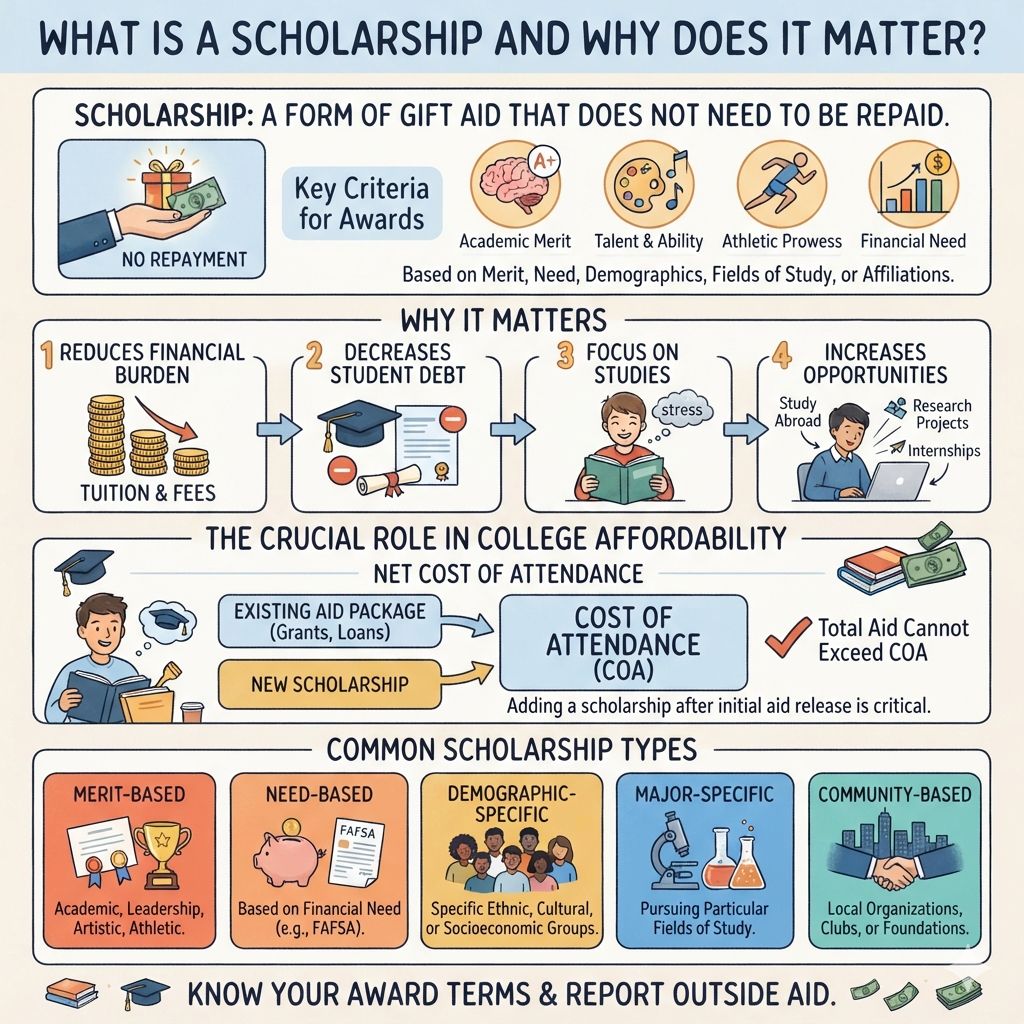
A scholarship is essentially a form of gift aid, meaning it does not need to be repaid. It’s typically awarded based on merit (academic achievement, talent, athletic ability) or need, although some scholarships are based on specific demographics, fields of study, or affiliations. These awards are a cornerstone of college affordability for many students, significantly reducing the financial burden of higher education.
The impact of receiving a scholarship extends beyond simply lowering the total cost of tuition and fees. It can influence a student’s ability to focus on their studies rather than worrying about finances, open doors to opportunities they might not otherwise afford, and ultimately reduce the amount of student loan debt they graduate with. For students relying on financial aid, a new scholarship can be a game-changer.
The primary reason a scholarship matters so much is its direct effect on your net cost of attendance. When a scholarship is awarded, it’s added to your existing financial aid package. However, institutions are generally required to ensure that your total aid—including scholarships, grants, loans, and work-study—does not exceed your total cost of attendance (COA).
This is where the process of adding a scholarship after initial aid release becomes critical.
- Merit-Based Scholarships: Awarded for academic excellence, leadership, artistic talent, or athletic prowess.
- Need-Based Scholarships: Awarded to students who demonstrate financial need, often determined by FAFSA information.
- Demographic-Specific Scholarships: For students belonging to certain ethnic, cultural, or socioeconomic groups.
- Major-Specific Scholarships: For students pursuing particular fields of study.
- Community-Based Scholarships: Often from local organizations, clubs, or foundations, focusing on community impact or local ties.
Understanding the type of scholarship you’ve received is the first step. Each type might have different reporting requirements or considerations for how it interacts with your existing aid. Always review the terms and conditions of your scholarship award carefully.
How to Report Your New Scholarship to Your College
The most critical step after receiving a scholarship award letter is to formally notify your college’s financial aid office. This isn’t something you can assume they know; you must proactively communicate this information. Most institutions have a designated process for reporting outside scholarships to ensure accurate aid adjustments.
Start by checking your college’s financial aid website. Look for a section on “Outside Scholarships,” “External Awards,” or “Reporting Scholarships.” This page will typically outline the specific steps required. Often, it involves filling out a form and submitting a copy of your official scholarship award letter.
The award letter is your proof of the scholarship and its terms.
Important: Do not delay in reporting your scholarship. The sooner you inform the financial aid office, the sooner they can make the necessary adjustments to your aid package, preventing potential overpayments or issues with your student account.
When filling out any required forms, be precise and complete. Include the full name of the scholarship, the awarding organization, the amount awarded, and how the funds are to be disbursed (e.g., directly to the school, to you, or split). This information helps the financial aid office accurately process the award and its impact on your overall financial picture.
Required Documentation
Most colleges will require specific documentation to process your outside scholarship. Having these ready can expedite the process:
- Official Scholarship Award Letter: This is the most important document. It must be on the awarding organization’s letterhead and clearly state the scholarship name, amount, award period, and recipient’s name.
- Scholarship Check (if applicable): If the scholarship check is made payable to the college, you may need to submit it along with other forms. If it’s made payable to you, you’ll still need to report it.
- Completed Scholarship Reporting Form: Many schools provide a specific form for students to report outside awards.
- Tax Information (if applicable): In some rare cases, particularly for non-tuition expenses, tax implications might arise, though this is usually handled after graduation or if the scholarship is unusually large.
The financial aid office will review the documentation and determine how the scholarship funds will be applied. This review ensures compliance with federal regulations (like Title IV) and institutional policies. They will then update your student account and financial aid summary.
Understanding the Impact on Your Financial Aid Package
When you add a scholarship after your initial financial aid has been released, the college’s financial aid office must re-evaluate your package. This is because financial aid is designed to cover your “cost of attendance” (COA), which includes tuition, fees, room and board, books, supplies, transportation, and personal expenses. Scholarships are considered resources that offset this cost.
The general rule is that your total financial aid cannot exceed your COA. If the addition of your new scholarship pushes your total aid package over this limit, the college is required to make adjustments. This usually means reducing other forms of financial aid that you receive.
The order of reduction typically follows a hierarchy dictated by federal regulations and institutional policy.
Warning: Be prepared for potential reductions in your existing financial aid. While a scholarship is excellent news, it doesn’t automatically mean more money in your pocket; it means your overall financial picture has changed, and aid must be balanced.
The goal of this re-evaluation is to ensure fair distribution of aid and prevent students from receiving more aid than they need to attend college. It also ensures that federal aid programs are used appropriately. Understanding this process helps manage expectations and avoid surprises when your financial aid status is updated.
The Hierarchy of Aid Reductions
While specific policies can vary slightly by institution, the general order in which financial aid is reduced when a new scholarship is added is as follows:
- Self-Help Aid: This typically includes student loans (both federal and private) and Federal Work-Study awards. These are often the first to be reduced or eliminated because they represent funds that must be repaid or earned.
- Institutional Grants and Scholarships: Aid provided directly by the college itself, such as merit or need-based scholarships offered by the university, may be reduced.
- Federal and State Grants: Pell Grants, Federal Supplemental Educational Opportunity Grants (FSEOG), and state-specific grants are generally reduced last, as they are need-based and crucial for affordability. However, they can still be adjusted if the COA is exceeded.
It’s important to note that the intention of a scholarship is to reduce the student’s debt burden. Therefore, the reduction in loans is often seen as a positive outcome, as it means less money to repay after graduation. However, if your goal was to use loans for living expenses beyond tuition, this adjustment might require a change in your budget.
Scenario Examples
Let’s look at a couple of common scenarios to illustrate how adding a scholarship can affect your aid:
| Scenario | Details |
|---|---|
| Scenario 1: Scholarship Covers Remaining Balance | A student has $20,000 in COA. Their initial aid package includes $10,000 in federal grants and $8,000 in federal loans, leaving a $2,000 balance. They receive a $2,000 outside scholarship. After reporting it, the scholarship covers the remaining balance. The $8,000 federal loan may be reduced or eliminated. |
| Scenario 2: Scholarship Exceeds COA Needs | A student has a COA of $25,000. Their initial package includes $15,000 in grants and $7,000 in loans, leaving a $3,000 balance. They then receive a $4,000 scholarship. The scholarship is applied first to the $3,000 balance. The remaining $1,000 from the scholarship ($4,000 – $3,000) will likely cause a reduction in the federal grants, bringing the total aid back down to $25,000. |
These examples highlight why accurate reporting and understanding of COA are so important. The financial aid office works to balance these components to meet your educational costs without over-awarding.
What to Do If Your Scholarship Check is Mailed Directly to You
Sometimes, scholarship checks are issued directly to the student, rather than to the college. This is common for scholarships where the funds are intended for broader use, such as living expenses, books, or other costs not fully covered by tuition and fees. Even if the check is made out to you, you are still required to report the scholarship to your financial aid office.
Your college will likely require you to endorse the check and then submit it to their financial aid or bursar’s office. They will then apply the funds to your student account first. Any portion of the scholarship that exceeds your outstanding balance (tuition, fees, room, board) will then be refunded to you.
This refund can be used for other educational expenses like books, supplies, or living costs.
Tip: When you receive a scholarship check made out to you, the first step should always be to contact your financial aid office. They will guide you on the proper procedure for handling and submitting the funds to ensure your financial aid remains in compliance.
The process ensures that the scholarship funds are accounted for within your overall financial aid package and that you receive any remaining balance for eligible expenses. Mismanaging a scholarship check, even one made out to you, can lead to serious consequences, including the suspension of your federal financial aid.
Disbursement Timing and Your Student Account
The timing of scholarship disbursement can also affect your financial situation. Some scholarships disburse funds directly to the college for a specific academic year, while others might be disbursed in installments each semester or quarter. Understand the disbursement schedule from your scholarship provider.
Once the financial aid office receives and processes your scholarship, they will update your student account. This update should reflect the new scholarship amount and any corresponding adjustments to grants or loans. You should be able to see this reflected in your online student portal or financial aid summary.
Always verify these updates to ensure accuracy.
- Check Your Student Portal Regularly: Most colleges provide an online portal where you can view your financial aid status, account balance, and transaction history.
- Review Updated Award Letters: After processing, you may receive an updated financial aid award letter reflecting the changes.
- Communicate Any Discrepancies: If you notice any errors or don’t see the expected adjustments, contact the financial aid office immediately.
Understanding the flow of funds from the scholarship provider to your student account and then to your financial aid package is key to managing your finances effectively throughout the academic year.
When Does Adding a Scholarship Trigger a Refund?
A refund from your financial aid package typically occurs when the total amount of financial aid disbursed to your student account exceeds the direct charges on your account for tuition, fees, and sometimes room and board. This most commonly happens when a scholarship award is applied, and it, along with other grants and loans, fully covers all institutional charges, leaving a surplus.
For instance, if your total tuition and fees are $15,000, but your combined federal grants and a new scholarship total $17,000, the $2,000 difference will be disbursed to you as a refund. This refund is intended to help cover indirect costs associated with attending college, such as books, supplies, transportation, and personal living expenses. Colleges usually have specific policies on when and how these refunds are issued.
It’s crucial to use these refunds wisely. They are still considered part of your financial aid package, and while they don’t need to be repaid like loans, they should be allocated towards educational expenses. Misusing refund money can lead to issues with future financial aid eligibility.
How Refunds Are Processed
The refund process is managed by the college’s business office or bursar’s office, often in coordination with the financial aid department. Here’s a general outline:
- Aid Disbursement: Financial aid funds (including scholarships, grants, and loans) are disbursed directly to your student account to cover institutional charges.
- Account Balance Calculation: The college calculates your account balance after all aid has been applied.
- Refund Determination: If the disbursed aid exceeds the charges, a refund is generated.
- Refund Issuance: Refunds are typically issued via direct deposit (if you’ve set it up) or a paper check. Direct deposit is usually faster and more secure.
The timing of refund issuance can vary. It usually occurs after the add/drop period has ended for the semester, ensuring all enrollment changes have been finalized. This prevents potential overpayments if your enrollment status changes.
Managing Your Refund
Receiving a financial aid refund can provide much-needed cash flow for living expenses. However, responsible management is key:
- Prioritize Educational Expenses: Use the refund primarily for books, supplies, technology, transportation, and other costs directly related to your studies.
- Budget Carefully: Create a budget to track your spending and ensure the funds last throughout the semester.
- Avoid Non-Essential Purchases: While tempting, try to avoid using refund money for discretionary items or significant purchases unrelated to your education.
- Save for Future Needs: If possible, save a portion of the refund for unexpected expenses or future semester costs.
If you receive a refund and still have unmet financial needs or wish to reduce your student loan borrowing, you can sometimes use the refund to make voluntary payments towards your loans or future tuition. Discuss these options with the financial aid office.
Common Challenges and How to Overcome Them
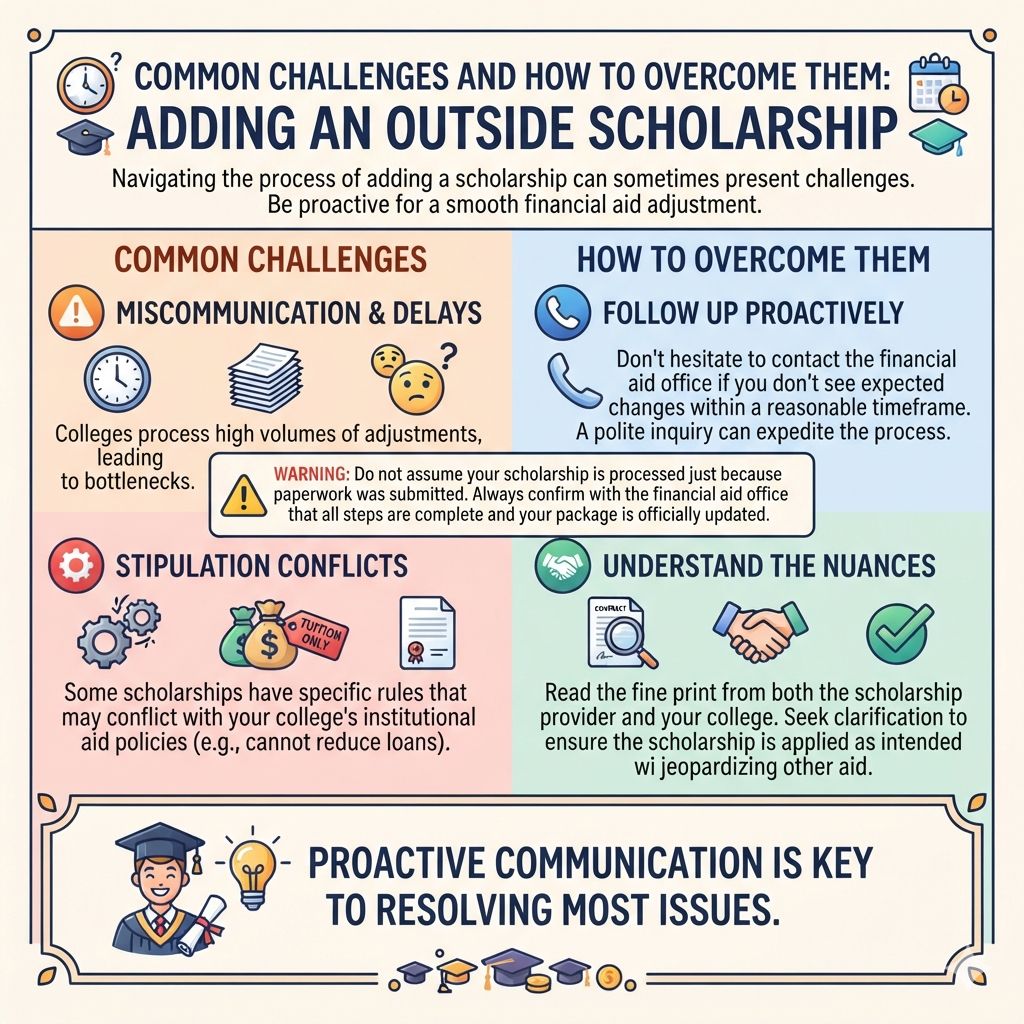
Navigating the process of adding a scholarship can sometimes present challenges. Awareness of these potential hurdles can help you address them proactively and ensure a smooth adjustment of your financial aid.
One common issue is miscommunication or delays in processing. Colleges receive a high volume of applications and adjustments, especially around key academic terms. If you don’t see the expected changes on your student account or financial aid portal within a reasonable timeframe, don’t hesitate to follow up.
A polite inquiry can often expedite the process.
Warning: Do not assume that your scholarship has been processed just because you’ve submitted the paperwork. Always confirm with the financial aid office that all necessary steps have been completed and your aid package has been officially updated.
Another challenge can arise if the scholarship has specific stipulations that conflict with institutional aid policies. For example, some scholarships might be intended to cover only specific expenses (like tuition) and may not allow for reduction of loans if other aid already covers tuition. It’s vital to understand these nuances from both the scholarship provider and your college.
Potential Issues and Solutions
Here’s a breakdown of common problems and how to tackle them:
| Issue | Solution |
|---|---|
| Delayed Processing: Your scholarship paperwork has been submitted, but your aid package hasn’t been updated. | Follow up with the financial aid office via email or phone. Note the date you submitted your documents and politely request an update on the status. Be persistent but patient. |
| Unclear Aid Adjustments: You see changes to your aid, but you don’t understand why or how much. | Schedule an appointment with a financial aid advisor to review your updated package line by line. Ask specific questions about each adjustment and its justification. |
| Scholarship Funds Not Applied: Your scholarship check was received by the school, but it hasn’t appeared on your student account. | Check if the check was made out to the university or to you. If to the university, confirm its receipt and ask the bursar’s or financial aid office for an update. If made out to you, ensure you followed the correct endorsement and submission process. |
| Scholarship Terms Conflict: The scholarship has specific rules that seem to clash with the college’s aid policies. | Consult both the scholarship provider and your financial aid office to clarify the terms. Sometimes, a written explanation from the scholarship donor can help the college adjust their interpretation. |
Maintaining organized records and clear communication is your best defense against these challenges. Keeping copies of all correspondence and documentation ensures you have proof of your submissions and discussions.
Frequently Asked Questions
What is the typical cost of attendance (COA) at most colleges?
The Cost of Attendance (COA) is an estimate of the total expenses a student will incur for one academic year. It includes tuition and fees, room and board, books and supplies, transportation, and personal expenses. COAs vary widely depending on the institution (public vs.
private, in-state vs. out-of-state) and the student’s living situation.
Do I have to report scholarships from my own high school or local community organizations?
Yes, you must report all outside scholarships, regardless of the source. This includes scholarships from high schools, community foundations, local businesses, religious organizations, and any other entity not directly affiliated with the college you are attending. Failure to report could jeopardize your entire financial aid package.
Can my financial aid be reduced if I receive a scholarship that only covers books?
Generally, scholarships intended to cover specific, smaller costs like books are less likely to significantly impact your main financial aid package, especially if your COA is substantial. However, all aid resources are considered. The financial aid office will determine if it needs to be factored in, but typically such specific scholarships are viewed favorably as they reduce your out-of-pocket expenses for essential academic materials without necessarily triggering a reduction in larger aid components like grants or loans.
What happens if I don’t report a scholarship and my aid isn’t adjusted?
If you fail to report an outside scholarship and your aid package is not adjusted accordingly, you may be considered to have received an overpayment of financial aid. This can lead to serious consequences, including having to repay funds to the government or the institution, potential suspension of future financial aid eligibility, and even repayment of the scholarship itself. It’s always best to be transparent and report all awards.
Can a scholarship be used for expenses beyond tuition, like study abroad or research trips?
This depends entirely on the terms set by the scholarship provider. Some scholarships are flexible and can be used for a variety of educational expenses, including study abroad programs, research opportunities, or specialized equipment. Others are strictly designated for tuition and fees only.
Always check the scholarship award letter and any accompanying documentation for specific usage guidelines.
Final Thoughts
Successfully adding a scholarship after your financial aid has been released hinges on proactive communication and careful record-keeping. By promptly notifying your college’s financial aid office and understanding how external awards affect your overall package, you can ensure your aid is accurate and maximize your financial support. Remember that this process, while sometimes leading to adjustments in grants or loans, ultimately aims to reduce your overall cost of education and potential student loan debt.