How to Make Arrows for a Recurve Bow: Sizing, Spine, and Setup
Measure your draw length first, then pick arrow spine for that draw weight and shaft length, add point weight to fine-tune, and finish by checking shelf clearance. Bad arrow order can leave you with weak or stiff arrows, poor grouping, and contact problems that waste both shafts and time. This guide lays out the practical build order for a first recurve arrow set: sizing, spine choice, point selection, finishing, and basic tuning.
First recurve arrow build worksheet
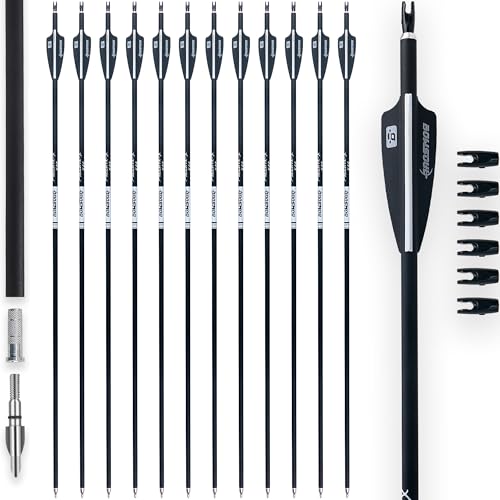

This worksheet puts the build order in one place. Fill it out before cutting shafts, because point weight and actual draw weight change the spine choice. The failure-correction column helps with the three common problems beginners see: weak flight, stiff flight, and shelf contact.
| Measured draw length | Actual draw weight | Starting shaft spine range | Recommended point weight | Failure-correction notes |
|---|---|---|---|---|
| 26 inches | 22 lb at draw | 900 to 1000 | 100 grains | Weak flight: move to stiffer spine or lighter point. Stiff flight: go weaker or add 125 grains. Shelf scrape: use feathers and check shaft length. |
| 28 inches | 25 lb at draw | 800 to 900 | 100 or 125 grains | Weak flight: shorten only after point and spine are right. Stiff flight: increase point weight before changing shafts. Shelf scrape: add more clearance margin and check nock fit. |
| 29 inches | 30 lb at draw | 700 | 100 grains | Weak flight: shaft is usually too weak for the setup. Stiff flight: lighter point is less likely to help than a weaker shaft. Shelf scrape: feathers and correct shaft length matter more than vane size. |
How long should recurve arrows be?
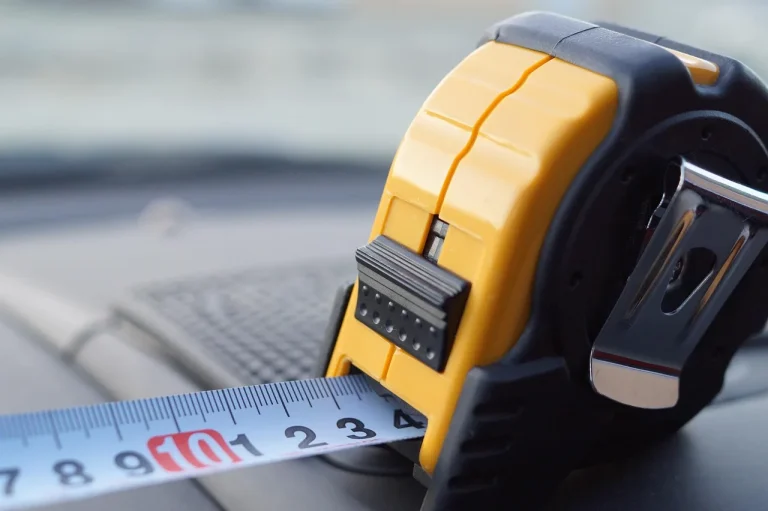
Start with arrow length at your draw length plus 1 to 2 inches. Measure arrow length from the nock throat to the end of the shaft, not to the tip of the point. That extra length keeps the point ahead of the shelf at full draw and leaves room for safe setup.
Measure from the nock throat
The nock throat is the correct starting point for arrow length. For recurve setup, that measurement is the shaft length used for selection and cutting. If the shaft ends too close to the riser or shelf at full draw, clearance problems become more likely.
A common first-timer mistake is cutting shafts before the point weight is chosen. That can turn a usable setup into a weak or stiff mismatch, because shorter arrows behave stiffer. Leave the shaft long until spine and point weight are settled.
Leave clearance room
The point should stay ahead of the shelf at full draw. Traditional recurve setups need that extra margin because fingers release the string with more side motion than a compound release aid. A longer shaft also gives a little more room for final tuning.
What spine arrows do I need for my recurve bow?
Arrow spine is the shaft’s deflection-based stiffness. A lower spine number means a stiffer shaft. Recurves shot with fingers need a weaker spine than compounds, because the string leaves the fingers with more flex and more side load on the arrow.
Why spine depends on the setup
Spine cannot be chosen from bow label alone. Shaft length, point weight, release style, and rest type all change the dynamic result. A shelf-shot traditional recurve usually needs more clearance margin and often a weaker spine than a centered target setup with an elevated rest.
Use starting ranges, then fine-tune
For a practical starting point, a 25 lb recurve with a 29-inch arrow and 100-grain point lands on 800 to 900 spine. The same arrow on a 30 lb bow lands on a 700 spine. Those examples show how a small draw-weight change can shift the starting spine choice.
Say your bow is labeled 28 lb, but you draw farther than 28 inches. The arrow does not care about the label. It reacts to the actual draw weight at your draw length, so the spine choice should move with the real draw, not the limb sticker.
How do I measure arrow length correctly?
Measure arrow length from the nock throat to the end of the shaft. Use your real draw length as the reference, then start at draw length plus 1 to 2 inches. That method keeps the shaft long enough for safe clearance and avoids trimming away useful tuning room.
Keep the measuring method consistent
Consistency matters more than a fancy ruler. Use the same measurement method for every shaft in the set so the finished arrows match. If one shaft is shorter, that arrow may behave stiffer and tune differently even when the spine label is the same.
Match the shaft to the full draw
The arrow must still sit safely ahead of the shelf at full draw. That is especially important for traditional setups, where the arrow passes close to the riser. If the shaft is too short, shelf contact or a poor launch angle can show up immediately.
Match spine to real draw weight
Measure the bow at actual draw length, not the limb label. Recurve limb labels are typically set at 28 inches, and limb weight often changes by about 2 to 3 lb per inch. That means a bow marked 28 lb can pull differently at 26, 28, or 30 inches.
Why the limb label is not enough
The label is only a reference point. If the archer draws shorter than 28 inches, the actual weight is usually lower. If the draw is longer, the weight is usually higher. That shift changes the spine demand and can move an arrow from correct to weak or stiff.
Pick point weight before buying shafts
Point weight should be chosen before buying shafts. Most recurve archers shoot 100 or 125 grain points. Heavier points weaken dynamic spine, which means they make the shaft behave as if it were weaker. Each 25 grains above 100 makes the shaft behave about 3 lb weaker.
Suppose a beginner chooses 125 grains instead of 100 grains on a borderline setup. The arrow may tune better without changing the shaft. If the shaft still ends up weak, the fix is usually a stiffer spine or a lighter point, not a random trim.
What point weight should I use on recurve arrows?
Use 100 or 125 grains as the normal starting range for recurve arrows. Pick the point weight before buying shafts, because it changes dynamic spine. If the setup is already near the weak side, a heavier point can push it further out of tune.
Start with one point weight first
A beginner should not mix point weights while learning the setup. Choose one weight, build a few test shafts, and tune from there. Testing a few shafts before buying a full dozen helps avoid a full set that is cut too short or matched to the wrong point weight.
Use point weight as the fine-tuning tool
Point weight is one of the cleanest ways to move dynamic spine without changing the bow. If the arrow acts stiff, a heavier point may help. If it acts weak, a lighter point may help. The change is small, but it often matters in a recurve setup.
Feathers, vanes, and arrow material
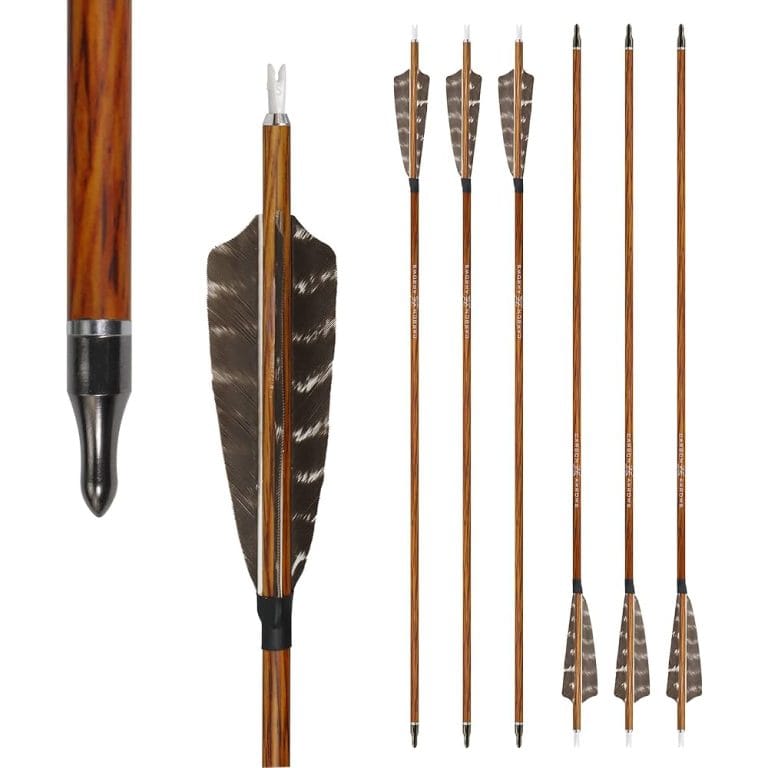
Feathers are recommended if the arrow sits on the shelf. Plastic vanes are recommended only with an elevated rest. Carbon, aluminum, and wood are all common material options, but the right choice depends on how much clearance the setup needs and how much tuning room the archer wants.
Choose fletching for the rest type
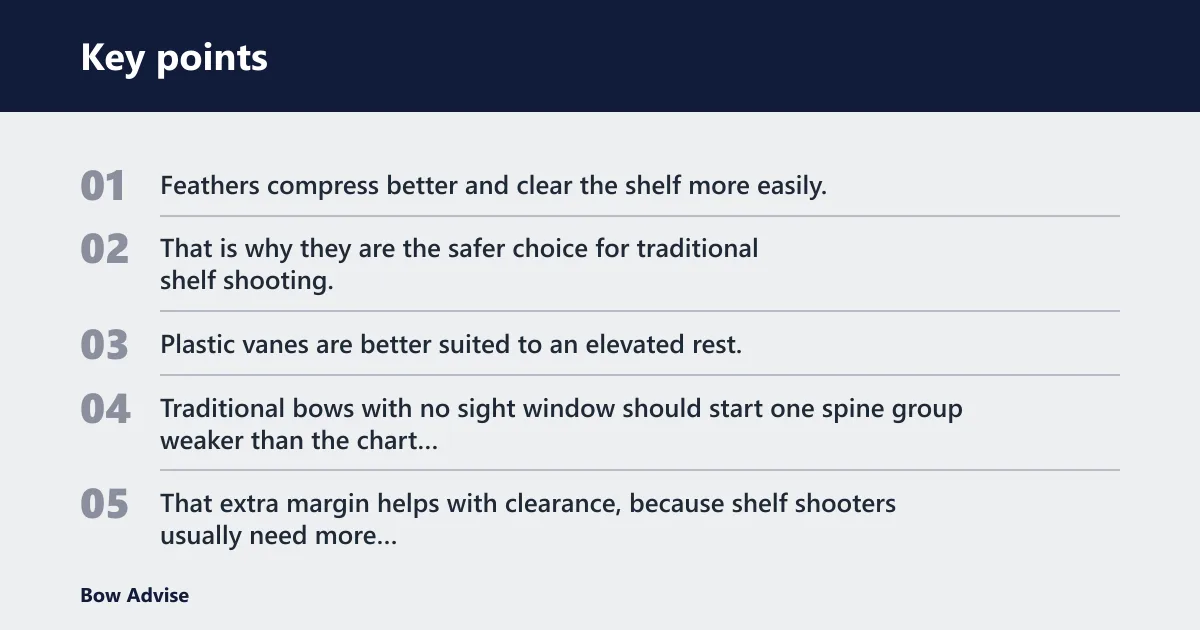
Feathers compress better and clear the shelf more easily. That is why they are the safer choice for traditional shelf shooting. Plastic vanes are better suited to an elevated rest, where they have more room and less risk of dragging on the bow.
Traditional bows with no sight window should start one spine group weaker than the chart suggests. That extra margin helps with clearance, because shelf shooters usually need more forgiveness than centered target setups.
Choose material by stiffness and use
Carbon shafts are light and consistent. Aluminum shafts are easy to sort and often forgiving for setup work. Wood shafts fit traditional builds and can work well, but they usually need closer matching of straightness, spine, and finish. Choose the material that fits the bow and the intended rest type.
Check nock fit before buying a dozen
Nock fit must match the string correctly. Test the nock on the actual string before buying a full dozen, because a poor fit can cause erratic launch or unsafe string release behavior. If the fit is wrong, fix that first.
How do I know if my arrows are too stiff or too weak?
Arrows that are too stiff usually leave the bow poorly and can group right or left depending on the shooter’s setup. Arrows that are too weak may flex too much, drift badly, and contact the shelf or rest. Shelf scrape often points to clearance problems, not only spine choice.
Fix weak flight first
If the arrow is weak, start by checking point weight and shaft length. A heavier point makes the shaft act weaker, so dropping from 125 grains to 100 grains can help. If that is not enough, move to a stiffer shaft.
Fix stiff flight carefully
If the arrow is stiff, a heavier point may bring the setup closer to tune. If that still leaves the arrow stiff, a weaker spine is the more direct fix. Do not trim a shaft shorter just to force more stiffness unless the overall setup has already been confirmed.
Watch shelf contact
Contact with the shelf usually means the setup needs more clearance margin, better fletching choice, or a different spine. For shelf shooting, feathers are the safer default. Vanes can work only when the bow uses an elevated rest that gives them enough room.
What arrow setup works best for a traditional recurve off the shelf?
A traditional recurve off the shelf usually works best with a longer shaft, feathers, a careful nock fit, and a spine choice that is one group weaker than a centered chart would suggest. That setup gives the arrow more clearance room and reduces shelf contact risk.
Use a shelf-friendly starting recipe
Keep the shaft long until clearance is confirmed. The more traditional the setup, the more important that margin becomes.
Build in this order
- Measure draw length.
- Measure actual draw weight at that draw length.
- Choose point weight first.
- Select a starting spine range from the real draw weight and shaft length.
- Test nock fit on the string.
- Choose feathers for shelf shooting or vanes for an elevated rest.
- Build a few test shafts before buying a full dozen.
Frequently asked questions
How long should arrows be for a recurve bow?
Start with draw length plus 1 to 2 inches. That gives enough shaft length for safe clearance and keeps the point ahead of the shelf at full draw. Measure from the nock throat to the end of the shaft, not to the point tip.
Do recurves need feathers or vanes?
Feathers are the better choice when the arrow sits on the shelf. Plastic vanes belong with an elevated rest. The main issue is clearance: feathers clear more easily, while vanes need more room and are more likely to contact a shelf setup.
Why are my recurve arrows too stiff or too weak?
Too stiff usually means the shaft is reacting more strongly than the setup needs, often from short length, light point weight, or an overly stiff spine. Too weak usually means the opposite. Fix point weight first, then spine, then shaft length if needed.