How to Scout Deer Sign for Bow Hunting
For bow hunting, it is commonly advised to rank deer sign by freshness first: fresh tracks, moist droppings, and bright rubs from roughly the last 24 to 48 hours near cover or a pinch point are often worth hunting, while older sign usually is not. Chasing every rub wastes time and can push deer off a property. This guide shows how to read sign, judge freshness, and decide when to keep scouting or set up.
Start with maps before walking
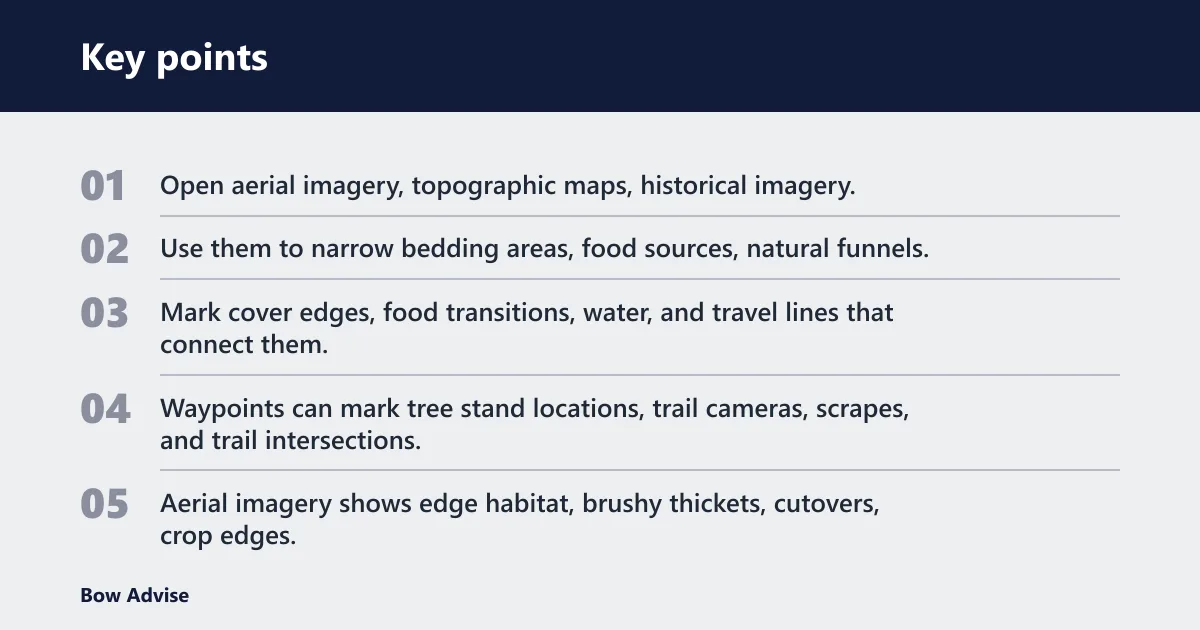


Open aerial imagery, topographic maps, historical imagery, and property lines before stepping onto the ground. Use them to narrow bedding areas, food sources, natural funnels, and likely travel lines so a beginner does not cover every trail on the parcel.
Mark cover edges, food transitions, water, and travel lines that connect them. Then mark access routes and no-go zones. Waypoints can mark tree stand locations, trail cameras, scrapes, and trail intersections, which keeps the plan organized before any disturbance starts.
Use aerial imagery and historical layers first
Aerial imagery shows edge habitat, brushy thickets, cutovers, crop edges, and isolated cover. Historical imagery can reveal where a field used to be open, where regeneration has thickened, and where old openings now hold bedding cover. That matters because deer often reuse travel lines even as the vegetation changes.
Read topo for movement shape
Topographic maps help identify saddles, benches, ridge points, creek confluences, and inside corners. HuntersLoadout lists those terrain funnels for good reason: deer often move through the easiest break in terrain or the tightest approach between cover blocks. Mark those places before deciding where to scout on foot.
Check boundaries and access routes
Property lines matter because pressure changes deer movement fast. Use boundaries to avoid crossing onto neighboring ground and to plan entry and exit routes that keep scent and noise away from bedding. A setup that looks perfect on a map is not worth much if the approach walks through the middle of the deer’s core area.
How do you tell fresh deer sign from old sign?
Fresh deer sign has clean edges, moisture, and current use. Old sign is weathered, dry, and often scattered with no supporting sign nearby. For bow hunting, freshness matters more than sign type because a recent track, rub, or scrape is more likely to predict daylight movement than an old, abandoned mark.
Track freshness
Fresh tracks in soft dirt, mud, or snow usually hold sharp edges and visible toe detail. Older tracks often soften, crumble, or fill with water and debris. Deeper tracks on soft ground can signal recent weight and a favored route, but depth alone does not prove current daylight use unless the edges still look crisp.
Rubs and scrape freshness
Fresh rubs often show bright wood, loose bark, and sometimes a wet sheen from exposed cambium or sap. Older rubs darken, weather over, and lose their sharp bark contrast. Fresh scrapes have kicked-up soil, clear boundaries, and a licking branch that still looks actively used; old scrapes often grow weeds, leaf litter, or rounded edges.
Use the season to judge value
Freshness alone is not enough. A fresh scrape in pre-rut or rut carries more bow-hunt value than the same scrape in midsummer. A fresh rub found along a travel route near cover matters more in the pre-rut than a random rubbed sapling in thick bedding where multiple deer passed through once.
Deer tracks and trails
Deer tracks and trails are useful when they show traffic pattern, not just presence. DeerTracksRanch lists fresh tracks, droppings, rubs, scrapes, and trails as scouting signs, but beginners should rank them by how recent and how directional they are. A hard-used trail that cuts between cover blocks is better than a faint path with no supporting sign.
Where to look for tracks
Check mud, snow, creek edges, old logging roads, field margins, wet leaves, and soft soil near crossings. High-traffic trails often appear where deer move from bedding to food, or where two paths meet at a pinch point. Tracks at trail intersections often matter more than isolated prints in open ground.
Suppose a 6-inch-wide trail runs through a muddy creek crossing, then splits around a brushy point. If the larger, clearer tracks keep taking the tighter route and the smaller, smeared prints wander into open ground, the first route is the better bow-hunt clue. It shows repeated, efficient movement.
What droppings can tell you
Droppings can confirm use, but they are weak by themselves. Moist, glossy pellets suggest recent activity; dry, bleached pellets suggest older use. Droppings do not tell you time of day, and a pile near a trail may simply mark a travel lane used by several deer classes, not a buck daylight route.
Rubs, scrapes, and buck sign
Rubs and scrapes matter most when they line up with travel routes and timing. The same source notes that rubs and scrapes often signal bucks marking territory or looking for mates during the rut. That makes them valuable, but only when they sit in the right season and are supported by better sign nearby.
Read rub lines, not single rubs
A single rubbed tree can be old or random. A rub line that follows a trail, creek edge, or terrain break is stronger evidence because it suggests repeated buck travel. Look for trees with bark damage at similar heights along a route, especially saplings and smaller trunks the deer can work while moving.
What scrapes mean by season
Pre-rut scrapes can indicate checking behavior and staging areas. During the rut, active scrapes with an overhanging licking branch and freshly disturbed soil often show recurring use. Outside that window, old community scrapes can mislead beginners because many deer may visit them without any daylight movement nearby.
Common false positives
An old rub near a parking area, a scrape in a wide-open field edge, or a beaten trail used by does, bucks, and fawns can all look promising without predicting a shootable encounter. Treat those as clues, not conclusions. If the sign lacks freshness, direction, or nearby cover, keep scouting.
Where are bedding areas and food sources likely to be?
Bedding areas and food sources shape most daylight movement. Outdoor Life frames whitetails around food, cover, water, and breeding needs, and bedding shifts with season and climate. For a beginner, the goal is to find the few places where deer can bed safely and move to feed without crossing too much open ground.
How to find bedding areas before bow season
Bedding areas often show as oval depressions in grass or leaves. The same source describes deer beds as oval depressions typically 3-4 feet long. Look for them in thick cover, on slight elevation, or along security cover that shields the deer’s view and wind sense. Fresh beds often sit where deer can smell danger from the downwind side while keeping an escape route open.
A common first-timer mistake is walking straight into a bedding pocket because the beds look obvious on a map. That can blow the whole area. If the sign cluster sits in thick cover and the wind would carry scent into it, mark the spot and back out rather than forcing a closer look.
Judge food by season
Early season food often means standing crops, food plots, and soft mast. The same source lists those as early-season food sources. As the season changes, acorns, agricultural fields, and food plots can shift in value. OnX says its Tree Data Layer helps locate acorn-producing oaks, young aspen, and thermal deer cover, which is useful when you need to narrow that search fast.
Use water as a secondary clue
Ponds, creeks, and springs matter more during dry weather and in secluded spots. Deer often prefer water that sits close to cover and away from constant human traffic. Drinking-area sign is usually subtle: tracks at the edge, a faint trail in or out, and occasional droppings nearby. Water alone rarely beats a stronger food or bedding clue.
Funnels, wind, and bow range
Funnels and pinch points help a beginner turn sign into a real setup. The same source lists saddles, benches, ridge points, creek confluences, and inside corners as terrain funnels. These spots matter because they squeeze deer movement into a narrower lane, which is exactly what bow range needs.
Match the setup to the wind
Wind direction should guide scouting, stand access, and exit routes. The same source says its Wind Calendar covers morning, afternoon, and evening forecasts for seven days, which helps decide whether a route is safe enough to use. A good sign cluster loses value if the approach carries scent into bedding or across the trail before legal shooting light.
Decide if the sign is in bow range
Strong sign far from a realistic shooting lane is weak hunting value. A cluster near a funnel, within a clean entry route, and close enough for a shot from a stand or blind is far more useful. If you cannot reach position without crossing the likely travel lane, keep scouting and pick a better setup.
Trail cameras while scouting
Trail cameras work best at pinch points, trail intersections, and over mock scrapes in strategic areas. Outdoor Life recommends placing trail cameras over mock scrapes in strategic areas. Keep checks low-disturbance, and move cameras from summer to fall as movement shifts from bedding-heavy patterns to rut travel and food-to-cover routes.
Deer sign priority matrix
Use this matrix to rank sign before deciding whether to hunt, keep scouting, or leave the area alone. It favors freshness, seasonal relevance, buck likelihood, and whether the sign actually supports a bow setup. Mixed sign should be judged by the strongest fresh clue, not by whichever sign looks most exciting.
| Sign | Freshness | Season relevance | Buck likelihood | Bow-huntability | Action rule |
|---|---|---|---|---|---|
| Tracks | High if sharp in mud, snow, or soft ground | High all season, strongest on travel routes | Medium unless size, depth, and route support it | High near pinch points and trail intersections | Hunt if fresh and tied to a funnel |
| Rubs | High when wood is bright and bark is loose | Highest pre-rut and rut | High when part of a rub line | Medium to high near cover edges | Hunt if fresh rubs line a travel route |
| Scrapes | High when soil is clean and branch is active | Highest pre-rut and rut | Medium to high in the right window | High if paired with a trail or funnel | Hunt if active and near bedding or staging cover |
| Beds | High only if edges are clean and press is recent | Season shifts matter a lot | Medium; beds may hold does, bucks, or both | Low for direct hunting, high for adjacent setup | Scout edge only; hunt nearby access, not the bed |
| Droppings | Medium; moisture helps, but timing is vague | Low to medium | Low alone | Low unless paired with stronger sign | Use as support only |
| Trails | Medium; traffic wear matters more than age | High when tied to food, water, or bedding | Medium | High when they narrow into a shot lane | Hunt if fresh traffic crosses a funnel |
- Hunt now if at least one fresh clue is present and it sits on a pinch point, travel route, or edge within a realistic bow shot.
- Keep scouting if sign is mixed, old, or spread out, but the area still looks promising on maps and access is low pressure.
- Leave it alone if the only strong sign is in bedding cover, the wind is wrong, or the route in would blow scent into the area.
Mixed sign deserves the highest single clue, not an average. Fresh tracks plus old rubs usually points to current travel, while old tracks plus a fresh scrape can still be weak if the scrape sits on a community edge with no nearby bedding or funnel. When clues disagree, the freshest sign closest to a bowable route wins.
Frequently asked questions
What does the deer sign mean?
Deer sign tells you where deer moved, rested, fed, or marked territory, but the meaning changes by freshness and season. Fresh tracks and rubs near a funnel point toward current travel. Old sign without supporting clues usually means past use, not a likely daylight encounter.
Where should I look for deer tracks and rubs?
Look for tracks in mud, snow, creek edges, soft roads, and trail crossings where deer are forced to funnel. Look for rubs along travel routes, especially near cover edges, bedding exits, and narrow movement corridors. A line of fresh rubs is far better than a single rubbed sapling.
How close can I scout without spooking deer?
Close enough to confirm sign, not close enough to invade bedding or force a deer to blow out. A safe rule is to stop at the edge of thick bedding cover unless the wind and access route keep your scent out of the area. If you can smell, hear, or see beds, you are usually too close.
How do I use trail cameras while scouting deer?
Place cameras on pinch points, trail intersections, or over mock scrapes in strategic areas, then keep checks low-disturbance. Reposition them from summer to fall as food, bedding, and rut movement change. The goal is to confirm daylight timing, not to check cameras so often that the area gets pressured.