How to Blood Trail a Deer at Night After a Bow Shot
Track the arrow first. Follow blood only while the sign stays clear. If the trail turns thin, stop and return at daylight, because a wounded deer pushed at night can run farther and be lost. Bad light, rushed steps, and noisy searching wipe out sign and can turn a recoverable deer into a lost one.
This guide covers arrow evidence, low-light tracking, and a clear stop-or-continue decision tree for night recovery after a bow shot.
Mark the shot site
Before moving, mark the last standing location, the last seen location, and the direction the deer took. Add waypoint pins or map notes at both points, then name nearby landmarks so the spot can be found again without guessing. That is the best start to any night recovery.
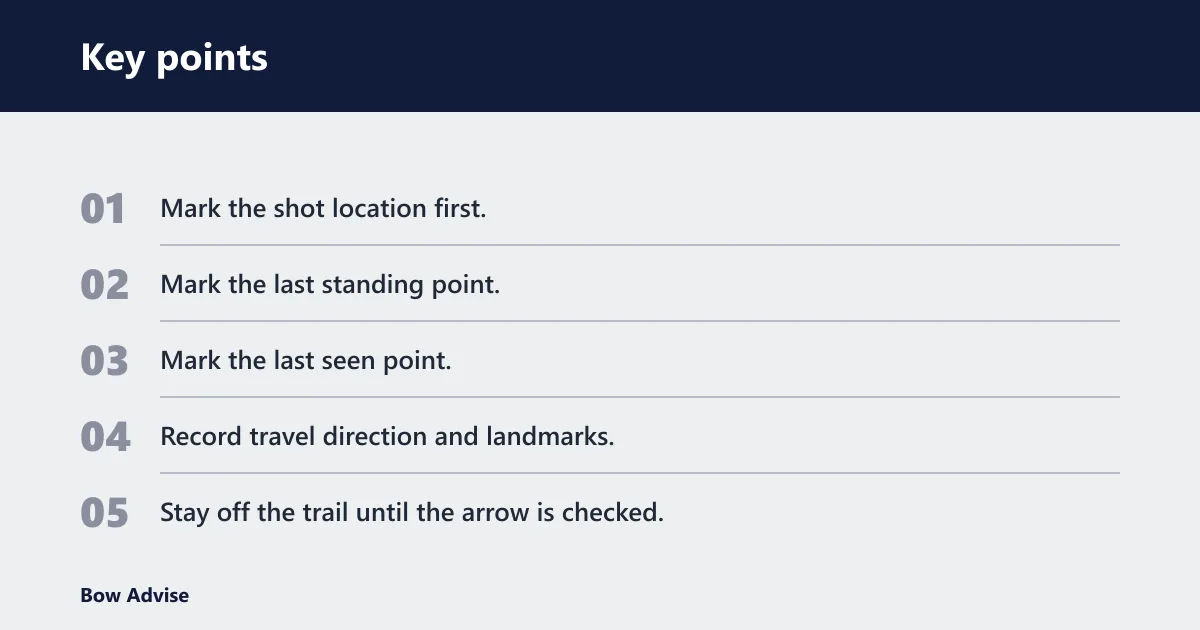
Last standing and last seen points
Use two references, not one. onX recommends taking two waypoint references after the shot: where the deer stood and where it was last seen. Those two points help separate the shot site from the direction of travel, especially when the animal lurches, circles, or disappears into cover.
A common first-timer mistake is marking only the tree stand or blind and then assuming the deer went straight ahead. If the deer hunched, kicked, and stopped in brush before running, the last standing point may be several yards from the first blood.
Direction of travel and landmarks
Note the exact line the deer took out of the scene. Use a fence post, stump, rock, corner tree, ditch edge, or gap in brush as a landmark. If the deer crosses a lane or field edge, record that too. Direction matters more than a rough guess about where it “probably went.”
Waypoint pins and map notes
Use a phone in map or compass mode, and keep the screen light as low as workable. A connected rangefinder with onX can help place the two points more cleanly. Type short notes such as “last stand, left shoulder low” or “last seen, south brush line” so the memory does not blur.
- Mark the shot location first.
- Mark the last standing point.
- Mark the last seen point.
- Record travel direction and landmarks.
- Stay off the trail until the arrow is checked.
Read the arrow first
The arrow can tell more than the first blood patch. Look at whether it passed through, whether the shaft is lodged or half-broken, and where blood appears on the shaft, vanes, and broadhead. Broken pieces, odor, and impact angle can all change the wait plan before a track begins.
Pass-through versus lodged shaft
A pass-through often leaves blood on both ends of the arrow and may show a clean exit path. A lodged shaft can mean the arrow did not exit, which can reduce visible blood at first but still give strong clues from the cut, the angle, and how deep the shaft is broken or bent.
Do not read too much into distance covered by the arrow alone. A broadhead with a shallow angle and little blood may still have hit a lethal chest area, while a shaft with heavy blood but poor penetration may point to a worse but slower hit. Read the whole arrow, not one detail.
Blood on the shaft, vanes, and broadhead
Blood on the shaft near the fletching can mean the arrow passed through tissue and exited on the far side. Blood on only the broadhead may come from a short penetration or a hit that never opened a clear exit channel. Vane spray, smears, and small clots matter more than a single bright patch.
What broken pieces and odor can suggest
A half-broken shaft, bent broadhead, or torn vane can show a hard impact, but the damage must be read with the blood. Strong odor on the arrow or a heavy gut smell pushes the wait longer. A sharp, clean impact with bright frothy blood can point toward a chest-cavity hit.
When should you wait after the shot?
Wait time should match the most likely hit, not impatience. Heart and double-lung hits can be short waits because the deer may expire quickly, while single-lung, liver, and gut hits need much longer. If the hit is uncertain, choose the longer wait and avoid a rushed track that bumps the deer.
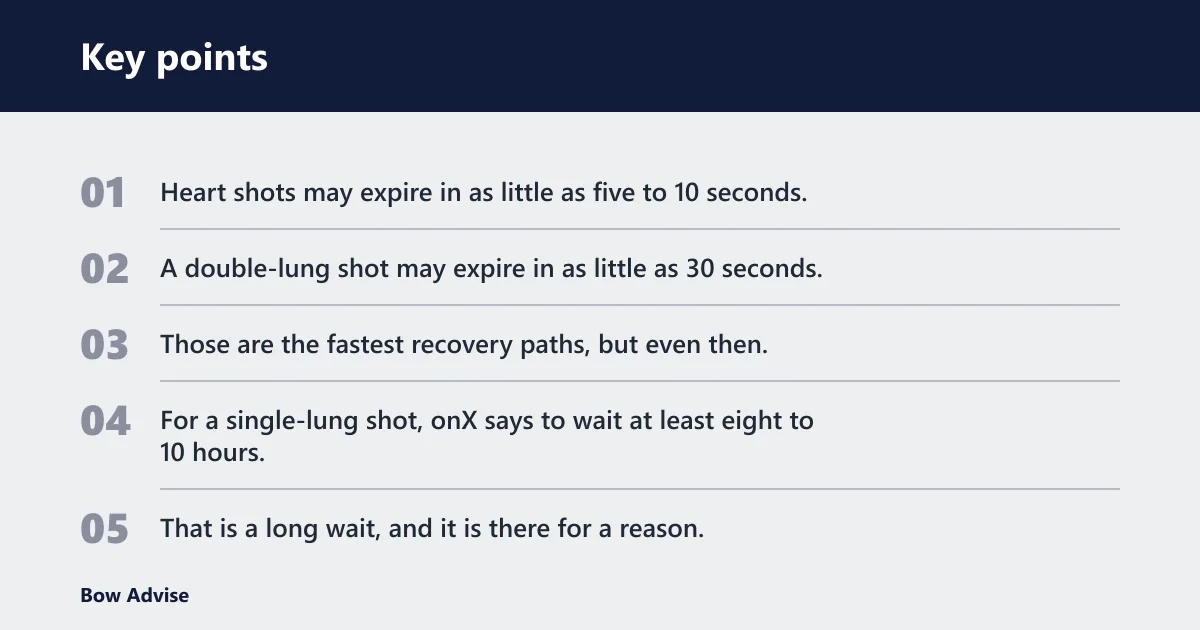
Heart and double-lung hits
Heart shots may expire in as little as five to 10 seconds, and tracking can begin within 10 to 15 minutes. A double-lung shot may expire in as little as 30 seconds. Those are the fastest recovery paths, but even then, stay still long enough to avoid pushing a deer that is still standing or moving.
Single-lung hits
For a single-lung shot, onX says to wait at least eight to 10 hours. That is a long wait, and it is there for a reason. A deer with one lung can move farther than expected, bed again, and leave only scattered sign if it is bumped too soon after dark.
Liver and gut hits
A liver shot wait recommendation is six to eight hours. A gut shot wait recommendation is 10 to 12 hours. An intestines shot may call for 12 to 24 hours of waiting. If the sign points to belly or gut, do not shorten the wait just because the deer ran hard; that can still be a slow, recoverable hit.
| Arrow condition | First blood appearance | Deer reaction | Likely hit | Recommended wait time | Track immediately? | When to call for help |
|---|---|---|---|---|---|---|
| Pass-through, bright blood on both ends | Bright red, steady drops | Run, stop, then stagger | Heart or double-lung | 10 to 15 minutes | Yes, if sign is strong | If the trail breaks or the deer is not found quickly |
| Pass-through, foamy blood on shaft | Bright red with foam | Fast run, short distance | Lung | Short wait, then move slowly | Yes, with caution | If blood becomes sparse or terrain turns unsafe |
| Half-broken shaft, dark red blood | Dark red, small pools | Hunched back, slower run | Liver or one-lung | Six to 10 hours or more | No | At once if permission, weather, or darkness makes the trail doubtful |
| Lodged shaft, yellowish material | Watery, dark, or yellowish sign | Tail tucked, stop and thrash | Gut or intestines | 10 to 24 hours | No | Immediately if the deer is likely bedding nearby or the line crosses restricted land |
Blood color clues at night
Blood color helps, but it can lie under bad light. Bright red blood can suggest a chest hit, dark red blood can point to deeper tissue, and foamy or watery sign can raise the odds of lung involvement. Soil, sap, mud, and flashlight glare can all fake a color read, so use more than one clue.
Bright red versus dark red
What does bright red deer blood trail mean? Bright red blood can fit a heart or lung hit, but it does not prove one exact location by itself. Dark red blood can appear on liver hits, and the shooting gears article says liver blood can be dark red. Read the deer’s reaction and arrow together.
Foamy, watery, and yellowish sign
The shooting gears article says bright frothy blood can suggest lung damage. Watery dark red blood may show mixed tissue and fluid. Yellowish material can point to stomach or gut contents, especially when paired with a smell and a slower deer reaction. That mix usually means a much longer wait.
False signals are common at night. Mud can turn blood brown. Wet leaves can spread a drop into a false splash. Sap can look red under white light. A fresh flashlight beam can also make a dark patch appear brighter than it is. Confirm color with shape, smell, and location.
Common reaction cues
Look for a hunched back, tail tucked, kick, run, stop and thrash. A deer that hunches and kicks hard may be reacting to a chest or belly hit. A deer that runs hard and stops to thrash may still be recoverable, but the wait decision should stay tied to the sign, not the drama of the exit.
Should you follow in the dark?
Follow in the dark only when the sign is strong, the route is safe, and the law allows it. Use a headlamp on a low setting, keep a backup light ready, and move slowly enough to preserve sign. If the trail gets thin, crosses risky ground, or enters restricted land, stop and return at daylight.
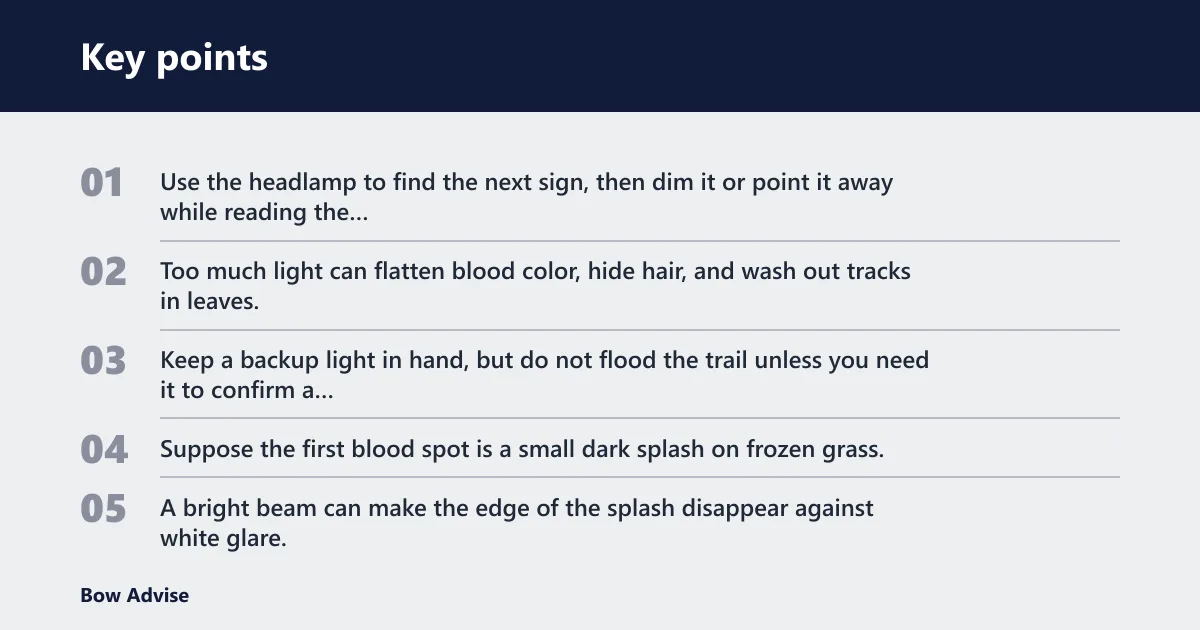
Headlamp use and backup light discipline
Use the headlamp to find the next sign, then dim it or point it away while reading the ground. Too much light can flatten blood color, hide hair, and wash out tracks in leaves. Keep a backup light in hand, but do not flood the trail unless you need it to confirm a safe step.
Suppose the first blood spot is a small dark splash on frozen grass, and the deer ran into heavy brush. A bright beam can make the edge of the splash disappear against white glare. A lower light angle often shows the track line better, especially when paired with a quick compass check.
Slow movement on leaves, snow, rain, or frozen ground
Leaves hold hair and blood, but they also hide them. Snow shows tracks clearly, yet a bright beam can make wet blood sparkle and mislead you. Rain can wash light sign downhill, and frozen ground can leave only a track line or a few broken twigs. In all four, slow movement matters more than speed.
Follow confirmed sign slowly and methodically. Use hair, tracks, disturbed leaves, broken brush, and the arrow or bolt itself as markers. If the blood disappears, back up to the last confirmed sign and fan out carefully instead of wandering ahead and creating a second, false trail.
When to stop and return at daylight
Stop when the trail becomes guesswork, when you lose permission to enter the next boundary, when a water crossing looks unsafe, or when the deer may be bedding very close with little sign. Do not keep searching just because the shot felt good. A bad night push can turn a recoverable deer into a lost one.
When should you call for help?
Call for help when the trail weakens, the hit looks marginal, or the land and law get complicated. An experienced helper, game warden, or legal tracking dog handler can save time and reduce mistakes. If state rules, land access, or property lines are unclear, stop the search and sort that out first.
Experienced helper or game warden
Bring in an experienced helper when the sign is fading, the terrain is unsafe, or you need a second set of eyes on arrow evidence and blood. A game warden can help interpret state rules when the trail nears a boundary or when night tracking conditions are questionable. Permission still matters on every step.
Legal tracking dog handler
A legal tracking dog handler is often worth calling when the sign is sparse, the deer crossed difficult cover, or you have a suspected liver or gut hit and want to avoid pressure. Check state rules first, because tracking dog use, time limits, and land access can vary widely by location.
Permission, land access, and state rules
Night tracking is not automatic just because a deer was hit. Landowner permission, property lines, and state restrictions can change what is allowed. If crossing into another parcel is likely, or if light use is restricted, return at daylight or get the correct approval before continuing. Track legally, then track safely.
Frequently asked questions
Is blood trail required for deer?
No. A deer can be recovered with little or no visible blood if the arrow path is closed off by hair, muscle, snow, leaves, or internal damage that does not bleed much outside. Mark the shot site, read the arrow, and do not assume the lack of blood means the deer was missed.
Is blood trail required for bowhunting?
No. Bowhunting does not depend on a visible blood trail every time. Some good hits leave easy sign, and some do not. What matters is the full picture: arrow evidence, deer reaction, direction of travel, and how much sign remains after the first careful check.
How long should I wait after shooting a deer at night?
It depends on the likely hit. Heart shots may allow tracking within 10 to 15 minutes. A double-lung shot may expire in as little as 30 seconds. Single-lung, liver, gut, and intestines hits need much longer waits, with gut sign often pointing to 10 to 24 hours before a careful follow-up.
What does bright red deer blood trail mean?
Bright red blood can suggest a heart or lung hit, especially if it is frothy or paired with a hard, fast reaction. It does not prove one exact hit by itself. Soil, mud, sap, and strong flashlight glare can distort the color, so read the arrow and deer behavior too.
What should I do if the blood trail disappears?
Stop at the last confirmed sign and mark it. Backtrack a few yards, then widen the search in a careful circle without trampling the ground. If the trail is weak, the hit is uncertain, or the route crosses land you cannot enter, return at daylight or call for help.
Should I follow a deer blood trail in the dark?
Only if the sign is clear, the path is safe, and the law allows it. Use a low headlamp, a backup light, and slow steps. If the blood gets spotty, the ground gets risky, or the deer may be close and bedded, stop and continue at daylight instead.
How do I mark the last place I saw the deer?
Take two waypoint references: the last standing point and the last seen point. Add the direction of travel and a nearby landmark, such as a tree, ditch, or fence corner. That gives you a fixed recovery line even if darkness, rain, or leaves blur the trail later.
When should I call for tracking help after a bow shot?
Call when the trail weakens, the hit looks like liver or gut, the terrain becomes unsafe, or you are unsure about legal access. An experienced helper, game warden, or legal tracking dog handler can keep the search lawful and controlled. Do not wait until the sign is fully gone.