How Long Should You Wait to Track a Deer? After a Bow Shot
A common rule of thumb is to wait about 30 minutes for a clean heart-lung shot, about 6–8 hours for a liver hit, and overnight for a gut or uncertain hit; if the deer was hit far back, low, or gave no blood, back out and wait. Move in too soon and you can bump a wounded deer, lose the trail, or turn a recoverable hit into a long search. This guide breaks down wait times by shot placement, arrow sign, deer reaction, weather, and legal access so you can decide whether to track, pause, or return at daylight.
This guide is part of our Bowhunting the Whitetail Rut: Timing, Tactics and Late-Season Adjustments series.
Bows do not drop deer instantly like rifles. The first choice after the shot is often the most important one, because a rushed follow-up can push a deer out of reach and into thick cover.
When to wait after the shot


The first 5 minutes
Watch the deer until it disappears, mark the last place you saw it, and note the exact hit location before doing anything else. Listen for a crash or fall, because a double-lung hit often ends that way, and a deer that beds quickly may be telling you the hit is farther back or less certain.
Move only enough to find the arrow if it is lying in plain view. Do not go into cover just to pull it if the deer was only out of sight for a moment.
When a short wait is safer
A short wait is the safer choice when the shot looked clean and the deer ran hard with a tucked tail, a hard kick, or a crash. It is also safer when the arrow sign points clearly to lungs or heart. A low, back, or quartering-away shot with weak sign calls for a longer pause.
If a deer mule-kicks, runs 50 yards, and you hear it fall, do not sprint in. A brief wait still helps keep pressure low and gives the animal time to expire if it is only partly down.
Recovery wait table
| Shot scenario | Deer reaction | Blood sign | Wait window | Action |
|---|---|---|---|---|
| Double-lung, broadside | Hard kick, fast run, crash possible | Pink or frothy blood | 20 to 60 minutes | Track with caution |
| Heart, low broadside | Short run, may stumble | Bright red blood | 30 to 60 minutes | Track carefully after a short wait |
| Liver, quartering-away | Hunch, slower run, may bed | Dark red blood | 3 to 6 hours | Back out and return later |
| Gut, low or far back | Runs off, may bed soon | Green or brown material | 6 to 12 hours or overnight | Back out; avoid pressure |
| Uncertain angle, no clear exit | Mixed reaction or no crash | Weak, patchy, or absent | Overnight | Back out unless the deer is clearly down |
| Single-lung suspicion | Strong run, then bedded sign | Pink with sparse blood | 4 to 8 hours | Conservative track, no pressure |
| High shoulder or forward hit | Explosive run, no fall seen | May be bright red or sparse | At least 1 hour, often longer | Wait and reassess sign |
| No blood found, deer out of sight | Unknown | No clear sign | Overnight | Back out and search by daylight |
American Hunter says a confident heart or lung hit can be followed after 30 minutes, while the National Deer Association advises waiting at least 30 minutes in the stand regardless of the shot and then trailing after one hour for a confident heart or lung hit. Those numbers fit a clean hit, not a guess.
How deer reaction tells you what happened
Deer reaction is the first filter because it helps separate a solid hit from a bad guess. A hard kick, a hunch, a mule kick, a crash sound, or a sudden bed often points to a more serious hit than a relaxed run with a high tail and no stumble.
Hard kick, hunch, or mule kick
A hard kick or mule kick often follows a lung or heart hit, though it is not proof by itself. A hunch, slow run, or short bed soon after the shot leans toward a liver hit or a marginal lung hit that needs more time.
Run speed, tail position, and crash sounds
A deer that runs hard with its tail tucked and then crashes may have taken a center-lung hit. If it runs off at a steady pace, keeps the tail level, and gives no crash sound, the hit is less certain and the wait should be longer.
F1 says that if you double-lung a deer, you will often hear a crash or see it go down. That is useful, but it should still be paired with the arrow and blood sign before anyone moves in.
Bedded soon after the shot versus running hard
A deer that beds soon after the shot often needs a longer pause, especially if the arrow looks dark or the hit was low. A deer that runs hard and leaves a clear lung trail can usually be followed sooner than one that disappears into thick cover with no clean sign.
What does the blood mean?
Blood color and texture help, but they do not settle the shot on their own. Use them with the angle, the deer’s reaction, and the time since the shot, because one clue can mislead if the others point somewhere else.
Pink or frothy blood
Pink or frothy blood usually points to the lungs. Archery Insider says pink, frothy blood usually means lungs, and that fits a deer that ran hard, crashed, or showed a quick drop in energy.
Bright red blood
Bright red blood often suggests a heart hit or a very forward lung hit. It can still mean the shot was too high or too far forward, so the waiting window should match the deer’s reaction and whether a crash was heard.
Dark red blood
Dark red blood often indicates liver. The same source says dark red blood often indicates liver, and American Hunter says liver hits often need 3 to 6 hours. That is a backing-out wound, not a quick follow-up.
Green or brown material
Blood with green or brown material means a gut hit. The same source says green or brown material means a gut hit, and American Hunter says gut hits may require 6 to 12 hours. Overnight is often the better choice if the deer is still alive.
What matters most is the whole picture. Pink blood with a hard crash is one thing. Pink blood with a poor angle and no crash is another. Do not let one color push you into a bad recovery plan.
How should you start the track?
Start by marking the hit site, noting the last sighting, and checking the arrow only if it is easy to reach without entering the deer’s escape route. If sign is thin, move slowly and stay on the exact line of blood or disturbed leaves instead of sweeping the area.
Mark the hit site and last sighting
Use a visible marker at the shot site and another at the point where the deer was last seen. This gives a clean line of travel, which matters once the blood trail bends, stops, or splits around cover.
Find the arrow without pushing the deer
The arrow can tell a lot if it is found where the deer was standing. Look for hair, blood, or tissue only if the arrow is already in reach. If getting it means walking into the bedding area, leave it and return later.
Move slowly when sign is weak
A common first-timer mistake is to follow a faint spot of blood straight into thick cover. Slow down, scan for tracks, clipped grass, and broken brush, and then back out if the trail weakens instead of forcing the issue.
Picture a deer hit at dusk on a steep hillside with light rain starting. The blood is sparse, the angle is uncertain, and the deer stopped once before disappearing. That is an overnight call, not a same-hour push.
- Mark the shot site.
- Note the deer’s reaction and last sighting.
- Check the arrow only if it is in easy reach.
- Match blood color and texture to the hit angle.
- Wait longer if the sign is weak or mixed.
- Track only when the wait window fits the hit type.
When should you back out or use a dog?
Back out when the trail goes cold, the sign turns weak, or the hit is uncertain. Use a tracking dog only where legal, and only after confirming local rules. If rain, darkness, or steep ground is erasing sign, more pressure is usually the wrong move.
Signs the trail is going cold
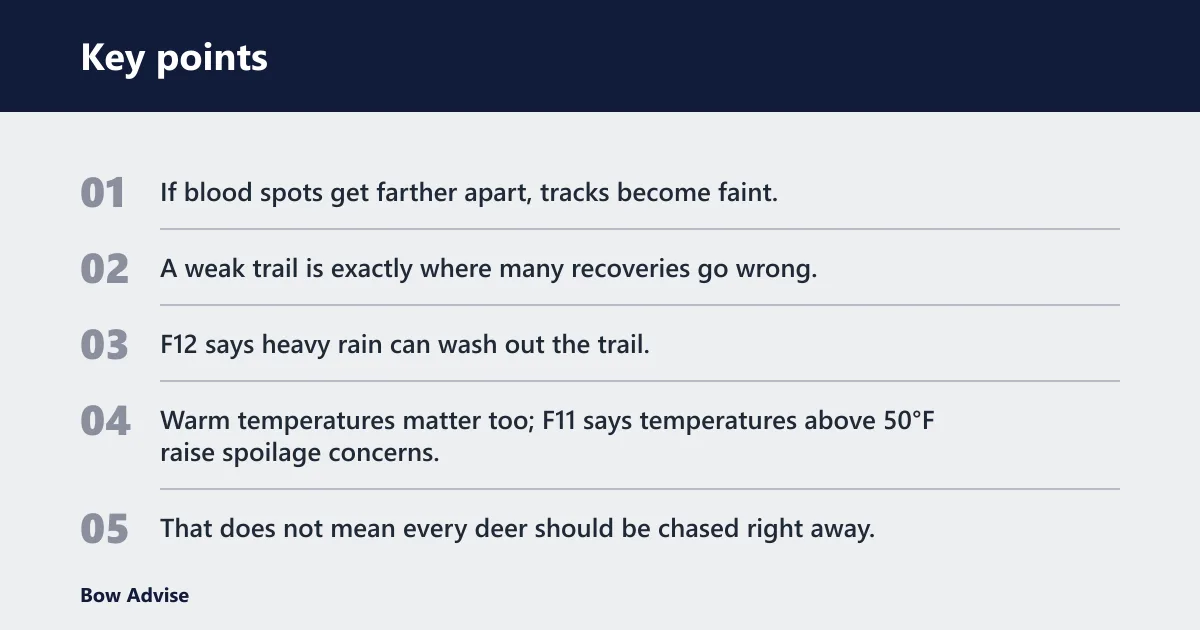
If blood spots get farther apart, tracks become faint, or the deer changes direction into thick cover, stop and reassess. A weak trail is exactly where many recoveries go wrong, because one rushed turn can push the deer onto its feet and out of range.
Rain, warm weather, and overnight waits
Heavy rain can wash out the trail. F12 says heavy rain can wash out the trail, so a wet evening favors a careful pause before the sign disappears. Warm temperatures matter too; F11 says temperatures above 50°F raise spoilage concerns, which can make long delays less attractive for a clean, known hit.
That does not mean every deer should be chased right away. It means the hit type sets the wait, and weather changes how cleanly that wait can be carried out.
When a tracking dog can help legally
A tracking dog can help when the blood trail goes cold, especially on a gut or liver hit where a deer may bed far from the shot. Use that option only where local rules allow it, and confirm the access law before calling in help.
If legal access is clear and the trail has nearly vanished, a dog is often more useful than more boot traffic. That is especially true in leaf litter, dry grass, or broken ground where blood spots become hard to separate from background sign.
Recovery checklist
Use this before you move in. It combines what you saw, what the arrow shows, the weather, the time of day, and whether legal access is available.
- Did the deer crash, hunch, or bed soon after the shot?
- Is the blood pink and frothy, bright red, dark red, or mixed with green or brown material?
- Was the shot broadside, quartering, high, low, or uncertain?
- Is the wait window 20 to 60 minutes, 3 to 6 hours, 6 to 12 hours, or overnight?
- Is rain likely to wash out the sign?
- Are temperatures above 50°F raising spoilage concerns?
- Can you legally use a tracking dog if the trail fades?
- Have you marked the hit site and last sighting?
Frequently asked questions
How long should you wait to track a deer after a bow shot?
Wait based on the most likely hit, not on impatience. A clean heart-lung hit can often be followed after 30 minutes, while the National Deer Association says to trail after one hour for a confident heart or lung hit. Uncertain, low, or back hits need much longer.
How long should you wait after a double-lung shot on a deer?
For a clear double-lung shot, 20 to 60 minutes is the common window, and a crash is often heard or the deer is seen going down. Even then, wait if the shot was not certain, because a marginal angle can turn a quick recovery into a lost deer.
How long should you wait after a liver shot on a deer?
A liver hit usually calls for 3 to 6 hours, and Archery Insider summarizes liver-hit wait time as 2 to 6 hours. Dark red blood is a strong clue, but the key is backing out and giving the deer time to bed and expire without pressure.
How long should you wait after a gut shot deer?
Gut shots need the longest patience: 6 to 12 hours or overnight. The same source says gut hits may require 6 to 12 hours, and green or brown material in the blood trail is a warning sign. Going in too soon can push the deer farther and spoil recovery odds.
What does frothy blood mean after a bow shot?
Pink or frothy blood usually means lungs. The same source says pink, frothy blood usually means lungs, and that sign fits a shot that may allow a shorter wait if the angle and deer reaction also point to a center hit. Do not read frothy blood by itself.
Should you track a deer in rain or overnight?
Heavy rain can wash out the trail, so a longer wait may be smarter if the hit is not clearly lethal. Overnight is often the better option for gut or uncertain hits, while warm temperatures above 50°F can raise spoilage concerns on a known, recoverable deer.
When should you call a tracking dog after shooting a deer?
Call a tracking dog when the trail goes cold and local rules allow it. That is most useful after a long wait on a liver, gut, or uncertain hit. Check the law first, because tracking dogs are legal in some areas and restricted in others.