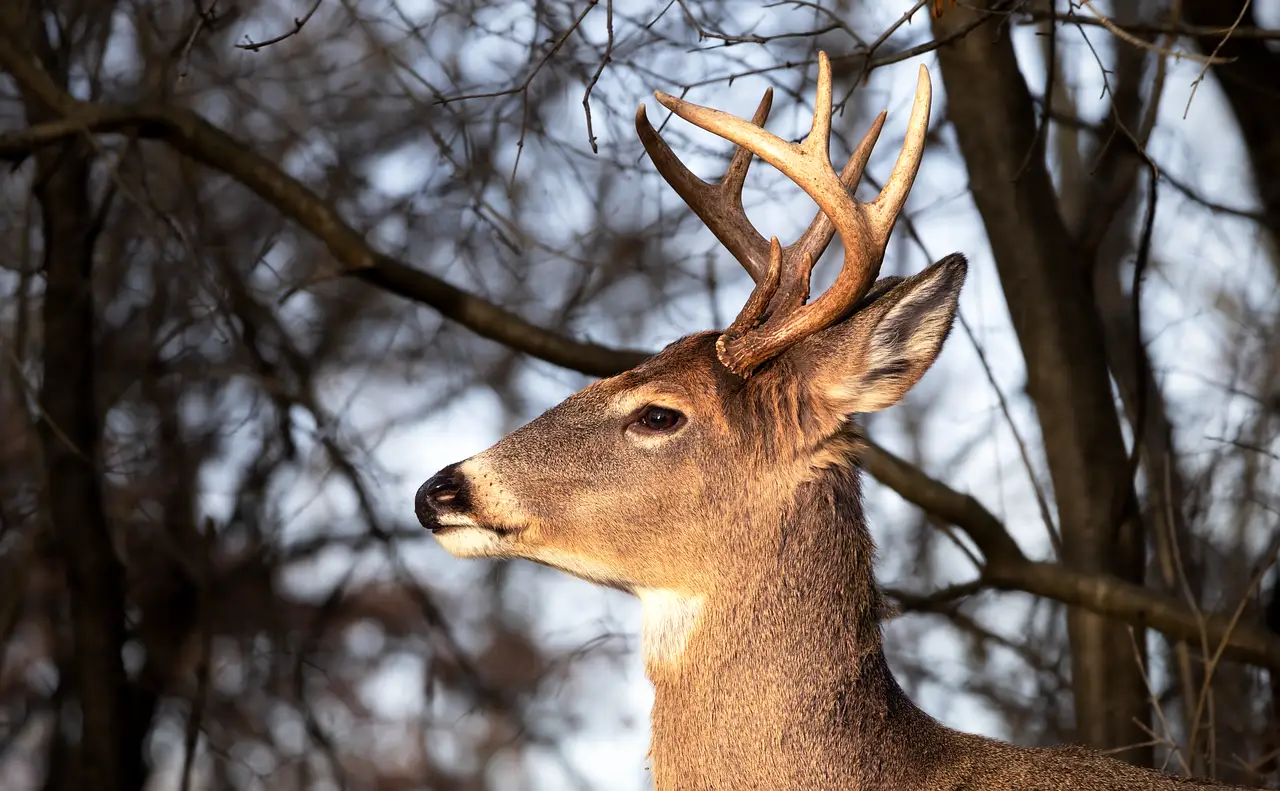
Where Do Bucks Go After the Rut?
After the rut, bucks usually shrink their range and shift to the safest food nearby, but only if recovery, food, and hunting pressure line up. Miss that filter, and you waste sits on fields they never reach in daylight. This guide shows how those three factors change post-rut movement and how to pick a late-season setup that fits them.
This guide is part of our Bowhunting the Whitetail Rut: Timing, Tactics and Late-Season Adjustments series.
Why post-rut bucks move the way they do
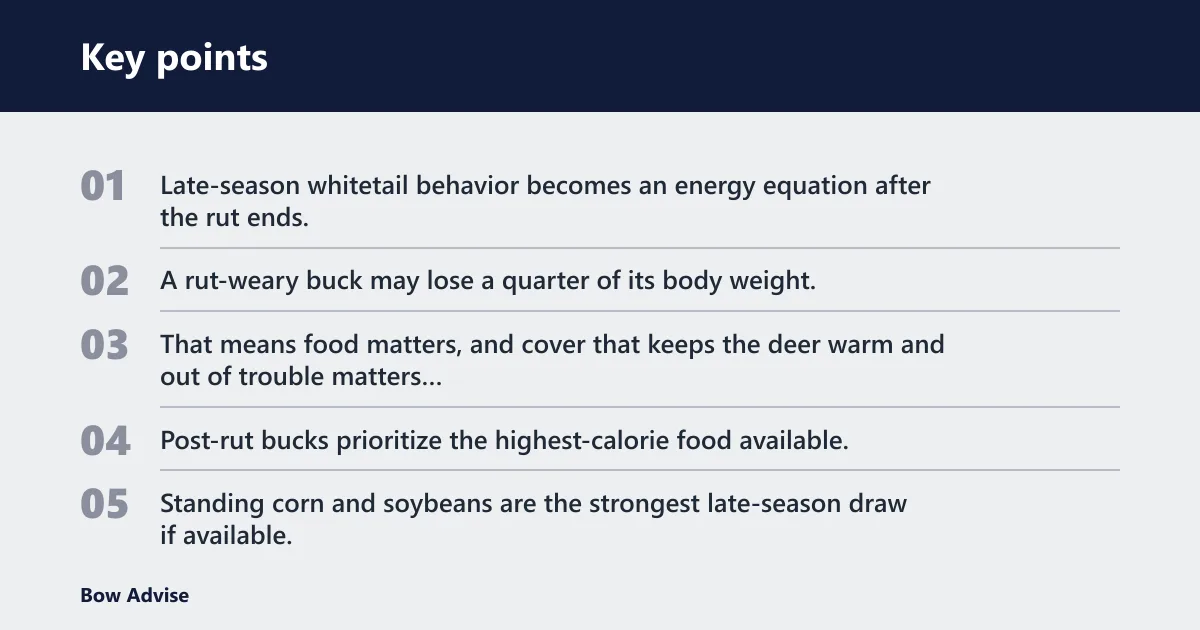


Late-season whitetail behavior becomes an energy equation after the rut ends. A rut-weary buck may lose a quarter of its body weight, so it must recover calories while avoiding extra risk. That means food matters, and cover that keeps the deer warm and out of trouble matters too.
Energy recovery after heavy rut activity
Post-rut bucks prioritize the highest-calorie food available. Standing corn and soybeans are the strongest late-season draw if available, followed by waste grain, brassicas, browse, and recent clearcuts. Not every buck hits the same food at the same hour. The strongest local fuel source gets the most daylight attention.
How body condition changes movement
A buck in poor condition cannot afford long, open walks just to reach average food. He usually favors the shortest route that balances calories gained against risk taken. That makes the best late-season setup a local choice, not a countywide theory.
How pressure alters travel
Pressure changes the route before it changes the food choice. Bucks under heavy pressure shift deeper, use tighter cover, and stay closer to thermal bedding. Hunting pressure also makes them less likely to step into a field edge in daylight, even when the food is strong. Visible access mistakes, repeated sits, and orange-flag traffic can kill the setup faster than cold weather helps it.
Where do bucks go after the rut?
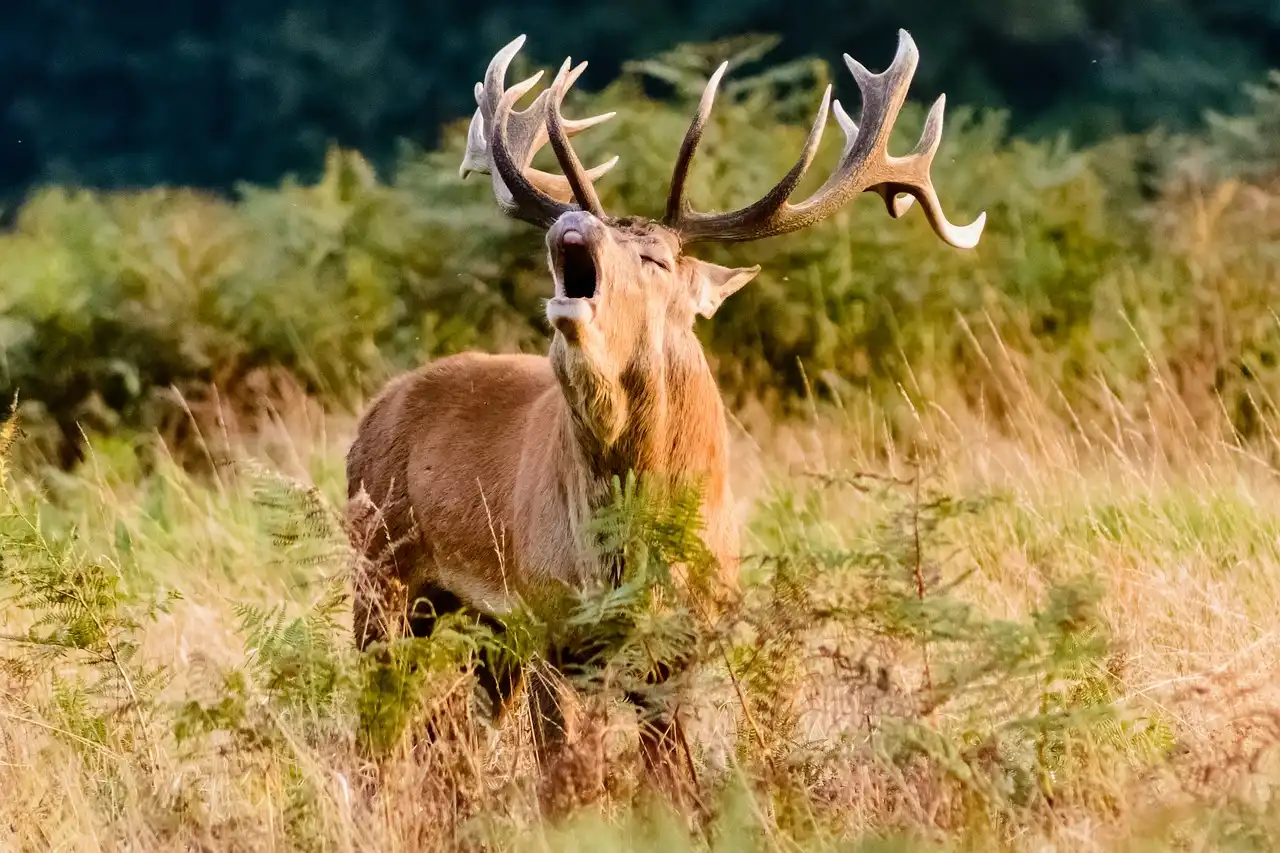
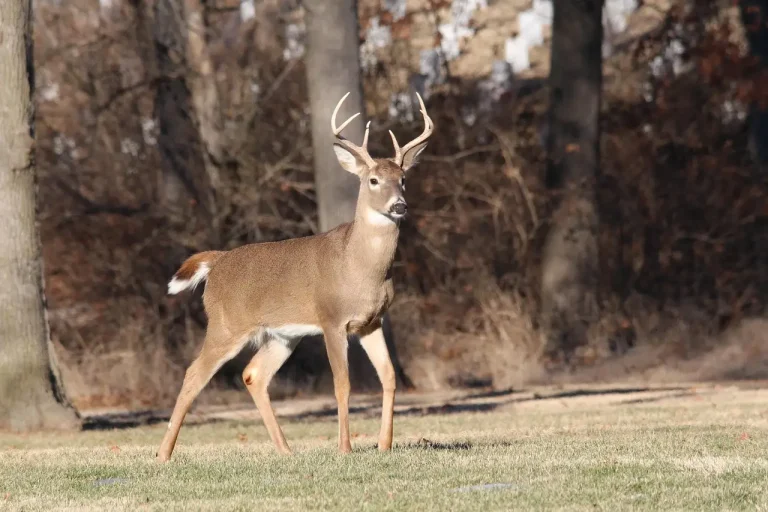
They usually move toward the nearest high-calorie food, but only if the route stays secure and the bedding nearby feels safe. Many mature bucks hold close to thermal cover, then make short evening moves to food, especially when the food source sits near bedding. Travel corridors between those two pieces often matter more than the food itself.
Food first, but not always first on the clock
Late-season bucks do not all arrive at the same time. Some show after sunset. Some show only on storm edges. Others stay in cover until a cold front or a fresh pressure break gives them confidence. That is why a buck sign plan should separate daylight feeding from nighttime feeding instead of assuming the field is empty or full based on one camera photo.
Thermal cover close to feeding areas
Late-season bucks also seek the warmest cover they can find. South-facing slopes are warmer bedding areas because they get more sun and less wind exposure. Conifers like cedar, pine, and hemlock cut wind and hold heat. Lee-side bedding near food often produces the cleanest setup because a buck can feed late and still stay close to cover.
Travel between bedding and food
Funnels and pinch points between bedding and food are often the best late-season intercept spots, especially when the food source is large or pressured. Oak ridge transitions, creek crossings, shelterbelt edges, and field corners can all force deer through a narrower lane. Those places matter most when the nearest food is too open to hunt from the edge.
Say your main food is about a 20-acre bean field bordered by thick conifers on the north side. If deer exit the cover before dark, a stand on the downwind pinch between bedding and beans is usually better than a random field edge, because it intercepts movement instead of hoping for a visible feeding deer.
What food sources matter most after the rut?
Standing corn and soybeans usually lead the list, because late-season bucks want the highest-calorie food nearby. Waste grain in cut fields can be excellent when snow or pressure makes the bigger fields less attractive. Brassicas, browse, and recent clearcuts matter too, but their value depends on what else is available in that area.
Standing corn and waste grain
Standing corn can often hold deer for days if cover and entry pressure stay low. Soybeans can still draw hard where pods remain or where deer can feed without exposing themselves. Waste grain in cut fields is a late-season food source that often gets overlooked because it looks less obvious than a green plot or a standing crop.
Soybeans and brassicas
Brassicas can be a strong late-season draw, especially after frost and repeated cold. Soybeans remain important when pods are accessible, but a field that looks good from the road may still fail if deer feel exposed crossing open ground. In pressured areas, the best food is often the one that sits closest to cover rather than the one that looks the most productive on paper.
Browse and recent clearcuts
Browse and recent clearcuts matter when cropland is limited or heavily hunted. Young clearcuts can provide tender woody growth and edge cover in the same place. That combination matters because a buck can feed without leaving security for long. Where food is thin, those cutovers can outproduce a distant field that looks better from a truck.
Thermal cover that holds late-season bucks
Thermal cover matters nearly as much as food once the rut ends. Bucks recovering from rut activity often stage in places that block wind and keep body heat in. South-facing slopes, conifers, cedar, pine, hemlock, and thick lee-side bedding all fit that need. The warmer the bedding, the more likely a buck is to hold nearby through cold, still periods.
South-facing slopes
South-facing slopes warm faster and hold less direct wind than exposed north-facing timber. They can become the first bedding choice after a cold snap, especially when the slope is near a dependable food source. A hunter should treat that cover as both a bedding clue and a route clue, since bucks often angle out of it late.
Conifers and dense bedding
Cedar, pine, and hemlock give deer a wind break and a heat break. In late season, that can matter as much as food quality. A buck may leave a better field option untouched if his nearest thermal pocket already meets his recovery needs. That is one reason bedding-edge setups often beat a straight food sit when pressure is high.
Lee-side bedding near food
Lee-side bedding gives a buck cover from the wind and a fast path to food. It also creates predictable exit lines when the wind stays steady. If the best food sits within a short walk of that bedding, the hunt often becomes a narrow window instead of a wide-open evening watch.
When cold fronts change the plan
Cold fronts can improve movement, but only when they push deer to feed earlier or harder than usual. A ten-degree temperature drop is a key late-season trigger. On cold afternoons, deer are on the best food near secure bedding. The strongest change usually shows in the last part of the day, not at daylight.
Temperature drop and late-day movement
A sharp drop in temperature can move deer from bed to feed sooner, especially if the food is already close to thermal cover. That is why late-day movement often rises after a front. The front does not create deer. It changes how comfortable they are with leaving cover before dark.
Best sit windows after a front
Afternoon sits over the best nearby food usually get the first look after a front. If the deer are living close to bedding, a setup on the first secure lane into the field can be better than a wide-open view of the whole food source. When the front is paired with light pressure, the window often opens earlier.
When weather does not move deer
Cold weather does not fix poor access, overhunted edges, or a food source that is too open. It also does not guarantee daylight movement if the best food is far from cover or if deer are already being pushed at night. A front can sharpen movement, but it cannot rescue a bad setup.
How to read scrapes and camera data
Scrapes still matter after the rut, but mostly as sign and inventory, not as a simple daylight promise. Field-edge scrapes are useful for inventory but usually hit at night. Bedding-area scrapes are more likely to be hit in daylight. Trail cameras should shift from rut inventories to funnels, pinch points, and weather-informed patterning.
Field-edge scrapes versus bedding-area scrapes
Field-edge scrapes can tell a hunter which bucks still travel an area, but the daylight odds are usually low once the rut fades. Bedding-area scrapes are more useful for daytime movement because they sit closer to where bucks feel secure. Post-rain refreshening can make both kinds of scrapes readable again, but sign alone should not override food and bedding pressure.
Using cameras to find funnels and pinch points
Late-season cameras work best as inventory tools on travel corridors, not just on food. Move them from rut heavy mineral or scrape locations toward funnels, pinch points, oak ridge transitions, and the narrow approaches into food. Weather-informed patterning matters too: a camera on a pinch point can show whether bucks move early after a front or wait for deep evening cover.
A common first-timer mistake is hanging a camera on the middle of a cut bean field and expecting a daylight pattern. If deer only cross the field edge after dark, the camera tells you the food is used, but not where to sit. A pinch point between the bed and the beans gives a better answer.
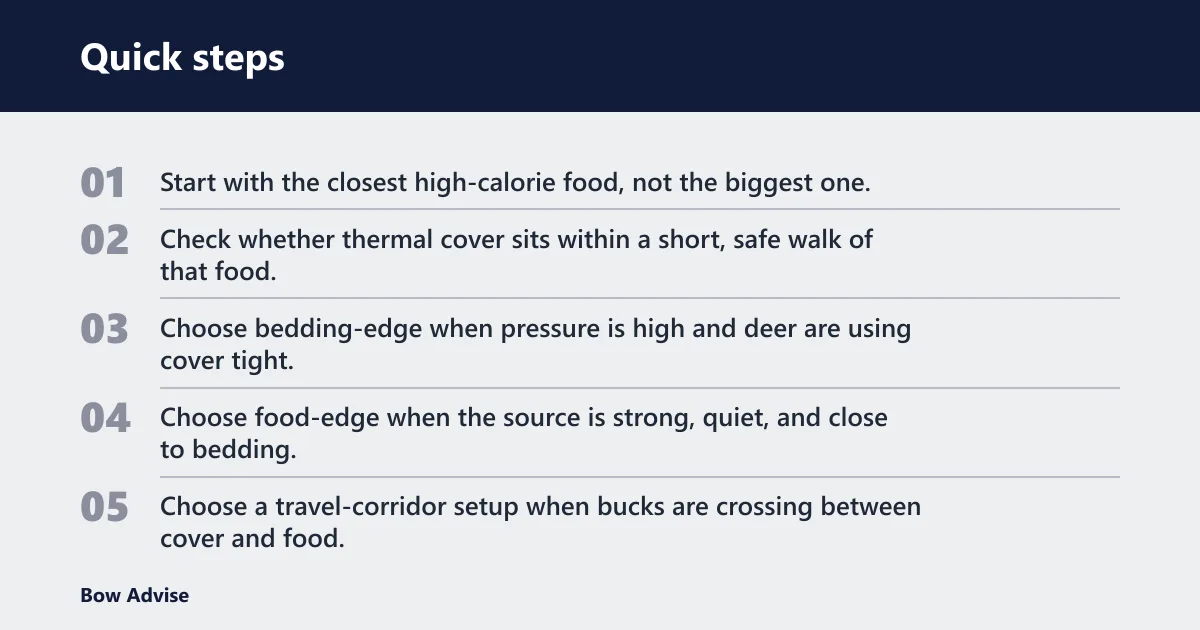
- Start with the closest high-calorie food, not the biggest one.
- Check whether thermal cover sits within a short, safe walk of that food.
- Choose bedding-edge when pressure is high and deer are using cover tight.
- Choose food-edge when the source is strong, quiet, and close to bedding.
- Choose a travel-corridor setup when bucks are crossing between cover and food.
- Use the cold front to time the sit, not to replace the right location.
Where bucks go after the Rut: 12 setup scenarios
This matrix helps turn the post-rut filter into a stand choice. Match the weather, food quality, bedding, and pressure level before choosing where to sit. The best stand type changes when any one of those pieces changes.
| Weather | Food quality | Bedding cover type | Pressure level | Best stand type | Hunt timing recommendation |
|---|---|---|---|---|---|
| Cold front, 10-degree drop | Standing corn | Conifers on lee side | Low | Food-edge stand on first quiet access | Last 3 hours before dark |
| Cold front, steady north wind | Soybeans with pods | South-facing slope | Moderate | Travel-corridor stand between slope and beans | Midafternoon into dusk |
| Light freeze, calm air | Waste grain | Thick cedar pocket | High | Bedding-edge stand on the downwind exit | First evening after the freeze |
| Cloudy, dropping pressure | Brassicas | Hemlock bedding | Moderate | Pinch point near plot entrance | Afternoon until legal light fades |
| Sunny, cold mornings | Browse in cutover | Recent clearcut edge | Low | Edge stand that covers the first feeder lane | Late morning if deer are already settled |
| Warm for season | Standing corn | South-facing slope | High | Corridor stand only, not field edge | Short afternoon sit after bedding is confirmed |
| Snow cover, rising wind | Waste grain | Conifers | Moderate | Lee-side bedding setup | First legal light to noon scouting style sit |
| Cold, bright, stable | Brassicas plus nearby browse | Cedar and pine mix | Low | Food-edge stand with hidden access | Late afternoon |
| Post-rain clearing | Soybeans | Oak ridge transition to bedding | Moderate | Transition stand on the first narrow lane | Same afternoon after the rain ends |
| Cold front after heavy pressure | Standing corn | Deep cedar bedding | High | Bedding-edge stand with minimal intrusion | One short evening sit only |
| Windy, cold, open fields exposed | Browse in clearcut | Wind-blocking hemlock edge | Moderate | Blind corridor stand tucked off the trail | Last 2 to 3 hours before dark |
| Mild day after fresh snow | Brassicas near beans | Mixed thermal cover | High | Pinch point between bedding and the nearest food | Afternoon only, with one clean exit |
Frequently asked questions
Where should I hunt bucks after the rut?
The best choice is the setup that sits between secure bedding and the best local food. If pressure is low, a food-edge stand can work. If pressure is high, a bedding-edge or corridor stand is often better. Hunt the route deer trust, not just the field they might reach.
Do bucks move more after a cold front?
Often yes, especially in the late afternoon. A ten-degree temperature drop is a useful trigger because it can push deer to feed sooner. But a front only helps when the food is close enough and the access is quiet enough. Poor entry or too much pressure can cancel the benefit.
Do bucks still use scrapes after the rut?
Yes, but mostly as sign, not as a guaranteed daylight stop. Field-edge scrapes are useful for inventory and often get hit at night. Bedding-area scrapes can show better daylight use. After rain, refreshed scrapes can reveal which bucks still use an area, especially near cover.
Where do whitetail bucks go after the rut?
Whitetail bucks usually narrow their movement and focus on nearby food, cover, and safety. Mature deer often stay close to thermal bedding until late-day feeding windows open. If the nearest food is poor or heavily pressured, they may shift to a different corridor or hold in cover longer.