What Are the Phases of the Whitetail Rut?
The whitetail rut is often described in five field phases: pre-rut, lockdown, peak rut, post-rut, and a later second rut. Phase matters because scrape use, buck travel, and stand choice can shift within days. Guess wrong and prime sits get burned on dead cover, poor access, and empty travel routes. This guide shows how to identify each phase from scrapes, rubs, trail-camera timing, buck movement, and regional differences.
This guide is part of our Bowhunting the Whitetail Rut: Timing, Tactics and Late-Season Adjustments series.
What are the phases of the whitetail rut?
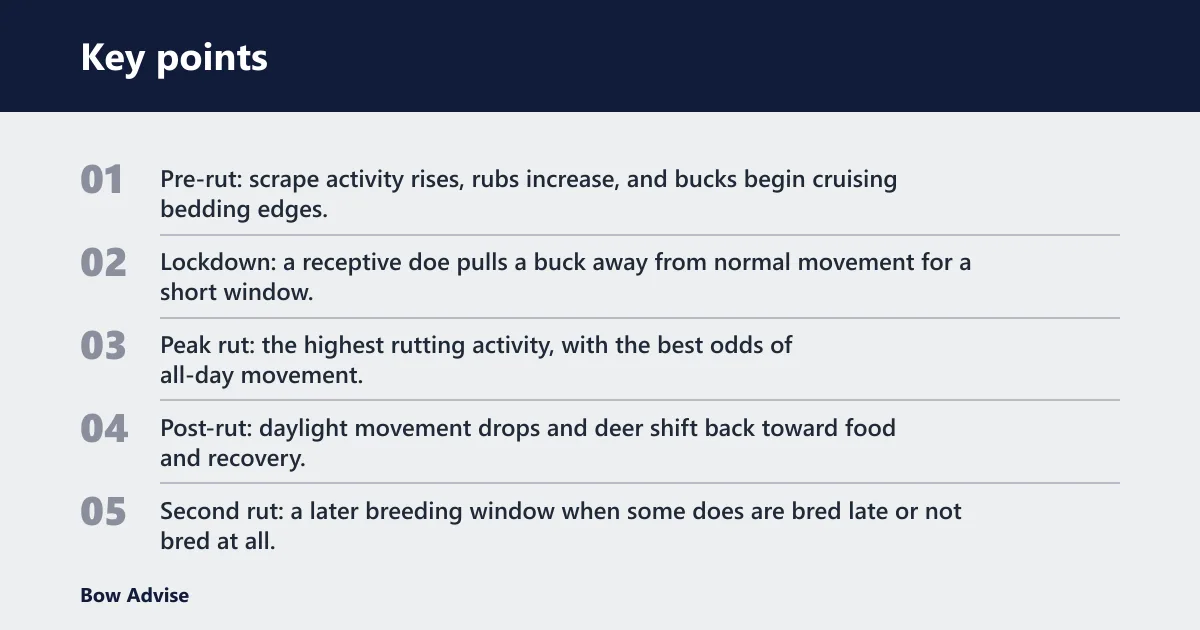


The main phases are pre-rut, lockdown, peak rut, post-rut, and second rut. The names matter less than what deer are doing on the ground. Bucks do not move the same way in every phase, and the best stand location changes with fresh sign, daylight timing, and doe behavior.
Rut phase order at a glance
- Pre-rut: scrape activity rises, rubs increase, and bucks begin cruising bedding edges.
- Lockdown: a receptive doe pulls a buck away from normal movement for a short window.
- Peak rut: the highest rutting activity, with the best odds of all-day movement.
- Post-rut: daylight movement drops and deer shift back toward food and recovery.
- Second rut: a later breeding window when some does are bred late or not bred at all.
Why the names matter less than the sign
Two hunters can sit the same week and read different phases because they are seeing different sign. One hillside may show fresh rub lines and new scrapes near bedding cover, which points to pre-rut. Another property may show almost no buck movement except one doe group under close watch, which fits lockdown.
How day length sets the timing
Photoperiod, or day length, is commonly described as a major biological factor behind estrus timing. That is why rut timing stays more consistent than moon-only theories suggest. Moon phase may change when deer show themselves in daylight, but it does not explain the rut as well as changing daylight does.
Rut phase decision table
| Phase | Visible sign | Likely deer movement window | Best stand location | Most common misread |
|---|---|---|---|---|
| Pre-rut | Fresh scrapes, active rubs, scent checking near bedding | Early morning and late morning, with some evening cruising | Bedding edges, travel routes, scrape lines | Confusing early scrape use with peak rut |
| Lockdown | Few fresh tracks, sudden drop in buck sightings, a doe and one buck together | Movement looks low all day, often in short bursts | Close to known doe bedding or secluded cover | Calling it a dead period and leaving too soon |
| Peak rut | Heavy tracking, fresh sign in corridors, bucks crossing open lines at odd hours | All day, including midday movement | Funnels, pinch points, travel corridors | Hunting only dawn and dusk |
| Post-rut | Sign thins out, rubs age, bachelor groups break up | Mostly early and late, with shorter daylight windows | Food sources, recovery cover, thick bedding nearby | Staying on the same rut stand after movement fades |
| Second rut | Scattered chasing returns, fresh scrapes may reappear | Brief late-day and midday windows around receptive does | Doe areas, food edges, travel routes near bedding | Assuming every late-November or December move is still peak rut |
What does pre-rut look like?
Pre-rut is the first clear shift from summer patterns. Scrape activity increases, rubs show up along travel routes, and bucks begin cruising bedding areas instead of staying locked into bachelor-group patterns. Morning hunts near bedding and travel routes are usually the strongest bet once this sign starts appearing.
Scrape and rub activity
Fresh scrapes are one of the easiest pre-rut clues to read. Look for dirt that has been worked clean, overhanging limbs that have been chewed or licked, and new sign appearing in the same travel lane more than once. Rub lines usually build near edges that connect bedding to feeding cover.
Cruising near bedding areas
Pre-rut bucks often cruise the downwind side of bedding cover, checking for does before daylight fully settles in. That makes morning the key window. A buck crossing from thick cover to a transition edge at 7:30 a.m. is often more useful than the same deer seen at dusk, because morning cruising is a classic pre-rut clue.
Picture a 24-acre oak flat with one fresh scrape at the edge of a cattail pocket and two new rubs on the trail out. That setup points more to pre-rut than peak rut. The likely move is a short early-morning cruise, not a full-day chase through every cover type on the property.
Best dawn setups
At dawn, pre-rut deer are most predictable near bedding edges, access routes between bedding and feeding, and scrape clusters that sit just off thick cover. Midday usually slows unless a buck is actively checking a doe pocket. Last light can still be productive, but the strongest sign often comes from morning movement.
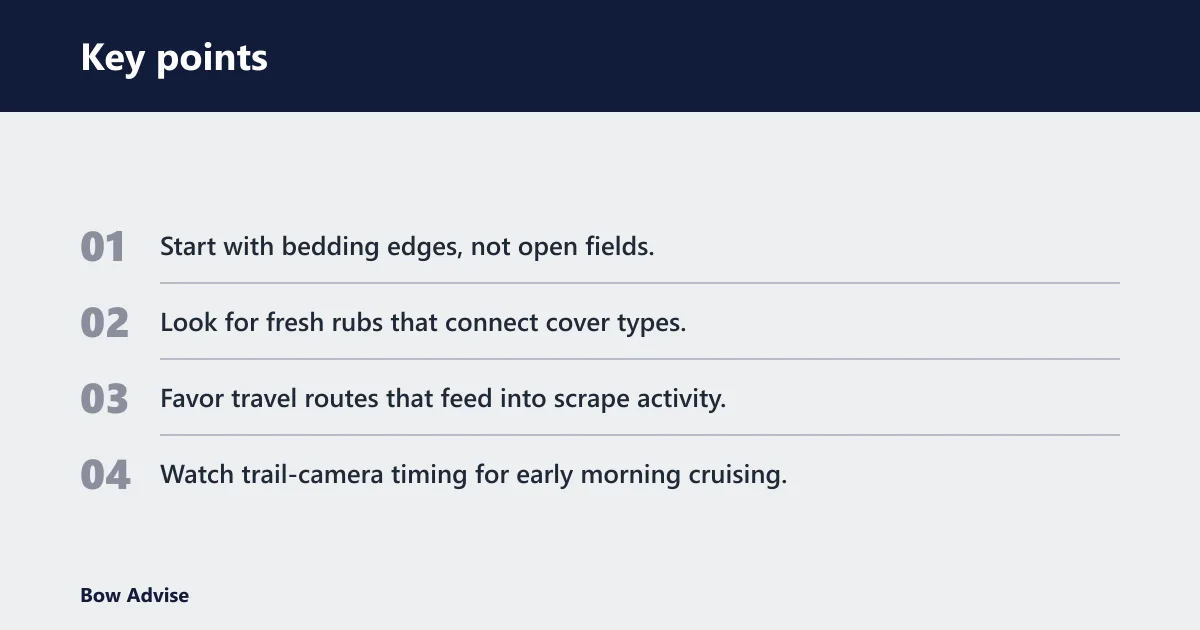
- Start with bedding edges, not open fields.
- Look for fresh rubs that connect cover types.
- Favor travel routes that feed into scrape activity.
- Watch trail-camera timing for early morning cruising.
How long does the pre-rut last?
Pre-rut length depends on region, but one central U.S. window commonly starts around November 1-5. In the upper Midwest, peak rut timing can follow soon after, so pre-rut may feel short. Farther south, the same transition can stretch longer because local breeding timing runs later.
What happens during lockdown?
Lockdown is the short period when a buck stays with a receptive doe and movement can seem to vanish. It typically lasts 4-5 days. Hunters often think the area went dead, but the deer are usually still there; they are simply tied up in cover and moving less openly.
Why movement seems to slow
When a buck is focused on a receptive doe, normal cruising stops. That can remove the biggest visible deer from the pattern at once. Tracks may disappear from the usual trail, and scrape use often slows because the buck is no longer checking the same sign lines as often.
How long lockdown usually lasts
The short answer is 4-5 days. That is long enough to fool hunters who are reading sign only from the trailhead or food plot edge. The key is to wait for a return of cruising sign, fresh tracks, and daylight crossings before assuming the rut is over.
What hunters misread most often
A common mistake is pulling stands after one slow sit and calling the woods “dead.” Another is shifting to food too early while a buck is still bedding with a doe nearby. Lockdown can also be mistaken for post-rut, even though the rut window has not actually closed yet.
Suppose a funnel had fresh track crossings for three days, then almost nothing for four days, while a doe group vanished from the camera. That pattern fits lockdown better than a true post-rut slide. The mistake would be abandoning the funnel just before movement starts again.
When is peak rut?
Peak rut is the highest rutting activity period, and it is the best time to expect all-day movement potential. One upper Midwest window often runs from November 3-5 to November 10-13. Another source groups the first peak in late October and early November, with a secondary peak often in mid-November.
All-day movement potential
During peak rut, deer can move at any hour. Dawn is still useful, but midday becomes real hunting time instead of dead time. Bucks are covering ground to find does, so a hunter may see a mature deer crossing a funnel at 11:15 a.m. or 1:40 p.m. as easily as at first light.
Funnels, pinch points, and travel corridors
Peak rut is the phase for places that force movement. Funnels, pinch points, creek crossings, narrow timber strips, fence gaps, and travel corridors all become more valuable because bucks are moving with purpose and less caution. Wide-open food plots can work, but the best odds often sit on forced movement.
Best calling opportunities
Calling is usually strongest in peak rut because bucks are on their feet and willing to investigate. Grunts, bleats, and subtle calling can pull a buck into view when he is already cruising. The best response often comes when the setup matches a travel corridor that a buck is already using.
What are the phases of the deer rut?
The deer rut is commonly broken into pre-rut, lockdown, peak rut, post-rut, and second rut. The labels help only if they are tied to what the woods are showing right now. Fresh scrapes, deer crossing times, and doe behavior are better clues than the name alone.
What should you hunt after peak rut?
After peak rut, movement often drops and food becomes more important. Bachelor groups are usually broken up, bucks are tired, and deer start recovering energy. The best setups shift toward food sources, recovery cover, and travel routes that connect bedding to late-day feeding areas.
Post-rut behavior
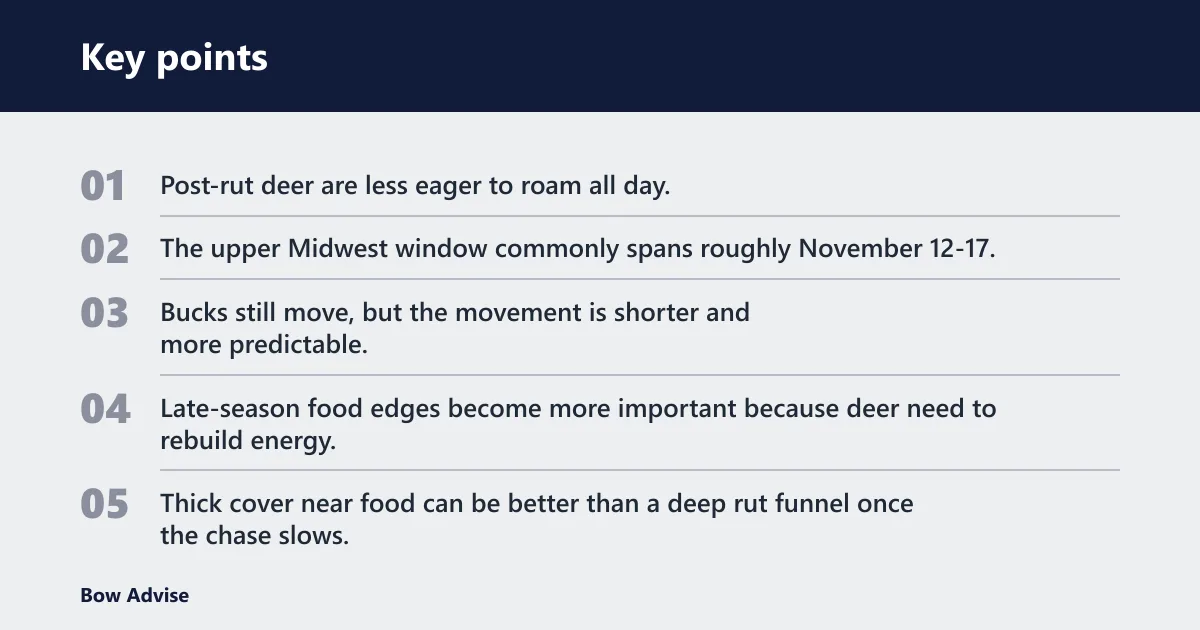
Post-rut deer are less eager to roam all day. The upper Midwest window commonly spans roughly November 12-17, which helps explain why some areas feel like they turn cold quickly after the main chase period. Bucks still move, but the movement is shorter and more predictable.
Food sources and recovery cover
Late-season food edges become more important because deer need to rebuild energy. Thick cover near food can be better than a deep rut funnel once the chase slows. Look for last-light exits from bedding and for feeding routes that stay close to protection.
How the second rut creates another window
The second rut exists because not every doe is bred during the primary rut. A later window opens when unbred does return to estrus, and in some cases young does enter heat as well. One source describes a smaller second rut in December, which can create another brief shift in movement.
A common first-timer mistake is treating every December scrape as a fresh peak-rut signal. Often it is just a small second-rut pulse on top of a generally post-rut pattern. The better move is to hunt doe concentrations and food, then watch for a short burst of cruising.
What phase of the rut is best for calling bucks
Peak rut is usually the best phase for calling bucks because deer are already moving and searching. Pre-rut can also work when a buck is cruising bedding cover. Post-rut calling is less reliable because movement has dropped and bucks are more likely to prioritize recovery over investigation.
Photoperiod and moon phase
Photoperiod is the primary driver of rut timing because changing daylight controls when deer cycle into estrus. Moon phase gets more attention from hunters because it can affect visible movement, but it is not the main reason the rut happens when it does. Use lunar charts as a movement clue, not a breeding calendar.
Why photoperiod is the primary driver
Day length changes gradually and predictably, which makes it a better explanation for rut timing than moon phase alone. That is why the broad annual timing is stable from year to year, even though daylight activity on a given sit may look different. The biology follows daylight first.
What moon phase may influence
Research cited by Outdoor Life, including work by Marcus Lashley at North Carolina State University on GPS-collared deer, found more daytime morning movement during a New Moon. That same reporting notes Full Moon conditions can mean deer move less at night and more during the day. This affects visibility, not rut timing itself.
How to avoid overreading lunar charts
Do not let moon phase override fresh sign. If you have active scrapes, daylight crossings, and cruising bucks, hunt the phase the woods are showing. If the sign says lockdown or post-rut, a promising moon chart will not fix a bad phase read.
How do whitetail rut phases vary by region?
Rut phases vary by region because local breeding timing shifts with latitude and photoperiod. Northern deer often hit peak rut earlier and tighter on the calendar. Southern deer can run later and feel stretched out, which changes when pre-rut sign appears and when post-rut begins.
Northern timing
In the upper Midwest, the pre-rut can begin around November 1-5, peak rut may run from November 3-5 to November 10-13, and post-rut may follow around November 12-17. That short, compressed window means hunters need to react quickly when sign changes.
Southern timing
Farther south, rut timing often spreads out and may occur later. That means a hunter who reads a peak-rut pattern in one state may still be in pre-rut or lockdown in another. The practical fix is to key on local sign rather than a statewide calendar.
How to adjust stands by region
North country hunters often need earlier stand shifts as sign changes fast. Southern hunters may get more useful time from one area because the phase transition is slower. In both cases, the best setup is the one that matches current movement, not the one that looked good two weeks ago.
Frequently asked questions
What are the stages of the whitetail rut?
The stages are pre-rut, lockdown, peak rut, post-rut, and second rut. The best way to read them is by sign and movement, not by the name alone. Fresh scrapes, cruising bucks, daytime crossings, and doe concentration tell you more than a calendar label.
What happens during the lockdown phase of the rut?
During lockdown, bucks stay with receptive does and move less openly. It typically lasts 4-5 days, and hunters often misread it as a dead woods phase. The better read is to keep watching doe bedding and nearby cover until cruising sign returns.
What is the second rut?
The second rut is a later breeding window that happens because not every doe is bred during the primary rut. It can also include young does entering heat. A smaller second rut is often noted in December, and it can create another short burst of movement.
Do moon phases affect whitetail rut timing?
Moon phase may influence how much deer move in daylight, but it is less accepted than photoperiod as the main driver of rut timing. Research cited by Outdoor Life found more daytime morning movement during a New Moon and more daytime movement with Full Moon conditions. That is movement timing, not breeding timing.