Does Rattling Work for Bowhunting? Rut Timing and Setup
Yes, rattling can work for bowhunting, but it is often worth trying mainly during the pre-rut through peak rut, when bucks are more likely to be cruising and cover is thick. On pressured or silent deer, it often does more harm than good. Bad rattling can pull the wrong buck, educate deer, and blow a setup. This guide shows when to rattle, when to stay quiet, and how to match the tactic to rut phase, cover, and buck pressure.
This guide is part of our Bowhunting the Whitetail Rut: Timing, Tactics and Late-Season Adjustments series.
Does rattling work for bowhunting?


Yes, especially when a buck thinks a fight is worth checking. The best windows are the pre-rut and the brief post-lockdown period, when daylight movement rises and buck competition is high enough to make antler noise believable. During those windows, a territorial or competitive buck may come in fast, hang up, or circle to sort out the sound.
Rattling is less useful once does are the main draw. When receptive does pull bucks away from competition, calling noise can lose to a real breeding chance. That is why rattling can work, but it is not a default rut tactic. It is a timed tactic.
What rattling can and cannot fix
Rattling can pull a curious, competitive buck into range. It cannot fix bad wind, a visible stand, or a parcel where deer have already learned that antler noise means danger. It also does not replace patience. If deer are already moving naturally past your setup, silence is often the better play.
A common first-timer mistake is to rattle hard because no deer is visible. On a roughly 20-acre parcel with weekly pressure, that can teach the local deer that the sound means trouble. One bad call can hurt the whole sit.
When should you start rattling for bucks?
Start when pre-rut sign shows that bucks are traveling more in daylight, checking scrapes, and rubbing in the same cover. That is when competition starts to matter. Rattling also has value after the brief lockdown period, when bucks begin moving again and may respond to a challenge before does fully control their attention.
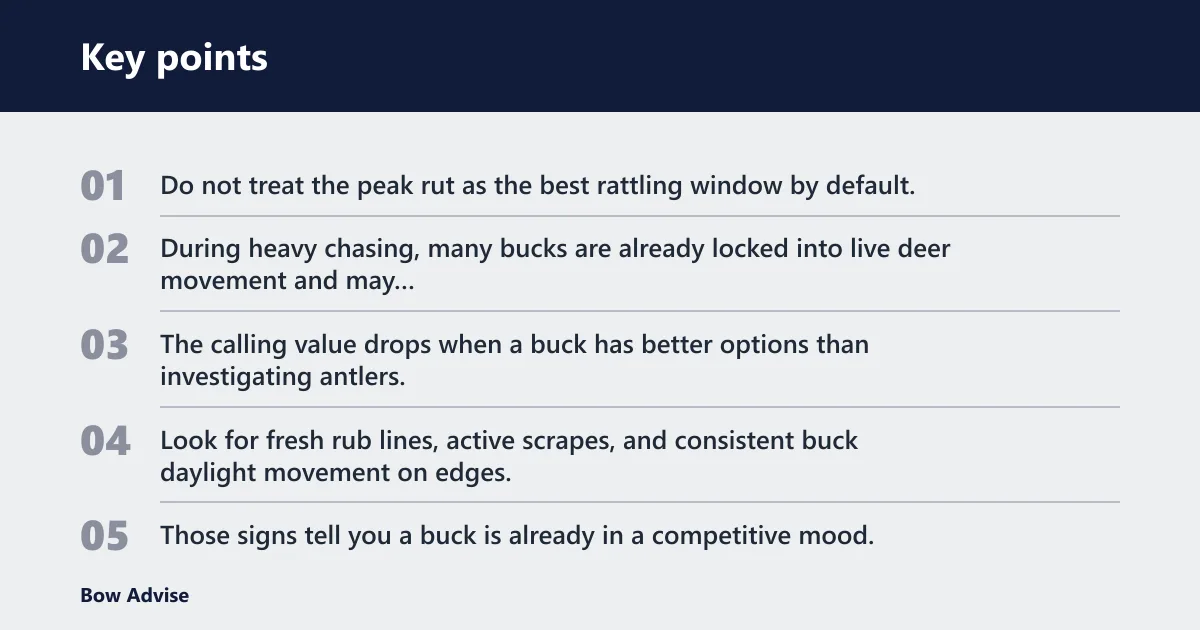
Do not treat the peak rut as the best rattling window by default. During heavy chasing, many bucks are already locked into live deer movement and may ignore noise or move only after dark. The calling value drops when a buck has better options than investigating antlers.
Pre-rut timing signs to watch
Look for fresh rub lines, active scrapes, and consistent buck daylight movement on edges, funnels, and doe travel routes. Those signs tell you a buck is already in a competitive mood. If you are seeing younger bucks cruise and a mature buck’s track pattern tighten up, rattling becomes more realistic.
Use the tactic most often in cover where a deer can hear the sound and still move in unseen. Open fields make the noise obvious and the deer exposed. Thick cover lets the sound feel believable.
Peak rut changes that reduce calling value
During the strongest chase period, the tactic can still work, but the odds shift. Bucks may ignore a challenge if a hot doe is nearby or if the sound does not fit the deer’s immediate priorities. At that point, a short grunt sequence or no calling at all may be the better choice.
If you already have daylight deer moving through, keep the setup quiet. The more active the woods, the less you need to force interest.
Post-lockdown opportunities and limits
After the brief lockdown period, some bucks start looking for the next social cue. That is a good time to try a short sequence in thicker cover, especially if bucks are back on their feet and moving earlier. The limit is pressure: the more often deer have heard calling, the more likely they are to ignore it.
Should I rattle today?
Use the table as a quick filter before you touch the antlers. If the rut phase, wind, and cover line up, rattling may be worth the noise. If any one of those factors is wrong, skip it or switch to a softer tactic such as a grunt tube or no calling at all.
| rut phase | buck sign present | wind direction | hunting pressure | terrain openness | recommended calling choice | stop/skip criteria |
|---|---|---|---|---|---|---|
| pre-rut | fresh rubs, scrapes, daylight travel | wind keeps your scent off the expected approach | low to moderate | thick cover, edges, funnels | short rattling sequence, then scan | skip if deer are already close or downwind |
| peak rut | some sign, but active chasing is visible | crosswind or quartering-away wind | low | broken cover with visual screening | light rattling plus one short grunt | stop if a deer is angling to your downwind side |
| brief post-lockdown | recent buck movement, fewer does tied up | wind supports a hidden approach | moderate or lower | timber, creek bottoms, brushy transitions | rattle first, then a deeper grunt tube follow-up | skip if repeated calling has already educated the area |
| late rut or post-rut | weak sign, scattered movement | wind risky or shifting | high | open or noisy terrain | use a grunt tube only, or stay quiet | avoid rattling if visibility is poor and cover is thin |
How to read the table quickly
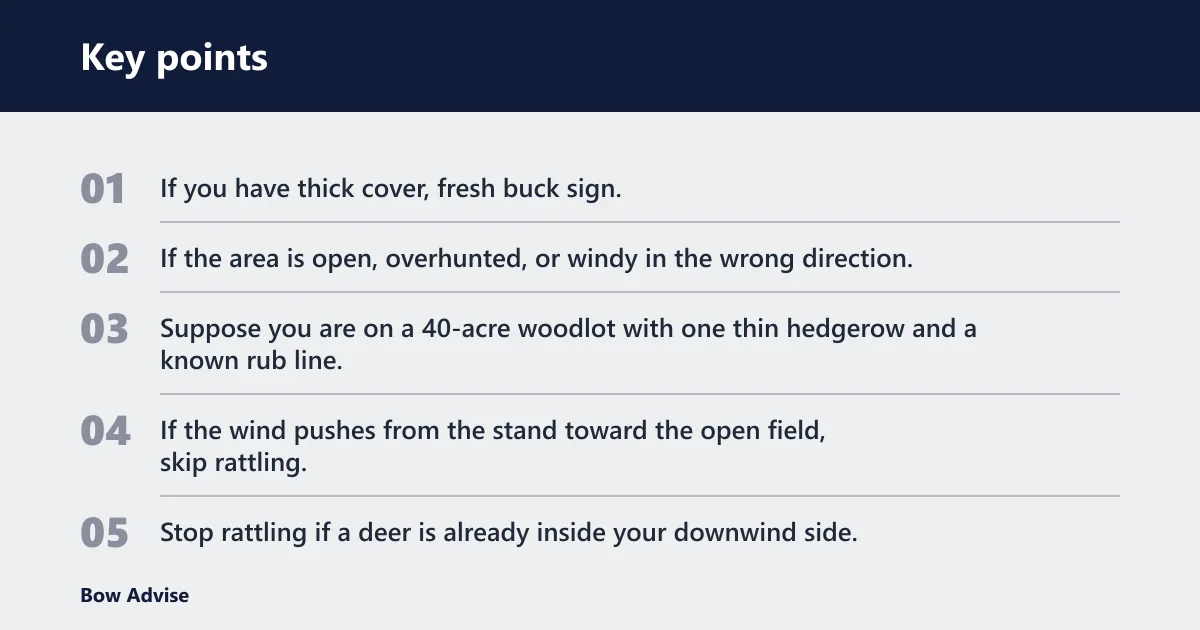
The shortest path is simple. If you have thick cover, fresh buck sign, and a wind that keeps your scent off the likely approach, a short sequence makes sense. If the area is open, overhunted, or windy in the wrong direction, the sound can spread farther than the deer can move unseen, which hurts the setup.
Suppose you are on a 40-acre woodlot with one thin hedgerow and a known rub line. If the wind pushes from the stand toward the open field, skip rattling. That setup turns a call into a broadcast.
Stop rules when wind, pressure, or cover are wrong
Stop rattling if a deer is already inside your downwind side. Stop if the cover is too open for a quiet approach. Stop if repeated calling has already made the woods suspicious. On small parcels and public land, less noise is often the better decision because deer can learn fast.
How to rattle whitetails without educating them
Use a short, believable sequence. Start with light tine tickling, then move into pushing and grinding, add louder clashing, pause briefly, and finish with a final hard separation. A common rule of thumb is that a 30-second sequence is enough in most cases. More noise usually means more suspicion, not more interest.
After the sequence, go still and scan. The next deer movement may be silent and fast. Mature bucks can charge in, but others will circle, hang up, or wait to see what the sound means.
A realistic calling sequence from start to finish
- Light tine tickling for a few seconds.
- Push and grind the antlers together.
- Build into louder clashing for a short burst.
- Pause and listen.
- Finish with a final hard separation.
That order matters because it sounds like two animals escalating, then breaking apart. Constant clashing sounds fake in the woods. A short sequence keeps the story believable.
How often to rattle during a sit
On all-day sits, a once-per-hour rule is a practical starting point. That keeps the setup from sounding overworked while still giving cruising bucks a chance to hear the sound. In the last light of the day, one well-timed sequence is usually better than multiple bursts.
If deer are moving nearby, call less. If the woods are quiet and you have good cover, one more sequence may be worth trying. Frequency should follow deer mood, not habit.
How to follow rattling with a grunt tube
A grunt tube can work with rattling or by itself. It can be adjusted deeper or higher-pitched, which helps match the age and mood of the deer you want to draw. Use it as a follow-up after rattling, or as a lower-profile option when you do not want the volume of antlers.
For a mature buck, a short, deeper grunt after the antlers stop can add realism. For a younger buck, a lighter follow-up can be enough. If the deer already seems keyed up, do not overcall.
Do bucks circle downwind after rattling?
Yes. Bucks may circle downwind to scent-check the sound, and that is one of the biggest reasons rattling fails. If a deer can get your scent, the whole setup can end fast. Calling into a deer’s 180-degree downwind can fail because the animal often tries to verify the challenge before committing.
Wind direction is not a side note. It is the setup. If the likely approach puts a buck behind your scent cone, the call may pull him just long enough to educate him.
How wind direction changes stand placement
Place the stand so the most likely approach stays out of your downwind side. A crosswind or quartering-away wind is often safer than a direct line into where the deer will travel. The goal is simple: make the buck work to investigate without ever getting a clean scent check.
Do not call when a deer is already behind your downwind side. That is the easiest way to lose the encounter.
When a downwind setup is a bad bet
If the terrain forces a buck to circle your back trail, skip rattling. If the wind swirls, skip rattling. If the deer can reach open ground and sort out the sound with a scent check, the call is helping the deer confirm danger rather than helping you bring it in.
Rattling antlers, grunt tube, and concealment
Rattling antlers work well when the noise needs to sound like real antlers. Bigger antlers create more volume, which can help in thicker cover or on windy days, but they must be carried quietly. A wrist strap keeps them quieter in transit, and they should be easy to stash after use so they do not swing or flash in the tree.
A grunt tube is a cleaner option when you want less movement and less noise. The two tools are not interchangeable. Antlers carry the fight story; the grunt tube adds a deer voice to it.
Choosing antlers versus a rattling bag
Real antlers are the stronger choice when sound quality matters. A synthetic rattling bag can be lower-profile and easier to carry, which may help on mobile hunts or on small parcels where gear noise matters. The tradeoff is sound. Do not assume a bag will fool every buck better than antlers.
Use the tool that matches the cover, pressure, and distance you expect. If the woods are thick and the setup needs volume, antlers are usually the better bet. If you need quiet carry and minimal movement, a bag may fit the hunt better.
How to set up the stand for low movement and fast shots
Back against a tree so your outline breaks up. Keep the bow ready with the release attached before you call. Keep the seat down for quick access, and leave a clear place to drop the antlers after the sequence. That reduces fumbling when a deer appears fast.
Also keep the antler movement low and inside the cover of the tree. Visible arm movement can flare a deer even if the sound is good. Scan constantly after the sequence. The first set of antlers you see may be the only chance.
How bucks react by age class
Mature bucks often show the strongest territorial response because they have more to defend and more to prove. Some charge in quickly. Others stop, circle, or hang up to sort out whether the fight is real. Younger bucks can still come in, but they may approach less aggressively or show up from the edge.
Pressure changes the reaction. A buck that has been called at before may respond differently than an unpressured deer in clean cover. That is why the same sequence can work one day and fail the next.
Why pressured deer often respond differently
On public land and other heavily hunted ground, repeated calling can educate deer. They learn to hang back, circle wider, or ignore the noise. Small parcels can be even worse because the deer have fewer safe routes and hear the same sounds over and over.
If the area has a lot of hunting traffic, use rattling sparingly. Sometimes a quiet stand with a grunt tube or no calling beats a louder approach.
Beginners versus advanced bowhunters
Beginners should start with the simplest rule set: use rattling only in pre-rut or brief post-lockdown windows, keep the sequence short, and avoid open or risky wind. Advanced bowhunters can fine-tune the volume, add a grunt follow-up, and read buck movement to decide whether to call once or stay silent.
For both groups, concealment and wind control matter more than perfect antler sound. A good call cannot fix a poor setup.
Frequently asked questions
Does rattling work for bowhunting during the rut?
Yes, but the best odds are usually during the pre-rut and the brief post-lockdown period, not at every point in the rut. Bucks respond when competition matters and they can investigate without blowing the setup. During heavy chasing, a deer may ignore the sound or choose a real doe over a fake fight.
How often should you rattle a deer during a hunt?
A once-per-hour rhythm is a practical rule for all-day sits. It keeps the woods from sounding overworked and gives cruising bucks a chance to hear the call without constant noise. If deer are already active nearby, call less. If the area is quiet and well covered, one more short sequence can be enough.
Will bucks circle downwind after hearing rattling?
Often yes. Deer try to scent-check the sound, and that means your wind setup matters as much as the call. If the likely approach puts the buck behind your downwind side, the call can fail fast. A crosswind or quartering-away wind is usually safer than letting the deer work straight into your scent cone.
Should I use rattling antlers or a rattling bag for bowhunting?
Use antlers when you want the most natural sound and more volume. A rattling bag can be easier to carry quietly and may fit a low-profile setup better. Neither tool is magic. Pick the one that matches the cover, pressure, and how much movement you can hide from the deer.
How do I avoid spooking deer while rattling from a tree stand?
Keep your body hidden behind the tree, make the sequence short, and avoid visible antler movement. Have the bow ready with the release attached, keep the seat down for quick access, and drop the antlers in a quiet spot after the call. Scan constantly, because a deer may appear fast and silent.