Quartering Away vs Broadside Shots: When to Wait and Shoot
Quartering-away is a green light only when the arrow can enter behind the near-side ribs and exit through the off-side shoulder pocket; broadside is the safer wait when you want the largest margin for error. Bad angle calls can turn a good deer into a lost blood trail, a shallow hit, or a wound that should never have happened. This guide breaks down quartering-away versus broadside shots, the shot window for each, and the angles to pass on.
Broadside vs quartering away: the real trade-off
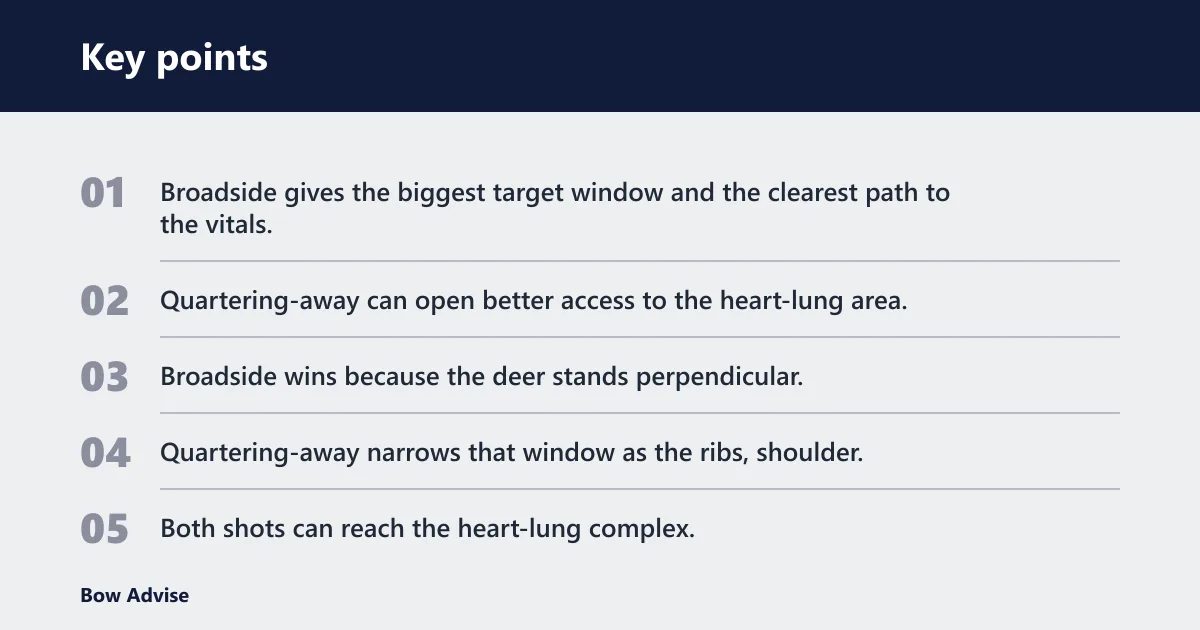


Broadside gives the biggest target window and the clearest path to the vitals. Quartering-away can open better access to the heart-lung area, but only when the angle is mild enough for the arrow to reach the off-side vitals without hitting heavy bone or stopping inside the chest.
| Decision factor | Quartering Away | Broadside Shots in Bowhunting | Winner |
|---|---|---|---|
| Target window | Smaller than broadside; depends on angle severity | Largest target window; clearest path to vitals | Broadside Shots in Bowhunting |
| Vital access | Can open a path to the heart-lung area through the ribs | Direct access behind the shoulder to both lungs | Tie |
| Penetration risk | Higher, especially on steep quartering-away shots | Lower, with less bone in the arrow path | Broadside Shots in Bowhunting |
| Blood trail potential | Good if the arrow exits low or through both lungs; less consistent on steep angles | Often bright red, frothy blood after double-lung hits | Broadside Shots in Bowhunting |
| Best use case | Mild quartering-away with enough penetration margin | Any time the deer offers it cleanly | Broadside Shots in Bowhunting |
Target window
Broadside wins because the deer stands perpendicular, which exposes the largest target window. Quartering-away narrows that window as the ribs, shoulder, and exit path shift out of line, so the shot becomes much more sensitive to angle and exact aim point.
Vital access
Both shots can reach the heart-lung complex, which is roughly basketball-sized on a mature whitetail. Broadside gives the most direct route. Quartering-away can be excellent, but only if the arrow tracks through the rib cage and reaches the off-side shoulder pocket or far-side vitals.
Penetration risk
Broadside usually gives the arrow a cleaner path and less bone to fight. Quartering-away asks more of the setup, arrow mass, and broadhead. A tuned bow with a quality broadhead improves the odds, but steep angles still raise the chance of partial penetration or a deflecting hit.
Blood trail potential
A broadside double-lung hit often produces bright red, frothy blood, and deer typically run 50–150 yards. Quartering-away blood trail quality depends on the exact angle of impact. When the exit is low and the lungs are cut well, the trail can be strong; when the shot is steep, it can be patchier.
Whitetail anatomy that decides the shot
Shot angle changes where the vitals sit relative to the entry point. The shoulder and scapula can block the path, and the lungs sit farther forward than many beginners expect. If the deer turns, the same aiming point no longer reaches the same tissue.
Where the heart and lungs sit on a whitetail
The heart-lung area is the primary target, but it is not a flat circle painted on the side of the deer. As the deer turns, the near-side rib cage, off-side ribs, and shoulder pocket shift that target window. That is why angle matters as much as pin placement.
How the shoulder and scapula block arrows
The shoulder blade and near-side shoulder can stop or deflect an arrow if the aim is too far forward. On quartering-to shots, the far-side shoulder becomes a bigger problem because the arrow may never reach the vitals. Bone interference is one of the main reasons to pass.
What changes when the deer turns from broadside to quartering away
As the deer angles away, the entry point moves farther back on the near side, and the exit path shifts toward the off-side shoulder. That change can help or hurt. Mild quartering-away often opens a clean lane. A steep quartering-away shot can sometimes lead to an arrow landing too far back or too shallow if the hunter misreads the line.
Where do you aim on a broadside deer with a bow?
On a broadside deer, the standard aim is behind the shoulder, not on the shoulder itself. For bowhunters, the ideal broadside entry point is about 4–6 inches behind the shoulder crease. That spot gives the best chance at both lungs without breaking heavy bone first.
How far behind the shoulder is too far back
Too far back means the arrow drifts into the liver, paunch, or lower abdomen instead of the chest cavity. That is a slower recovery and a bigger mistake. Beginners often aim too far back when they try to avoid the shoulder, but moving several inches off the vital lane is the wrong fix.
What a good broadside hit should do to the blood trail
A proper broadside double-lung hit often leaves bright red, frothy blood and a fairly clear trail. The blood may start strong or appear after a short wait. A narrow trail or dark, thicker blood can point to liver or non-lung tissue, which means the deer should be given more time.
Where do you aim on a quartering-away deer with a bow?
On quartering-away deer, the classic aim is the far-side shoulder. That line helps the arrow travel through the rib cage and reach the far-side vitals. Mild quartering-away is usually the sweet spot; steep quartering-away demands more caution because the exit lane becomes harder to predict.
Mild quartering-away: aiming near the far-side shoulder
A mild quartering-away shot is roughly 30–45 degrees. This is often considered one of the better archery shots because the arrow may slip behind the near-side ribs and into the vitals at an angle that can reach the off-side lung or shoulder pocket. It is still not a license to rush.
Steep quartering-away: when the far-side vitals are harder to reach
A steep quartering-away shot is 60+ degrees. The farther the deer turns, the more the vitals slide away from the entry line, and the more likely the arrow is to stop short of the far-side chest. This is where draw weight, arrow mass, and broadhead design matter most.
How angle severity changes entry point and penetration risk
As the angle steepens, the entry point moves rearward on the near side, but the true goal is still the heart-lung complex and far-side shoulder pocket. That means the hunter must judge both the entry and the exit, not just the spot under the pin. A steep angle raises the odds of a poor hit, even with a sharp broadhead.
When should I wait for a broadside shot on a deer?
Wait for broadside when the deer is steeply quartering away, when the shoulder blocks your exit path, or when your setup gives limited penetration margin. Broadside is the safer wait for many bowhunters because it gives the clearest path to the vitals and the broadest forgiveness under pressure.
If the deer is steeply quartering away
When the deer is 60+ degrees quartering away, broadside is often the better call. The far-side vitals move out of reach, and a miss can land too far back. Unless the hunter has a very solid setup and a clear exit lane, waiting is the cleaner decision.
If the shoulder blocks your exit path
If the near-side shoulder or far-side shoulder sits in the arrow path, the shot gets much riskier. The shoulder blade can stop or deflect an arrow, especially if the aim point is too high or too far forward. A deer that is half-turned with a tight front leg is often telling the hunter to wait.
If your setup gives limited penetration margin
Shorter draw length, light arrow mass, and fixed-blade broadheads with weak tuning forgiveness can reduce penetration margin. A tuned arrow and a quality broadhead help, but they do not erase bad geometry. If the arrow would have to drive through heavy bone on a steep angle, the better answer is to pass.
Choose broadside if… / Choose quartering away if…
Broadside is the better pick when the deer is calm, fully turned, and offers the largest window to the heart-lung area. Quartering away is the better pick when the angle is mild, the far-side shoulder pocket is visible, and the hunter can place the arrow through the ribs without forcing it into heavy bone.
Broadside shot: aim point, pass/shoot call, penetration risk, expected blood trail
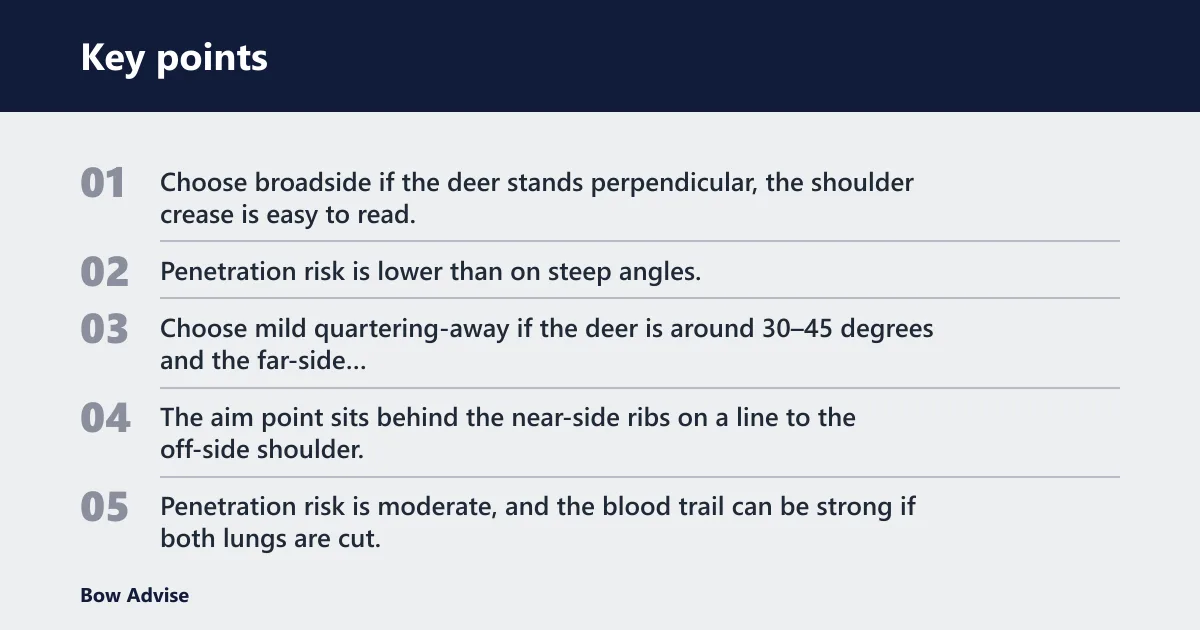
Choose broadside if the deer stands perpendicular, the shoulder crease is easy to read, and the entry point can sit about 4–6 inches behind the shoulder crease. Penetration risk is lower than on steep angles, and the expected blood trail is often bright red and frothy after a double-lung hit.
Mild quartering-away shot: aim point, pass/shoot call, penetration risk, expected blood trail
Choose mild quartering-away if the deer is around 30–45 degrees and the far-side shoulder pocket is clear. The aim point sits behind the near-side ribs on a line to the off-side shoulder. Penetration risk is moderate, and the blood trail can be strong if both lungs are cut.
Steep quartering-away shot: aim point, pass/shoot call, penetration risk, expected blood trail
Choose steep quartering-away only if the arrow path still reaches the far-side vitals cleanly and your setup has enough penetration margin. The risk rises fast as the angle steepens. Blood trail quality depends on the exact angle of impact, so this is often a pass for beginner bowhunters.
Quartering-to shot: aim point, pass/shoot call, penetration risk, expected blood trail
Quartering-to is usually a pass because the deer angles toward the hunter and the far-side shoulder can prevent the arrow from reaching the vitals. The margin for error is reduced, and bone-interference risk goes up. Even a sharp broadhead cannot fix a bad angle.
Bow-only shot-angle decision table
Use this table as a field rule, not a theory exercise. The right call depends on angle, setup, and whether the arrow can reach the heart-lung area without being stopped by the shoulder or sent too far back into the paunch.
| Shot angle | Aim point | Shoot or pass | Penetration risk | Expected blood trail |
|---|---|---|---|---|
| Broadside | 4–6 inches behind the shoulder crease | Shoot if the lane is clear | Lower | Often bright red, frothy after a double-lung hit |
| Mild quartering-away, 30–45 degrees | Behind the near-side ribs, on line to the far-side shoulder pocket | Shoot if the exit path is clear | Moderate | Good if both lungs are cut; depends on exit and angle |
| Steep quartering-away, 60+ degrees | Farther back than many beginners expect, but only if the arrow still reaches the vitals | Usually pass unless the setup and angle are ideal | Higher | Less consistent; may be spotty if the hit is low or rearward |
| Quartering-to | Usually not a recommended bow aim | Pass | High | Poor or uncertain if the arrow fails to reach the chest cavity |
Arrow setup changes the call. More draw weight, heavier arrow mass, and a well-tuned broadhead setup improve penetration margin. They do not turn a bad angle into a good one, and they do not remove the far-side shoulder from the path on a quartering-to shot.
How draw weight, arrow mass, and broadhead type affect the call
A heavier arrow generally carries better through tissue than a very light setup, and a tuned bow flies truer into angled targets. Fixed-blade broadheads add cut and durability, but they also punish poor tuning more than some mechanical heads. Even so, the shot angle stays the first decision.
What deer angle gives the best blood trail after a bow shot?
A clean broadside double-lung hit often gives the most reliable blood trail because the arrow has a direct path through the lungs and the deer commonly leaves bright red, frothy blood. Mild quartering-away can also produce a strong trail, but the result depends more on exact entry, exit, and whether both lungs are cut.
Broadside blood trail clues
Bright red, frothy blood is a strong sign of a double-lung hit. The trail may start with a short run of 50–150 yards before the deer beds or expires. Wider, easier-to-follow blood is more common when the exit hole is low and the lungs are opened well.
Quartering-away blood trail clues
Quartering-away blood trail quality depends on the exact angle of impact. A low exit through the chest can create a good trail, but steep quartering-away shots may leave less blood on the ground if the arrow tracks high, rearward, or fails to exit. That is why the wait time matters.
When should I pass on a shot because the angle is too steep?
Pass when the deer is turned so far away that the arrow would need an uncertain path to reach the far-side vitals. A steep quartering-away angle, a quartering-to angle, or a shoulder that blocks the exit lane are all good reasons to wait. The better shot is the one that still gives recovery confidence.
Body language that says wait
Wait if the front leg is forward and tight to the chest, the deer is taking a half-step, or the head is turned so the body angle keeps changing. In a treestand or ground blind, that body language often means the arrow lane is shrinking. A broadside pause is usually worth the extra seconds.
A simple pass-or-shoot checklist
- Can the arrow reach the heart-lung area without hitting the shoulder?
- Is the angle broadside or only mildly quartering away, around 30–45 degrees?
- Can the hunter clearly identify the far-side shoulder pocket or behind-the-shoulder aim point?
- Does the bow setup give enough penetration margin for this exact angle?
- If any answer is no, pass and wait for broadside or a milder quartering-away angle.
Frequently asked questions
Is a quartering-away shot better than a broadside shot with a bow?
Not always. Quartering-away can be an excellent archery angle, and many hunters consider it the premier archery shot, but broadside gives the largest target window and the clearest path to the vitals. Broadside is usually the safer wait; mild quartering-away is the better shot only when the angle and penetration path are both right.
When should I wait for a broadside shot on a deer?
Wait for broadside when the deer is steeply quartering away, quartering toward you, or moving in a way that hides the shoulder pocket. Broadside offers the most forgiving aim point and the best chance of a clean double-lung hit. If the deer is not settled, waiting is usually the better call.
Where do you aim on a quartering-away deer with a bow?
The classic aim is near the far-side shoulder, with the arrow entering behind the near-side ribs and driving toward the off-side chest. On a mild quartering-away deer, that line can reach the heart-lung area cleanly. On a steep angle, the same aim may not give enough penetration or the right exit path.
Where do you aim on a broadside deer with a bow?
Aim behind the shoulder, not on it. For bowhunting, the ideal broadside entry point is about 4–6 inches behind the shoulder crease. That placement gives the best chance at both lungs while avoiding the heavy bone of the shoulder blade.
Is a quartering-to shot ethical for bowhunting?
It is usually a pass for bowhunters. Quartering-to raises the risk that the far-side shoulder blocks the arrow before it reaches the vitals, and the margin for error is much smaller. If the deer is angling toward the hunter, the safer decision is to wait for broadside or mild quartering-away.
How far behind the shoulder should I aim on a broadside deer?
The standard bowhunting answer is about 4–6 inches behind the shoulder crease. That point usually centers the arrow in the heart-lung area without contacting the shoulder blade first. Aiming too far back can push the shot into the liver or paunch, which creates a much harder recovery.
What deer angle gives the best blood trail after a bow shot?
A clean broadside double-lung hit often gives the best blood trail because the blood is usually bright red and frothy, and the wound path is direct. Mild quartering-away can also produce a good trail when both lungs are cut. Steep quartering-away and quartering-to shots are less consistent.
When should I pass on a shot because the angle is too steep?
Pass when quartering-away becomes so steep that the arrow may not reach the far-side vitals, or when the shoulder blocks the exit path. If the angle moves past mild quartering-away into 60+ degrees, the risk rises fast. A clear pass is better than a questionable hit and a weak trail.