What Draw Weight Do You Need for Deer Hunting?
For deer, start at the lightest draw weight that lets you shoot accurately, cold, and from a seated position with your fixed pin, movable sight, or traditional bow setup. For many beginners, about 40 to 45 pounds is a practical starting draw weight for deer hunting, and 50 pounds is generally plenty. Too much weight usually hurts accuracy, makes penetration less consistent, and weakens ethical shot control. This guide shows how to pick a legal, practical draw weight and check it with simple field tests.
Recommended draw weights for different hunters


The right draw weight is the heaviest setting you can draw smoothly when you are cold, seated, and under control, then repeat with the same anchor and sight picture. For many adult deer hunters, the practical sweet spot is 45–60 pounds, while many states set the legal floor at 40 pounds for deer.
Do not treat the legal floor as the best hunting number. Draw weight is measured in pounds, but the bow’s efficiency, your draw length, arrow weight, and broadhead all affect whether that poundage works in the field. A shorter draw length or poor tuning can make a legal setup perform like a much weaker one.
Draw-weight decision table
| Hunter profile | Bow type | Shot distance | Form confidence | Recommended draw-weight range |
|---|---|---|---|---|
| Average adult beginner | Compound | 20 to 30 yards | Can hold anchor, settle pin, and release without shaking | 40 to 50 pounds |
| Average adult beginner | Compound | 30 to 40 yards | Strong enough to stay steady from a blind or tree stand | 45 to 50 pounds |
| Traditional bow user | Recurve | 20 to 25 yards | Can draw cleanly while seated and keep form through the hold | 45 to 55 pounds |
| Traditional bow user | Longbow | 15 to 25 yards | Can repeat the same shot without collapsing at full draw | 45 to 55 pounds |
| Youth or small-framed hunter | Compound | 15 to 25 yards | Can draw cold without body twist or bow arm drop | 30 to 40 pounds, if legal |
| Older hunter with reduced strength | Compound | 20 to 30 yards | Can draw from a seated position and hold at full draw | 35 to 45 pounds, if legal |
| Older hunter with reduced strength | Recurve or longbow | 15 to 20 yards | Can keep shoulder position and release without strain | 45 pounds or less if accuracy stays solid |
The table is a starting point, not a guarantee, and it separates legal minimums from practical recommendations. A 40-pound compound may be enough for one archer and too much for another if draw length is short, tuning is poor, or the hunter cannot settle the pin after a cold draw. That is why the seated test matters more than the sticker on the limb.
What draw weight checklist
| Red flag | What it means | What to do |
|---|---|---|
| Cannot draw the bow smoothly while seated | The setup is too heavy for real hunting positions | Step down in poundage |
| Anchor changes under stress | Form is breaking before the shot breaks | Reduce draw weight and rebuild reps |
| Pin movement gets worse after 10 to 15 seconds at full draw | Holding strength is not there for a calm shot window | Lower poundage or shorten shot distance |
| Shoulder or back tension appears during practice | The bow is overbowed for current strength | Back off weight before hunting |
| Short-drawing under pressure | Real-world draw length is dropping below normal | Choose a lighter, easier-to-control setup |
| Accuracy falls apart in cold weather or low light | Form and strength are not stable in hunting conditions | Use a lighter weight you can repeat cold |
Is 40 pounds enough to hunt deer with a bow?
Yes, 40 pounds can be enough for deer with the right arrow, broadhead, and tuning. It is a workable starting point, not a universal finish line, because state rules, bow type, and draw length still matter.
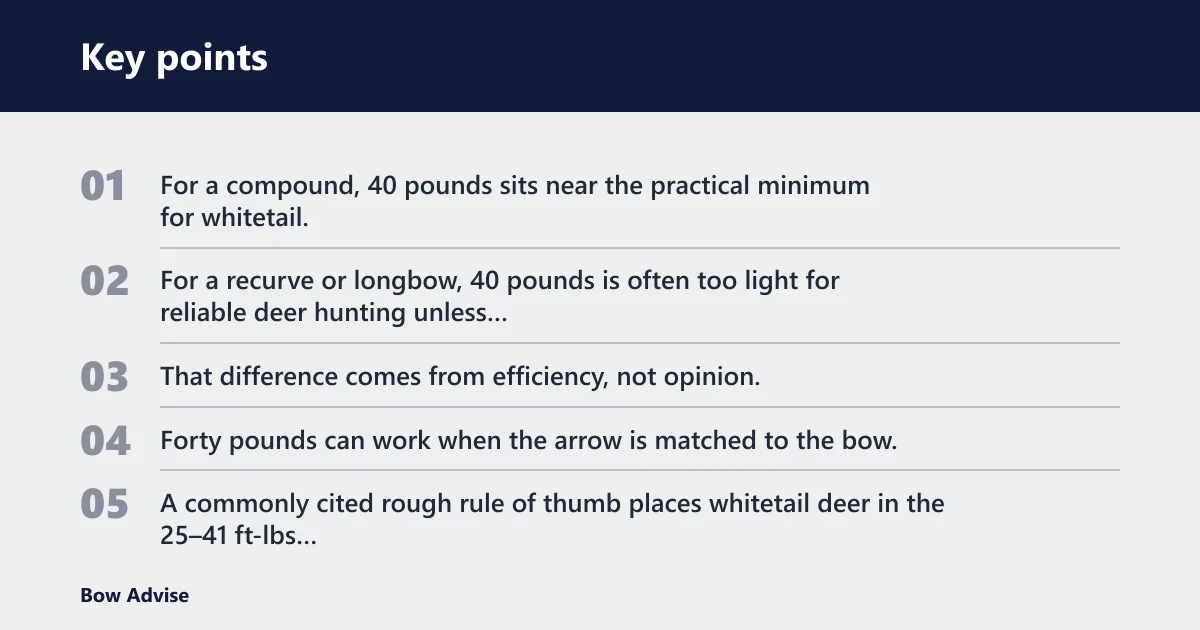
For a compound, 40 pounds sits near the practical minimum for whitetail. For a recurve or longbow, 40 pounds is often too light for reliable deer hunting unless the setup is very close range and the archer is highly consistent. That difference comes from efficiency, not opinion.
When 40 pounds can work
Forty pounds can work when the arrow is matched to the bow, the broadhead is legal and sharp, and the shot is kept close. A commonly cited rough rule of thumb places whitetail deer in the 25–41 ft-lbs kinetic-energy band, so the setup has to land in that range by actual arrow performance, not by limb label alone.
Suppose a hunter with a compound draws 28 inches, shoots a well-tuned 350-grain arrow, and keeps shots inside 25 yards. That setup is far more likely to produce a clean deer-ready result than a heavier bow that cannot be held steady.
When 40 pounds is too light
Forty pounds is too light when the hunter cannot keep form, the bow is badly tuned, or the arrow is too light and fast without enough penetration. It is also too light if state law requires more. Legal minimums can vary, and one cited state, Pennsylvania, is listed at 35 pounds.
Distance matters too. A longer shot leaves less room for error in angle, wind, and animal movement. If a hunter needs more range than the setup can support, the answer is usually less distance, better tuning, or a different bow setup, not a guess at a bigger number.
What the arrow and broadhead must do
The arrow must carry enough mass to drive the broadhead through vitals after bone or heavy muscle. Heavier arrows increase momentum and penetration, but they must match bow spine and broadhead choice. A common regulated range is at least 300 to 400 grains where rules specify arrow weight.
Broadheads matter as much as poundage. Sharp fixed blades often penetrate well and are simple to tune around; mechanicals can fly well too, but they must comply with state rules and open reliably. A legal setup that is dull or poorly matched can fail even at a sound draw weight.
What matters more than draw weight for deer penetration?
Kinetic energy, arrow weight, speed, and tuning matter more than draw weight alone. A commonly cited rough rule of thumb places whitetail deer in the 25–41 ft-lbs kinetic-energy band, and draw weight only helps if the full setup turns that weight into usable arrow performance at hunting distance.
Kinetic energy and arrow speed
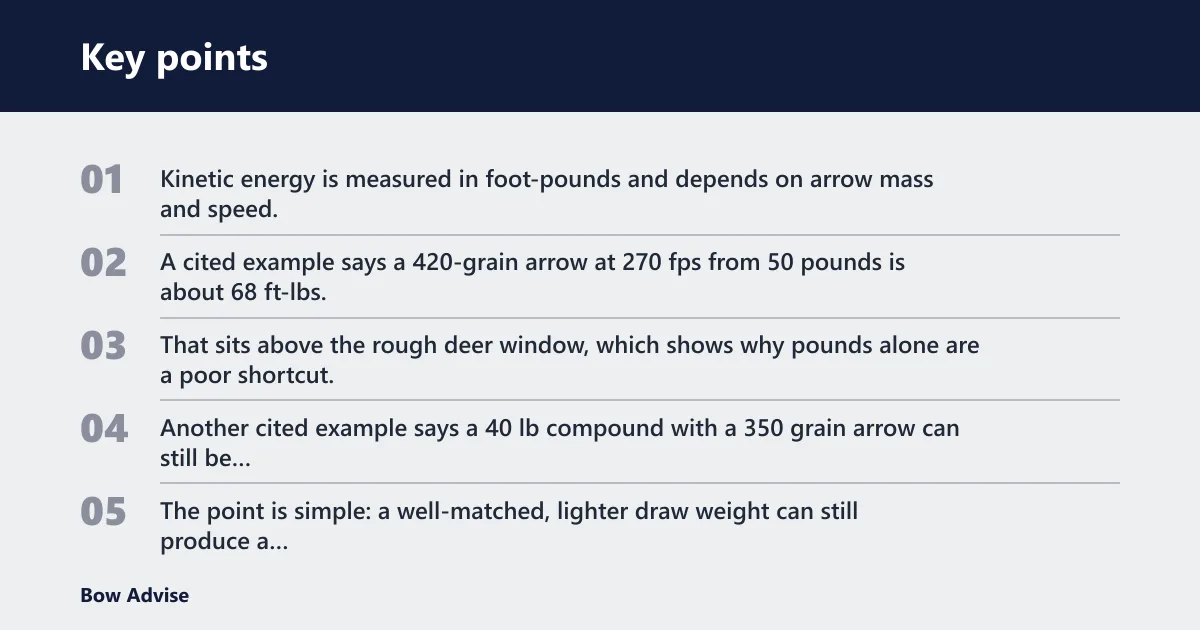
Kinetic energy is measured in foot-pounds and depends on arrow mass and speed. A cited example says a 420-grain arrow at 270 fps from 50 pounds is about 68 ft-lbs. That sits above the rough deer window, which shows why pounds alone are a poor shortcut.
Another cited example says a 40 lb compound with a 350 grain arrow can still be deer-capable when the setup is matched well. The point is simple: a well-matched, lighter draw weight can still produce a hunting-ready result if the arrow setup is right and the bow is efficient.
Arrow weight, spine, and broadhead choice
Arrow spine must fit the bow, not just the desired speed. If spine is wrong, broadhead flight can suffer, and poor flight costs penetration. A heavier arrow can help, but only when the shaft, insert, nock, and head all stay within a tuned system.
Broadhead choice changes the energy budget. Fixed blades usually demand careful tuning but can penetrate very well; mechanical heads may fly more like field points in some setups but still must comply with state rules. Either way, sharpness and proper flight matter more than chasing an extra few pounds.
Bow tuning and real-world penetration
Bow tuning often affects real-world penetration more than poundage alone. A clean paper tear, correct center-shot, and matched arrow spine help the broadhead reach the vitals with less wasted energy. If the bow throws a broadhead poorly, added draw weight will not fix the basic problem.
A common first-timer mistake is to add five pounds after a good range session and assume the deer setup improved. If that extra weight causes a slight pluck, poorer anchor, or a bad release, the actual field result usually gets worse, not better.
How much draw weight for compound, recurve, and longbow?
Compounds usually need less poundage than traditional bows because they are more efficient. Recurves and longbows generally need more draw weight to produce similar field performance. For deer, compounds often land in the 40–50 pound range, while recurves and longbows often sit around 45–55 pounds.
Compound bows
A compound bow’s cams and longer power stroke help it move the arrow more efficiently, so a hunter often gets usable deer performance at a lower poundage. Practical minimums for whitetail are about 40 pounds with a compound, and many adult hunters are comfortable in the 45–60 pound zone.
That does not mean a compound should always be cranked up. If the hunter loses steadiness or shortens draw length under pressure, the advantage disappears. The best compound weight is the highest number that still allows calm, repeatable shots.
Recurve bows
A recurve generally needs more draw weight than a compound because it is less efficient. Practical minimums for whitetail are about 45 to 50 pounds with a recurve or longbow, and the usable range often rises toward 55 pounds for consistent deer hunting.
Traditional bows also reward close shots and clean tune work. Because the margins are tighter, a recurve shooter should be more conservative on range and more careful with arrow match and broadhead selection than a compound shooter.
Longbows
A longbow has similar practical needs to a recurve and is often even less efficient than a compound. In close-range deer hunting, it works best with a tuned setup and a hunter who can repeat the draw without collapse, torque, or creeping forward at anchor.
If a longbow hunter needs to ask whether the setup is enough, the better question is usually whether the shot distance is short enough. Close-range, controlled shots are the cleanest path with this bow type.
How do you know if your draw weight is too heavy?
Your draw weight is too heavy if you cannot draw it cold, seated, and without strain while keeping the same anchor and release. A hunting bow must be manageable in real clothing, from real positions, and during the low-light moments when deer actually move.
Cold-weather and seated draw test
Start seated, then draw the bow while wearing the layers you would hunt in. If the draw is jerky, the shoulder rolls forward, or the string is short-drawn, the setup is too heavy for hunting. This test matters because tree stands, blinds, and cold weather reduce strength and mobility.
Next, hold at full draw long enough to settle the pin. If the pin wanders, the bow arm shakes, or the release feels rushed, step down in poundage. Hunting accuracy is built on control, not on what the limbs say on the sticker.
Signs of overbowing and form breakdown
Overbowing usually shows up as creeping, flinching, face pressure changes, or a collapse after the shot breaks. Those errors can be small on the range and large on a deer. They also shorten the time the hunter can hold at anchor, which matters at alert animals and close encounters.
Short-drawing under stress is another warning sign. It means the archer is not actually getting the planned draw length when it counts, so arrow speed and energy drop. That is one reason a lighter bow with steady form can beat a heavier bow with poor control.
When to step down in poundage
Step down if the bow cannot be drawn safely from a stand, if the anchor changes under pressure, or if practice groups open up as soon as the weight increases. The better hunting bow is the one that stays accurate after cold hands, extra clothing, and a few hours in the woods.
State regulations and setup checks
Check the current regulation booklet before hunting, because minimum draw weight, arrow weight, and broadhead rules vary by state. The legal minimum draw-weight range across states is described as 30 to 45 pounds for deer, and that spread is wide enough to change the answer for the same bow.
Verify the full setup, not just the limbs
- Confirm the current deer minimum for draw weight in the regulation booklet.
- Check whether the state also sets an arrow-weight rule.
- Verify broadhead width or design rules before the season starts.
- Match arrow spine to the actual draw weight and draw length.
- Test the full setup for quiet draw, clean flight, and repeatable anchor.
Legal rules can change by season and location within a state, so the current booklet is the final check. A setup that is legal for one unit or weapon season may not be legal for another.
Picture a hunter who has a 40-pound compound, a legal broadhead, and a properly spined 350-grain arrow. That setup can be deer-ready if the arrow flies cleanly and the hunter keeps shots inside a distance he can repeat without rushing. Change only the broadhead to a bad match, and the same bow can become a poor hunting setup.
Frequently asked questions
What draw weight do you need for deer hunting?
Start with the lightest draw weight that you can draw smoothly while seated and cold, then hold accurately at full draw. For many adult hunters, 40 to 45 pounds is a practical starting point, and the average adult sweet spot is often 45–60 pounds. Legal minimums still come first.
What is the best draw weight for a beginner deer hunter?
The best starting weight is the heaviest bow the beginner can draw cold, seated, and repeat without form loss. Many beginners do well around 40 to 45 pounds on a compound. If accuracy falls apart, the better move is less poundage, not more.
Do you need more draw weight for a recurve than a compound?
Usually yes. Recurves and longbows are less efficient than compounds, so they often need more poundage to reach similar field performance. Practical minimums for whitetail are about 45 to 50 pounds with a recurve or longbow, while compounds can often start around 40 pounds.
How do legal draw weight minimums vary by state for deer?
They vary enough that the state booklet must be checked every season. The legal minimum draw-weight range across states is described as 30 to 45 pounds for deer, with many states at 40 pounds and Pennsylvania cited at 35 pounds. Local rules can also cover arrows and broadheads.