Apex Longbow Vs G7: Proven Essential Guide
Choosing between an Apex Longbow and a G7 usually depends on your shooting style and budget. The Apex often suits traditional purists wanting simplicity and speed, while the G7 offers modern stability and customization, making it great for beginners focusing on consistent accuracy.
Welcome! If you’re getting serious about archery, you might be scratching your head over which traditional bow setup is right for you. Deciding between the Apex Longbow and a classic G7 setup can feel overwhelming. Many beginners worry about getting the “wrong” gear and slowing down their progress. Don’t worry! I’m Salman Arfeen, and I’m here to break down these two fantastic options simply.
We will look at what makes each bow special, focusing on what matters most: comfort, stability, and how fast you can improve your grouping. Forget the confusing specs for a moment. We are going to compare them head-to-head so you can confidently choose the best tool to start hitting your targets. Let’s explore what makes the Apex and the G7 unique for your journey into traditional archery!
Understanding the Basics: Longbows Explained for Beginners
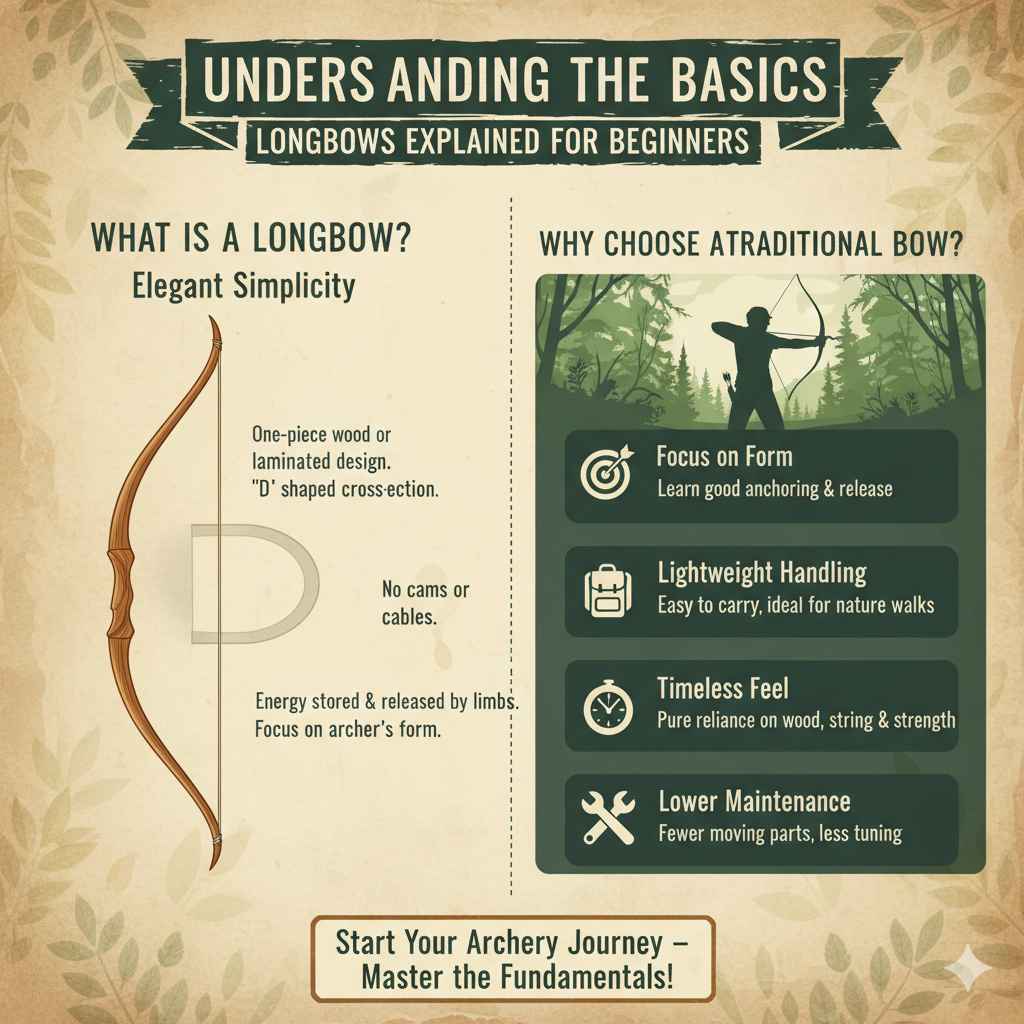
Before diving into the specific models, let’s make sure we are all on the same page about what a longbow is. Simply put, a longbow is one of the oldest and most elegant types of bows. It’s typically a single piece of wood or a simple laminated design, shaped like a “D” when viewed from the side.
Unlike modern compound bows with cams and cables, longbows are elegant in their simplicity. When you draw a longbow, the limbs store the energy, and when you release, that energy pushes the arrow forward. This simplicity is what attracts many people—it puts the focus entirely on your form.
Why Choose a Traditional Bow?
Many archers start with a compound bow, but they often transition to a longbow or recurve for several reasons. For a beginner, choosing a traditional style can sometimes speed up learning good fundamentals because there are fewer mechanisms to hide imperfections.
- Focus on Form: Without the let-off or stabilizers of modern gear, you must learn good anchoring, consistent draw length, and smooth release.
- Lightweight Handling: Traditional bows are usually lighter and easier to carry during long walks in the woods.
- Timeless Feel: There is a deep satisfaction in shooting a bow that relies purely on the wood, fiberglass, and your own strength.
- Lower Maintenance: Fewer moving parts mean less adjustment and tuning required once you set it up properly.
Deep Dive: The Apex Longbow Philosophy
The “Apex Longbow” often refers to a specific style or line of bows designed for performance within the traditional category. Think of Apex models as striving for the pinnacle—the best possible performance within the constraints of a straight-limbed design.
Apex bows generally prioritize speed and mass distribution to minimize hand shock (the vibration felt after the shot). They often feature advanced materials like high-density wood cores or specific fiberglass laminations designed to store energy efficiently.
Key Characteristics of an Apex Style Bow
When you handle an Apex-style longbow, you’ll notice a commitment to clean lines and often a slightly more aggressive limb profile compared to basic beginner bows. This aggression is designed to give you more speed (faster arrow flight) for the same draw weight, which helps the arrow reach the target quicker, minimizing the effect of wind drift.
Pros of the Apex Longbow Design
These advantages make the Apex appealing to archers moving beyond their very first starter bow:
- Speed Potential: Due to superior material layering, they often shoot faster than standard wooden longbows at the same draw weight.
- Reduced Hand Shock: Better limb design often translates to a smoother shot experience, which builds confidence faster.
- Streamlined Profile: Often thinner and more compact, making them excellent for hunting situations where maneuverability matters.
- Aesthetic Appeal: They frequently feature beautiful wood grains and finishes, which appeals to the traditional enthusiast.
Considerations for Beginners with Apex
While fast, speed can sometimes come at a minor cost when you are learning rhythm:
- Stiffness: Because they are built for speed, the draw cycle might feel slightly more aggressive or “stack” (get harder) sooner than a slower, more forgiving bow.
- Higher Price Point: Quality materials mean they usually cost more than entry-level models.
Comparing Against the G7 Longbow Setup
The “G7” designation doesn’t refer to one single manufacturer’s bow, but rather it is often used in the traditional community to represent a robust, highly customizable, take-down recurve or a very stable, slightly reflexed longbow setup popular among serious hobbyists. For the purpose of this comparison, we will define the G7 setup as one that emphasizes stability, modularity (often being a take-down design), and incorporating modern accessories common in traditional shooting circles.
The G7 concept leans heavily on practical, all-around performance. If the Apex is the sleek sports car, the G7 setup is the reliable, fully-equipped SUV of traditional archery. It’s built to handle various conditions and is often easier to tune for specific arrow spine requirements.
What Makes the G7 Setup Different?
The primary difference often lies in customization and stability. A G7 setup frequently implies:
- Take-Down Capability: The limbs detach from the riser (handle section). This is excellent for transport and for easily swapping limbs to change draw weight without buying a whole new bow.
- Accessory Friendly: G7 style risers usually have standard bushings (screw holes) for adding stabilizers, arrow rests, and clickers—tools that serious target archers use.
- Balanced Draw Weight: G7 designs often favor a very smooth draw cycle over maximum raw speed, which is superb for holding steady at full draw.
Benefits of the G7 Approach
For a beginner who plans to practice a lot and wants to eventually move into competitive target shooting, the G7 setup offers flexibility:
- Adaptability: You can easily tune the setup to perfectly match your preferred arrow spine as you change arrow types or draw weights.
- Stability Additions: Adding a long stabilizer (a rod extending forward from the bow) dramatically reduces vibration and helps keep the bow perfectly vertical during the shot, massively boosting beginner consistency.
- Longevity: If you start at 30 lbs and later want to shoot 45 lbs, you just buy new limbs, not a new riser.
Table: Apex Longbow vs. G7 Setup at a Glance
Here is a simplified comparison to help you see the general differences:
| Feature | Apex Longbow (Typical) | G7 Setup (Typical) |
|---|---|---|
| Design Philosophy | Speed and Simplicity (Often One-Piece) | Stability and Modularity (Often Take-Down) |
| Hand Shock Potential | Medium to High (Depends on build quality) | Low to Medium (Easily reduced with stabilizers) |
| Customization | Minimal (Bare-bow shooting focus) | High (Accepts sights, rests, stabilizers) |
| Transport Ease | Requires a long bow case | Breaks down for easy storage in a smaller bag |
| Ideal User Profile | Traditional hunter or minimalist enthusiast | Beginner learning fundamentals or target archer |
The Beginner’s Focus: Draw Cycle and Consistency
As a beginner, your biggest hurdle isn’t speed; it’s consistency. Can you pull the bow back to the exact same spot, hold it steady, and release smoothly every single time? This is where the draw cycle matters most.
Understanding Draw Weight and Stacking
Draw weight is how much force it takes to pull the string back. It’s crucial to start light! If you cannot comfortably draw and hold your bow for 15–20 seconds without shaking, your weight is too high. You cannot focus on your aim if you are fighting the bow.
Stacking happens when the bow becomes significantly harder to draw in the last few inches before full draw. Apex-style bows, aiming for high speed, sometimes have more pronounced stacking. G7-style risers, often designed with slightly more reflex or being a recurve design, tend to have a smoother, more linear draw that doesn’t stack as sharply.
For someone learning shot process, a smoother draw (more characteristic of a well-designed G7 setup) is often more forgiving.
The Role of Arrow Rest and Clickers
The Apex bow is often shot “off the knuckle” (shooting directly off the hand/shelf) or with a simple leather or stick-on rest. This demands perfect arrow flight right off the bow.
A G7 setup usually incorporates modern accessories:
- Arrow Rest: A properly tuned rest (like a plunger system or simple shelf rest) allows the arrow to leave the bow cleanly, even if your form has slight imperfections. This is a huge confidence booster for beginners.
- Clicker: A clicker is a device that audibly signals when you have reached your exact, perfect draw length. Learning to shoot to a clicker is one of the best ways to instantly improve consistency. G7 setups readily accommodate clickers, while one-piece Apex bows do not.
Setting Up Your Bow: Essential Gear for Both
Regardless of whether you lean toward the sleek Apex or the customizable G7, you need a solid foundation of safety gear and tuning equipment. You cannot properly evaluate the bow without the right arrows.
Essential Beginner Archery Checklist
Before you head to the range, make sure you have these items. Remember, safety first! Always check range rules, such as those established by the National Archery in the Schools Program (NASP) guidelines regarding safe shooting lanes and retrieval procedures, before starting your session. You can review basic safety guidelines here.
- Arrows: Ensure your arrows spine (stiffness) matches your bow’s draw weight and your draw length. This is non-negotiable for safety and accuracy.
- Armguard: Protect your forearm from string slap. This prevents painful bruises and the flinching that comes from anticipating the sting.
- Finger Tab or Glove: Protects your drawing fingers. A good tab ensures a clean, consistent release.
- Bow Stringer: NEVER try to string a traditional bow by bending the limbs by hand! Use a proper stringer tool to safely string and unstring your bow.
- Quiver: To hold your arrows safely on the range.
Tuning for Optimal Performance (The Beginner’s Start)
Tuning means making the bow and arrow work together perfectly. For both Apex and G7 setups, the starting point is arrow selection, followed by brace height.
1. Brace Height Adjustment
Brace height is the distance between the deepest part of the bow grip and the string when the bow is unstrung. Too low, and the bow is sluggish; too high, and it feels harsh and may cause hand shock.
- Finding the Sweet Spot: Most modern longbows work well between 6 and 7.5 inches. Consult your bow manual.
- How to Adjust: You adjust this by twisting the bow string tighter (to raise the height) or untwisting it (to lower the height). Do this slowly, a few twists at a time.
2. Arrow Selection
If you bought a 40 lb bow, you might need a 500 spine arrow, but this depends heavily on your actual draw length. Using arrows that are too weak (low spine number) for a powerful bow can cause them to flex too much, leading to poor flight or, in rare severe cases, damage to the bow.
It is highly recommended that beginners purchase arrows suggested by the bow manufacturer or a reputable archery shop based on their actual measured draw length. For example, if you have a 28-inch draw, you need arrows slightly longer than 28 inches.
Step-by-Step: Choosing Your Ideal Bow Path
Making the final decision between the Apex style and the G7 style should feel like matching a tool to a job. Ask yourself these three core questions:
Step 1: Define Your Primary Use Case
What will you do most often with this bow?
- If you prioritize hunting, simplicity, and maximum portability: The sleeker, one-piece Apex Longbow might be your preference. It’s minimal and fast through thick brush.
- If you prioritize structured practice, tuning, and future target shooting: The modular G7 Setup allows you to add the tools you need (like stabilizers) to build a consistent target rig.
Step 2: Assess Your Comfort with Complexity
Are you okay with a bow that is perfectly tuned out of the box but can’t be easily changed, or do you want the ability to tinker?
- If you want to shoot immediately and don’t want to worry about screw-in stabilizers or limb bolts, the one-piece Apex is simpler to maintain.
- If you like the idea of swapping limbs when you get stronger, or adding precision accessories, the G7 take-down design is superior.
Step 3: Test Drive If Possible
This is the most crucial step. If you can visit a local pro shop or a range that rents equipment, try drawing both styles if available. Feel the draw cycle. Which one feels less jerky when you hit full draw? Which one feels balanced when you hold it aimed at a target?
Many archery associations offer introductory days. Getting professional feedback on how you handle the different bow shapes is invaluable. For example, the American Archery Council often provides resources on local clubs where you can try different equipment.
Maintenance Matters: Keeping Your Bow Ready
Whether you choose the pure design of the Apex or the adaptable G7, maintenance keeps it safe and shooting true. Traditional bows require less maintenance than compounds, but they need specific care.
Caring for Wood and Laminations (Apex & G7 Risers/Limbs)
Wood is organic, meaning it reacts to the environment. Humidity and temperature swings are the biggest enemies of your bow’s core structure.
- Temperature Control: Never leave your bow in a hot car trunk or near a direct heat source (like a fireplace). Extreme heat can soften the glue holding the laminations together.
- Storage: Store the bow vertically or horizontally, ideally in a case that buffers against rapid temperature changes. Do not hang it by the string for long periods.
- Wipe Down: After shooting, especially in humid conditions, wipe the limbs and riser dry. A little wood wax applied every few months can protect the finish.
String Maintenance
Bow strings are made of synthetic materials (like Dacron or FastFlight). They don’t stretch like natural materials, but they do wear out.
- Waxing: Apply quality bowstring wax to the entire length of the string (except the center serving—the part where the arrow nocks). Wax the string every few weeks, depending on how often you shoot.
- Inspection: Regularly check the string for broken fibers. If you see any fraying or damage near the tips or serving, replace the string immediately. A broken string can cause catastrophic damage to the bow limbs.
Advanced Consideration: The Shooting Stance
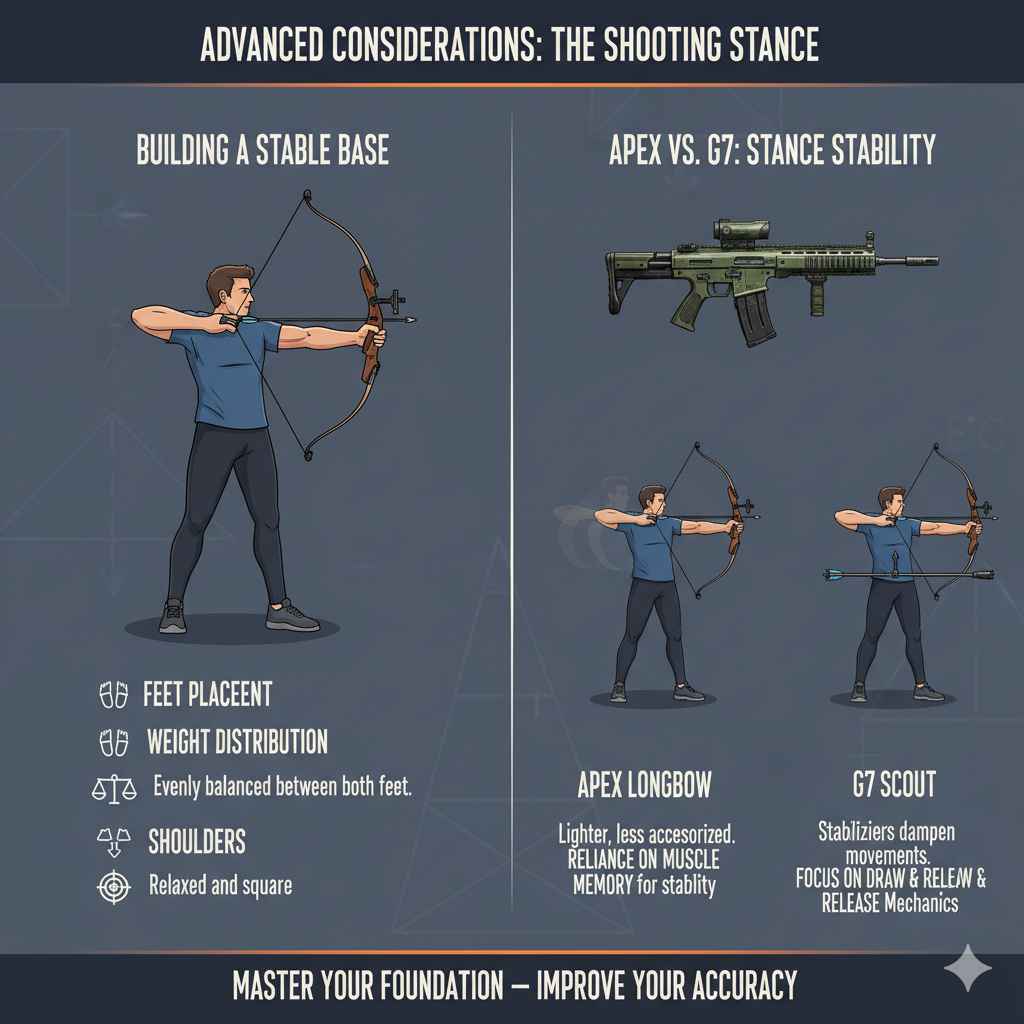
No matter how good your equipment is—Apex or G7—your stance is the foundation. If your stance drifts, your groupings will drift.
Building a Stable Base
Think of your feet as the foundation of a house. A wobbly foundation means the house (your shot) will fall over.
- Feet Placement: Stand facing slightly away from the target (about a 45-degree angle). Imagine a line running from the target straight through your toes.
- Weight Distribution: Keep your weight evenly balanced between both feet. Avoid leaning forward or backward.
- Shoulders: Keep your shoulders relaxed and square to your body line, not hunched up toward your ears.
The difference here between the two bows is subtle but important for form breakdown. Because the Apex is often lighter and less accessorized, it forces you to rely entirely on muscle memory for stability. A G7 setup, with stabilizers, helps physically dampen minor movements, allowing a beginner to focus solely on the draw and release mechanics without fighting the bow’s natural tendency to twist slightly.
Frequently Asked Questions (FAQ) for New Traditional Archers
Q1: Can I use compound bow sights on an Apex or G7 longbow?
In most cases, compound sights are not compatible with traditional one-piece Apex longbows because they lack mounting bushings. However, many G7-style take-down risers include threaded inserts that allow you to mount simple recurve sights. Keep in mind that adding sights shifts you away from pure traditional shooting.
Q2: Which setup is better for total beginners?
For absolute beginners focused on building clean fundamentals, a G7-style take-down setup often provides more forgiveness thanks to smoother draw cycles and accessory options like stabilizers or clickers.
If you prefer simplicity and a minimalist experience from day one, the Apex longbow is still an excellent choice.
Q3: Is a one-piece longbow harder to maintain than a take-down bow?
Not necessarily. Both require similar care (string waxing, proper storage, temperature control). However, take-down bows are easier to transport and store, which can make them more convenient long-term.
Q4: Can I hunt with a G7 setup?
Yes. While many hunters prefer the sleek simplicity of a one-piece Apex-style longbow, a properly configured G7 take-down bow works perfectly well for hunting—especially if you remove stabilizers and extra accessories for field use.
Q5: Which one improves grouping faster?
If grouping consistency is your main goal, the G7 setup may help you progress faster due to its smoother draw and optional tools like a clicker. That said, archers who commit to mastering form with an Apex often develop extremely strong fundamentals.
Q6: Does higher speed really matter for beginners?
Not as much as many people think. While Apex bows may offer slightly more arrow speed, accuracy and consistency matter far more than raw speed when you’re learning.
Conclusion: Which Should You Choose?
The decision between the Apex Longbow and a G7-style setup ultimately comes down to your goals and personality as an archer.
- Choose Apex if you value simplicity, minimalism, and a pure traditional feel.
- Choose G7 if you want flexibility, smoother draw characteristics, and room to grow with accessories.
For most beginners focused on consistent improvement and long-term adaptability, the G7 setup offers a slightly more forgiving learning curve. However, if your heart is set on the timeless elegance of a sleek longbow, the Apex will never be the wrong choice.
In the end, the best bow is the one that makes you excited to practice. Consistency beats equipment every time.