Apache Vs Longbow: Proven Essential Guide
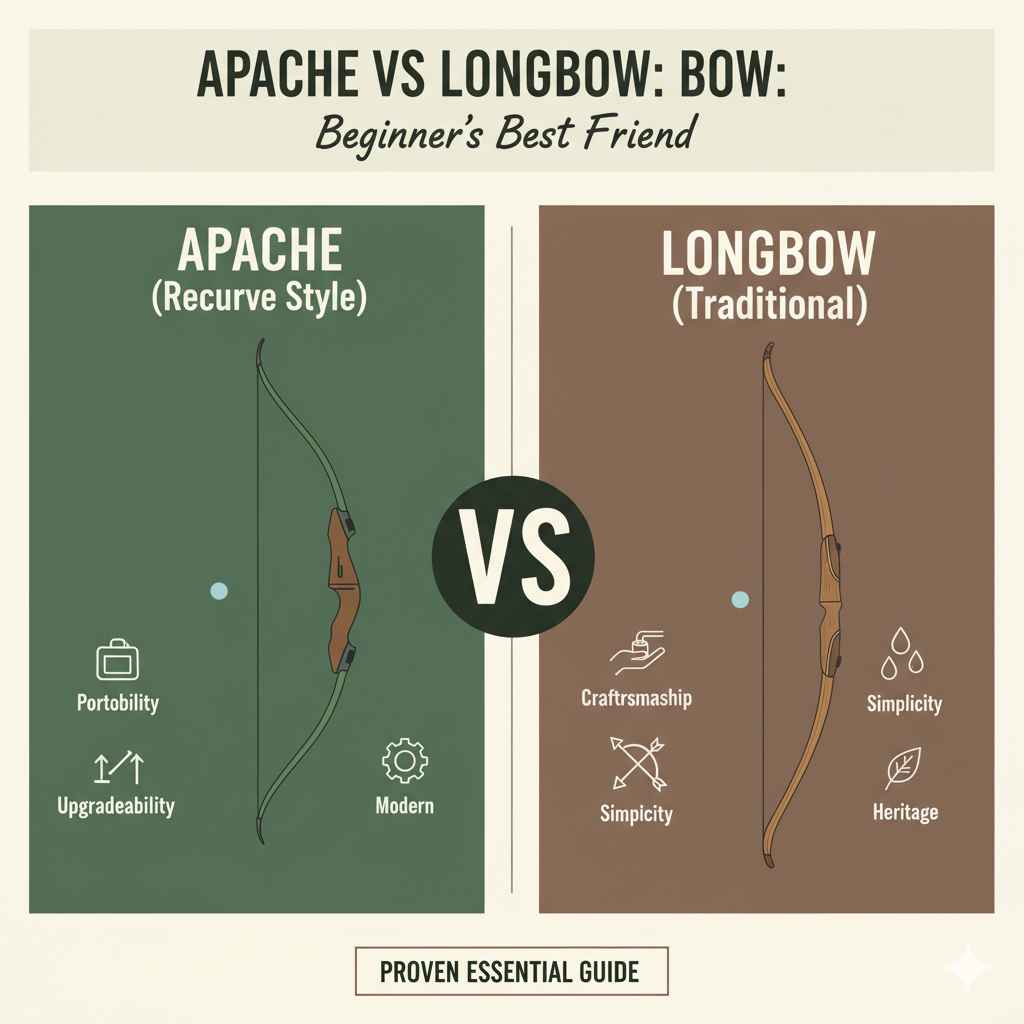
Apache vs Longbow: The Apache is a modern recurve bow often used in target shooting, known for its adaptability and ease of use, whereas the traditional Longbow is simpler, requiring pure form, making the choice depend on your shooting goals and preferred style.
Welcome, new archers! Deciding on your first bow can feel like a puzzle. You hear terms like “Apache” and “Longbow,” and they sound completely different. It is easy to get lost in the details when you just want to hit the target! Don’t worry. Choosing between these two styles does not have to be complicated. We are here to clear up the confusion, explain what makes each bow special, and help you pick the perfect tool to start your archery journey safely and successfully. Let’s break down the Apache recurve versus the classic Longbow.
Understanding the Basics: What Are We Comparing?
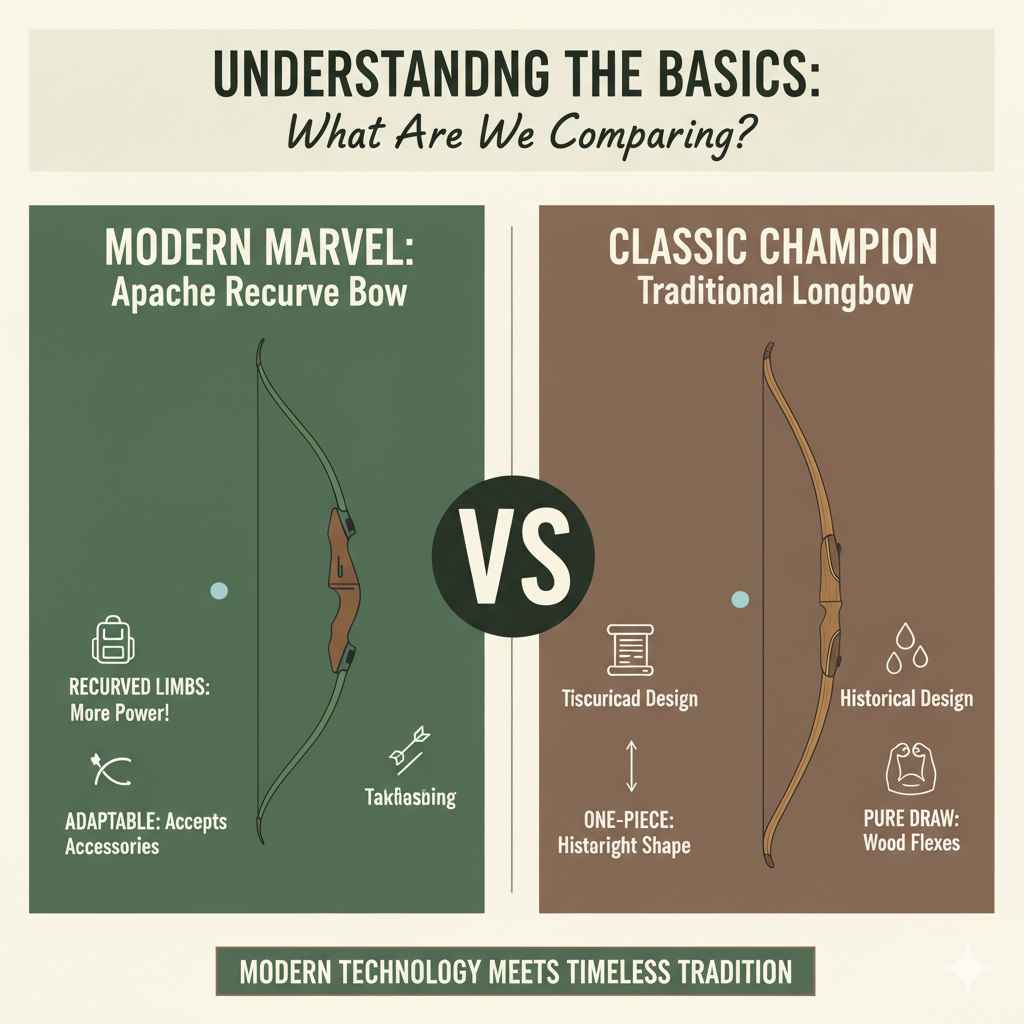
Before we dive into the comparison, let’s make sure we know exactly what we are looking at. The “Apache” usually refers to a type of modern, often takedown, recurve bow setup. The Longbow, however, is the ancestor—a simple, powerful stick of wood.
The Modern Marvel: The Apache Recurve Bow
When archers mention an “Apache” bow today, they are usually talking about a modern recurve bow that often features a three-piece takedown design. This means the limbs (the flexible top and bottom parts) detach from the riser (the handle section). This design makes it incredibly portable and easy to store. Modern recurves are built with advanced materials, often using fiberglass and wood laminations.
- Key Feature: Takedown capability for easy transport.
- Limbs: Curved tips that bend away from the archer when unstrung, providing more stored energy (speed) than a simple straight limb.
- Adaptability: They are designed to accept modern accessories like sights, stabilizers, and arrow rests.
The Classic Champion: The Traditional Longbow
The Longbow is history in your hands. Think Robin Hood! A traditional longbow is one continuous piece of wood (or laminated wood, though traditionally self-bows made of Yew were prized). It has very few moving parts, if any. There are no complex curves or places to attach gadgets.
- Key Feature: Simplicity and historical connection.
- Shape: Long, straight, and relatively flat in cross-section.
- Draw: The draw weight must be pulled entirely from the wood flexing, offering a very pure, traditional shooting experience.
Apache Recurve vs. Longbow: A Head-to-Head Comparison
To make your decision easier, let’s look at how these two bows stack up across the most important areas for a beginner: ease of use, speed, and accessories.
Speed and Power
Power in a bow is often measured by how fast it flings an arrow (Arrow Velocity). Generally, modern designs are more efficient at storing and releasing energy.
The recurve design of the Apache allows the tips to curve away from the archer. When you draw this bow, those curved tips add extra stored energy compared to a straight-limbed longbow of the same draw weight. This means:
- The Apache often shoots an arrow slightly faster for the same draw weight.
- This extra speed can sometimes help an arrow overcome slight aiming errors, which is helpful when you are learning.
Ease of Learning and Consistency
For a beginner, consistency is everything. Consistency comes from having predictable equipment.
The Longbow demands almost perfect form. Because it lacks sights, you must rely entirely on “instinctive” shooting—a skill that takes years to master. Even small shifts in your hand position or anchor point drastically change where the arrow lands.
The Apache, especially when set up with modern rests and sights, offers more forgiveness:
- Sights: You can attach a sight, which acts like the iron sight on a rifle, helping you aim precisely at the target.
- Rests: Modern arrow rests keep the arrow straight as it leaves the bow, leading to cleaner arrow flight, which improves grouping.
- Draw Cycle: Modern materials often provide a smoother pull back, making it easier to hold steady at full draw.
Portability and Maintenance
How easy is it to get your bow to the range or store it in your closet?
The Apache’s takedown design is a huge advantage here. You can unscrew the limbs from the riser in seconds. This makes it fit easily into a small backpack or a dedicated case, which is perfect for travel or storage in small apartments.
The Longbow, being one solid piece, is long! You need a much longer case or have to carefully lean it against a wall. While maintenance is simple (mostly just keeping the wood dry and the string waxed), it requires more physical space.
| Feature | Apache Recurve (Modern) | Traditional Longbow |
|---|---|---|
| Construction | Takedown (3 pieces), modern materials (laminates, fiberglass). | One piece, historically wood (Yew, Osage Orange). |
| Accessories | Accepts sights, stabilizers, plunger buttons. | None (Pure instinctive shooting). |
| Portability | Excellent; easily breaks down for travel. | Poor; long and one piece. |
| Arrow Speed | Generally faster due to limb design (recurved tips). | Slower for equivalent draw weight; very forgiving on the draw. |
| Learning Curve | Easier entry point due to sights and rests. | Steep learning curve; requires perfect form immediately. |
When to Choose the Apache Recurve
If your main goal is to learn quickly, shoot accurately at distances, and maybe even try competitive target archery, the modern recurve setup often called the Apache style is your friend.
Ideal For:
- Beginners who want faster initial success.
- Archers interested in Olympic-style or modern target archery.
- Those who need portability for travel or storage.
- Shooters who prefer using sights to dial in accuracy.
Setting Up Your Apache for Success
One of the best parts of the recurve system is customization. Here are the essential accessories you will want to add:
- Sight: Start with a simple 3-pin or 5-pin sight. This lets you set an exact point of aim. You can learn the fundamentals of shooting first, then worry about fine-tuning the pins later.
- Arrow Rest: A drop-away or magnetic rest ensures the arrow flies straight off the shelf. This reduces “archer’s paradox” wobble.
- Stabilizer: This long rod attaches to the front of the riser. It helps dampen vibration and acts as a weight to keep the bow steady when you hold at full draw.
- Clicker (Advanced): Once you get good at finding your anchor point, a clicker gives you an audible “click” when your arrow is drawn to the exact same length every time.
Remember, aiming with a sight is a skill, just like learning to hold the bow steady. Many great archers start this way. If you are interested in the technology and engineering that goes into modern archery, the recurve platform is fascinating. You can even look into resources from national governing bodies, like the National Archery in the Schools Program (NASP), which often uses recurve bows, showing how effective they are for teaching fundamentals on the NASP official website.
When to Choose the Traditional Longbow
Choosing the Longbow means you are choosing tradition, discipline, and the purest form of archery. You are signing up for a journey focused entirely on your body, your focus, and your connection to the shot.
Ideal For:
- Archers who value historical connection and simplicity.
- Those patient enough to dedicate time to mastering instinctive aim.
- Hunters looking for a low-tech, silent setup (where legal).
- Shooters who want to focus entirely on form over equipment tuning.
Mastering the Longbow: Focus on Form
Shooting a longbow successfully is a masterclass in body mechanics. Since you cannot rely on external aids, you must perfect three things:
- Consistent Anchor Point: Your drawing hand (the one holding the string) must touch the exact same spot on your face (usually corner of the mouth or below the jaw) for every single shot.
- Consistent Draw Length: You must pull the string back the same distance every time. This is hard without a clicker! Practice using a landmark, like the tip of your index finger meeting a specific spot on your jawbone.
- Follow-Through: After the release, your hand must stay exactly where it was until the arrow hits the target. Do not drop your hand to see where the arrow went!
Because the Longbow requires so much consistency, it can be more frustrating initially. However, when you finally start grouping arrows, the feeling of accomplishment is huge because you did all the work.
If you are interested in the history and craft behind traditional archery, you might find resources on traditional bow making fascinating. Learning about how materials like laminated wood behave can deepen your appreciation for the simplicity of the Longbow design. You can find historical context on how these bows were developed, often tracing back through documents from educational institutions regarding historical weaponry development.
The Role of Draw Weight in Your Decision
Draw weight (how hard it is to pull the string back) is critical for safety and comfort, regardless of which bow you choose. Beginners often choose weights that are too high, leading to injury, fatigue, and poor form development.
Recommended Starting Draw Weights
As your guide, Salman Arfeen strongly recommends starting low. You can always buy heavier limbs for your Apache later, but you cannot undo the bad habits built up with a bow that is too heavy.
| Archer Profile | Recommended Starting Draw Weight (Lbs) |
|---|---|
| Youth (Under 12) | 10–16 lbs |
| Average Adult Female | 18–24 lbs |
| Average Adult Male | 24–30 lbs |
For the Apache Recurve: Because the recurve limbs are usually more efficient, a 25 lb recurve might feel slightly easier to manage than a 25 lb longbow, simply due to material dynamics.
For the Longbow: Start even lighter! Since you have no sight to compensate for errors, a lighter bow (18–22 lbs for an adult male) allows you to focus 100% on form without muscle strain causing sloppy releases.
The Release: A Crucial Difference
How you let go of the string is perhaps the biggest technical difference between shooting these two bows.
Releasing the Apache (Finger Tab/Glove)
With a modern recurve, you almost always shoot using three fingers (index finger above the arrow, middle and ring fingers below) or a mechanical release aid (though mechanical aids are usually reserved for compound bows, some recurve shooters use them). You must use protection:
- Finger Tab: A small piece of leather or synthetic material that protects your finger pads from the string snap.
- Shooting Glove: A glove that covers the fingers used for drawing.
The release technique is often called a “clean release,” where you smoothly relax your drawing fingers simultaneously. The string slides cleanly off the leather/glove.
Releasing the Longbow (Bare Fingers)
Traditional longbow shooters almost always use their bare fingers (or sometimes a simple finger sling/tab). Because the Longbow’s string often moves faster and snaps against the finger, proper protection is essential to avoid string burn or bruising.
The release here is often described as letting the string “push” your fingers away rather than actively pulling them back. It’s a sudden, clean relaxation. If you pluck the string (pulling your hand sideways upon release), the arrow will fly wildly, which is why form is so important.
Safety First: Gear Check for Both Bows
Archery is a safe sport, but only if you respect the equipment. Whether you choose the high-tech Apache or the simple Longbow, safety gear is non-negotiable.
Essential Safety Gear Checklist
- Armguard: This is mandatory! It protects your bow arm (the one holding the bow) from the painful snap of the string upon release.
- Finger Protection: A finger tab (for recurve) or shooting glove (for longbow). Never shoot repeatedly without protection.
- Bow Stringer: This tool is essential for safely stringing and unstringing a recurve bow. Trying to muscle a recurve limb into place can cause it to break or twist, ruining the bow and potentially causing injury. Longbows can sometimes be strung by hand if the draw weight is low, but using a stringer is always safer.
- Safe Backstop: Never shoot arrows into the air or toward anything you don’t want them to hit. Use a proper, large target butt that can stop the arrow safely.
Always check your equipment before shooting. Look for cracks in the riser of the Apache or any deep gouges or delaminations in the limbs. With a Longbow, check the wood for stress cracks, especially where the limb tapers. If you see damage, do not shoot it; consult an archery expert.
The Skill Development Path: Where Do They Lead?
Your choice today sets the direction for your archery skill development over the next few years.
The Recurve Path (Apache Style)
This path trains you for precision mechanics. You learn how to tune your equipment—adjusting sight pins, balancing the bow with weights, and achieving a perfect limb alignment. This sets you up perfectly for Olympic Recurve, which is one of the most widely practiced competitive styles globally.
The skills learned here are highly transferable to compound bows later on, as they both rely heavily on external aids and tuning.
The Longbow Path
This path trains pure instinct and consistency. Every miss is a lesson in form correction. Shooters who master the Longbow often develop exceptionally consistent anchor points and releases because they are forced to by the equipment.
This path connects directly to historical archery and traditional bowhunting. The focus is internal rather than external.
Which Bow Should You Start With? My Advice
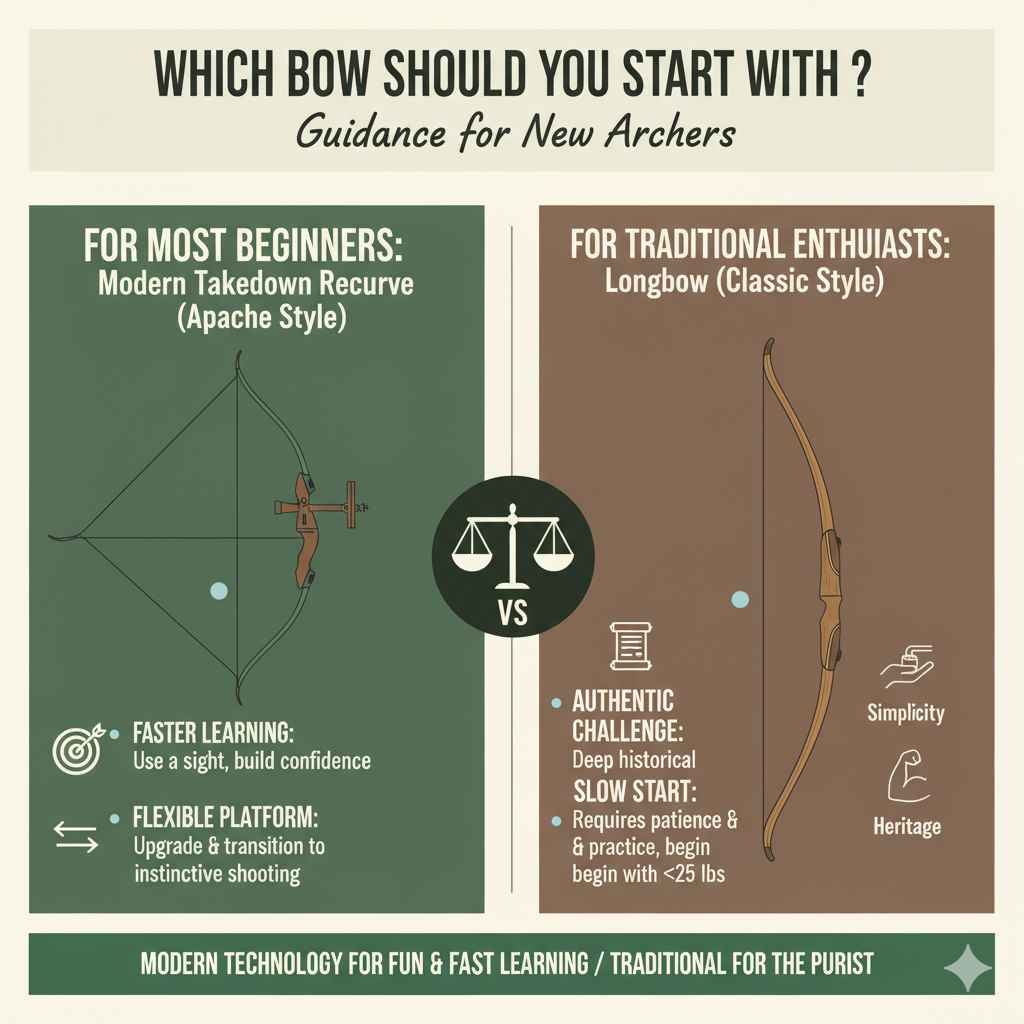
As an archery guide, I always recommend the bow that keeps you shooting consistently and safely. For the vast majority of beginners today, that means the modern recurve.
Here is my simple recommendation:
- If you want to learn faster and have fun immediately: Get the Apache-style Takedown Recurve. The ability to add a sight means you will see results sooner, which builds confidence. You can always remove the sight later and shoot instinctively on the same bow to transition toward traditional form!
- If you are deeply committed to traditional history, love a challenge, and are prepared for a slower start: Choose a Longbow with a very light draw weight (under 25 lbs).
Think of the Apache as a flexible training platform, and the Longbow as a specialized discipline.
Frequently Asked Questions (FAQ)
Q1: Is the Apache bow easier to learn on than a Longbow?
Yes, generally the Apache-style recurve is easier for beginners because you can add a sight to help you aim, which compensates for small inconsistencies in your form as you learn.
Q2: Can I use the same arrows for both bows?
Maybe, but probably not ideally. Longbows often prefer stiffer arrows (lower spine) because they are shot off the hand or a simple shelf, meaning they bend less upon release. Recurves with modern rests prefer slightly more flexible arrows (higher spine) when using sights. Always check the manufacturer’s recommended spine chart for your specific arrow weight and bow draw weight.
Q3: Which bow is faster, the Apache or the Longbow?
For the same draw weight, the Apache recurve is usually faster. Its recurved tips store more energy efficiently than the straight limbs of a traditional longbow.
Q4: Do I need a sight to shoot accurately with the Apache recurve?
No, you don’t need a sight — but it helps beginners tremendously. A sight allows you to aim with a clear reference point, which speeds up early accuracy and builds confidence. Many archers start with a sight, then later remove it to practice instinctive shooting once their form improves.
Q5: Is the Longbow more difficult to maintain than the Apache recurve?
Not necessarily more difficult — just different.
- A modern recurve requires checking limb bolts, string condition, and accessory alignment.
- A traditional longbow requires careful storage (avoid moisture and extreme heat) and should usually be unstrung after shooting to protect the limbs.
Both need regular string waxing and inspection for cracks or limb damage.
Q6: Which bow is better for backyard target shooting?
The Apache-style recurve is typically better for backyard practice because:
- It’s easier to transport and store.
- You can adjust draw weight by swapping limbs.
- You can use sights for faster improvement.
However, if you value simplicity and quiet shooting, a longbow works beautifully as well.
Q7: Can I hunt with either bow?
Yes — provided the draw weight meets local hunting regulations (often 40 lbs or more for big game). Always check your local laws. For beginners, focus on mastering accuracy and ethical shot placement before considering hunting.
Q8: Which bow builds better long-term skills?
Both build excellent skills, but in different ways:
- Apache Recurve: Develops technical precision, tuning knowledge, and competitive target fundamentals.
- Longbow: Builds instinctive aim, release discipline, and strong anchor consistency.
Neither is “better” — they simply train different aspects of archery.
Conclusion:
The choice between an Apache-style modern recurve and a traditional longbow comes down to your goals and personality as an archer.
- Choose the Apache Recurve if you want:
- Faster early success
- Adjustable equipment
- Portability
- The option to compete or upgrade later
- Choose the Longbow if you want:
- A traditional, minimalist experience
- Deep focus on pure form
- Historical connection
- A rewarding, discipline-driven challenge
For most beginners, the Apache recurve provides a smoother, more encouraging starting point. But for those who value tradition and are ready for a steeper learning curve, the longbow offers unmatched satisfaction.
No matter which path you choose, start with a light draw weight, focus on consistent form, and practice safely. The bow is only the tool — your technique is what truly determines success.