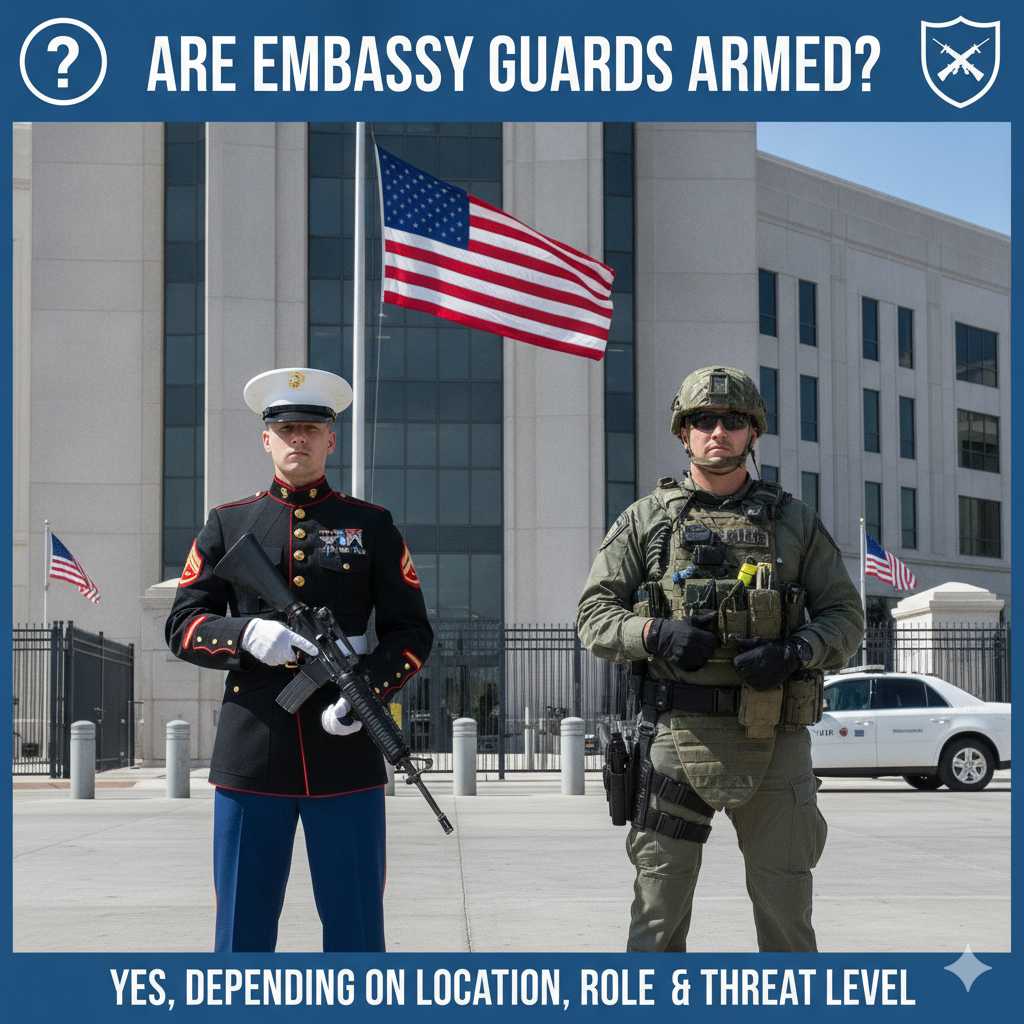
Are Embassy Guards Armed? Security Rules Explained
Most U.S. embassy guards, specifically the Marine Security Guards (MSGs) and Diplomatic Security Service (DSS) Special Agents, are armed. Their armament is part of a comprehensive security plan designed to protect personnel, facilities, and classified information within U.S. diplomatic missions worldwide. Security protocols are extremely strict and vary based on threat assessments.
The Unseen Shield: Why Embassies Need Protection
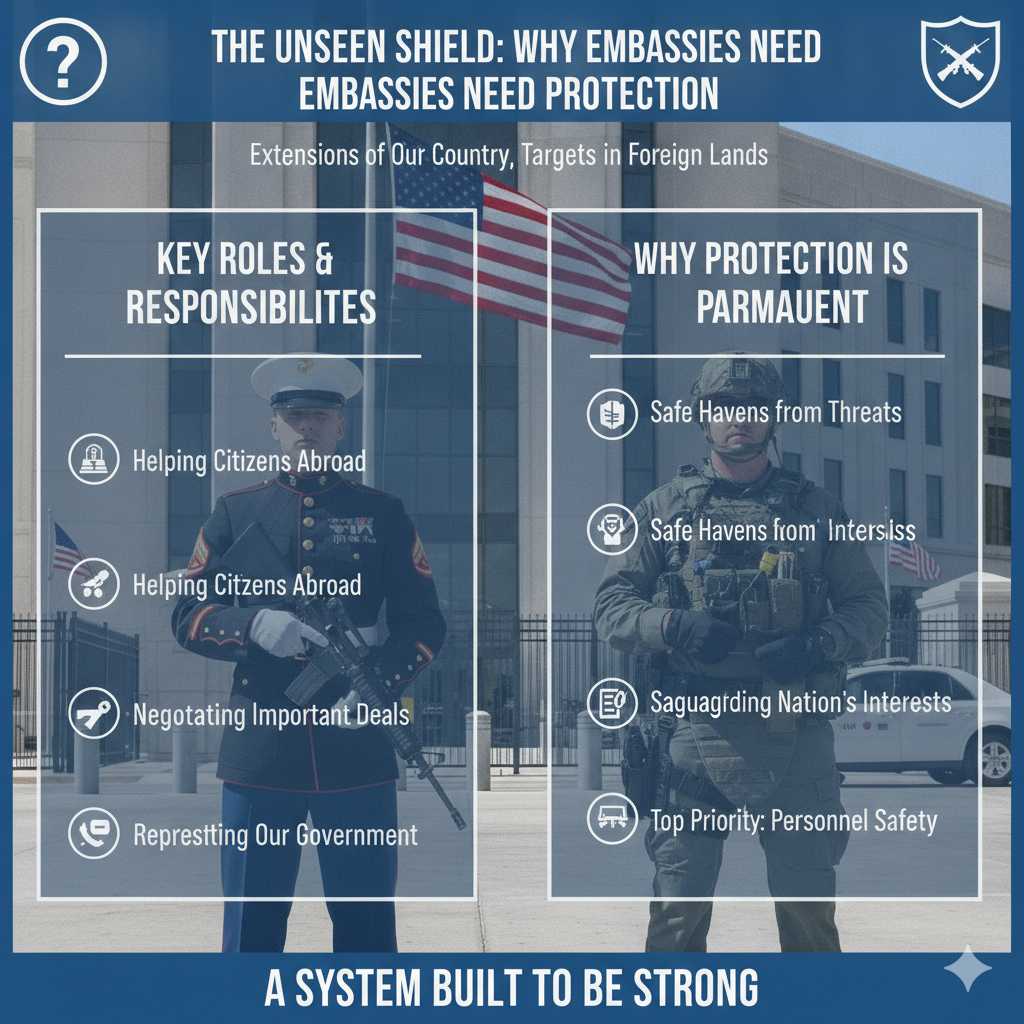
Embassies are more than just buildings. They are extensions of our country in foreign lands. Think of them as our home away from home, but with a lot more responsibility.
They handle everything from helping citizens abroad to negotiating important deals. Because of this, they become targets.
Countries around the world have different ideas and sometimes conflicts. For this reason, our embassies must be safe havens. They need to be protected from threats, both big and small.
This protection ensures our diplomats can do their jobs without fear. It also safeguards our nation’s interests.
The people working in embassies are important. They represent our government. Their safety is a top priority.
So, the security you see, and the security you don’t, all work together. It’s a system built to be strong.
Who Guards the Gates? Marine Security Guards and Special Agents
When you picture an embassy guard, you might imagine a uniformed Marine. You’d be partly right! The U.S.
Marine Corps plays a critical role. They provide a visible and robust presence at many embassies. These are the Marine Security Guards, often called MSGs.
These Marines are highly trained. They are selected for their discipline and professionalism. Their job is to be the first line of defense.
They protect the embassy building itself. They also safeguard sensitive areas within the embassy.
But it’s not just the Marines. There are also Diplomatic Security Service (DSS) Special Agents. These agents are sworn federal law enforcement officers.
They work for the State Department. Their mission is broader. They are responsible for the overall security of our diplomats and facilities worldwide.
Special Agents have a lot of training. This includes firearms proficiency and counter-terrorism tactics. They often work behind the scenes.
They manage the security systems and direct the overall security plan. They also investigate security incidents.
So, you have these two key groups. The Marines provide a strong physical presence. The Special Agents provide expert law enforcement and management.
Together, they create a powerful security team for our embassies.
The Real Story: My Visit to a U.S. Embassy
I remember visiting a U.S. embassy in Europe a few years ago. I had a specific appointment.
As I approached, I noticed two Marines standing post. They were in crisp uniforms. They looked incredibly alert.
They weren’t just standing there; they were observing everything. Their presence was a clear signal of security.
I had to go through a few security checkpoints. Each one felt thorough. They checked my ID carefully.
They scanned my bag. It wasn’t intrusive, but it was detailed. I saw other people being asked questions.
The whole process was calm but firm. I could feel the underlying readiness. It made me feel safe, honestly.
Later, I saw a few people in plain clothes who looked like they were in charge. They moved with purpose. They weren’t wearing uniforms, but they had an air of authority.
I later learned these were likely DSS Special Agents overseeing things. It struck me then how many layers of security there are. It’s not just one type of guard.
It’s a whole system working together.
The experience gave me a new appreciation. It’s easy to see the uniformed guards. But the unseen work, the planning, the constant vigilance – that’s the real strength.
It’s a job that requires immense focus and dedication. It’s not something you can do casually.
Inside the Security Toolkit: What Arms Are Used?
Now, let’s get to the core question. Are embassy guards armed? Yes, they are.
But the choice of weapons is carefully considered. It’s not a free-for-all. The type of firearm depends on the role of the guard and the security assessment of the location.
Marine Security Guards often carry standard-issue military sidearms. These are typically semi-automatic pistols. They also might carry shotguns or rifles depending on their specific post and threat level.
Their training focuses on immediate threat response. They are prepared to defend the post.
Diplomatic Security Special Agents are law enforcement officers. They are authorized to carry a variety of firearms. This usually includes their service pistol.
In some situations, they might be authorized to carry more powerful weapons like submachine guns or rifles. This is especially true if they are part of an immediate response team.
The weapons are not just carried; they are part of a larger security strategy. They are tools used by highly trained professionals. The goal is always to neutralize threats quickly and effectively.
But just as importantly, they are meant to deter threats in the first place.
The rules about carrying and using these weapons are very strict. They are governed by detailed policies. These policies ensure that force is used only when absolutely necessary and in accordance with U.S.
and international law. It’s a heavy responsibility.
Key Security Personnel & Their Roles
Marine Security Guards (MSGs)
These are U.S. Marines stationed at embassies. Their main job is to protect the physical embassy building.
They stand guard at posts and control access. They are trained to respond to immediate threats and secure the facility.
Diplomatic Security Service (DSS) Special Agents
These are sworn federal law enforcement officers. They lead the overall security effort. They manage security systems, conduct investigations, and develop security plans.
They are also armed and ready to respond to threats.
Local Guard Forces
In some cases, embassies also employ local security personnel. These guards are hired and trained by the U.S. government.
Their duties are usually focused on perimeter security and access control, working under the supervision of DSS agents.
Strict Rules of Engagement: When Force Becomes an Option
Carrying a firearm is one thing. Knowing when and how to use it is another. For embassy guards, these rules are incredibly precise.
They are known as Rules of Engagement (ROE).
These rules dictate the circumstances under which force can be used. They are designed to protect lives. This includes the lives of embassy personnel, visitors, and even the guards themselves.
They also aim to protect government property.
Generally, force is only authorized when there is an imminent threat. This means a threat that is happening right now. It could be an attack on the embassy.
It could be an attempt to breach security or harm someone. The force used must be proportional to the threat.
For example, a guard might be authorized to use deadly force if someone is actively trying to enter a secure area with a weapon. Or if an individual is assaulting another person. The goal is to stop the threat, not to punish.
These rules are not optional. They are part of the rigorous training for every guard and agent. They are reviewed and updated regularly.
This ensures they remain effective and appropriate for the ever-changing global security landscape.
The decision to use force is never taken lightly. It carries immense personal and professional consequences. That’s why the training is so extensive.
It’s about more than just shooting. It’s about judgment, de-escalation, and understanding the law.
Understanding “Imminent Threat”
- Direct and Immediate Danger: The threat must be happening right now, not something that might happen later.
- Clear Intent to Harm: The attacker’s actions show a clear purpose to cause injury or death.
- No Other Option: Force is used only when there are no other safe ways to stop the danger.
Beyond Firearms: A Multi-Layered Defense System
While firearms are a critical part of embassy security, they are just one piece of a much larger puzzle. U.S. embassies employ a sophisticated, multi-layered defense system.
This system is designed to prevent threats before they even reach the point where weapons are needed.
Think of it like an onion. Each layer has a job to do. If one layer is breached, the next one is there to stop the threat.
This layered approach is key to effective security.
The outermost layer might be the physical perimeter. This includes high walls, fences, and controlled access points. It’s designed to keep unauthorized people out from the start.
Then there are surveillance systems. These include cameras everywhere, motion detectors, and sophisticated alarm systems. These systems are monitored 24/7 by security personnel.
They can detect unusual activity from a distance.
Access control is another crucial layer. Every person and vehicle entering an embassy goes through strict checks. This involves ID verification, bag searches, and sometimes even vehicle inspections.
This stops unwanted items or individuals from getting inside.
Within the embassy itself, there are secure areas. These areas have their own access controls. Only authorized personnel can enter.
These spaces protect sensitive information and personnel.
And of course, there is the human element. The trained guards, agents, and security staff are the active components of this system. They respond to alarms, patrol the grounds, and make real-time decisions.
This integrated approach means that even if a threat manages to get past one security measure, there are several others in place to stop it. It’s a constant cycle of monitoring, assessment, and response.
A Layered Security Analogy: The Castle
Outer Moat: Distant surveillance, traffic control, preventing approach.
High Walls & Drawbridge: Perimeter fencing, controlled entry points.
Guards on the Walls: Marine Security Guards watching the exterior.
Inner Courtyard Checkpoints: Access control for different buildings within the embassy compound.
Castle Keep: Secure rooms and offices for sensitive work.
The King and His Advisors: Diplomatic Security Service Agents managing the overall defense.
Threat Assessment: Why Security Levels Change
You might have noticed that security at embassies can look different. Sometimes it seems more intense than other times. This is because security is not static.
It’s dynamic. It changes based on threat assessments.
The U.S. Department of State’s Diplomatic Security Service constantly monitors global threats. They gather intelligence.
They work with local governments and other intelligence agencies. This helps them understand potential risks to U.S. personnel and facilities abroad.
If there’s an increase in tensions in a particular region, or if a specific threat emerges, security measures at the embassy there will be heightened. This could mean more guards on duty. It could mean stricter access controls.
It might even mean deploying specialized security teams.
The threat level can also be influenced by specific events. For example, if there are upcoming elections in the host country that might be contentious, or if there are major international summits planned. These events can sometimes lead to a rise in security concerns.
Conversely, in areas with very low threat levels, security might appear less overt. However, even in these situations, the underlying security infrastructure and protocols remain in place. The guards are still vigilant, even if they aren’t as visible.
This constant assessment and adaptation are vital. It ensures that the security measures are always appropriate for the specific risks faced by each embassy. It’s about being prepared for what might happen.
Factors Influencing Security Levels
- Geopolitical Climate: Regional conflicts, political instability.
- Intelligence Reports: Specific threats against U.S. interests or personnel.
- Host Country Conditions: Local crime rates, civil unrest, planned protests.
- Special Events: High-profile visits, international conferences, holidays.
The Personal Toll: What It’s Like to Be an Embassy Guard
Being an embassy guard or special agent is more than just a job. It’s a commitment. It requires a specific kind of person.
The individuals who serve in these roles often face unique challenges.
One of the biggest challenges is the constant vigilance required. You’re always on alert. You have to be aware of your surroundings at all times.
This can be mentally exhausting. There’s no “off” switch for a significant part of your shift.
Living and working abroad can also be difficult. Guards and agents are often far from home and family. They operate in environments that can sometimes be unstable.
They have to adapt to different cultures and customs.
The responsibility is immense. You are directly responsible for the safety of diplomats, visitors, and colleagues. A single mistake could have severe consequences.
This pressure requires incredible discipline and emotional control.
Despite these challenges, many find the work deeply rewarding. They are serving their country. They are playing a vital role in protecting U.S.
interests and personnel abroad. This sense of purpose is a powerful motivator.
The training is designed to prepare them for these pressures. It includes psychological preparation, stress management, and teamwork exercises. The goal is to build resilient individuals and cohesive teams.
A Day in the Life (Concept)
Morning Briefing: Reviewing overnight activity and current threat intelligence.
Post Assignment: Taking up a specific guard post or patrol route.
Constant Observation: Monitoring surroundings, people, and vehicles.
Access Control: Vetting visitors and deliveries carefully.
Response Drills: Practicing emergency procedures regularly.
Equipment Checks: Ensuring all security gear is functional.
End of Shift Debrief: Reporting any incidents or observations.
Local Guards vs. U.S. Personnel: Different Roles, Same Mission
Embassies often rely on a mix of security personnel. While U.S. Marines and DSS agents are the core, local guards play an important supporting role.
It’s crucial to understand their distinct responsibilities.
U.S. Marine Security Guards and DSS Special Agents are U.S. citizens.
They are federal employees or military personnel. They have specific training and legal authority granted by the U.S. government.
Their roles are focused on protecting U.S. interests and personnel.
Local guards are hired from the host country. They are employed by the embassy under contracts. Their primary duties usually involve perimeter security.
They might manage gates, patrol the outer grounds, and assist with initial access control.
They undergo thorough vetting and training provided by the U.S. government. This training ensures they understand embassy security procedures and standards.
However, their authority and the types of weapons they carry may differ from U.S. personnel. Often, their armament is less extensive.
The relationship between U.S. personnel and local guards is one of teamwork. The local guards act as an important first line.
They help maintain order and control access. They work under the direction and supervision of the DSS Special Agents. This ensures a unified security posture.
This collaborative approach is effective. It leverages local knowledge while maintaining U.S. control over critical security functions.
It’s a practical way to ensure comprehensive coverage.
Local Guard vs. U.S. Personnel: A Quick Look
| Feature | U.S. Marine Security Guard / DSS Agent | Local Guard Force |
|---|---|---|
| Employer | U.S. Government (State Dept./U.S.M.C.) | Contracted Host Country Nationals |
| Primary Role | On-site security leadership, response, sensitive area protection | Perimeter security, access control, general patrol |
| Armament | Service pistol, rifles, shotguns (depending on role/threat) | Service pistol, potentially less lethal options (depending on contract/threat) |
| Authority | Sworn law enforcement/military authority | Limited authority, under U.S. supervision |
When to Be Concerned: Recognizing Red Flags
Most of the time, the security you see at an embassy is a routine part of operations. However, there are signs that might indicate increased concern or a specific security event. It’s helpful to know what to look for, though direct intervention is not advised.
An increase in visible security personnel is often the first sign. If you notice more uniformed guards or agents than usual, it could mean heightened alert status. This could be due to a specific threat or a planned event.
Stricter access procedures are another indicator. If checkpoints become more thorough, or if entry is delayed significantly, it suggests increased scrutiny. This is designed to prevent any potential threats from entering.
Changes in the physical environment can also be a signal. You might see temporary barriers, increased lighting, or enhanced surveillance equipment being deployed. These are all measures to bolster security.
Unusual activity around the embassy perimeter could also be a cause for concern. For example, if there are sudden, large, or organized groups gathering. Or if there’s unexpected vehicle activity.
It’s important to remember that these are just observations. Embassies operate under a wide range of security postures. An increase in visible security does not automatically mean there is an immediate danger.
It often means that security professionals are taking proactive steps.
If you ever witness something that seems genuinely alarming, such as an active assault or a security breach, the best course of action is always to alert local authorities immediately. Do not approach the embassy or attempt to intervene yourself.
The Bottom Line: Protection is Paramount
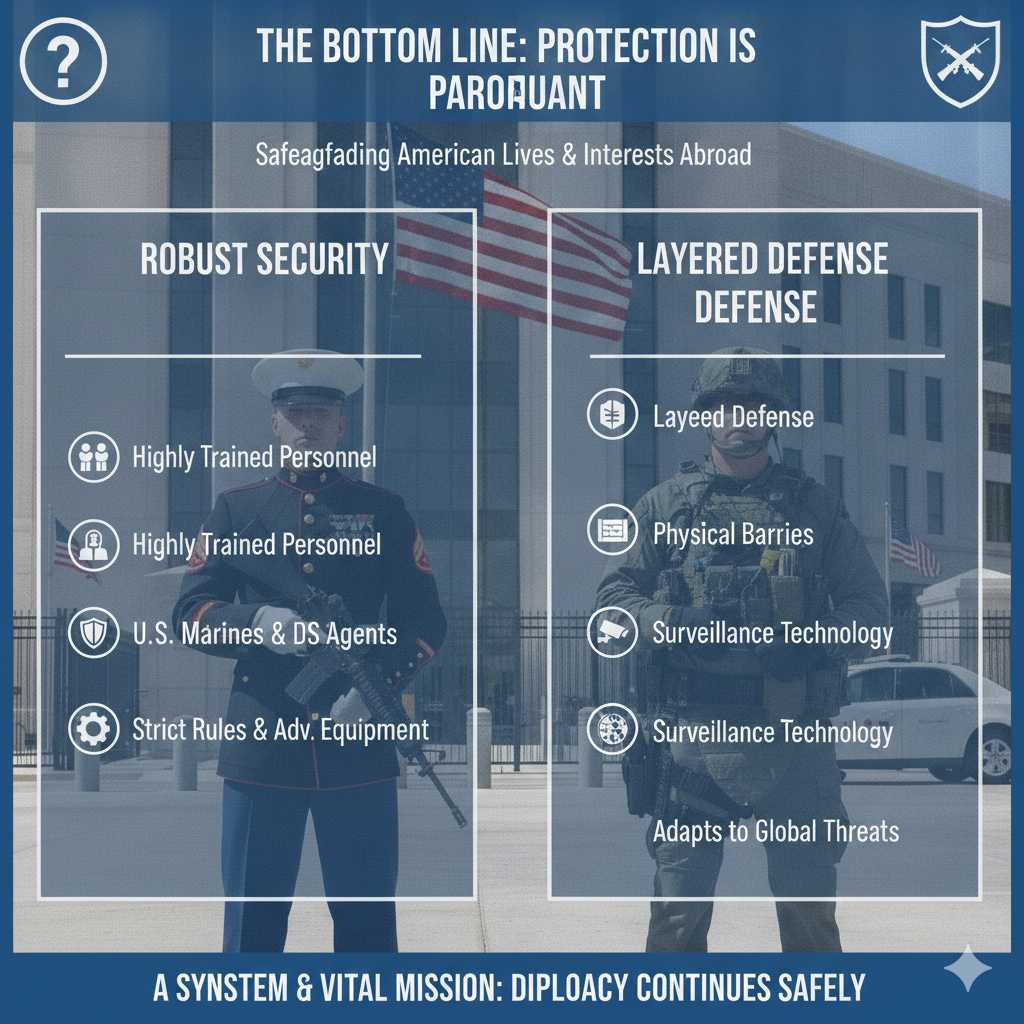
So, to bring it all together, yes, U.S. embassy guards are armed. This is a fundamental aspect of protecting American lives and interests around the world.
The security at these facilities is incredibly robust. It involves highly trained U.S. Marines and Diplomatic Security Special Agents.
They operate under strict rules and with advanced equipment.
This armament is part of a layered defense system. This system includes physical barriers, surveillance technology, and strict access controls. It’s designed to prevent threats before they materialize.
The level of security can change. It adapts to the ever-evolving global threat landscape. This ensures that protection remains effective.
It’s a complex and vital mission. It allows our diplomats to represent our country safely. It ensures that our nation’s work abroad can continue unimpeded.
Frequently Asked Questions
Are all guards at U.S. embassies armed?
No, not all personnel present at an embassy are armed. However, key security personnel, such as U.S. Marine Security Guards and Diplomatic Security Service Special Agents, are armed as part of their duties to protect the embassy and its personnel.
What kind of weapons do embassy guards carry?
The types of weapons vary. Marine Security Guards might carry service pistols, shotguns, or rifles. Diplomatic Security Special Agents, as law enforcement officers, are authorized to carry their service pistols and, in certain situations, more advanced firearms.
Are the rules for using weapons different for embassy guards?
Yes, embassy guards operate under very strict Rules of Engagement (ROE). These rules dictate when and how force, including deadly force, can be used. They are designed to protect lives and property while adhering to legal and ethical standards.
Do local guards at embassies carry firearms?
Local guards employed by embassies often have specific roles in perimeter security and access control. While they undergo training, their armament may differ from that of U.S. personnel and is often determined by local laws and specific embassy security contracts.
U.S. personnel maintain oversight.
How does the U.S. decide how much security an embassy needs?
Security levels are determined by threat assessments conducted by the Diplomatic Security Service. These assessments consider geopolitical factors, intelligence reports, and local conditions to set appropriate security measures, which can be adjusted as threats change.
Can civilians carry weapons inside a U.S. embassy?
Generally, no. Civilians visiting or working at a U.S. embassy are typically not permitted to carry firearms or other weapons, except in very specific, authorized circumstances related to official duties or diplomatic immunity.
Security personnel are the primary individuals authorized to carry arms within the facility.
What is the role of the Marine Security Guards?
Marine Security Guards (MSGs) are the primary defenders of the embassy building itself. They stand post, control access to secure areas, and are trained to respond to immediate threats to protect the facility and personnel.
Conclusion: A Constant Vigilance
The security of U.S. embassies is a multifaceted operation. It relies on dedicated professionals and a robust system.
Understanding that guards are armed is key, but it’s just one part of the story. The real strength lies in the layered defenses and constant vigilance that protect our diplomats and interests abroad.