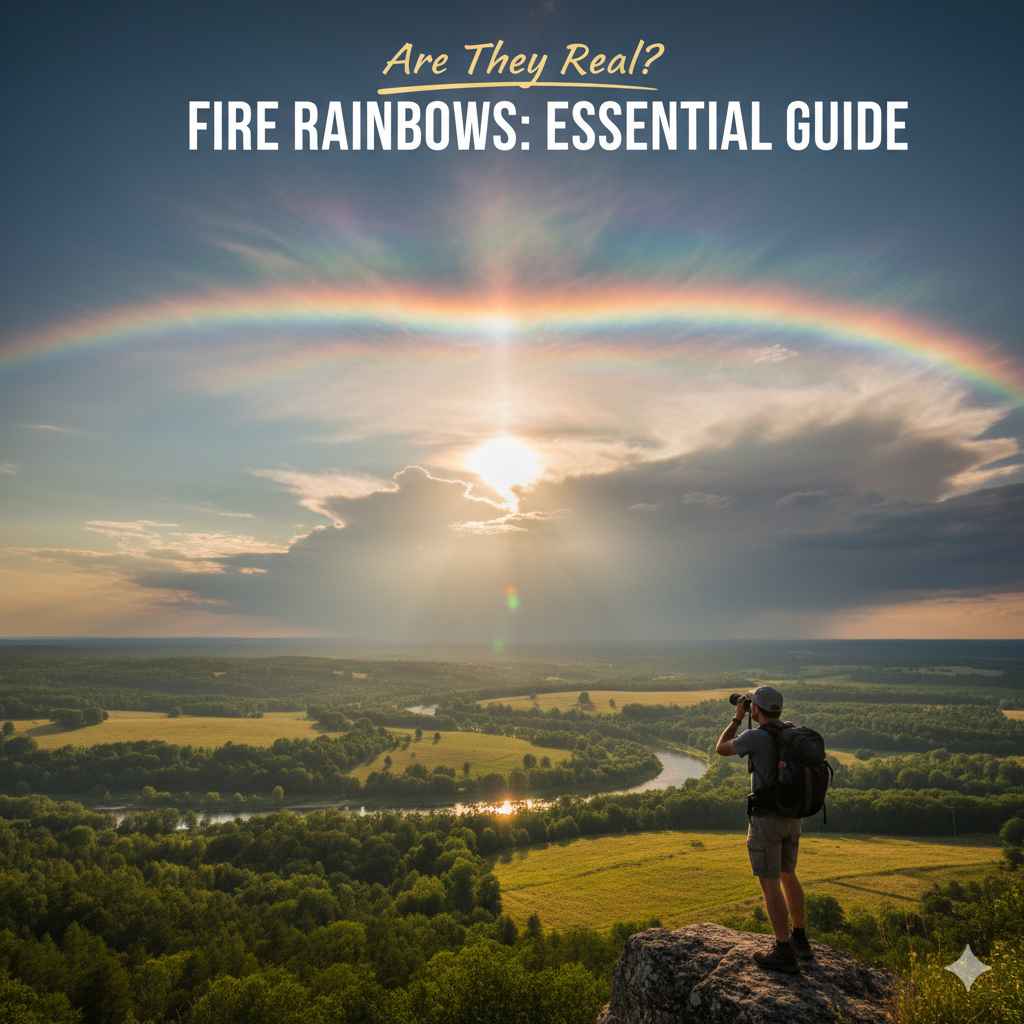
Are Fire Rainbows Real? Circumhorizontal Arc Explained
Yes, fire rainbows are real! Also known as circumhorizontal arcs, these stunning optical phenomena are beautiful, natural displays created by ice crystals in high-altitude clouds, not actual fire. This guide will explore what they are, how they form, and where you might see them. For more on this, see our guide on Is a Triple Rainbow Possible? Exploring Rare Weather Phenomena. For more on this, see our guide on Is a 3X Scope Good for Hunting.

LSIUHWUWI
LSIUHWUWI Natural Phenomenon Wall Art 3 Panel…
- Framed Canvas Wall Art Prints Painting Size:12x16inchx3pcs(30x40cmx3pcs).
- High Definition Canvas Printing :Picture Photo Printed on High Quality Canvas.Stretched and framed.Waterproof canvas, allowing you…
- Easy to Hang and Reusable :Each Panel Of Canvas Prints Already Stretched On Solid Wooden Frames, Gallery Wrapped, With Hooks And A…
As an Amazon Associate I earn from qualifying purchases.
Have you ever seen a picture of a colorful arc across the sky, looking like a rainbow but shaped differently and appearing much higher up? It might seem too magical to be true, like something out of a fantasy story. Many people wonder, “Are fire rainbows real?” The good news is, they absolutely are! These dazzling displays are a real, natural wonder.
They aren’t made of fire, despite their name, but are created by tiny ice crystals high in the atmosphere. If you’ve ever felt frustrated by not knowing how these sky wonders are formed, this guide is here to help. We’ll break it down simply, so you can understand the science behind these breathtaking sights and maybe even spot one yourself!
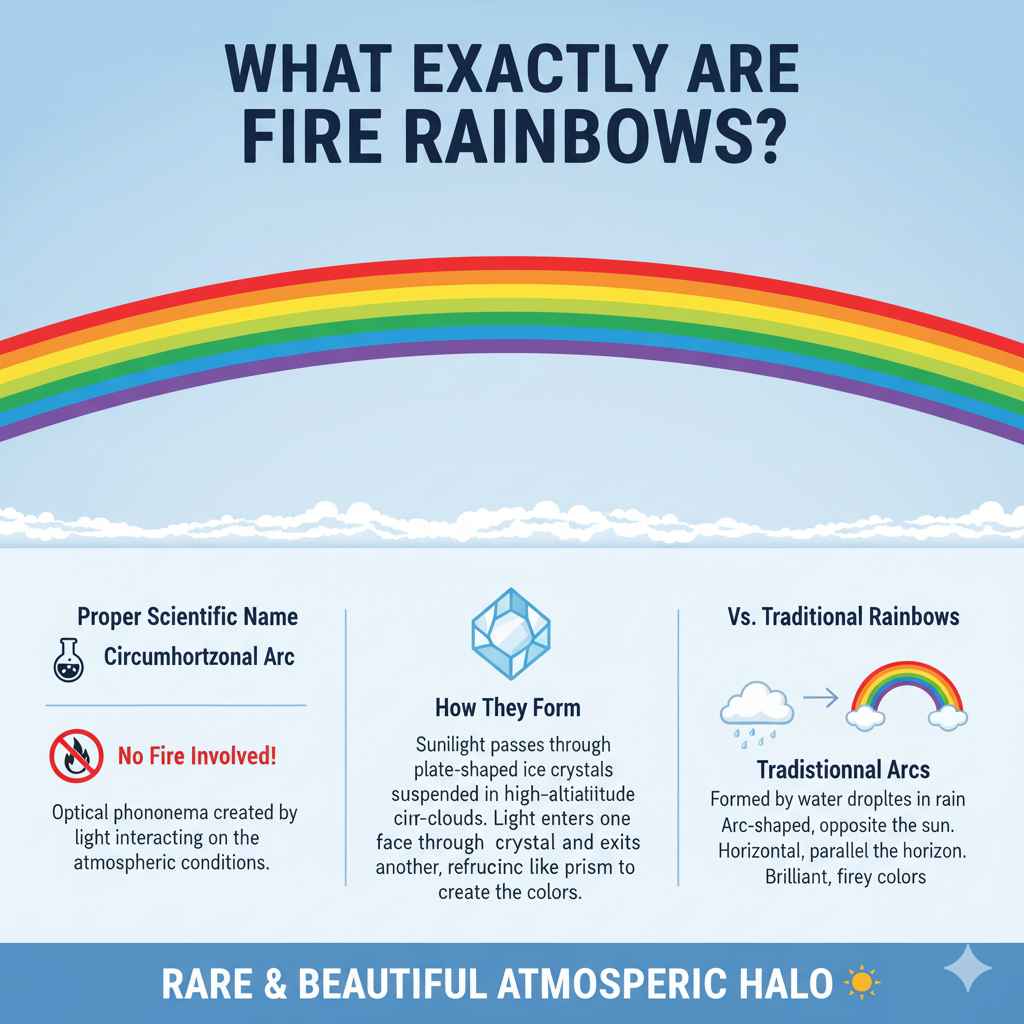
What Exactly Are Fire Rainbows?
The vibrant, often wide, and sometimes curved bands of color that people call “fire rainbows” have a proper scientific name: circumhorizontal arcs. The term “fire rainbow” is a bit of a misnomer because, as we’ll discover, there’s no fire involved! These are optical phenomena, meaning they are created by light interacting with atmospheric conditions. They are a type of halo, which are a family of transparent, white, or colored optical atmospheric phenomena created by light interacting with ice crystals suspended in the atmosphere.
Unlike traditional rainbows, which are formed by water droplets in rain and appear in a specific arc shape opposite the sun, circumhorizontal arcs are almost parallel to the horizon. They stretch horizontally across the sky and can display brilliant red, orange, yellow, green, blue, and violet colors, much like a rainbow. The intense colors are what give them their fiery appearance, leading to the popular nickname.
How Do Fire Rainbows Form?
The formation of circumhorizontal arcs is fascinating, and it all comes down to the specific conditions of sunlight and ice crystals. It’s a bit like how a prism splits light, but on a grand scale in the sky.
The Key Ingredients
For a fire rainbow to appear, three main things need to be present:
- Sunlight: The sun needs to be positioned at a specific angle in the sky. It must be high enough, at least 58 degrees above the horizon.
- Ice Crystals: These aren’t just any ice crystals. They need to be specific, flat, hexagonal plate-shaped ice crystals. These are found in very high-altitude clouds.
- The Right Clouds: The clouds involved are cirrus clouds, which are thin, wispy clouds made entirely of ice crystals.
The Science Behind the Colors
When the sun is high in the sky and shines through clouds containing these special ice crystals, something magical happens. The flat, hexagonal ice crystals act like tiny prisms. As sunlight enters one side of a crystal and exits through another, it’s refracted, or bent. Because different colors of light bend at slightly different angles, the white sunlight is split into its component colors – the colors of the rainbow.
The specific shape and orientation of the ice crystals are crucial. For circumhorizontal arcs, the hexagonal plate-shaped ice crystals must be oriented horizontally. This allows them to refract sunlight in a way that creates a broad, colorful band parallel to the horizon. The higher the sun is in the sky, the higher the circumhorizontal arc will appear. If the sun is too low, these arcs generally won’t form.
It’s important to note that the colors visible in a fire rainbow are the most intense when the sun is at its highest point, typically around midday during the summer months. However, their appearance can vary based on the thickness and composition of the ice crystals within the clouds.
Where and When Can You See Fire Rainbows?
Seeing a fire rainbow is a special event, and not something you can witness every day. Certain locations and times offer a much better chance.
Geographical Locations
Due to the sun’s angle requirements, fire rainbows (circumhorizontal arcs) are most commonly observed in the:
- Northern Hemisphere: Primarily visible in the middle and high latitudes during late spring and summer.
- Southern Hemisphere: Also visible but typically during their summer months (December to February).
In places closer to the equator, where the sun is often overhead or directly high in the sky for much of the year, the sun might not be at the required 58-degree angle often enough for these arcs to form. However, with the sun’s path varying throughout the year, even in some lower latitudes, they can occasionally be seen when the conditions are just right.
Time of Day and Year
The optimal time to spot a fire rainbow is:
- Midday: The sun needs to be high in the sky, typically between 10 AM and 2 PM, depending on your location and the time of year.
- Summer Months: In the Northern Hemisphere, this means looking between May and July. In the Southern Hemisphere, it’s between November and January.
During these times, the sun reaches its highest altitude, increasing the chances of it being above the 58-degree threshold required for the light to interact with the ice crystals in the correct orientation.
Identifying the Clouds
Look for high-altitude clouds that fit the description of cirrus clouds. These are thin, wispy, and feathery clouds, often appearing somewhat transparent. They are made of ice crystals, which are the essential ingredients for forming an arc. You won’t see fire rainbows during a rain shower; they appear in fairer weather with specific high cloud formations.
Fire Rainbows vs. Other Atmospheric Phenomena
The sky offers many beautiful optical displays. It’s easy to confuse a fire rainbow with a regular rainbow or other halo phenomena. Here’s how they differ:
Regular Rainbows
Regular rainbows are produced by the refraction and reflection of sunlight by spherical water droplets in the air. This typically happens during or after rain. Key differences:
- Shape: A perfect semi-circle.
- Position: Always appear opposite the sun.
- Formation: Caused by water droplets.
- Sun Angle: Can form when the sun is lower in the sky.
Sundogs (Parhelia)
Sundogs are bright spots of light that appear on either side of the sun, often at the same altitude as the sun. Like fire rainbows, they are caused by ice crystals.
- Shape: Bright spots, not a continuous arc.
- Position: To the left and right of the sun.
- Formation: Caused by hexagonal ice crystals, but these crystals are oriented to refract light horizontally.
Circumzenithal Arcs (FZARs)
These are often mistaken for fire rainbows and are arguably even more spectacular! They are bright, colorful arcs that appear high overhead, forming a U-shape or a wide smile above the sun. They are also formed by horizontal, hexagonal ice crystals but require the sun to be even higher (at least 70 degrees above the horizon).
- Shape: A wide, colorful arc directly overhead.
- Position: High in the sky, zenith.
- Formation: Caused by horizontal, hexagonal ice crystals.
- Sun Angle: Sun must be very high.
To help distinguish them, think of the horizon. A fire rainbow is a horizontal band of color. A regular rainbow is a curved arc opposite the sun. Sundogs are bright spots on either side of the sun. A circumzenithal arc is a spectacular colorful band high overhead.
Tips for Photographing Fire Rainbows
Capturing the beauty of a fire rainbow can be challenging, but with a few tips, you can get some stunning shots.
Equipment Suggestions
While you can capture decent images with a smartphone, a camera with more manual controls will yield better results.
- Camera: A DSLR or mirrorless camera provides more control.
- Lens: A wide-angle lens is excellent for capturing the full arc and the surrounding sky.
- Tripod: Essential for stability, especially if capturing in lower light conditions or for longer exposures to bring out colors.
- Filters: A polarizing filter can sometimes help enhance the colors and reduce glare.
Camera Settings
Getting the settings right is key to making your photos pop.
- Exposure: Start with your camera in an automatic mode if you’re a beginner. For more control, switch to Aperture Priority (Av/A) or Manual (M) mode. Aim for a balanced exposure that doesn’t blow out the bright colors or lose detail in the darker parts of the sky.
- Aperture: If using Aperture Priority, an aperture between f/8 and f/11 is usually a good balance for landscape photography, ensuring sharpness across the frame.
- ISO: Keep your ISO as low as possible (e.g., 100-400) to minimize digital noise and maintain image quality.
- Focus: Set your focus to infinity or use manual focus to ensure the sky and clouds are sharp.
Composition and Framing
Think about what else you want in your shot.
- Include a Foreground: A compelling foreground element, like trees, mountains, or a building, can add depth and scale to your photo.
- Frame the Arc: Position the arc creatively in your frame. It doesn’t always have to be centered.
- Capture the Context: Show the surrounding sky and landscape to give viewers a sense of where and when the photo was taken.
Post-Processing
Don’t be afraid to enhance your photos afterward.
- Adjust Saturation and Vibrance: Carefully increase these to make the colors in the arc more vivid, but avoid overdoing it, which can make the colors look unnatural.
- Contrast: Enhance the contrast slightly to make the arc stand out more against the sky.
- Sharpening: Apply a bit of sharpening to bring out the details.
Remember, patience is key. You might wait a long time for a fire rainbow to appear, so always have your camera ready!

Frequently Asked Questions (FAQ) About Fire Rainbows
Here are some common questions beginners have about these breathtaking sky phenomena.
Q1: Are fire rainbows dangerous?
A1: No, fire rainbows are completely harmless optical phenomena. They are made of light and ice crystals, so there’s no fire or physical danger associated with them.
Q2: Can I see a fire rainbow during a thunderstorm?
A2: No, you cannot see a fire rainbow during a thunderstorm. They form in high-altitude, thin clouds (cirrus clouds) made of ice crystals when the sun is high. Thunderstorms involve low-altitude, dense water-based clouds (cumulonimbus) and bring rain and lightning.
Q3: Is a fire rainbow a real rainbow?
A3: While they share some characteristics like displaying colors, a fire rainbow (circumhorizontal arc) is different from a traditional rainbow. Rainbows are formed by water droplets and have a typical arc shape opposite the sun. Fire rainbows are formed by ice crystals and appear as a horizontal band of color parallel to the horizon.
Q4: What is the minimum altitude the sun needs to be for a fire rainbow to form?
A4: The sun must be at least 58 degrees above the horizon for a circumhorizontal arc (fire rainbow) to form. This is why they are most commonly seen midday in summer at higher latitudes.
Q5: Why is it called a “fire” rainbow if there’s no fire?
A5: The name “fire rainbow” comes from the vibrant, fiery appearance of the colors – reds, oranges, and yellows – that can be seen in the arc. It’s a descriptive nickname based on its visual intensity, not its composition.
Q6: Is it possible to see a fire rainbow at night?
A6: No, fire rainbows are only visible during daylight hours when sunlight is present. They are a phenomenon caused by sunlight interacting with ice crystals.
Q7: Do I need special equipment to see a fire rainbow?
A7: No special equipment is needed to see them. Your eyes are all you need! However, binoculars might enhance the colors slightly, and a camera is useful if you want to capture the sight.
Conclusion: A Skyward Spectacle
So, to answer that burning question: “Are fire rainbows real?” Yes, they are very real! These stunning, vibrant arcs of color are scientific marvels, known technically as circumhorizontal arcs. They are formed by the precise interaction of sunlight and specific ice crystals found in high-altitude cirrus clouds. Their name, “fire rainbow,” is a testament to their intensely bright, fiery hues.
Understanding the conditions needed – a high sun (at least 58 degrees), the right kind of ice crystals, and thin cirrus clouds – helps demystify these breathtaking phenomena. While they are most commonly seen in the middle to higher latitudes during the summer months around midday, their appearance is always a special treat.
Next time you’re out on a clear, sunny day with wispy clouds high above, keep an eye on the sky. You might just be lucky enough to witness one of nature’s most spectacular light shows. Whether you see one with your own eyes or admire them in photographs, fire rainbows are a beautiful reminder of the wonders that occur in our atmosphere every day. They inspire awe and wonder, proving that sometimes, the most magical sights are rooted in simple, elegant science.
Related pick: Check today's price on Amazon