Are Arrow Points Universal Across Different Arrow Shafts
No, arrow points are not universal. While most share a standard 8-32 thread size, their weight, diameter, and type must perfectly match your arrow shaft and intended use. Choosing the correct point is essential for safety, accuracy, and protecting your equipment. This guide will show you exactly how to do it. For more on this, see our guide on Is Bow Fishing Legal in Texas? Rules, Regulations, and Tips. For more on this, see our guide on Is a 4X32 Scope Good for Hunting.
Have you ever stood in front of a wall of arrow points, feeling completely overwhelmed? They come in all shapes, sizes, and weights. It’s a common frustration for new archers. You might wonder if you can just grab any pack and screw it onto your arrow. The short answer is no, and trying to do so can lead to poor shots, damaged gear, and even safety risks.
Don’t worry, because this is much simpler than it looks! Think of an arrow point not as a one-size-fits-all accessory, but as a crucial component that fine-tunes your arrow’s performance. Getting it right is one of the biggest secrets to becoming a consistent, accurate archer. In this guide, I’ll walk you through everything, step by step. We’ll uncover how to match points to your arrows perfectly, making you a more confident and capable shooter.
The “Almost” Universal Secret: Understanding Thread Size
Let’s start with the part that causes the most confusion. When people ask, “are points universal for arrows,” they are often thinking about the screw-in threads. The good news is that there is a widely accepted industry standard here, which simplifies things a lot.
Most modern arrow inserts (the threaded piece glued inside the arrow shaft) use something called an 8-32 thread. This is the standard set by the Archery Trade Association (ATA). This means that a huge majority of the screw-in field points and broadheads you find in stores will fit a huge majority of modern carbon and aluminum arrows. This is the “almost universal” part of the secret.
However, “almost” is the key word. Exceptions exist, and it’s important to know about them:
- Micro-Diameter Arrows: Some ultra-thin arrow shafts, designed for long-range shooting and wind resistance, use different, non-standard thread systems or inserts. They require specific points made by the manufacturer.
- Traditional Archery: Wood arrows used in traditional archery often use a “taper-hole” point that is glued onto a tapered end of the shaft, rather than screwed in.
- Older Equipment: Very old arrows or specialty arrows might not follow the 8-32 standard.
So, while the 8-32 thread covers most beginner and hobbyist setups, you can’t assume it’s universal. The real secret isn’t just about the thread; it’s about matching the point’s other characteristics to your arrow and your goal.

Beyond the Threads: 3 Critical Factors for Choosing the Right Point
If the thread size is mostly standard, what else matters? Everything! The point’s diameter, weight, and type are what truly determine if it’s the right fit for your arrow. Getting these three things right will transform your accuracy and make your shooting experience safer and more enjoyable.
1. Diameter: The Perfect Flush Fit
The diameter of your arrow point must match the diameter of your arrow shaft. When the point is screwed in, it should sit perfectly flush with the end of the arrow. There should be no lip or edge where the point is wider or narrower than the shaft.
Why is this so important?
- Target Preservation: If your point is wider than your arrow shaft, it creates a large hole in the target. When you pull the arrow out, the wider point can cause the shaft to tear the target material, drastically reducing its lifespan.
- Arrow Protection: A point that is narrower than the shaft leaves the edges of your expensive carbon or aluminum arrow exposed. When the arrow hits the target, these exposed edges can splinter, crack, or “mushroom,” ruining the arrow.
- Accuracy and Penetration: A seamless, flush fit ensures the arrow flies with less drag and penetrates the target cleanly and straight.
Most arrow manufacturers list the shaft’s diameter on their website or packaging. Points are also often sold with their diameter listed, making it easy to find a match.
2. Weight (Grains): The Key to Arrow Balance
Arrow points are measured in a unit of weight called grains (gr). Common weights for field points are 85 gr, 100 gr, and 125 gr. This is not just a random number; the point’s weight is arguably the most critical factor for tuning your arrow’s flight.
The weight of the point affects two major things:
- Arrow Spine: The spine of an arrow is a measure of its stiffness. A heavier point will cause the arrow to flex more when shot, effectively weakening its spine. A lighter point will make it flex less, stiffening its spine. You must match your point weight to the recommended range for your arrow’s spine rating. Using a point that’s too heavy for a weak-spined arrow can cause erratic, unsafe flight.
- Front of Center (FOC): FOC describes the arrow’s balance point. Adding weight to the front shifts the balance point forward, increasing the FOC. A higher FOC can make an arrow more stable in flight, especially at long distances, but too much can cause it to nosedive. A good FOC balance is essential for tight groupings. According to the Pennsylvania Hunter Education program, proper arrow balance is critical for accuracy and safety.
Most arrow manufacturers provide a chart that recommends point weight ranges for each arrow spine they produce. Always start with their recommendation!
| Arrow Spine | Common Draw Weight Range | Recommended Point Weight (Grains) |
|---|---|---|
| 500 | 30-40 lbs | 85 – 100 gr |
| 400 | 40-60 lbs | 100 – 125 gr |
| 340 | 55-75 lbs | 100 – 125 gr |
| 300 | 65-85 lbs | 125+ gr |
Note: This table is a general guide. Always check your specific arrow manufacturer’s recommendations.
3. Type: The Right Tool for the Job
Finally, you need to choose the right type of point for what you want to do. Using a hunting broadhead for target practice at your local range is not only inappropriate but often against the rules and will destroy the targets. Each point is designed for a specific purpose.
A Beginner’s Guide to Common Arrow Point Types
The world of arrow points can seem endless, but for most beginners and hobbyists, you only need to know a few key types. Here’s a simple breakdown of the most common ones and what they are used for.
Field Points
These are the most common points for practice and target shooting. They have a simple, rounded cone shape that is designed to penetrate foam or bag targets easily and be removed without causing excessive damage. They are sometimes called “practice points” for this reason. They come in various styles, like bullet points (rounded tip) or combo points (sharper tip), but their function is the same: to help you practice your form and accuracy.
Broadheads
Broadheads are used exclusively for hunting. They feature sharp blades designed for clean and ethical harvesting of game animals. It is crucial to practice with broadheads before a hunt, as their blades can cause the arrow to fly differently than it does with a field point. State and local regulations often dictate the minimum size and type of broadhead legal for hunting, so be sure to check with your local wildlife agency, like the U.S. Fish and Wildlife Service, for rules in your area.
There are two main types:
- Fixed-Blade Broadheads: The blades are solid and do not move. They are known for their durability and reliability.
- Mechanical (or Expandable) Broadheads: The blades are tucked away during flight and expand upon impact. They offer a more aerodynamic profile, often flying more like a field point.
Blunts and Small Game Heads
These points are designed for hunting small game like squirrels or rabbits, or for stump shooting (a form of practice where archers shoot at stumps and other natural targets). Instead of a sharp point, they have a flat or specially shaped tip, like the popular “Judo” point with its spring-loaded arms. This design delivers a high-energy shock to the target without penetrating deeply, and the arms on Judo points help prevent the arrow from getting lost under grass or leaves.
| Point Type | Primary Use | Key Feature | Beginner-Friendly? |
|---|---|---|---|
| Field Point | Target Practice | Simple cone/bullet shape for easy target removal. | Yes, essential for all beginners. |
| Fixed-Blade Broadhead | Hunting | Solid, sharp blades for ethical harvesting. | For hunting only, with proper practice. |
| Mechanical Broadhead | Hunting | Blades expand on impact for better aerodynamics. | For hunting only, with proper practice. |
| Blunt / Judo Point | Small Game / Stump Shooting | Flat or grabbing tip to prevent over-penetration. | Yes, great for fun, safe practice outdoors. |
How to Choose the Perfect Arrow Point: A 5-Step Guide
Ready to put it all together? Follow these simple steps to ensure you choose the perfect point every time, building confidence and improving your accuracy from the start.
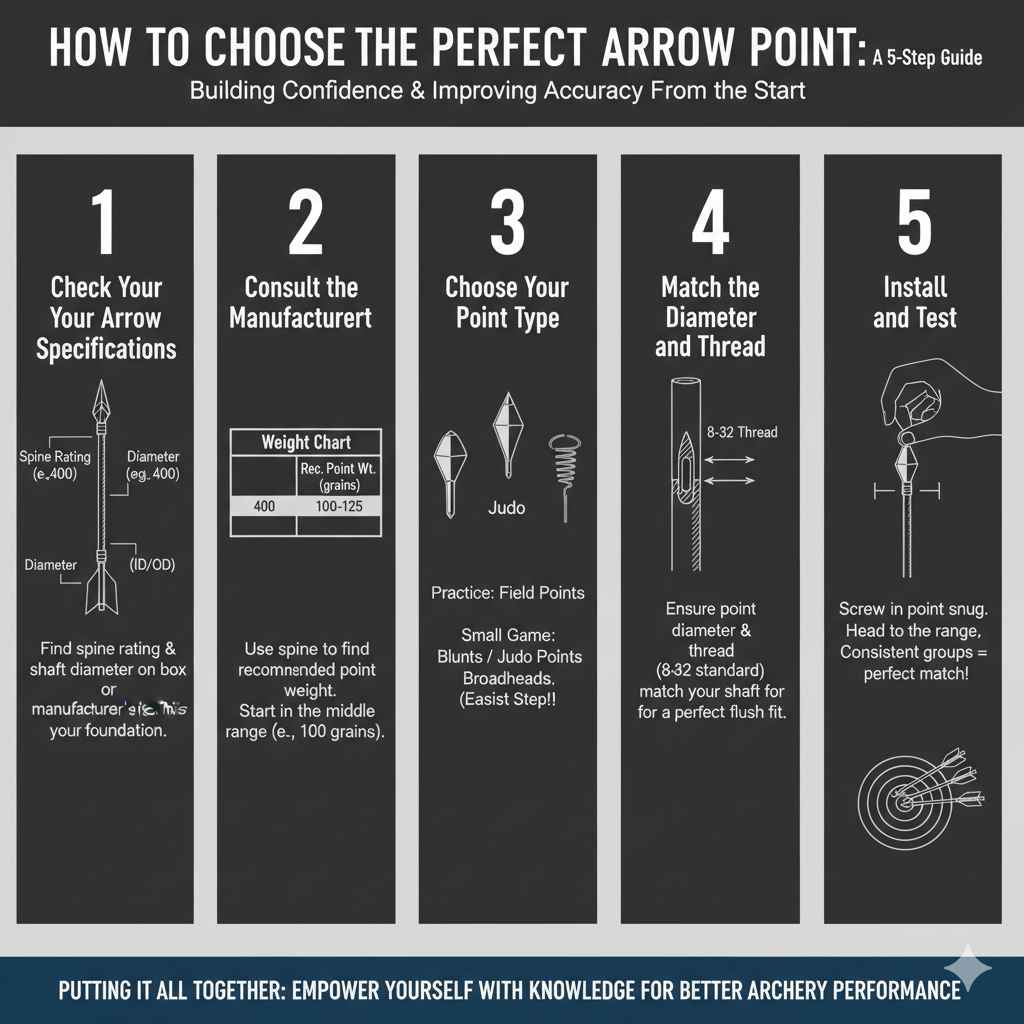
- Check Your Arrow Specifications: Look at your arrow shaft or the box it came in. Find the spine rating (e.g., 340, 400, 500) and, if possible, the shaft’s inside and outside diameter. If you can’t find it, visit the manufacturer’s website. This information is your foundation.
- Consult the Manufacturer’s Chart: Use the arrow’s spine rating to look up the manufacturer’s recommended point weight range. For a 400 spine arrow, this will likely be between 100 and 125 grains. Beginners should always start with a weight in the middle of the recommended range, such as 100 grains.
- Choose Your Point Type: Decide what you’ll be doing. If you are heading to the range to practice, you need field points. If you are planning to hunt small game, you’ll want blunts or Judo points. This is the easiest step!
- Match the Diameter and Thread: Now that you know the weight and type, find a point that matches. For most modern arrows, you’ll need the standard 8-32 thread. Most importantly, ensure the point’s diameter matches your arrow shaft’s diameter for that perfect, flush fit.
- Install and Test: Screw the point in by hand until it is snug. It should not be loose or wobbly. You can use a simple tool to tighten it slightly, but don’t overtighten. Head to the range and see how your arrows fly! If your groups are consistent, you’ve found a perfect match.
Frequently Asked Questions (FAQ)
Can I use any 100-grain point on my arrow?
No. While the weight might be correct, the point’s diameter must also match your arrow shaft’s diameter to ensure a safe, flush fit. Additionally, you need to confirm it uses the correct thread size, which is usually the standard 8-32, but not always.
What does “8-32 thread” mean?
This is a standard machine thread size. The “8” refers to the major diameter of the screw (approximately 0.164 inches), and the “32” refers to the number of threads per inch. It’s the industry standard for most arrow inserts, meaning most points and inserts from different brands are compatible.
How do I know my arrow’s diameter?
The best way is to check the manufacturer’s website or the original packaging. Arrow specifications are usually listed in detail online. If you’re unsure, you can take your arrow to a local archery pro shop, and they can measure it for you and recommend a matching point.
Do heavier points make arrows fly farther?
No, quite the opposite. A heavier point increases the total arrow weight, which will generally cause it to fly slower and have a more curved trajectory (more drop over distance). However, a heavier point can increase stability and kinetic energy, which is important for hunting.
What is the difference between a field point and a broadhead?
A field point has a simple, non-bladed tip and is used only for practice on targets. A broadhead has sharp blades and is used only for hunting. You should never use a broadhead on a standard archery target, as it will destroy the target and dull your blades.
Can I reuse arrow points?
Absolutely! As long as the point is not bent, damaged, or rusted, you can unscrew it and use it on other compatible arrow shafts. Always inspect your points for damage before use, as a bent point will cause poor arrow flight.
What tools do I need to change arrow points?
For most screw-in points, you don’t need any special tools. You can usually tighten them securely by hand. However, some archers use a simple arrow point wrench or a pair of pliers (with a cloth to prevent scratching) to get them a little snugger. This ensures they don’t vibrate loose after several shots.
Conclusion: Your Path to Perfect Arrow Flight
So, are points universal for arrows? The essential secret is that while the thread size is standardized in most cases, the point itself is far from universal. True accuracy and safety come from a thoughtful match between the point and the arrow shaft.
By focusing on the three critical factors—diameter, weight, and type—you move beyond guesswork and start making informed decisions. You now have the knowledge to walk up to that wall of arrow points with confidence, knowing exactly what to look for. You understand that a flush fit protects your gear, the right weight balances your arrow’s flight, and the correct type matches your archery goals.
This isn’t just about technical details; it’s about building a better connection with your equipment and your sport. Every well-chosen component is a step toward a more satisfying shot. Keep practicing, stay safe, and enjoy the incredible feeling of watching your perfectly matched arrow fly straight to its mark.