How to Find the Right Peep Height for a Consistent Anchor Point
Set peep height so your anchor puts the peep, nose contact, and sight housing in line at full draw; the correct setting is the one that matches a repeatable anchor, not a guessed measurement. If it is wrong, your sight picture shifts, anchor pressure changes, and accuracy suffers shot to shot. This guide shows how to diagnose peep height from anchor, release type, and housing alignment before you tie anything off permanently.
What you’ll need
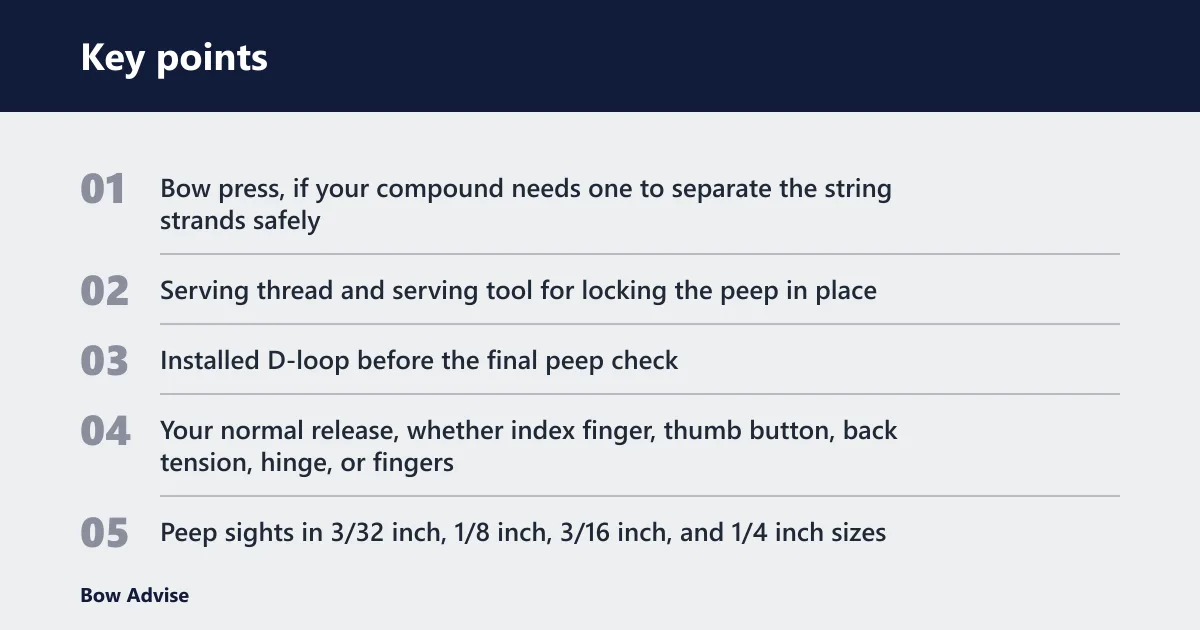


- Bow press, if your compound needs one to separate the string strands safely
- Serving thread and serving tool for locking the peep in place
- Installed D-loop before the final peep check
- Your normal release, whether index finger, thumb button, back tension, hinge, or fingers
- Peep sights in 3/32 inch, 1/8 inch, 3/16 inch, and 1/4 inch sizes
- A tape measure or ruler for checking nocking point reference and starting position
- A marker for noting the first usable peep position before serving it
How do you set a starting peep height?
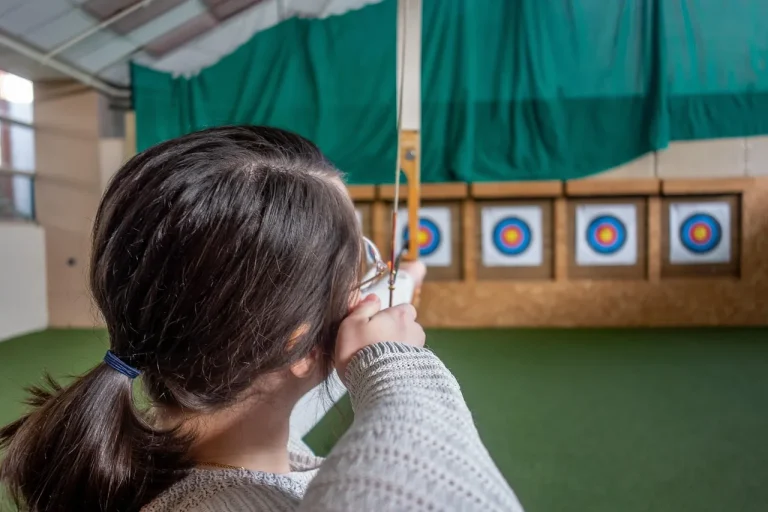
Start from full draw, not brace height. Draw with your eyes closed, settle into your normal anchor, then open your eyes and check where the peep sits against your nose contact and sight housing. That first usable position is your starting point, and it should be judged with the D-loop already installed.
- Install the D-loop first and set your normal release on it.
- Draw with your eyes closed and settle into your anchor.
- Open at full draw and check the peep against nose contact and housing center.
- Mark the string where the peep naturally lines up.
- Adjust in small increments, then draw again and recheck.
A small move can change whether the housing fills the circle cleanly or sits high, low, or off-center.
Peep setup matrix
This starting table is not a universal setting. It is a practical first pass based on draw length, bow length, anchor style, D-loop length, and release type. Final position can still shift plus or minus 0.5 inches after serving and break-in.
| Draw length | Axle-to-axle | Release type | Anchor style | D-loop length | Starting peep height |
|---|---|---|---|---|---|
| 26-27 inches | 28-32 inches | Index finger | Corner of mouth | 1/2 inch | About 5.75-6.25 inches above the nocking point |
| 28-29 inches | 32-34 inches | Thumb button | Jawbone | 5/8 inch | About 5.5-6.0 inches above the nocking point |
| 29-30 inches | 34-36 inches | Back tension | Corner of mouth | 5/8 inch | About 5.25-5.75 inches above the nocking point |
| 30-31 inches | 36-42 inches | Hinge | Side of face or cheekbone | 3/4 inch | About 5.0-5.5 inches above the nocking point |
| Any draw length | Shorter bow in the same size class | Fingers | Under chin | Same as above | Higher than a longer bow with the same anchor |
Should you move the peep or fix the anchor?
Fix the anchor first if your nose contact, jaw contact, or corner-of-mouth reference changes from shot to shot. Move the peep first only when the anchor stays identical and the sight housing still sits high, low, or off-center at full draw. A wrong anchor can look like a wrong peep.
Symptom checklist
| What you see at full draw | Most likely cause | First correction |
|---|---|---|
| Nose touches string some shots, not others | Anchor drift | Fix anchor reference |
| Housing sits high in the peep circle every shot | Peep too low | Move peep up |
| Housing sits low in the peep circle every shot | Peep too high | Move peep down |
| Peep lines up at rest, not at full draw | String twist or break-in | Retune twists before moving peep |
| Housing is centered but the picture feels cramped | Peep aperture too small | Try a larger aperture |
Say your anchor is a corner-of-mouth reference with light nose contact, and the housing sits about one-third high in the peep every time. That points to height, not anchor drift. If the same archer shifts nose pressure between shots, the fix changes to anchor consistency instead.
Set and lock the peep
A bow press is needed on many compound bows to install and serve the peep safely. Separate the string strands, place the peep, and serve it so the sight aligns at full draw. The serving should hold the peep without making it bind or rotate under normal draw force.
- Press the bow only enough to open the string for the peep.
- Set the peep on the marked string position.
- Serve above and below the peep to lock it in place.
- Release the press and draw again to check full-draw alignment.
- Add or remove string twists only if the peep is aligned at full draw but rotated at rest.
String rotation at rest can be normal if the peep aligns correctly at full draw. If that alignment changes after a few shots, string break-in is a common reason, and twist count may need adjustment.
How do you know if your peep is too high or too low?
Use the full-draw picture, not a guess. If the housing sits high in the peep circle, the peep is usually too low. A peep that is off-center only on some shots often points to anchor drift or string rotation, not height alone.
Peep aperture also changes what you see. Smaller apertures give a tighter sight picture, but they also leave less margin for imperfect head position.
Suppose a hunter uses a 3/16 inch peep on a 30-inch draw, 31-inch ATA bow, and the housing is barely visible at dawn. Moving to a 1/4 inch peep can improve the light window, but only if the housing still centers cleanly at full draw.
If that didn’t work, try this next
- Recheck anchor with eyes closed and no change in jaw or nose contact.
- Move the peep in small increments and retest at full draw.
- Inspect string twist count if the peep aligns differently after several shots.
- Confirm at 20 yards before final serving lock.
Treat the peep position as a starting zone, not a final rule. The correct position is the one that keeps your anchor, peep circle, and sight housing aligned together.
Common mistakes
- Installing the peep before the D-loop is final
- Moving the head to find the peep instead of bringing the string to the face
- Using brace height instead of full-draw alignment
- Ignoring release type, especially when changing from index finger to thumb button or back tension
- Assuming every peep issue is rotation, when wrong installation height can be the real problem
- Choosing a peep size without checking the sight housing and light window
A shorter axle-to-axle bow usually needs a higher peep position than a longer bow with the same draw and anchor. That is why the same archer may need a different setup on a 30-inch bow than on a 40-inch bow.
After any peep move, confirm the anchor first, then shoot at about 20 yards before serving the setup permanently.
Frequently asked questions
How do I find the right peep sight height for my anchor point?
Draw with your eyes closed, settle into your normal nose and jaw contact, then open at full draw. If the housing is centered and the anchor feels unchanged, mark that position and confirm it again after a small adjustment. Final height should match the anchor, not a chart alone.
Should I set peep height with my eyes closed?
Yes, but only as the first check. Close your eyes to reach your normal anchor, then open at full draw and verify housing center, nose contact, and sight window. The closed-eye draw is a starting method, not the full decision on its own.
Do I need my D-loop installed before setting peep height?
Yes. The D-loop should already be installed before verifying peep height.
How do I know if my peep is too high or too low?
If the sight housing sits low in the peep circle, the peep is likely too high. If the housing sits high, the peep is likely too low. If the peep aligns on some shots and not others, check anchor consistency and string twist before moving the peep again.
Why does my peep line up on some shots but not others?
That usually points to one of three things: anchor drift, string rotation, or break-in after serving. First confirm nose contact and jaw reference, then check whether the peep aligns at full draw every time. If it does, adjust twists; if it does not, check the anchor.
Does a shorter axle-to-axle bow need a higher peep?
Usually yes. Shorter bows create a steeper string angle, so the peep often needs to sit higher to match the same anchor. That effect is strongest on compact hunting bows, which is why one setup can feel right on a longer bow and wrong on a shorter one.