Peep Sight Alignment Problems and How to Fix Them
If your peep is misaligned at full draw, check draw length, anchor, D-loop twist, and cam timing first; change peep height or string twists only after the misalignment repeats at the same anchor. If you skip the cause, the sight picture stays inconsistent and setup changes pile up. This guide shows how to isolate each fault and fix peep sight alignment problems in order.
What peep alignment means


A peep sight is the rear aperture in the bowstring, and alignment matters only at full draw. At rest, a rotated peep can be normal. The check that counts is the sight picture with the bow fully drawn, the anchor set, and the sight housing centered in the opening.
A small offset is not always a fault. If the peep lines up the same way every shot at full draw, the issue is often setup geometry, not a bad peep.
What you’ll need
- Bow press for safe peep installation and twist adjustment
- Allen keys for sight and accessory checks
- Small flashlight or bright indoor light
- Marker or tape for reference marks on the string
- Bow square or draw-length gauge
- Draw board or a helper for controlled full-draw checks
- Level for bow cant and sight leveling checks
Why is my peep sight not lining up when I draw my bow?
The usual causes are anchor drift, bow cant, D-loop changes, or string rotation. A peep should line up the same way at full draw, not only on some shots. If the sight picture changes with body position or draw cycle, the peep is often reacting to something upstream.
Start by asking what changed recently: new string, new D-loop, a draw-length tweak, a sight move, or a different anchor. One change at a time is the fastest way to find the fault.
Peep alignment diagnostic table
| Symptom pattern | Most likely root cause | First fix | Second check | When to stop and go to a press |
|---|---|---|---|---|
| Always off by the same amount at full draw | Peep height or a fixed anchor mismatch | Verify anchor and sight centering at full draw | Check D-loop length and draw length | If the offset stays fixed after anchor standardization |
| Off only on some shots | Anchor drift or head tilt | Repeat face contact, nose-to-string, and release hand position | Level the bow and repeat the draw | If repeatability does not improve after form correction |
| Looks rotated at rest and changes after several shots | String rotation or creep | Mark the string and watch the mark over a shooting session | Compare full-draw alignment before and after a short shot block | Any twist change should happen in a press |
| Was good before a D-loop install, then shifted | Effective draw length changed by about 1/2 inch | Recheck full-draw anchor and peep height with the D-loop in place | Confirm the sight housing still fills the peep circle | If the new length still does not settle the picture |
| Sight housing does not fill the peep circle | Peep aperture too large for the sight setup | Consider a smaller aperture | Check whether the sight is magnified | If the peep change still leaves a blurry sight picture |
How do I know if string rotation is the real problem?
True string rotation usually shows up as a peep that changes position after repeated draws or after a new string begins to settle. A new string often needs break-in because peep rotation is common early. If the alignment gradually changes but your anchor stays identical, the string is a stronger suspect than your form.
Do not add or remove twists by hand on the bow. A press is needed to separate strands and adjust twists safely. A rotated peep may need added or removed twists in the string, but that work should happen with the bow secured.
How to read the rotation pattern
- Mark the string above and below the peep with a fine marker.
- Draw to anchor three times and note whether the marks shift relative to the peep.
- Shoot a short, consistent group and recheck at full draw.
- If the peep moves more after each cycle, stop and plan a press adjustment.
A new string may start with a clean peep on day one, then the sight picture can rotate a bit after about 150 shots and again after about 300 shots. That is a break-in pattern, not a random anchor issue.
Should I move the peep or fix my anchor first?
Fix anchor first. Face contact, nose-to-string reference, and release hand position can shift peep-to-housing alignment shot to shot. If the anchor is not repeatable, peep height changes only hide the real fault. Bow cant and head tilt can also imitate a twisted peep, so both need standard checks before any peep move.
Keep the bow level the same way on every rep, then draw to the same face contact. If the sight picture settles after that, the peep was not the main issue.
Anchor and cant check
- Set the bow level with a sight level or bow level.
- Draw to the same nose-to-string touch point every time.
- Place the release hand in the same position under the jaw or along the face reference point.
- Repeat the draw with the same head angle and compare the sight picture.
A common first-timer mistake is changing peep height after one odd shot, then changing it again when the next shot looks different. If the anchor is inconsistent, each change chases a moving target.
How do I fix a twisted peep sight on a compound bow?
Use a bow press, then correct string twist in controlled steps. A peep that is rotated at rest is often reacting to string twist or creep, and the proper correction is adding or removing twists in the string. The D-loop must already be installed before final peep height verification, because it changes effective draw length by about 1/2 inch.
If the peep looked close before the D-loop and now sits high or low, reset the height after the loop is in place. Do not call the peep finished until the full-draw sight picture is stable.
Safe correction sequence
- Press the bow and expose the string section around the peep.
- Add or remove about one twist increment, then re-seat the peep.
- Bring the bow back to full draw and check whether the sight housing centers in the opening.
- Recheck after about 5 to 10 shots before making another press adjustment.
Stop adjusting if the peep is still off after a repeatable anchor and a verified D-loop. At that point, the setup needs a deeper draw-length check rather than more twisting.
Is my peep sight too high or too low?
A peep is too high or too low when the sight housing does not naturally center in the opening at full draw with a repeatable anchor. Because the D-loop changes effective draw length by about 1/2 inch, final height should be verified only after the loop is installed. Height changes made before that step are often temporary.
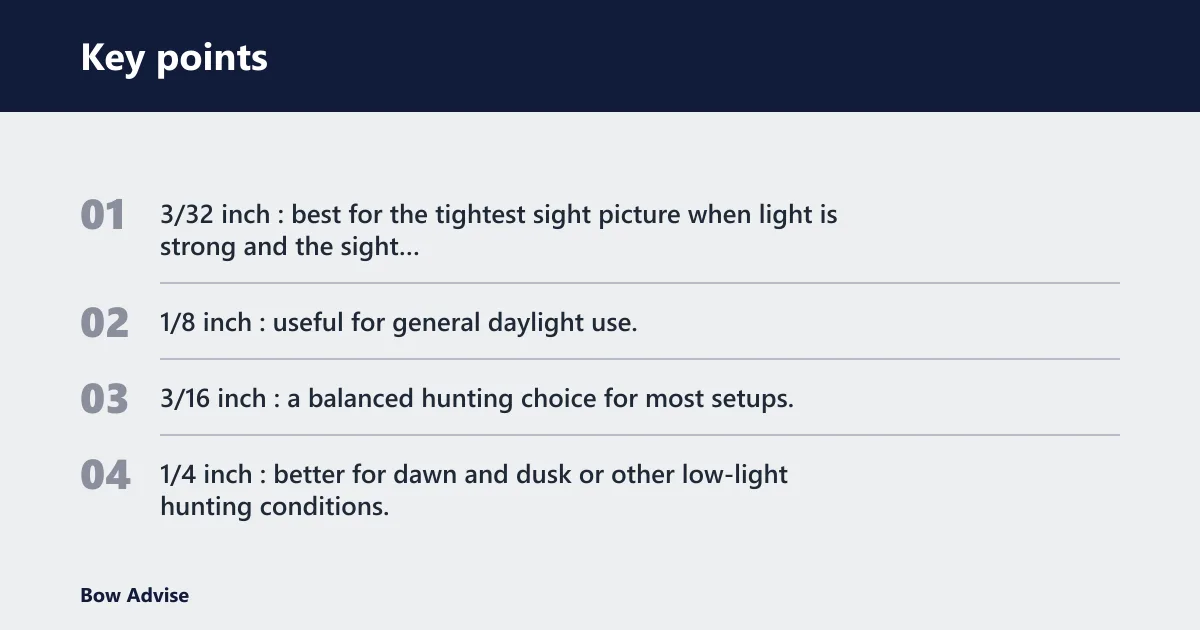
At the same time, the aperture size matters. A 3/32 inch peep is the highest-precision option, 1/8 inch is a general daylight option, 3/16 inch is the hunting sweet spot, and 1/4 inch is recommended for low-light hunting.
Choosing the right aperture size
- 3/32 inch: best for the tightest sight picture when light is strong and the sight picture fills the opening cleanly.
- 1/8 inch: useful for general daylight use.
- 3/16 inch: a balanced hunting choice for most setups.
- 1/4 inch: better for dawn and dusk or other low-light hunting conditions.
If the sight housing still does not fill the circle well, a smaller aperture may solve the framing problem. If the image is blurry with a magnified sight, a clarifier or verifier lens is the correct accessory; it does not fix rotation or anchor drift.
What about clarifier, verifier, and tubing?
Use a clarifier or verifier lens only when the sight picture is blurry and the bow uses a magnified sight. It can sharpen the view, but it will not fix a peep that is sitting high, low, or rotated by string geometry. Tubed peeps and tubeless peeps both still depend on correct full-draw alignment.
Do not use tubing to hide a bad anchor or a draw-length error. That only masks the symptom.
Common mistakes
Most peep problems get worse when archers change the peep before standardizing the anchor. Another common error is treating bow cant or head tilt as a peep defect. A third is moving to a larger aperture because the picture looks dark, when the real issue is that the sight housing does not fill the peep circle.
Another mistake is adjusting twists without a press. That can damage the string or create a new alignment problem.
What to avoid
- Changing peep height before anchor is repeatable
- Adjusting string twists outside a bow press
- Using tubing to cover a draw-length problem
- Choosing a low-light aperture for a bright range setup without checking the sight picture first
Frequently asked questions
Why does my peep line up sometimes and not others?
That pattern usually points to anchor drift or head tilt before it points to peep height. Repeat the draw with the same face contact, the same release hand position, and the bow held level. If the alignment still varies, inspect string rotation and D-loop length next.
Can bow cant or head tilt cause peep sight alignment problems?
Yes. Bow cant and head tilt can make a correct peep look wrong by shifting the sight picture. Level the bow the same way every shot, then keep the head position consistent. If the peep centers when the bow is level, the issue was form, not peep placement.