Best peep sight options for left-handed bow setups
For many left-handed compound bows, a smaller peep such as 1/8 inch is often used for hunting, while a slightly smaller one such as 3/32 inch can work better for brighter target-style sight pictures; I’d still fine-tune based on anchor and light conditions. Pick the wrong size or tube setup, and your peep will fight your left-hand draw, blur your pins, and make anchor repeatability harder. I’ll compare peep sight types, sizes, tubing versus non-tubed options, and the fit checks I use on my own left-handed bow setups.
Best peep sight options for left-handed bow setups
The best overall pick I reach for is the TRUGLO Centra Peep because it fits a lot of left-handed hunting bows well, comes in 1/4, 1/8, and 3/16-inch sizes, and uses an angled design that helps the sight picture settle when string rotation is part of the problem. It is CNC-machined aluminum, which I trust for daily use.
Left-handed setup is not a label issue. It changes where your eye settles, how your head wants to cant, and how fast the peep picture feels right at full draw. I switched to a left-hand bow after realizing I am left-eye dominant, and my groups tightened within two weeks because my anchor stopped arguing with my sight picture.
Quick picks by left-handed setup type
- Top pick for left-handed hunters: TRUGLO Centra Peep, especially if you want an angled peep and a simple aperture choice.
- Best for twist-prone strings: Hamskea peep with dual 35- and 40-degree string grooves.
- Best for glasses and low-light hunting: larger aperture, usually 1/4-inch if your pins still fill the circle cleanly.
- Best for a clean, budget-minded build: a straight peep in the aperture size that matches your anchor, if your string tracks well.
📊 The Hamskea peep uses dual 35- and 40-degree string grooves. Source: 12 Best Peep Sights for 2026.
I switched to a left-hand bow after discovering I am left-eye dominant, and my groups tightened within two weeks.
What a peep sight does on a compound bow
A peep sight is a small ring set into the bowstring. I think of it as the rear sight on a compound bow. At full draw, it lines up your eye with the front sight so the peep centers the front sight inside its circle. If that alignment changes from shot to shot, your aim changes too.
On a left-handed compound bow, the same basic job applies, but the feel is different. Your head position, anchor hand, and eye dominance can make a crooked peep picture feel normal for one shooter and wrong for another. That is why I treat handedness as fit, not branding.
Common aperture sizes and what they change
Common peep sizes often include 1/8, 3/16, and 1/4 inch. Smaller apertures work better for precise target shooting. Larger apertures work better for low-light hunting. A bigger hole gives you a brighter sight picture, while a smaller hole makes the view tighter and more exact when the light is good.
I use a smaller opening when I want the pins framed tightly and my anchor is dead repeatable. I use a larger opening when I am hunting at last light and need to see the pins fast, even if the circle is a little less exact.
Which peep sight works best for a left-handed bow setup?
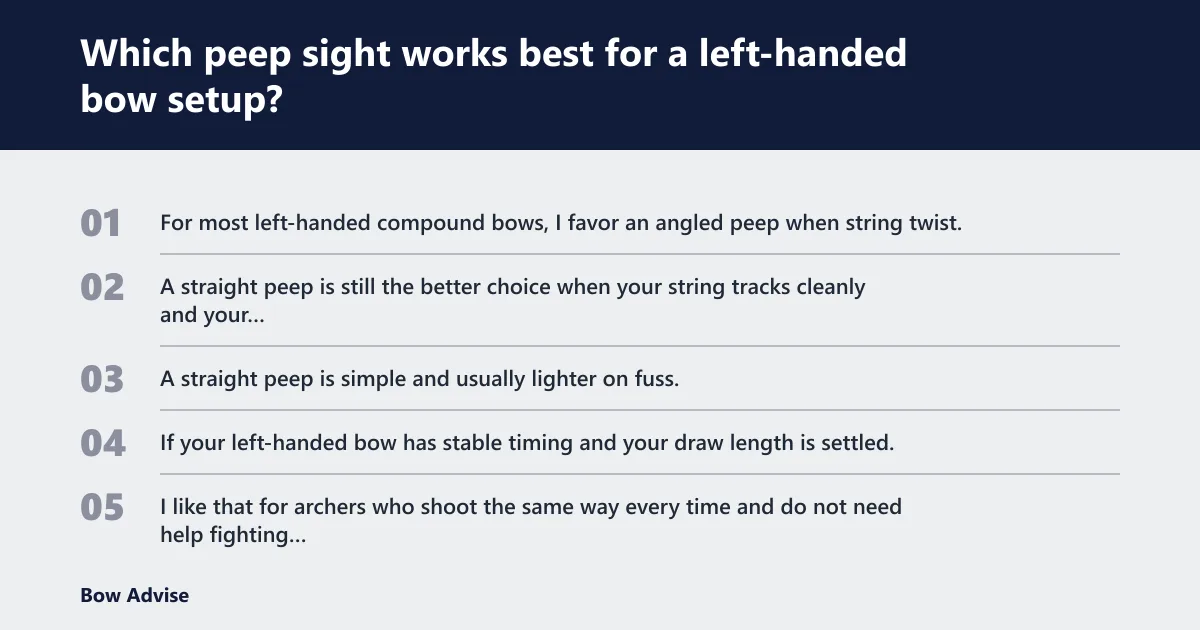
For most left-handed compound bows, I favor an angled peep when string twist, draw-cycle rotation, or a slightly inconsistent head position keeps the peep from landing where I want it. A straight peep is still the better choice when your string tracks cleanly and your anchor never changes from shot to shot.
Straight peep vs angled peep
A straight peep is simple and usually lighter on fuss. If your left-handed bow has stable timing and your draw length is settled, it can give a clean sight picture with fewer moving parts. I like that for archers who shoot the same way every time and do not need help fighting rotation.
An angled peep is the one I reach for when the string wants to rotate before the shot breaks. The self-aligning design helps the peep settle into place, and the 35-degree and 40-degree string grooves matter because they match different string angles and bow setups. That makes them useful on bows that are harder to tune perfectly by feel alone.
When a self-aligning peep makes sense
If your left-handed bow shows peep rotation after setup, if your anchor shifts between practice sessions, or if your head position changes once you add glasses, I would lean angled. I have seen shooters chase the wrong fix for weeks when the real issue was peep style, not bow tune.
If you already draw to the same spot every time and the peep lands in line without effort, do not fix what is not broken. A straight peep can be the calmer, cleaner option.
How I would choose peep size, material, and coating
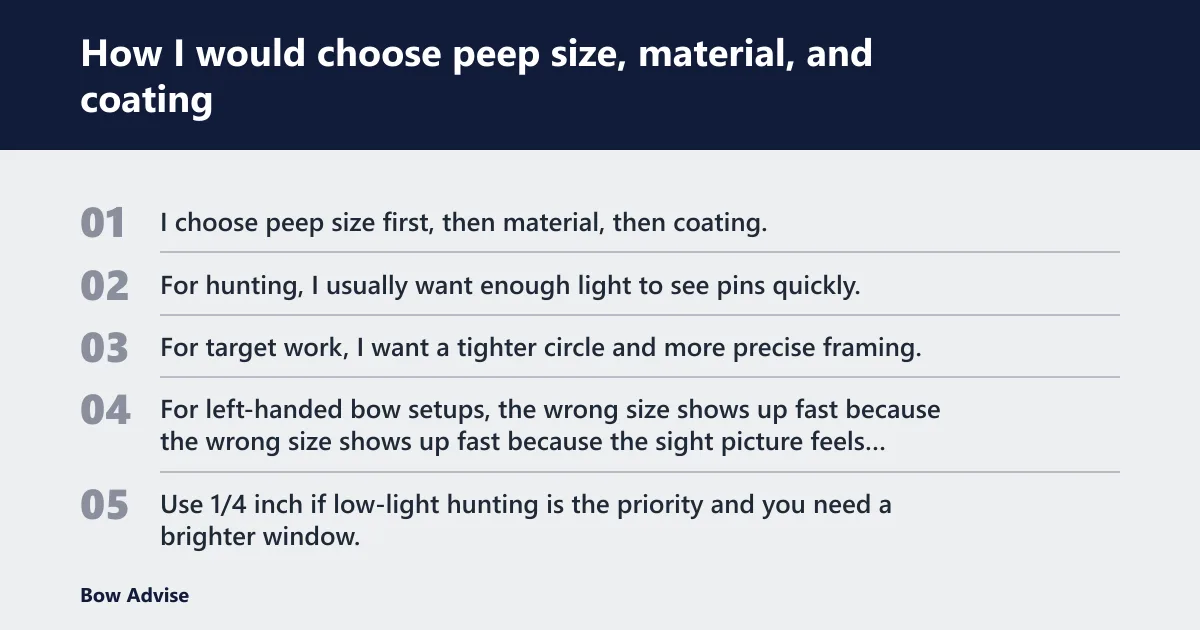
I choose peep size first, then material, then coating. For hunting, I usually want enough light to see pins quickly. For target work, I want a tighter circle and more precise framing. For left-handed bow setups, the wrong size shows up fast because the sight picture feels off even when the bow is tuned.
Aperture size for hunting, target practice, and low light
Use 1/4 inch if low-light hunting is the priority and you need a brighter window. Use 1/8 inch when you want a tighter, more precise sight picture and your eyes can still resolve the pins cleanly. A 3/16-inch peep is often treated as a middle-ground option for left-handed compound archers.
If you shoot with glasses, I usually nudge bigger rather than smaller, because lenses and frame edges can make a small peep feel cramped. That does not mean every glasses-wearer needs a huge aperture. It means the peep has to work with your eye, not against it.
CNC-machined aluminum vs polymer
CNC-machined aluminum is the material I trust most for a durable peep that still stays light. It feels more secure to me on a hunting bow, especially when I am carrying it through cold mornings and brush. The TRUGLO Centra Peep uses CNC-machined aluminum, which is one reason I keep recommending it for hard use.
Polymer can work, and plenty of archers use it without issue. I still prefer aluminum when I want a peep that feels solid and wears well over time.
Teflon coating and anti-glare features
A Teflon coating matters more than many shooters think. It gives the peep a smoother surface and helps reduce string wear, which is useful on bows that get shot a lot. The Hamskea peep includes a proprietary Teflon coating, and I like that idea for strings that already need to last through a full season.
Anti-glare technology matters when the sun is hard and the target face or deer shoulder catches light in an ugly way. The Hamskea peep uses aerospace anti-glare technology, which is worth looking at if your left-handed sight picture gets washed out in bright conditions.
Left-handed peep sight selection matrix
| Left-handed setup need | Recommended peep type | Aperture size | Likely tradeoff |
|---|---|---|---|
| Left-handed hunting bow with steady anchor | Angled peep | 1/8 inch | Cleaner hunting picture, less brightness than larger apertures |
| Left-handed bow with glasses | Angled or straight, depending on rotation | 3/16 inch | Brighter view, slightly less pin framing precision |
| Low-light hunting | Angled peep with anti-glare help | 1/4 inch | Fast sight picture, less precision than a smaller hole |
| Anchor is very consistent | Straight peep | 1/8 or 3/16 inch | Less rotation help, simpler setup |
| String twist keeps changing the view | Angled peep with 35- or 40-degree grooves | 1/8 or 3/16 inch | Better alignment, more setup sensitivity |
| Installation without shop tools | Straight peep only if already aligned | Any matched size | Less ideal for major changes; may still need a bow press |
How do I stop peep sight twist on a left-handed compound bow?
The first fix is not the peep itself. It is string alignment and cam timing. If those are off, the peep rotates because the string is telling it to rotate. A left-handed shooter feels that twist quickly because the sight picture changes at the exact moment the eye wants a repeatable anchor.
String alignment and cam timing basics
When I diagnose twist, I check whether the bow hits full draw the same way every time and whether the cams finish together. If timing drifts, the peep can stop at a different angle shot to shot. That creates the kind of mismatch that makes archers blame the wrong part.
Anchor inconsistency can look like peep twist. So can a head position that changes after you add glasses or switch anchors. I have watched shooters move their jaw, then their peep, then their confidence. The real fix was picking one anchor and repeating it.
35-degree and 40-degree groove choices
The Hamskea peep uses dual 35- and 40-degree string grooves. I like that because it gives more room to match the string angle instead of forcing one shape onto every bow. On a left-handed bow with more rotation, those grooves can help the peep settle where the eye expects it.
If your string angle is gentler, a different groove angle may work better. That is why I do not buy a peep by brand first. I buy it by how the string behaves at full draw.
When a bow press or pro shop visit is needed
A bow press may be needed for installation, and professional help may be the safer route. If the string has to be separated, moved, or served back in place correctly, I would rather use a press than improvise and damage the string. A compound bow can punish a bad install fast.
My first compound bow was set 10 lb too heavy, and I flinched for a month before I backed the limb bolts out. That taught me a simple rule: when setup is wrong, form starts lying to you. Peep work is the same.
How do I know if my peep sight matches my draw length and anchor?
Your peep matches your draw length and anchor when it comes to full draw naturally, with the circle centered and your front sight sitting the same way every shot. If you have to hunt for the hole, tilt your head, or shift your jaw to find it, the peep size or style is wrong.
My fit check for left-handed bows
- Draw the bow to your normal anchor and close both eyes first.
- Open your aiming eye and check whether the peep lands where you expect without moving your head.
- Look at whether the front sight centers inside the peep circle cleanly.
- Check the picture after a few shots, not just one.
- Repeat the test with glasses, then without them, if you hunt or target shoot both ways.
If the peep looks right only when you stretch your neck or crush your anchor, it does not match. I would change the aperture size first, then the peep type, then the string setup.
Can I install a peep sight without a bow press?
Sometimes, but I would not count on it. If the peep needs the string opened to slide in, a bow press is usually the safer way to do it. If the peep is being swapped on an already compatible setup, it may go in cleanly, but I still prefer a press when I am working on my own hunting bow.
Skipping the press can save time and create a mess. If you are not sure how much tension is safe to relieve, let a pro shop handle it. That is cheaper than fixing a damaged string.
What material is best for a durable peep sight?
For durability, I prefer CNC-machined aluminum. It is light, strong, and less likely to feel flimsy in cold weather or after a lot of shooting. I also like models with a smooth finish or Teflon coating because they are kinder to the string and usually feel cleaner at draw.
Polymer peeps can work for light use, but on a hunting bow I want a material that holds up season after season. If glare bothers you, look at an angled peep with anti-glare technology rather than chasing material alone.
Do left-handed compound bows need different peep sights?
No, left-handed compound bows do not need a special category of peep sight just because they are left-handed. They need a peep that matches the shooter’s eye, anchor, draw length, and string behavior. The difference is in fit and sight-picture habits, not a separate left-hand-only part.
That said, left-handed shooters often notice alignment problems differently because their reference habits are reversed from what many products assume. That is why I pay more attention to how the peep looks at full draw than to whether the box says universal.
Should I use an angled or straight peep on a left-handed bow?
I use angled when I need help with rotation, and straight when the bow is already well behaved. A left-handed bow does not force one answer. It forces you to be honest about your anchor consistency, your string twist, and whether the sight picture settles without effort.
If your peep keeps drifting or your head position changes with weather, clothing, or glasses, I would lean angled. If your full-draw picture is stable every time, a straight peep is simpler and can stay that way for years.
What peep size is best for hunting in low light?
For low-light hunting, I prefer a larger aperture because it gives a brighter sight picture. The guide says larger apertures suit low-light hunting, and that matches what I see in the field. A 1/4-inch peep can give an easier view when the woods are dim.
If your pins still frame well, a 3/16-inch peep can be a smart middle ground. I would only shrink below that if you are chasing a tighter, more exact sight picture and do not need the extra brightness.
Frequently asked questions
What peep sight works best for a left-handed bow setup?
I start most left-handed hunters with an angled peep, usually in 1/8 inch or 3/16 inch, because it handles rotation and gives a repeatable full-draw picture. If the bow tracks cleanly and the anchor never drifts, a straight peep can be the simpler choice.
What material is best for a durable peep sight?
CNC-machined aluminum is my first choice for durability. It is light, tough, and a good fit for hunting bows that see weather and regular shooting. If you want smoother string contact, look for a Teflon coating too, since that helps reduce wear on the serving.
How do I stop peep sight twist on a left-handed compound bow?
Start with string alignment and cam timing. If those are off, the peep will rotate no matter what brand you buy. After that, move to an angled peep with the right groove angle, and check whether your anchor and head position are actually consistent.
Can I install a peep sight without a bow press?
Sometimes, but I would not treat that as the normal route. Many compound bows need the string relieved to install a peep safely, and a bow press makes that far easier. If you are unsure, a pro shop visit is the safer call.
How do I know if my peep sight matches my draw length and anchor?
At full draw, the peep should land naturally without head tilt or jaw shifting, and the front sight should center inside the circle the same way every shot. If you need to reach for the peep, the size or style is wrong for your anchor and draw length.
Do left-handed compound bows need different peep sights?
No, they need the same peep categories, but fit matters more than the label. Left-handed shooters often notice alignment problems sooner because their sight-picture habits differ. The best peep is the one that lines up cleanly with your eye at full draw.