Do Peep Sights Affect Arrow Speed?
No, a peep sight does not meaningfully change arrow speed; any speed change is usually too small to measure, while anchor inconsistency can change your point of impact far more. Ignore that, and you may chase a fake speed loss while your groups wander. This guide explains why peeps barely affect speed, what actually changes arrow performance, and how setup choices affect a compound bow.
Do peep sights affect arrow speed?
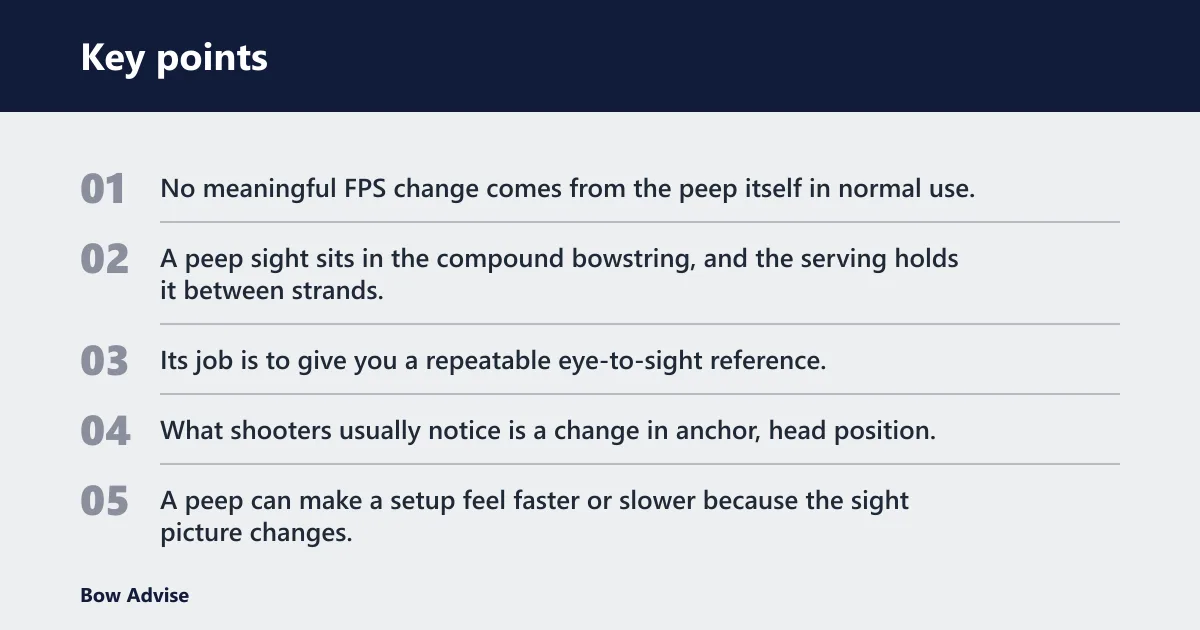


No meaningful FPS change comes from the peep itself in normal use. A peep sight sits in the compound bowstring, and the serving holds it between strands. Its job is to give you a repeatable eye-to-sight reference, not to drive or slow the arrow. What shooters usually notice is a change in anchor, head position, or confidence at full draw.
What shooters think changed
A peep can make a setup feel faster or slower because the sight picture changes. If the circle-in-circle alignment is clean, the bow feels settled. If the aperture is too small, too dim, or badly aligned, the archer may hold longer, move the head more, or creep the anchor, and that feels like the bow lost speed.
The arrow does not suddenly lose several feet per second because a ring is in the string. More often, the issue comes from draw length, torque, cam timing, or form. A peep complaint often points to one of those instead.
What actually shifts
What actually changes is the shot process: aim, anchor, and hold. A correct sight picture depends on the eye, peep, and sight housing lining up the same way at full draw. If any of those move, the archer may take longer to settle, even though the arrow leaves the bow at nearly the same speed.
How a peep sight changes your shot
A peep changes the shot by changing the reference you use to aim. The peep sight aligns with the front sight to create a consistent eye-to-sight reference, and that reference only works when full-draw position is repeatable. If draw length or anchor drifts, the peep-to-housing relationship drifts too.
Peep position in the string
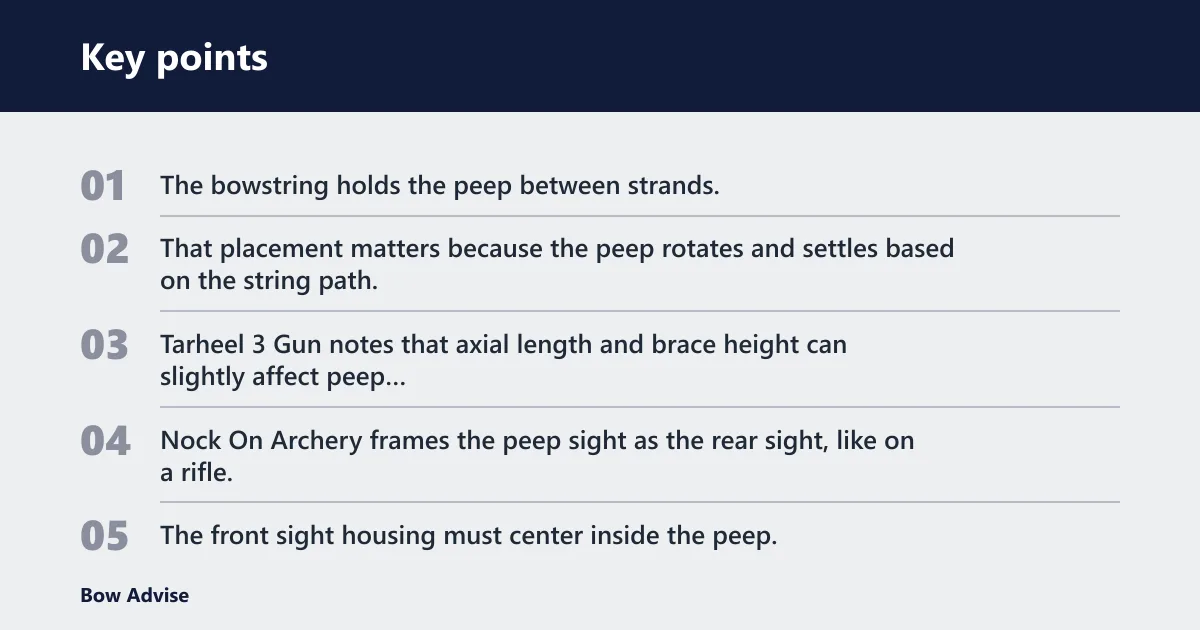
The bowstring holds the peep between strands, and the serving knots secure the installation. That placement matters because the peep rotates and settles based on the string path, draw length, and how the archer comes to anchor. Tarheel 3 Gun notes that axial length and brace height can slightly affect peep placement, which is one reason setup checks belong at full draw.
Why the sight picture depends on full-draw alignment
Nock On Archery frames the peep sight as the rear sight, like on a rifle, and that is the right way to think about it. The front sight housing must center inside the peep, forming a circle-in-circle sight picture. If the eye is not in the same place at full draw, the view changes shot to shot.
Proper setup checks whether, at full draw with eyes closed, the archer looks directly through the peep. That test matters because it separates anchor and head position from aiming effort. If the eye lands off-center, the archer will compensate at the last second, which often gets mistaken for a speed issue.
How draw length and anchor shape the view
Draw length controls where the head lands and how the peep rotates into view. A mis-set draw length can distort alignment, change the peep-to-housing relationship, and make the anchor feel wrong. That is not arrow speed loss. It is a setup problem that changes how the bow aims and how long the archer needs to settle.
Peep sight decision table
Choose peep size for the sight picture you need, not for imagined speed gains. Smaller apertures tighten the view and larger apertures brighten it. The table below compares the practical trade-offs for bright target work, 3D shooting, and low-light hunting.
| Peep size | Light transmission | Sight-picture sharpness | Likely impact on perceived speed | Best use case |
|---|---|---|---|---|
| 1/16 inch | Low | Very sharp | Can feel slower because you hold longer to get a clean view | Bright target setup with strong light and a fixed, repeatable anchor |
| 3/32 inch | Low to moderate | Sharp | Usually neutral, with good clarity and little visual clutter | Target or 3D shooting where precision matters more than dawn visibility |
| 1/8 inch | Moderate | Balanced | Often feels neutral because the housing stays visible without crowding the eye | General-purpose hunting and mixed light |
| 3/16 inch | Higher | Less sharp than smaller peeps | Can feel faster to aim because acquisition is easier | Low-light hunting and shaded timber |
| 1/4 inch | Highest | Least precise at distance | Feels quickest to find in dim conditions, but may reduce fine aiming confidence | Very dim dawn or dusk hunting when brightness matters most |
For hunting, 3/16 inch to 1/4 inch is commonly recommended as a practical balance. That range gives more usable light than a tiny aperture while still allowing a workable sight picture. In low light, Impact Point Archery describes 1/8 inch as common for hunters, and notes that it lets more light reach the eye.
Why does a peep feel slower?
A peep can feel slower when it makes the aiming process less forgiving, not because it drags the arrow down. Bow torque, grip pressure, and a drifting sight housing can change the view through the peep. When the picture is unstable, the archer spends more time correcting it and assumes the bow itself changed.
Bow torque and drifting housing
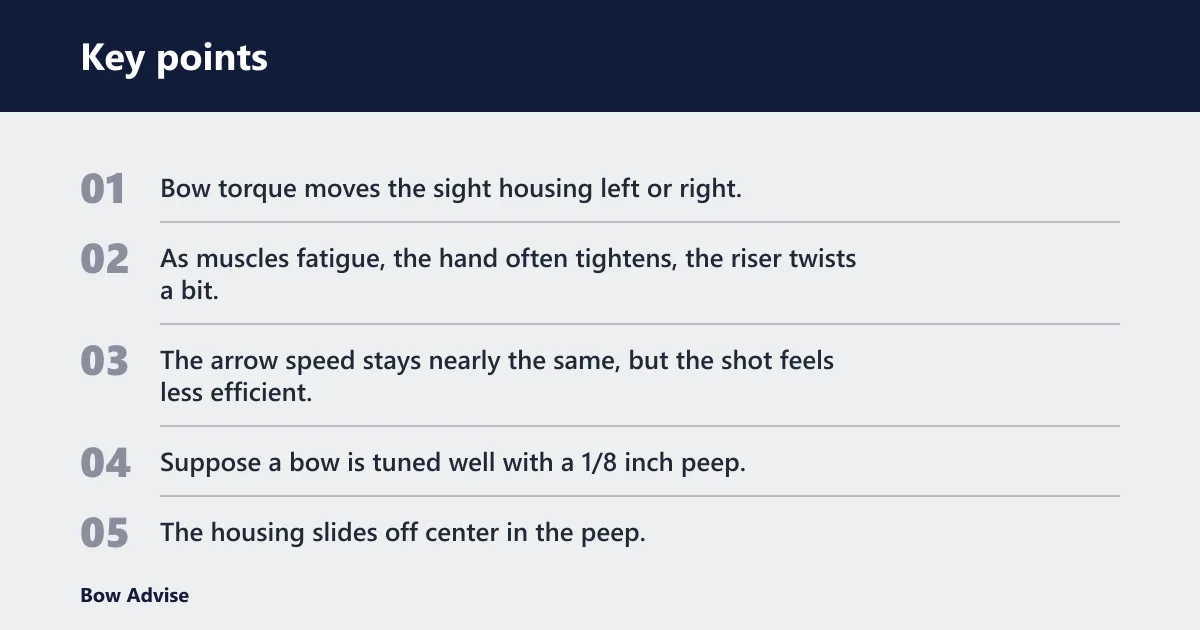
Bow torque moves the sight housing left or right, and that change shows up immediately in the peep. Grip pressure is a common cause. As muscles fatigue, the hand often tightens, the riser twists a bit, and the housing appears to wander. The arrow speed stays nearly the same, but the shot feels less efficient.
Suppose a bow is tuned well with a 1/8 inch peep, but the grip tightens late in a practice round. The housing slides off center in the peep, and the archer starts holding longer to force the circle back into place. That feels like the bow slowed down, yet the real problem is torque.
Fatigue and inconsistent anchor
An inconsistent anchor point changes vertical peep alignment. The face contact reference must be repeatable. If the hand lands slightly higher, or the nose and string contact shift, the eye lines up differently each time. That makes the sight picture feel slower to acquire because the archer keeps searching for the same reference.
A common first-timer mistake is moving the anchor to “find” the peep instead of fixing the anchor first. That usually creates more variation, not less. The correct order is repeatable anchor first, then peep placement and housing alignment.
Mis-set draw length and peep rotation
Wrong draw length can change peep rotation and the way the sight picture lines up. If the draw is too long, the archer may overreach and roll the head forward. If it is too short, the string may settle differently at full draw. Either way, the peep may not stop in the same place every shot.
That is where speed complaints often begin. The shooter thinks the bow lost pace because the hold feels awkward. In reality, the draw length is changing the peep-to-housing relationship and the anchor consistency.
What peep size is best?
The best peep size depends on light, distance, and how much precision the archer wants from the sight picture. Smaller apertures increase precision, larger apertures admit more light. For hunting, the right choice is usually the size that gives a clean circle-in-circle view without making dawn or dusk shots too dim.
Common aperture sizes
Common sizes often include 1/16, 3/32, 1/8, 3/16, and 1/4 inch. The smaller the hole, the sharper the view. The larger the hole, the easier it is to see in low light. That trade-off matters more than any supposed speed change from the peep itself.
Choosing smaller apertures for precision
Bright target and 3D setups often favor smaller apertures because the sight picture is tighter. A sharp peep can help center the front sight housing with less visual noise. The downside is obvious: less light reaches the eye, so the sight picture can dim at dawn or dusk.
Choosing larger apertures for low-light visibility
Low-light hunting often favors a larger peep opening because visibility matters more than the last bit of precision. A larger opening improves visibility at dawn or dusk, but it can reduce precision at distance. For many hunters, that trade-off is worth it when the shot may happen in dim timber or first light.
How do you use a peep sight properly?
Use a peep sight by building a repeatable anchor, confirming circle-in-circle alignment at full draw, and checking that the peep stays centered through the full draw cycle. Proper setup is less about the part itself and more about making the eye, peep, and housing line up the same way every shot.
- Set a repeatable anchor point that puts the face, release hand, and string contact in the same place every time.
- Draw to full anchor with normal shooting posture, then check whether the peep centers naturally without head hunting.
- Confirm the circle-in-circle alignment between peep and housing before settling the pin on target.
- Watch for serving wear, peep rotation, or movement that changes the reference point.
- Recheck at full draw after any draw-length change, cam work, or string replacement.
Check serving wear and rotation
The serving knots secure installation, but wear in the serving can let the peep shift. That creates inconsistent alignment and can make the bow feel different even though the arrow speed has not changed. If the peep turns, changes height, or needs constant correction, the setup needs attention.
When setup problems mimic speed loss
Setup problems often look like speed loss because they change how the bow aims and how long the archer holds before release. Wrong draw length, poor peep height, and grip torque can all make the shot feel off. The arrow is usually not slower; the view and hold are simply less efficient.
Wrong draw length
Wrong draw length changes the peep-to-housing relationship and can make the anchor feel unstable. That instability can look like a slower shot because the archer hesitates before release. The fix is not a different peep size in most cases. It is a correct draw length and a full-draw check.
Poor peep height or placement
Peeps that sit too high or too low force the head to move into position instead of letting the bow settle under a natural anchor. Tarheel 3 Gun recommends measuring peep placement at full draw with the normal shooting position, which is the right approach. The goal is to remove guesswork from the sight picture.
Grip torque that changes the sight picture
Bow torque can shift the housing and make the peep look misaligned. The archer then over-corrects, which feels like the bow is slower to settle. That is a form issue, not a speed issue. A stable grip and repeatable pressure usually solve more than a peep swap ever will.
Frequently asked questions
How does a peep sight change arrow speed?
It usually does not change arrow speed directly. What changes is how fast the archer can find a clean circle-in-circle sight picture. A smaller aperture can take longer to center, while a larger opening can be easier to see through in dim light. That affects perceived speed, not arrow velocity.
Can a peep sight slow down a bow?
Not in the mechanical sense. The peep does not add meaningful drag that would slow the arrow enough to matter in normal use. A badly matched peep size, however, can make the shot process slower because the archer spends more time confirming alignment, especially if the anchor is inconsistent.
Will a peep sight affect accuracy more than speed?
Yes. A peep affects aiming consistency far more than speed. A correct sight picture is the circle-in-circle alignment of peep and sight housing, and that relationship is critical to shooting success. If it is off, groups open up long before arrow speed becomes a real concern.
What peep sight size is best for hunting?
For hunting, 3/16 inch to 1/4 inch is commonly recommended as a practical balance, especially if the shot may happen at dawn or dusk. A larger opening improves visibility, while a smaller one gives a sharper view. Many hunters settle near 1/8 inch to 3/16 inch depending on light and personal preference.