Best Peep Sights for Beginners (2026): research shows
For many beginner compound bow setups, a fixed round peep with a larger aperture—often around 1/8 to 3/16 inch—can be a practical choice because it is usually easier to find and align than a very small opening or an adjustable style. A peep that is hard to center can slow your shot process and push misses left or right. This guide ranks the best peep sight options by failure risk, explains which styles beginners should start with, and shows how to pick the right aperture size.
This guide is part of our Peep sights for archery: complete guide series.
Best peep sight option for most beginners
The best first choice for most beginners is a self-aligning angled peep. It cuts the chance of an off-center ring at full draw, where many new compound shooters lose time and consistency. If you want a clear sight picture with less frustration, start there.
A peep sight is the small circular ring installed in the bowstring. On a compound bow, it works as the rear sight, while the front sight or scope housing is the aiming reference that should center inside it at full draw. The setup only works when the peep, anchor point, and eye position repeat shot to shot.
Quick comparison
| Product | Badge | Best for | Price | ||
|---|---|---|---|---|---|
 | Archery Peep Sight Tubing Replacement Rubber Peep Sight– QI HUO JU – | Budget pick | Flexible rubber tubing, 6.5ft length | $6.99 Price as of 12 Oct 2026 | View |
 | 37/45 Degree Aluminum Hooded Peep Sight Compound BowHNZMDY | Our pick | Aluminum hooded housing, 37-degree angle | $13.99 Price as of 12 Oct 2026 | View |
 | SOPOGER Archery 37/45 Hooed Degree Peep Sight Kit 6X 8XSOPOGER | Upgrade pick | Hooded kit with magnifier and cores | $24.99 Price as of 12 Oct 2026 | View |
Use the chart to rank peep styles by the failure mode that matters most: alignment, brightness, or setup complexity. Beginner success usually comes from the peep that matches anchor consistency and the light you actually shoot in.
How we chose
The comparison below uses five beginner filters: ease of alignment, low-light brightness, twist resistance, glasses compatibility, and setup complexity. Those are the points where new compound shooters usually run into trouble.
It also weights failure risk over marketing claims. A peep that looks simple on paper can still fail if the anchor point shifts, the aperture is too small, or the sight housing disappears in low light.
Beginner peep-selection matrix
| Peep option | Ease of alignment | Low-light brightness | Twist resistance | Glasses compatibility | Setup complexity |
|---|---|---|---|---|---|
| Self-aligning angled peep | 5/5 | 3/5 | 4/5 | 4/5 | 3/5 |
| Round fixed peep | 3/5 | 4/5 | 3/5 | 3/5 | 2/5 |
| Tubeless peep | 4/5 | 3/5 | 4/5 | 3/5 | 3/5 |
| Tube peep | 4/5 | 3/5 | 2/5 | 4/5 | 5/5 |
Go/no-go checklist before you buy
- Go if your anchor point is repeatable to the same spot on your face.
- Go if the front sight or scope housing stays visible without head tilt or strain.
- Go if your shooting light includes dawn, dusk, woods shade, or indoor lanes.
- No-go if you have to move your head to force the peep into view.
- No-go if the aperture makes the front sight disappear in low light.
- No-go if your draw length changes enough that the peep height feels different from shot to shot.
Self-aligning angled peep: best for most beginners
- Includes clarifier for magnification as a telescope
- 5 inner core sizes included
- Brim protects lens from light interference
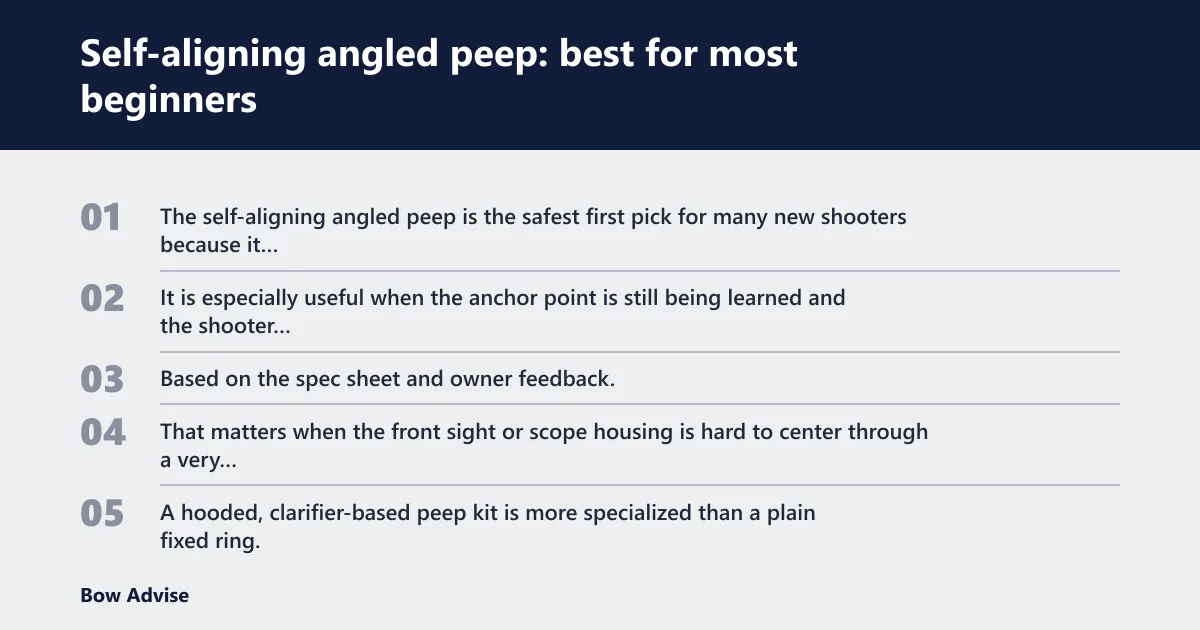
The self-aligning angled peep is the safest first pick for many new shooters because it cuts alignment frustration. It is especially useful when the anchor point is still being learned and the shooter needs the peep to fall into place at full draw without extra head movement.
Based on the spec sheet and owner feedback, the hooded design helps the sight picture stay cleaner, and the included clarifier and multiple cores give more room to tune visibility. That matters when the front sight or scope housing is hard to center through a very small ring.
The drawback is setup complexity. A hooded, clarifier-based peep kit is more specialized than a plain fixed ring, so it makes sense only if the shooter wants that extra optical control and is comfortable with a more involved setup.
Round fixed peep: best for simple, low-cost setups
- Includes 3 inner core sizes (1/8", 1/16", 3/32")
- Aluminum construction for durability
- Hooded design helps see sight pins better
A round fixed peep is the simplest entry-level option when the shooter has a repeatable anchor and consistent string alignment. It is inexpensive, familiar, and easy to understand: the front sight housing should sit centered in the circle at full draw.
This style makes sense for target practice or hunting if the archer wants a straightforward ring without extra parts. The hooded housing on this kit can also make the pins easier to see, which helps when the front sight needs to stand out inside the peep.
The drawback is that a fixed ring gives less forgiveness. If the anchor point shifts, or the shooter changes face pressure, the peep may not line up cleanly and the sight picture can feel cramped until the form becomes consistent.
Tube peep: best for bows that need more rotation help
- Flexible, impact-resistant high-density rubber material
- Fits 1/8, 1/4, 3/16 peep sights
- Easy to attach for any skill level
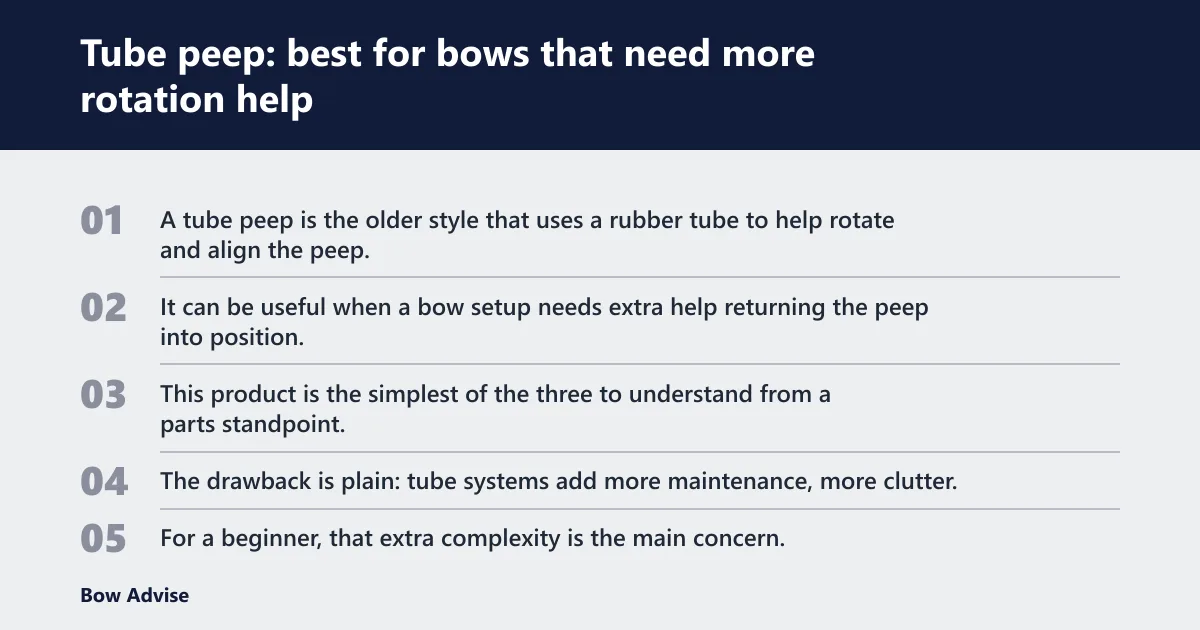
A tube peep is the older style that uses a rubber tube to help rotate and align the peep. It can be useful when a bow setup needs extra help returning the peep into position, and the flexible tubing can feel familiar to some beginners.
This product is the simplest of the three to understand from a parts standpoint, and its 6.5ft rubber tube gives room for installation. The drawback is plain: tube systems add more maintenance, more clutter, and more things that can wear, stretch, or need replacement.
For a beginner, that extra complexity is the main concern. A tube can help with alignment, but it also adds another failure point in a system that already depends on repeatable anchor, string alignment, and sight housing position.
What peep size should I use for hunting versus target shooting?
For hunting, a larger aperture usually makes more sense because it gives a brighter sight picture in low light. For target shooting, a smaller aperture can help precision by tightening the view around the front sight or scope housing. The right size is the one that stays clear in the light you actually shoot in.
Aperture size changes both brightness and precision. A smaller opening can feel cleaner on a bright range lane, but it can also make the front sight harder to find at dawn or in dark timber. A larger opening is easier to see through, though it can reduce the crispness of the aiming window.
Say your hunting setup uses a black front sight and you practice near sunset. A tiny peep may make the front sight look dim and slow to center. Moving up to a larger opening often solves the problem faster than changing your anchor or forcing your head position.
What is the difference between tube peeps and tubeless peeps?
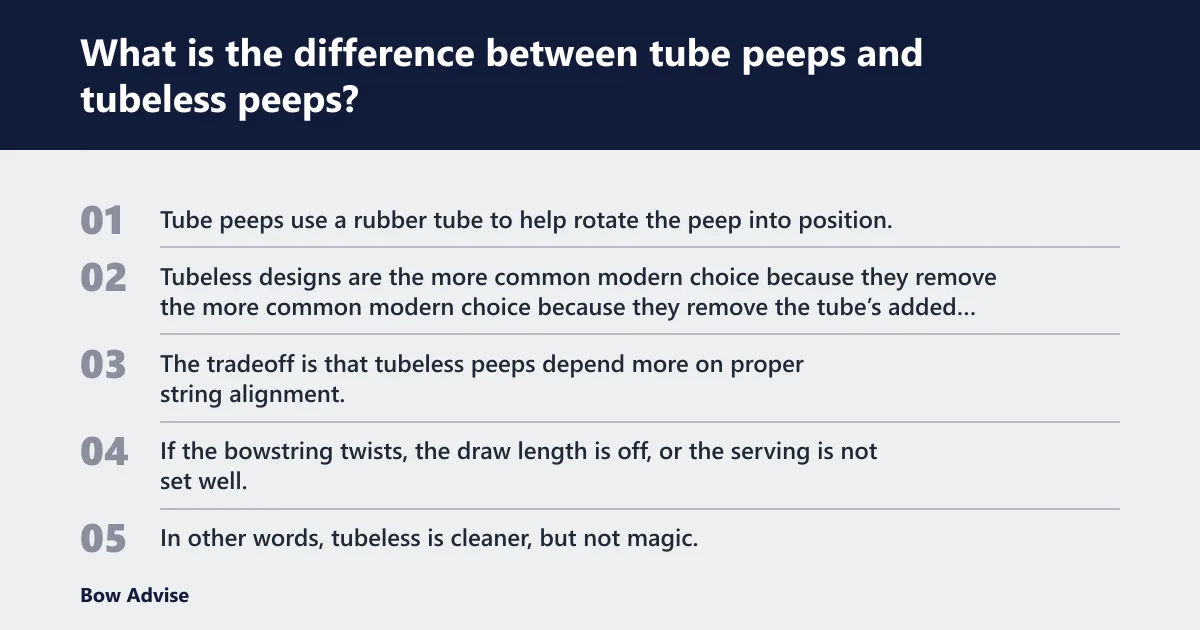
Tube peeps use a rubber tube to help rotate the peep into position, while tubeless peeps rely on string setup and tuning instead of that extra rubber connection. Tubeless designs are the more common modern choice because they remove the tube’s added clutter and maintenance.
The tradeoff is that tubeless peeps depend more on proper string alignment. If the bowstring twists, the draw length is off, or the serving is not set well, the peep can still rotate out of center. In other words, tubeless is cleaner, but not magic.
Tube systems can feel forgiving at first because the tube encourages the peep to return. The downside is that tube wear, stretch, and routing issues can create new problems later, which is why many beginners do better with a simpler modern tubeless setup.
Should I start with a round peep or an angled/self-aligning peep?
Most beginners should start with an angled/self-aligning peep if the goal is to cut alignment frustration. A round fixed peep works fine when anchor point and head position are already repeatable, but it demands more discipline from the shooter.
Choose the round peep only if the bow naturally comes to the same spot every draw and the sight housing centers without effort. Choose the self-aligning style if the peep is often off-center, if you wear glasses, or if your face pressure changes while learning form.
A common first-timer mistake is choosing the simplest-looking ring and then forcing the head to make it work. That is the wrong fix. The peep should meet the anchor, not the other way around.
How do I stop a peep sight from twisting in my bowstring?
Peep twist usually comes from string and cable behavior, not from the peep alone. The first step is to confirm that the bow’s draw length, timing, and string setup are correct, because a peep can only align consistently when the string returns to the same position every shot.
If the peep keeps turning, check whether the anchor point is inconsistent, whether the bowstring serving is worn, or whether the peep height needs a different position for the shooter’s face. A peep that is installed correctly still fails if the archer’s draw cycle changes.
Do not force your head to make a misaligned peep work. That creates a bad habit and usually hides the real issue, which is either string alignment, draw-length sensitivity, or a peep style that does not fit the bow.
How high should a peep sit for my anchor point?
The peep should sit at the right height for your anchor, which means it should come into view naturally when the bow reaches full draw and the face lands on the same reference point every time. If the height is wrong, the whole aiming picture shifts.
Begin with the anchor point, not the peep. The peep should meet your face position, and the front sight housing should center without neck strain or a need to raise or drop the bow awkwardly. That is the core alignment check for any compound setup.
Suppose a shooter anchors under the jaw but has to tilt the head down hard to see through the ring. That is a sign the peep is too high, too low, or mismatched to the draw length. The fix starts with geometry, not guessing at aperture size.
Will a peep sight work if I wear glasses or need a larger aperture?
Yes. A peep sight can work with glasses, and a larger aperture is often easier for glasses wearers because it gives more room for the eye box and a less cramped sight picture. Beginners who struggle with head position often find bigger openings easier to center.
Glasses can make a tiny peep feel tighter because they add another visual layer between the eye and the front sight. A self-aligning angled peep with a larger opening is often the safer starting point when the shooter needs more forgiveness in the face position.
If the target or pins look dim through the ring, the aperture is probably too small for the light or the eye position is too inconsistent. A brighter front sight can help, but the peep opening still needs to let the sight picture breathe.
How do I fix a peep that does not line up at full draw?
Start by checking the anchor point and sight picture before changing hardware. If the peep misses center at full draw, the most common causes are inconsistent face pressure, draw-length mismatch, or a peep style that expects a cleaner string path than the bow currently gives it.
Next, confirm that the front sight or scope housing is actually visible through the ring. The peep’s job is to center that front reference. If the archer has to move the head to make it happen, the setup is wrong, not the shooter.
Then decide whether the issue is rotation or size. Rotation problems point toward string setup, peep type, or a tube/tubeless mismatch. Sight-picture problems point toward aperture size, low-light conditions, or a peep height that does not fit the anchor.
Which one should you buy?
Choose by failure risk, not by hype. If the shooter is brand new, wears glasses, or is still building a repeatable anchor, the self-aligning angled peep is the safest default. If the setup is simple and the anchor is already consistent, a round fixed peep can work well at lower cost.
Choose a larger aperture for hunting or dim timber, and a smaller one only when the sight picture stays bright enough to remain clear. For low-light use, prioritize brightness and fast alignment over a tight, exact-looking ring.
Choose the tube peep only when the bow truly needs that extra rotation help and the added maintenance is acceptable. Choose the tubeless route when you want a cleaner modern setup and are willing to get the string alignment right.
Here is the short rule set: beginner target shooter with repeatable anchor, start with a basic round peep; beginner hunter or glasses wearer, start with a self-aligning angled peep; bow that needs more rotation help, consider a tube system, but treat it as the most maintenance-heavy option.
Frequently asked questions
What is the best peep sight option for a beginner compound bow setup?
The safest choice for most beginners is a self-aligning angled peep because it cuts alignment frustration at full draw. If the anchor is already very repeatable, a round fixed peep can work well too, but it gives less forgiveness when head position or draw consistency changes.
What peep size should I use for hunting versus target shooting?
Use a larger aperture for hunting because it keeps the sight picture brighter in low light. Use a smaller aperture for target shooting when the goal is a tighter, more exact view. The right size is the one that keeps the front sight visible without forcing your head position.
Will a peep sight work if I wear glasses or need a larger aperture?
Yes. Glasses wearers often do better with a larger peep opening because it gives more room for eye position and reduces the cramped feeling of a small aperture. A self-aligning style can also help when the face position changes slightly from shot to shot.
How do I stop a peep sight from twisting in my bowstring?
Check string alignment, draw length, and serving condition first. A twisting peep is often a symptom of an underlying setup issue. If the bow returns to a different string position each draw, changing the peep alone will not fix it for long.
How high should a peep sit for my anchor point?
It should sit at the height that lets the peep line up naturally when the anchor lands in the same place every time. If you have to lift, drop, or tilt your head to find it, the height is wrong for that anchor or draw length.
How do I fix a peep that does not line up at full draw?
First, confirm whether the problem is twist, size, or anchor inconsistency. If the peep is turning, look at the string setup. If the sight picture is dark or crowded, change aperture size. If the head has to move, correct the anchor before anything else.