Peep sight vs kisser button: which helps aim better?
For compound bows, a peep sight often helps aiming more; for recurve bows, a kisser button can help anchor consistency, and using both only helps when each fits your anchor and draw length. Ignore that fit, and groups open up fast. I break down peep sight vs kisser button by bow type, hunting, and target use, then show when I use one, both, or neither.
Peep sight vs kisser button: the real trade-off
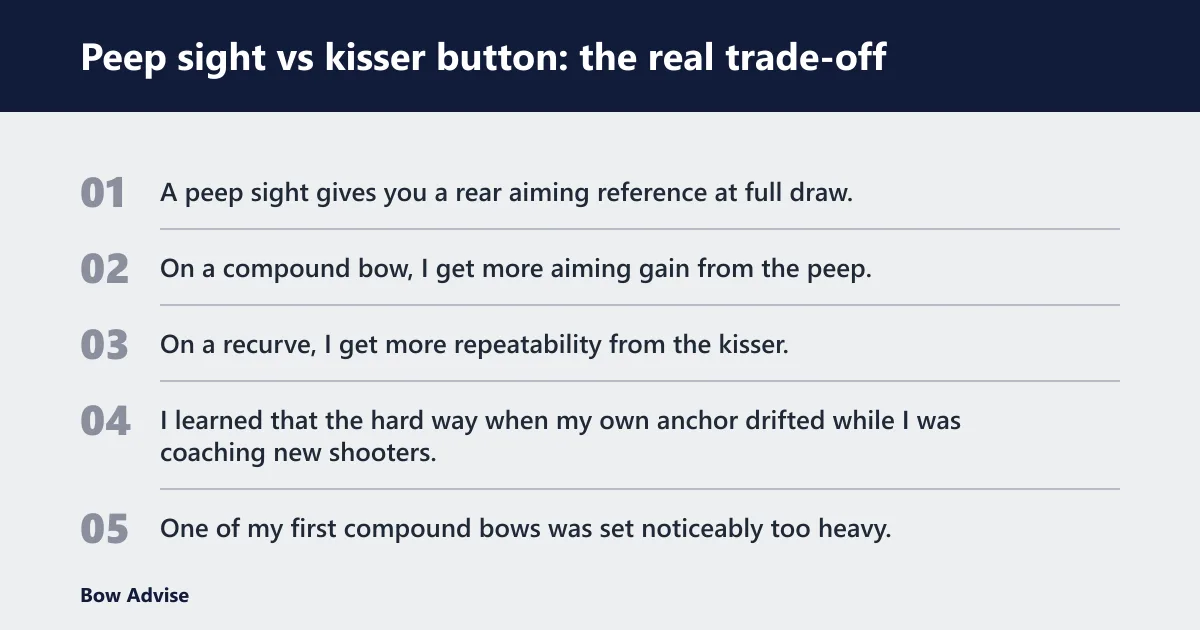


The short answer is plain. A peep sight gives you a rear aiming reference at full draw, while a kisser button gives you a repeatable mouth reference for your anchor point. On a compound bow, I get more aiming gain from the peep. On a recurve, I get more repeatability from the kisser.
I learned that the hard way when my own anchor drifted while I was coaching new shooters. One of my first compound bows was set noticeably too heavy, and I spent some time flinching before I backed the limb bolts out. The accessory was never the real fix.
| Decision factor | Peep sight | kisser button: which helps aim better | Winner |
|---|---|---|---|
| Aiming clarity | Gives a rear sight picture and centers the pin at full draw | Does not create a sight picture; only helps place the head and string hand the same way | Peep sight |
| Anchor repeatability | Depends on your anchor being already stable | Gives a mouth-based reference that helps repeat the same anchor point | Kisser button |
| Low-light risk | Can be hard to see at last light in timber or from a tree stand | Works by feel, so visibility is less of a problem | Kisser button |
| Best fit for compound bows | Common on compounds and built for sight alignment | Usually secondary, and sometimes awkward on a compound face setup | Peep sight |
| Best fit for recurve bows | Can be added to some recurve bows, but far less common | Often used as a practical anchor aid on recurves | Kisser button |
Aiming clarity
The peep wins this row because it is a direct aiming aid attached to the bowstring. At full draw, I line the peep with the front sight, then center the pin. That is why a peep helps me judge where my arrow will land, especially as distance grows.
A kisser button does not tell me where the sight picture is. It tells me where my lips sit on the string. Useful? Yes. Better for aiming itself? No.
Anchor repeatability
The kisser wins here because repeatable face contact is what steadies the shot. If my lips, chin, nose, or jaw move around shot to shot, the sight picture changes even when the peep is perfect.
I coach a lot of beginners who think aiming trouble is an aiming problem. Half the time, their real issue is anchor drift. A kisser gives them one more concrete reference point so they stop floating around the string.
Low-light risk
The peep loses this role. In low-light hunting, especially from a stand or in thick timber, a peep can be slow to find or almost disappear against a dark background. I have watched good shots fall apart at last light because the archer could not settle on the aperture cleanly.
A kisser button does not depend on seeing a tiny opening. That makes it calmer under poor light, but only if the archer already has a solid anchor and the shot is close enough that a simple face reference is enough.
Best fit for compound and recurve bows
The peep is the clear compound winner. Peep sights are most common on compound bows, and that matches how compounds are shot: draw to the same stop, find the rear aperture, and run the pin. (wikihow.com)
Peep sights can also be added to some recurve bows, but I rarely see that beat a clean anchor system on a recurve. The kisser button fits better there because it supports the face reference the archer is already using.
Which helps aim better in hunting and target shooting?
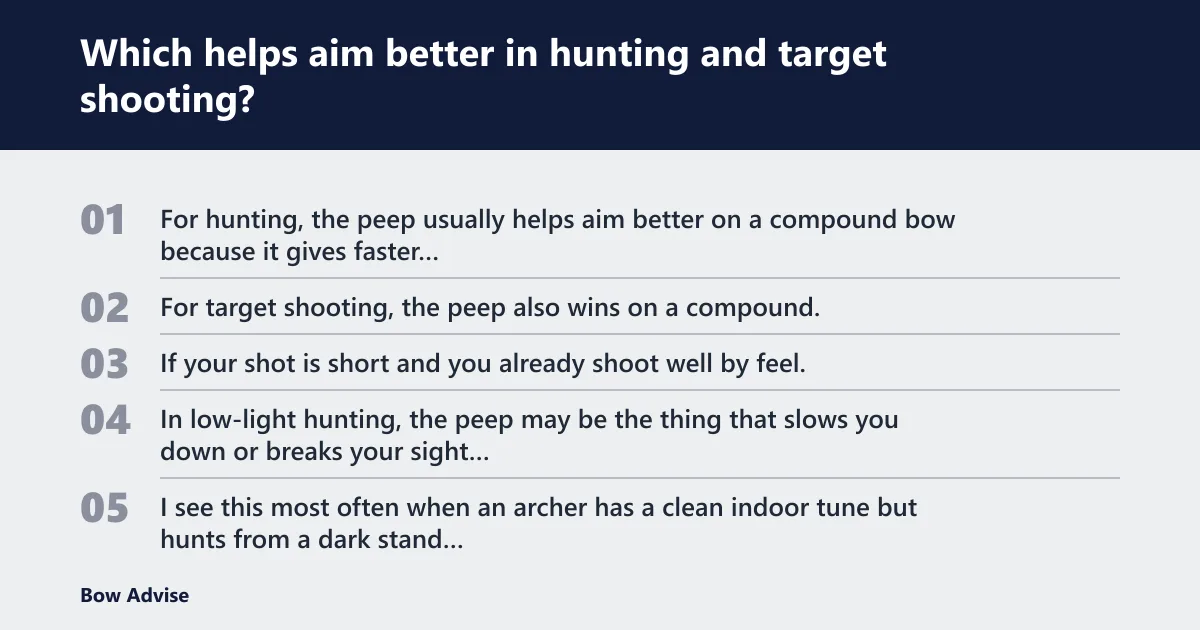
For hunting, the peep usually helps aim better on a compound bow because it gives faster sight alignment when the shot opens up past point-blank distance. For target shooting, the peep also wins on a compound, while the kisser is mainly an anchor aid. If your shot is short and you already shoot well by feel, the kisser can be enough on a recurve.
Last-light whitetail hunting
This is where the peep gets tested hardest. In low-light hunting, the peep may be the thing that slows you down or breaks your sight picture when the woods go gray. I see this most often when an archer has a clean indoor tune but hunts from a dark stand and loses the peep in the last few minutes of legal light.
If your anchor is solid and your target is close, the kisser can keep the shot together without asking your eyes to find a small rear opening. That is why some hunters like a kisser as a backup cue, not as a peep replacement.
Indoor target shooting
The peep wins indoors for compound shooters because lighting is controlled and the sight picture is the main task. At target distances, the rear alignment matters more than a mouth reference, especially once groups tighten and you start caring about tiny errors.
A kisser can still help, but mostly as a consistency check. If the anchor is the weak link, the kisser tightens the whole shot. If the anchor is already locked in, the peep is the bigger accuracy gain.
Short-range practice vs longer distances
At short range, a strong anchor can carry more of the load. I can get decent results with a clean mouth or chin reference when the target is close and forgiving. As distance stretches, the peep starts mattering more because tiny head changes move the sight picture enough to open groups.
That is the practical split I use when coaching. Anchor control helps at every distance, but the peep becomes more valuable as the arrow path gets less forgiving.
How anchor point changes your shot
Your anchor point is the real source of repeatable aim. Chin, nose, cheek, ear, and mouth references all work if they are the same shot to shot. When that contact changes, the sight picture changes with it, even if the bow and arrow tune are perfect.
Chin, nose, cheek, ear, and mouth references
I have seen shooters anchor under the jaw, touch the nose, brush the cheek, or use the corner of the mouth. The important part is not the spot itself. The important part is that the same face contact happens every time at full draw.
When I switched to a left-hand bow after realizing I am left-eye dominant, my groups tightened fairly quickly. That was not magic. I finally lined up the eye, face, and anchor in a way my body could repeat.
Why a repeatable anchor steadies the sight picture
A repeatable anchor steadies the sight picture because it locks your head and string hand into one geometry. If the head creeps forward, the peep may still look centered, but the arrow leaves from a different angle.
That is why the kisser button matters so much for beginners. It teaches the body where full draw feels right before the archer starts chasing tiny sight errors.
What changes when you move from beginner to consistent shooter
Beginners need a reference. Consistent shooters need fewer crutches. Once an archer can hit the same anchor every time, the peep starts paying off more because the face side of the shot is already under control.
That is also where eye dominance and glasses start to matter. If the peep line does not match the dominant eye, or if glasses make the aperture harder to find, the best anchor in the world will not save the shot.
What goes wrong with peep sights
The main peep problems are visibility, twist, and fit. A peep sight is attached to the bowstring, so it can shift when the string changes over time. A peep also has to be evaluated at full draw, because that is where alignment either works or fails.
Low-light visibility problems
At last light, the peep can vanish into the background. Tree stands and dark timber make that worse. If I am hunting whitetail and the last legal minutes are dim, I care a lot about whether I can find the aperture without hunting for it.
That is one reason some archers decide the peep is not worth it for their hunting setup. Their groups may be fine on paper, but the field tells a different story.
Peep twist from bow string stretch
Bow string stretch can change peep alignment over time, including over a season. I see it most after prolonged field use, heat, moisture, and repeated shooting. A peep that sat perfect in August can rotate enough by October to annoy you.
When that happens, realignment or replacement often needs a bow press. The press reduces string tension so the peep can be moved safely. That is part of the maintenance cost of shooting a compound with a peep.
When a bow press becomes part of the fix
If the peep rotates a little, I can often correct it on the press and be back shooting. If it keeps moving, I look at string condition and overall fit. A peep that keeps drifting is usually telling me the setup is not settled yet.
That is why I never call the peep a set-and-forget part. It is simple, but it still lives on a moving string.
Can you shoot accurately with only a kisser button?
Yes, you can often shoot accurately with only a kisser button if your anchor is consistent and your distances are fairly modest. That works best on some recurve setups and on archers who already shoot well by feel. It is not my first pick for precision compound shooting, though.
When a kisser-only setup can work
A kisser-only setup can work when the shot is built around repeatable face contact and a calm release. I use that idea more often with recurves than compounds. If the archer can settle the mouth reference and hold the same head position, the groups can be very good.
Why it fits some recurve shooters better than compound shooters
Recurve shooters often rely on anchor and gap or instinctive aiming, so the kisser fits their shot model better. A compound bow is built around a peep, sight picture, and controlled full-draw alignment. Taking the peep away from a precision compound setup usually removes more help than the kisser can replace.
Limits at longer range
At longer range, a kisser-only setup starts to show its limits. The anchor may still be repeatable, but without a rear aiming reference, tiny errors in head position and eye line can grow fast. That is why I do not treat the kisser as a peep replacement for long-distance compound work.
Proof matrix: which setup fits each shooting context?
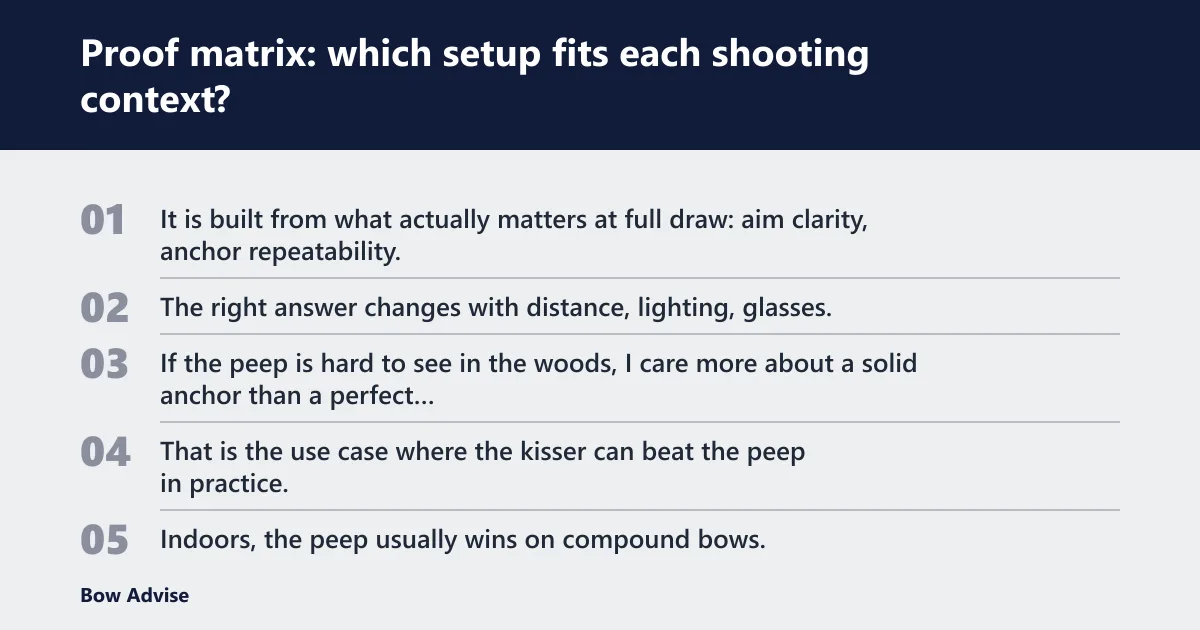
This is the matrix I use when I coach. It is built from what actually matters at full draw: aim clarity, anchor repeatability, low-light risk, and whether the bow setup matches the aid. The right answer changes with distance, lighting, glasses, and how steady your face-to-string contact already is.
| Shooting context | Aiming clarity | Anchor repeatability | Low-light risk | Recommended setup |
|---|---|---|---|---|
| Hunting at last light | Peep is strong if visible; weak if the aperture disappears | Kisser helps keep the anchor from wandering under pressure | High for peeps in timber and tree stands | Kisser first for visibility problems, peep only if you still see it clearly |
| Indoor target shooting | Peep gives the cleanest sight picture | Kisser helps only if the anchor drifts | Low risk for peeps under controlled light | Peep sight, with kisser only as a backup anchor cue |
| Beginner anchor training | Peep can distract before the anchor is stable | Kisser gives immediate face reference | Low to moderate, depending on bow type | Kisser first; add peep later on compound if the anchor is already repeatable |
| Glasses wearers | Peep can help or hurt depending on lens position and eye dominance | Kisser helps the head land in the same place | Moderate if lens glare or fog slows peep pickup | Start with anchor stability, then test peep fit at full draw |
| Recurve and compound setups | Compound favors peep; recurve usually does not | Kisser fits recurve better and can assist compound anchor control | Lower on kisser-only recurve setups | Compound: peep first. Recurve: kisser first. Both only if the anchor stays natural |
Hunting at last light
My recommendation changes fast here. If the peep is hard to see in the woods, I care more about a solid anchor than a perfect rear aperture. That is the use case where the kisser can beat the peep in practice, even though it does less for the sight picture itself.
Indoor target shooting
Indoors, the peep usually wins on compound bows. The environment is controlled, the sight picture is clear, and the archer can benefit from the cleanest possible alignment. The kisser only moves ahead if the anchor is the weak link.
Beginner anchor training
For beginners, I often start with the kisser because it teaches repeatability. Once that anchor settles down, a compound shooter can add a peep without building two bad habits at once. That order keeps the shot simple.
Glasses wearers
Glasses can change the answer. I have seen peeps help one shooter and frustrate another because the lens position changed the sight picture at full draw. If you wear glasses, I pay extra attention to eye dominance, face contact, and how easily the aperture appears without craning your neck.
Recurve and compound setups
This row is the easiest one to call. Compound bows usually reward the peep. Recurve bows usually reward the anchor aid. Using both together only makes sense when the archer’s draw length, head position, and release hand all match the same shot every time.
Choose peep sight if… / Choose kisser button if…
Choose a peep sight if your main problem is aiming precision on a compound bow, you shoot at longer distances, you can see the aperture clearly at full draw, and your anchor point is already stable. I would also choose it when you want the cleanest target picture for indoor work.
Choose a kisser button if your main problem is anchor repeatability, you shoot recurve, you hunt in low light where the peep disappears, or your face contact changes shot to shot. I would also start here for a beginner who needs one simple reference before adding more gear.
Choose both if you shoot a compound bow, your anchor is already close to repeatable, and the peep does not force your head forward or change your draw length. That is the setup I use when I want a fixed face reference plus a clean sight picture.
What should I use if my peep twists or I hunt at last light?
If your peep twists, fix the setup before you blame the aim. A bow press is usually part of the realignment process, and string stretch may be the reason it moved in the first place. If you hunt at last light and the peep is still hard to see, I would lean on a kisser or a stronger anchor plan instead of forcing a bad sight picture.
Frequently asked questions
Which is more accurate, a peep sight or a kisser button?
On a compound bow, a peep sight usually helps accuracy more because it gives a rear aiming reference at full draw. A kisser button helps repeat the anchor, which supports accuracy indirectly. If the anchor is sloppy, though, the better sight aid will not save the shot.
Can you shoot a bow accurately with only a kisser button?
Yes, especially on recurves and at shorter ranges where anchor consistency matters more than a rear sight picture. I would not use kisser-only as my first choice for precision compound target work. It can shoot well, but it asks more of the archer’s face control.
Do I need both a peep sight and a kisser button?
Only if both solve a real problem in your shot. A peep helps sight alignment, and a kisser helps anchor repeatability. If one of those is already stable, adding the other may just add clutter unless it improves your full-draw repeatability.
Is a kisser button better than a peep sight for low-light hunting?
Often, yes. In last-light timber or from a tree stand, a peep can be hard to see or slow to find. A kisser works by feel, so it can be the cleaner option when visibility is the thing breaking the shot.
What are the downsides of using a peep sight?
The main downsides are low-light visibility, peep twist, and the fact that string stretch can move the alignment over time. If it drifts, I may need a bow press to realign or replace it. The peep is simple, but it is not maintenance-free.
Will a peep sight work on a recurve bow?
Some recurve setups can use string peeps, but they are far less common than on compounds. I usually think of recurves as anchor-first bows. A kisser button tends to fit that style better because it helps repeat the face reference without turning the bow into a compound-style setup.