Can You Shoot a Compound Bow Without a Peep Sight?
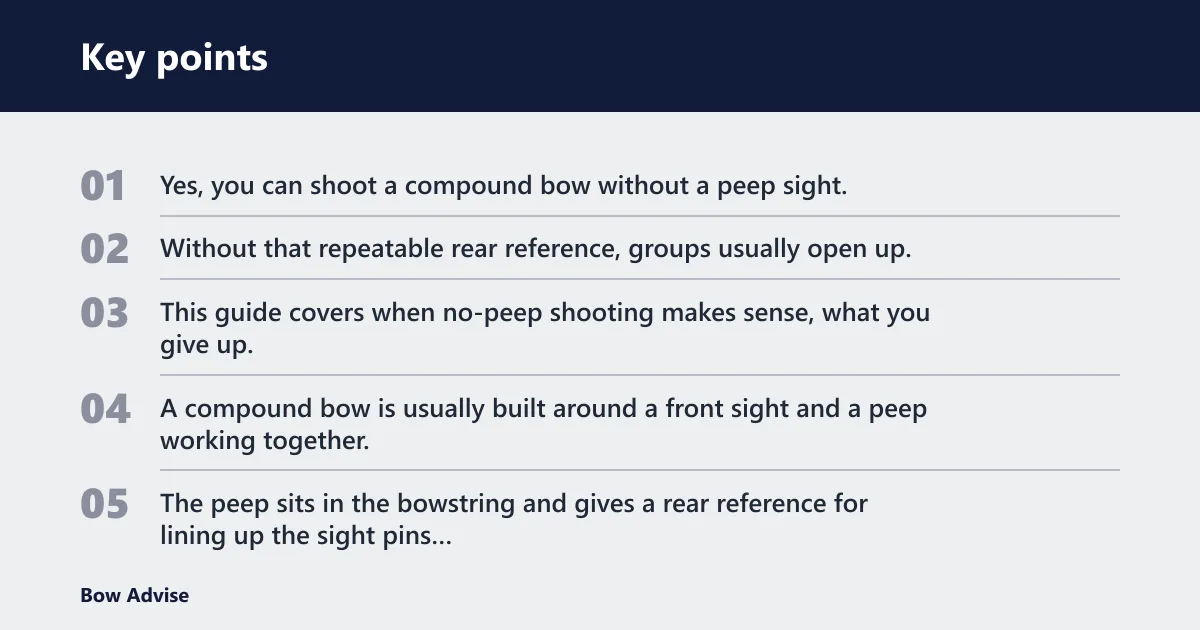
Yes, you can shoot a compound bow without a peep sight, but only if you replace it with a fixed aiming reference and accept less precise anchor control. Without that repeatable rear reference, groups usually open up, tuning problems are harder to spot, and misses become more likely. This guide covers when no-peep shooting makes sense, what you give up, and the safest ways to aim a compound bow without treating it like the same setup.
When no-peep shooting works and when it doesn’t


What changes when the peep comes off
A compound bow is usually built around a front sight and a peep working together. The peep sits in the bowstring and gives a rear reference for lining up the sight pins with the target. Remove it, and the front sight is still there, but the rear reference is gone, so the sight picture becomes less repeatable shot to shot.
The biggest loss is not the hole in the string itself. It is the repeatability it gave your anchor point and eye position. If your jaw, cheek, nose, neck, or ear contact changes, the point of aim changes with it.
When no-peep shooting makes sense
No-peep shooting can be acceptable for short-range practice, experimentation, or a temporary setup change. It can also make sense for archers who want a more open sight picture and are willing to put in the practice needed to keep anchor and bow position exact.
It is not the same as a standard compound setup. Barebow shooting is the closer fallback, and it requires a different aiming method and more practice. For hunting, the margin for error is much smaller.
When it does not
If the goal is repeatable hunting accuracy, a peep is usually the safer choice. Low light, pressure, and awkward shooting angles expose every weakness in anchor control. A no-peep setup can still work, but it gives up the clean rear reference that most compound bow archers rely on.
What you’ll need
- A compound bow with a leveled sight
- A stable anchor reference you can hit the same way every time
- A target at a close, known distance
- Basic tuning that has already been checked
- A large target face for the first shots
- A front sight with either multi-pin or single-pin aiming
How to shoot a compound bow without a peep sight
The safest no-peep method starts close and treats setup as the priority. Tune the bow first, establish a repeatable anchor point, and only then evaluate group size. If the bow is not tuned, left-right misses may come from rest or nocking-point problems instead of the missing peep.
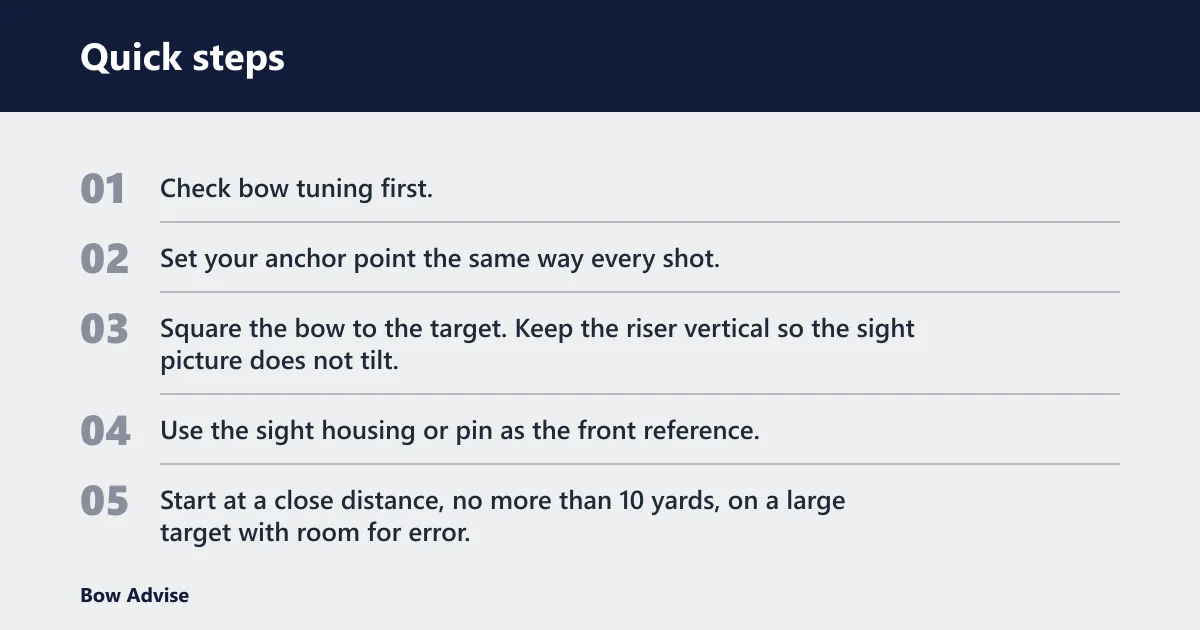
Steps for a no-peep setup
- Check bow tuning first. Rest and nocking point alignment must be correct before any sighting work.
- Set your anchor point the same way every shot. Use jaw, cheek, nose, neck, or ear contact, but keep one reference.
- Square the bow to the target. Keep the riser vertical so the sight picture does not tilt.
- Use the sight housing or pin as the front reference. Put the pin where you want the arrow to land.
- Start at a close distance, no more than 10 yards, on a large target with room for error.
- Watch the group, not one arrow. If impacts drift left or right, recheck anchor before changing the sight.
- Make only one change at a time. Move the sight in the direction the arrows are hitting, then recheck.
What to expect from the groups
Expect a wider group than a normal peep-and-sight setup until the anchor becomes automatic. A common first-timer mistake is changing face contact after every shot because the sight picture feels unfamiliar. That usually creates a vertical stringing pattern or a left-right spread that looks like a tuning problem.
Suppose the bow groups into about 2-inch clusters at 10 yards with a peep, then opens to about 5 inches without one. That does not prove the bow is inaccurate; it usually means the anchor or eye position is less repeatable. The fix is practice and consistency, not chasing the sight around.
How to aim a compound bow without a peep sight
A no-peep compound bow is aimed by repeating the same face contact, keeping the bow vertical, and using the front sight as the only sight picture reference. It is possible, but it asks more of the archer than a peep-and-pin setup does. The target stays the same; only the rear reference changes.
Use repeatable face contact
Pick one anchor and keep it fixed. A jaw-only anchor is different from a jaw-plus-nose anchor, and those differences matter. Eye-dominance problems also show up more clearly without a peep, because the eye may drift off the center line and shift the pin picture.
Accept a wider sight picture
Without a peep, the pin will look less boxed-in. That wider picture can feel faster, but it also makes small aiming errors easier to miss. Keep the bow level and center the same pin position on the target every shot.
Confirm the arrow impact pattern
Use short-distance groups to judge the setup. If the impacts climb or spread sideways, fix anchor or tune before stretching distance. A sight is only useful after the bow is set correctly and the arrow flight is stable.
When a larger peep is enough
Often the answer is not removing the peep. A larger peep may solve the real problem if the current one is too hard to see in dim light, too tight with glasses, or too restrictive for the field of view you want. That keeps standard compound aiming intact.
Low-light hunting
Low-light hunting is one situation where peep size often matters most. A smaller peep can be harder to use at dawn or dusk, while a larger peep is easier to see in dim conditions. The tradeoff is practical: more visibility usually means less precision in the sight picture.
Glasses and limited field of view
If glasses make the peep feel cramped, a larger opening can help without changing the whole setup. That is often a better first move than removing the peep entirely, especially if the bow is already tuned and the sight pins are set.
Keeping standard compound aiming
Many archers do better by keeping the peep and adjusting size than by deleting the rear reference. Multi-pin and single-pin sights still work normally. Common hunting pin spacing is 20, 30, 40, 50, and 60 yards after proper tuning.
Peep sight decision table
| Option | Use case | Risk | Expected accuracy tradeoff | Recommended next step |
|---|---|---|---|---|
| Keep the peep | Hunting, low light, glasses, regular target practice | Low | Best repeatability with the least guesswork | Confirm tuning, level the sight, then zero pins |
| Remove the peep | Backyard practice, experimental setup changes, short-range use | Moderate to high | Groups usually open up, especially past close range | Use a fixed anchor and start inside 10 yards |
| Try a larger peep first | Low-light hunting, glasses, narrow field of view | Low to moderate | More visibility, slightly less precision | Swap one size up and retest at dawn or dusk |
| Switch to barebow-style aiming | No-peep shooting, close-range practice, learning a different method | High | Less precision than standard compound aiming, more practice needed | Commit to a different aiming method and rebuild anchors |
Common mistakes
The first mistake is changing anchor point from shot to shot. No-peep shooting lives or dies on repeatable face contact, so a different jaw or nose touch changes everything.
The second mistake is judging the setup before tuning the bow. Rest and nocking point errors can create left-right problems that have nothing to do with the peep. Fix the bow first, then judge the aim.
The third mistake is expecting hunting-level precision without practice. A no-peep setup can work, but it rarely feels as stable as a peep and sight until the archer rebuilds the new anchor.
The fourth mistake is ignoring low-light limits. If dawn or dusk is part of the plan, a small peep may be too hard to use, but removing it entirely can create a different problem: a harder sight picture under pressure.
What happens if I remove the peep sight from my compound bow
Removing the peep takes away the rear aiming reference and usually makes the sight picture less consistent. That often shows up as wider groups, more anchor drift, and less confidence when the shot matters. The bow can still shoot, but the archer now has to control more of the aiming process by feel and repetition.
Can you shoot a bow without a peep sight in hunting conditions?
You can, but it is not the best default choice for hunting. Hunting rewards a repeatable sight picture, stable anchor, and quick low-light acquisition. A larger peep is usually the better answer if visibility is the issue, because it keeps standard compound aiming intact.
How do sight pins change without a peep?
The pins themselves do not change, but the way they are used does. Multi-pin and single-pin sights still need to be leveled and tuned, and the bow must be sighted in after tuning. Without a peep, the pin is harder to index the same way every shot, so zeroing becomes less forgiving.
Can a single-pin sight help if the peep is removed?
A single-pin sight can still be used, but it does not solve anchor inconsistency. It uses a sight tape and movable indicator, so the distance system is there. The harder part is keeping the same face contact and bow position so the pin lands in the same place every time.
Frequently asked questions
Can you shoot a compound bow without a peep sight?
Yes. The bow will still launch arrows, but the sight picture can become less repeatable. That often matters most for hunting and longer distances, where small anchor errors can show up quickly. A consistent face reference and a tuned bow are commonly treated as minimum requirements if the peep comes out.
Do you need a peep sight on a compound bow?
No, but most compound bows are set up with one because it gives a stable rear reference for the sight pins. If accuracy and confidence matter more than trying a different method, keeping the peep is usually the better choice. A larger peep is often a simpler fix than removal.
Is it harder to aim a compound bow without a peep sight?
Yes. The rear reference is gone, so the eye has to hold the sight picture more consistently on its own. That usually means more practice and a wider acceptable error band at first. The difficulty drops only when anchor point and bow position become automatic.