Peep Sight Rotation at Full Draw: Causes and Fixes
If a peep rotates a little and returns to the same spot at full draw, start with string stretch, serving slip, cam lean, or D-loop twist; reserve the bowstring only if the rotation stays outside the acceptable hold after those fixes. Ignored rotation can cost sight picture, anchor consistency, and a clean shot. This guide breaks down the symptom patterns, the least-invasive fixes, and the cases that justify a new string.
Why peep rotation happens


A peep sight is the rear aiming point on a compound bow string. It should line up with the archer’s eye at full draw, not at brace height. When it turns, the cause is usually tied to the bowstring, the D-loop, the way the bow is anchored, or a setup issue that only looks like rotation.
The peep aperture also changes the view through the string. A smaller hole gives a tighter sight picture and more precision, while a larger hole passes more light and helps in low-light hunting. Common peep sizes are about 1/8 inch, 3/16 inch, and 1/4 inch.
What the string, serving, and D-loop each change
The bowstring is a helical strand bundle, so twist in the string can change where the peep wants to stop at full draw. Serving holds the peep in place on the string and keeps it from moving up or down. The D-loop clips the release aid to the string, and its stability can affect alignment.
A loop change can alter anchor feel and the point where the peep settles, but it does not change true draw length by a fixed amount.
Why a new string can keep settling
A new bowstring may improve after the first 100 to 300 shots. That is normal settling, not automatic failure. If the peep starts off slightly off and then becomes stable, the issue may be break-in rather than a bad install.
If the peep keeps drifting after that window, or it keeps returning to the wrong place after several adjustments, the problem is no longer “new string settling.” At that point, serving condition, string wear, or a shop-level reinstall deserves attention.
What you should check first
Start at full draw, not brace height. The goal is to see what the peep does when the bow is actually loaded and the anchor is set. That is the only position that tells you whether the symptom is true rotation, a height problem, or a false diagnosis caused by body position.
Also check the same shot the same way. A consistent anchor, head position, and bow cant matter because each one can move the sight picture without any real change in the string.
Full-draw check versus brace-height check
If the peep looks fine at rest but wrong at full draw, the brace-height view is not enough. The string and cams load differently under draw force. A peep that appears straight on the rack can still land off-center when the bow is at shooting tension.
Anchor consistency and head position
Inconsistent anchor can mimic a peep problem. If the release hand, nose contact, or jaw position shifts shot to shot, the eye lands in a different place behind the peep. That makes the aperture look rotated, even when the string has not changed.
Suppose the peep looks perfect on one arrow and high on the next. If the archer’s anchor moved a little, the error may be body position, not hardware. The fix is to repeat the same anchor before changing the bow.
Bow cant as a false diagnosis
Bow cant, or head tilt, can make the sight picture look off-axis. The peep may appear twisted when the bow is actually rolled slightly. That is especially easy to misread with a narrow aperture or a sight housing that leaves little light around the ring.
ArcheryBuddy recommends seeing a thin ring of light around the sight housing when centered. If that ring changes only when the bow is canted, the problem may be posture and not peep rotation.
Peep rotation troubleshooting matrix
This matrix separates symptom pattern from the likely cause, the quickest safe test, and the least-invasive fix. Use it to avoid treating every symptom as a string problem. If a test points to serving damage, persistent creep, or repeated return to the wrong orientation, stop tuning and send it to a shop.
| Symptom pattern | Likely cause | Quickest safe test | Least-invasive fix | Escalation point | When to stop tuning and re-serve/replace |
|---|---|---|---|---|---|
| Rotates same direction every draw | True string rotation, cam timing effects, or string twist mismatch | Draw to anchor several times with the same head position and note whether the peep lands in the same place every time | Check D-loop position first; if still off, adjust string twists in the direction needed for that bow’s setup | If the peep still stops in the same wrong spot after safe adjustments | If the same-direction return persists after multiple safe adjustments or the serving starts creeping |
| Changes shot to shot | Inconsistent anchor, release-hand pressure, or D-loop slip | Hold the anchor point the same for several draws and watch whether the peep changes less | Correct anchor routine first; inspect the D-loop for movement or uneven tie | If the D-loop shifts or the anchor is already repeatable | If loop slippage or serving wear keeps returning after retie and retune |
| Looks high/low in aperture | Wrong installation height or a peep that was tied off at the wrong point on the string | Check the peep at full draw with a consistent anchor and compare to the sight housing center | Reposition the peep height and re-tie serving above and below the peep | If the peep height still misses center after a correct re-tie | If the peep keeps migrating up or down the string or serving is separating |
| Looks off-axis only when head/bow cant changes | Head tilt, bow cant, or inconsistent eye position | Keep the bow upright and repeat the draw with the same head posture | Correct form before touching the string or peep | If the off-axis view remains even with stable posture | If the peep still looks wrong after form is repeatable and the string is stable |
| Worsens after new-string break-in | Normal settling, then persistent creep, or a poor initial install | Track whether the peep improves during the first 100 to 300 shots | Retune after settling; minor D-loop nudges may be enough | If the peep keeps moving after the break-in window | If the string still creeps, the serving separates, or strand damage appears |
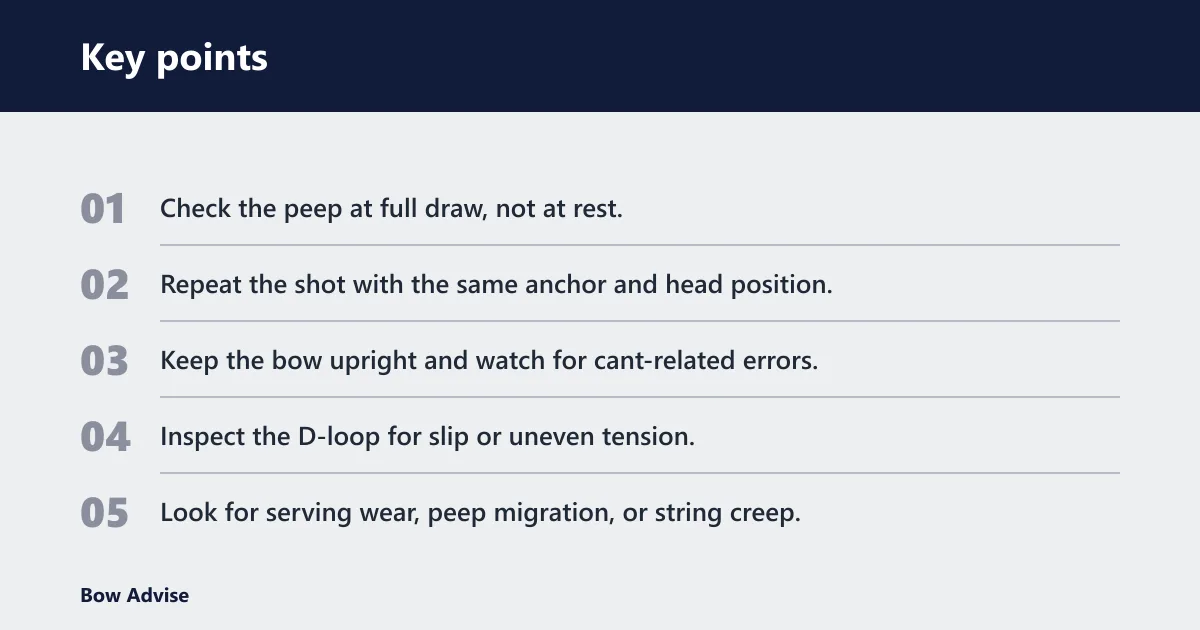
- Check the peep at full draw, not at rest.
- Repeat the shot with the same anchor and head position.
- Keep the bow upright and watch for cant-related errors.
- Inspect the D-loop for slip or uneven tension.
- Look for serving wear, peep migration, or string creep.
- Stop and use a shop if the problem returns after safe correction.
Is it a string issue or a D-loop issue?
A D-loop issue usually shows up as a small, repeatable alignment error that can be fixed without changing the string. A string issue is more likely when the peep rotates the same direction every draw, or when the problem keeps returning after the loop is corrected. The difference matters because the least-invasive fix should come first.
When a D-loop nudge can correct minor alignment
If the peep is close but slightly off center, the D-loop can be adjusted to fine-tune alignment. That is the right place to start when the symptom is small and stable. It is also the least disruptive move because it does not change the full string geometry or require major re-serving.
When D-loop slippage points to a larger problem
If the loop moves after a few shots, the issue is not just aim. Slippage means the release connection is changing under load. That can produce a peep that seems to rotate, then “fix itself,” then drift again. A loop that will not hold should be retied before string twists are changed.
When string twists are the right next step
If the D-loop is stable, the anchor is consistent, and the peep still lands off-center the same way every draw, string twist is the next step. The bowstring’s twist changes how the peep settles under load. Acceptable twist changes vary by bow and string setup, so there is no universal count that fits every rig.
Say the peep stops just left of center every time, even after the loop is checked and the anchor is repeatable. That pattern points away from form and toward the string. The safe next move is a controlled adjustment, not random twisting.
When should you twist the bowstring?
Twist the bowstring when the peep is consistently off at full draw, the loop is stable, and the anchor is repeatable. String twists can change peep orientation, but the amount needed depends on the bow, cam system, and string set. Major changes should be done in a bow press so the work is controlled and safe.
What string twists can change
Adding or removing twists can move the peep’s stopping point. It can also change timing enough to affect draw feel. That is why this is more than a cosmetic fix. A twist that improves alignment but hurts timing is not a real solution.
Why accepted twist changes vary by bow
Different bows respond differently to twist changes because cam timing, cable length, and string length are not identical across models. That is why advice like “a half twist fixes it” should be treated as a starting point, not a rule.
Why a bow press is the safe route for major changes
A compound bow press is required for many peep adjustments, especially when the string must be moved, the serving must be re-tied, or the peep must be reinstalled. The ArcheryBuddy guide warns against installing a peep sight without a proper bow press. A pro shop installation is described as costing about $10 to $20.
Major adjustment is not the place to improvise. If the peep has to be re-served, reinstalled, or moved substantially, shop work is the safer choice for most archers.
How does peep size affect the fix?
Peep aperture size changes how much light reaches the eye and how sensitive the sight picture feels. A smaller aperture can make misalignment look worse because there is less room for error. A larger aperture is easier to see through in low light, but it gives up some precision.
1/8 inch, 3/16 inch, and 1/4 inch tradeoffs
The same source says a 1/8 inch peep is best for target archery and long-range precision. The same guide says a 3/16 inch peep is the most popular all-around size. It also says a 1/4 inch peep is best for hunting and low-light shooting.
Those sizes do not fix rotation by themselves, but they change how the problem feels. A 1/8 inch hole can make small alignment errors more obvious. A 1/4 inch hole can hide minor error, especially when light is fading.
Precision versus low-light use
If a bow is used for low-light hunting, the larger aperture is often easier to live with. If the goal is tighter sight picture discipline, the smaller aperture can help. The key is to match the peep to the use case before chasing a rotation problem that is actually a visibility problem.
When is it time to replace the string?
Replace the string when the problem is no longer a tuning issue. Visible serving separation, strand damage, or persistent creep after retuning are stronger signs than a one-time alignment miss. If the peep keeps returning to the wrong orientation after safe adjustment, the string may be at the end of its useful life.
Visible serving separation or strand damage
If the serving is opening up, the peep can migrate or rotate because the lock point is failing. A simple check is to look for a gap, loose wraps, or fuzzing where the serving no longer sits tight on the string. Strand damage is even more serious. Those are not cosmetic issues. They mean the string itself is no longer holding geometry the way it should.
Persistent creep after retuning
A string that keeps settling after the first 100 to 300 shots may still be normal. A string that keeps creeping after that window, after being retuned, is different. That is a sign the set may not be holding its shape well enough for dependable peep alignment.
Picture a hunting bow that had a fresh string installed, then stayed off by the same amount after 200 shots and another careful retune. That is not normal break-in anymore. At that point, re-serving or full replacement is the cleaner path.
Rotation that returns after several safe adjustments
If the peep rotates, gets corrected, and then goes back to the same wrong spot after a few sessions, the setup is telling you something. Either the string is no longer stable, the serving is slipping, or the peep install is not holding. Re-serve or replace instead of chasing the same symptom again.
Frequently asked questions
Why does my peep sight rotate at full draw?
The most common reasons are string twist, D-loop movement, inconsistent anchor, bow cant, or a new string still settling. The key is to judge it at full draw, where load reveals the true pattern.
How do I fix a peep sight that twists when I draw?
Start with the least invasive fix. Check the D-loop, confirm a repeatable anchor, and rule out bow cant. If the peep still lands wrong in the same way, use controlled string twist changes in a bow press. If the serving is worn or the problem returns, stop and go to a shop.
Is peep rotation a string problem or a D-loop problem?
It can be either. A D-loop problem usually looks small, repeatable, and tied to loop slip or loop length. A string problem is more likely when the peep rotates the same direction every draw or keeps drifting after the loop is corrected. Test the loop first, then the string.
When should I twist the bowstring to correct peep alignment?
Twist the string when the peep is consistently off at full draw, the D-loop is stable, and the anchor is repeatable. Do not treat twist advice as universal, because acceptable changes vary by bow and string setup. For major changes, use a bow press or a pro shop.
Can a new string cause peep sight rotation?
Yes. A new bowstring may improve after the first 100 to 300 shots, and some early movement is just settling. If the rotation keeps going after that window, or returns after retuning, the issue may be persistent creep rather than break-in. That is when re-serving or replacement becomes more likely.
Will bow cant or head tilt make the peep look twisted?
Yes. Bow cant and head tilt can make the peep look off-axis even when the string is fine. That is why the first check should be at full draw with the bow held upright and the anchor kept the same.