G5 Peep Sight Review: Is It Worth It for Hunters Today?
The G5 peep sight is a solid fixed-aperture hunting choice if your draw length and anchor stay the same; I’d start most hunters with a 1/8-inch opening, then go larger if low-light visibility becomes an issue. A bad peep match slows your sight picture, changes anchor feel, and costs clean shots when light falls. I’ll cover fit by draw length, fixed versus tubed and adjustable peeps, low-light performance, and who should buy G5 versus skip it.
This guide is part of our Peep sights for archery: complete guide series.
Verdict

My short answer: yes, I would recommend the G5 Outdoors Meta Pro Peep for hunting if your bow is already tuned and your anchor is repeatable. From the spec sheet and owner feedback, it is a low-maintenance fixed-aperture peep that favors consistency over adjustability, and that tradeoff makes sense in the woods.
The one setup condition that decides everything is draw length fit. If the peep lands cleanly at full draw and your face settles into the same spot every time, the fixed aperture is a strength. If you are still moving peep height around, shooting with uneven anchor pressure, or fighting a dark sight picture at dawn, I would look at another style before I bought this one.
Pros and cons
- Pros: fixed-aperture simplicity
- Pros: radial string grooves for secure engagement
- Pros: machined from a single piece of 7000 series aluminum
- Pros: hand-anodized, non-abrasive finish
- Cons: fixed aperture limits field of view
- Cons: less forgiving if your draw length or anchor changes
- Cons: low-light use can suffer compared with a larger opening
According to g5outdoors.com — G5 says the company is ‘Made in Michigan!’. (source)
Specs at a glance
| Item | What the G5 Meta Pro gives you | Why it matters in the field |
|---|---|---|
| Peep type | Fixed-aperture peep sight | Less to move, twist, or tune once set |
| Construction | Machined from a single piece of 7000 series aluminum | Stiff, light, and suited to a hunting bow |
| Finish | Hand-anodized and non-abrasive | Helps reduce contact wear on the string |
| String interface | Radial string grooves | Improves seating and alignment retention |
| Interior shape | Convex interior | Helps maintain a round sight image |
| Hunting use | Built for repeatable sight picture and quiet use | Useful when you want fewer moving parts in cold weather |
What the materials suggest before you ever shoot it
The material story is plain. G5 says the peep is machined from a single piece of 7000 series aluminum, with a hand-anodized, non-abrasive finish. That points to a part built for the string, not for shelf appeal. It also fits the kind of hunting setup I trust when I want fewer failure points.
I pay attention to how a peep should behave inside a compound bow string. The string groove seating has to hold alignment through the draw cycle, not just at brace height. If the peep rotates, shifts, or bites into serving in a sloppy way, the sight picture suffers long before any broadhead flies.
Who it is for
This peep is for bowhunters who already have a stable anchor and a clean draw-length setup. It also fits archers who want a fixed hunting part they can leave alone through a season, without rubber tubing to stretch, crack, or snap at the wrong time. If you like simple gear and repeatable head position, it belongs on your short list.
It is not my first pick for archers still working through draw-length changes, glasses issues, or uneven anchor pressure. Bad fit shows up everywhere, and a peep sight is no exception.
Who should skip it
- Archers still changing draw length or peep height
- Hunters who need more low-light flexibility than a fixed opening allows
- People who want the option to fine-tune sight picture size on the fly
- Left-handed shooters who have not confirmed the peep matches their setup path and anchor behavior
What works

The strongest part of the G5 Meta Pro is consistency. A fixed peep removes one source of movement from the system, and that matters in hunting because a quiet, repeatable sight picture beats clever marketing every time. The radial string grooves help the peep seat cleanly, and the convex interior is there to keep the image round instead of oval-looking when your head angle changes a bit.
Low-light use at dawn and dusk
In overcast light, the reviewer said the peep provided a clear sight picture, and that matches the kind of hunting use I care about most. Fixed apertures do have a tradeoff, though. A smaller opening can help the picture feel precise, but it can also cut usable light and make the front sight look dim when dawn is still thin.
That is why aperture size matters more than people admit. A wider opening gives a bigger field of view, while a tighter one can help you center the pin more cleanly. If you hunt dark timber or stay on stand after first and last light, the opening you choose matters as much as the brand name on the peep.
Quiet, repeatable sight picture in the woods
Bowhunting conditions punish sloppy parts. Wet weather, cold gloves, and uneven anchor pressure all make a peep work harder. The fixed G5 design keeps the system simple, and based on the review notes there were no visible signs of wear and tear after several weeks. That is the kind of result I want from a hunting part that lives on the string.
I also like that fixed peeps avoid rubber tubing failure points. I have watched tubing stretch, twist, and eventually quit on other setups. The review notes a previous peep with rubber tubing could stretch or break, and that is exactly the weakness this style removes.
What does not
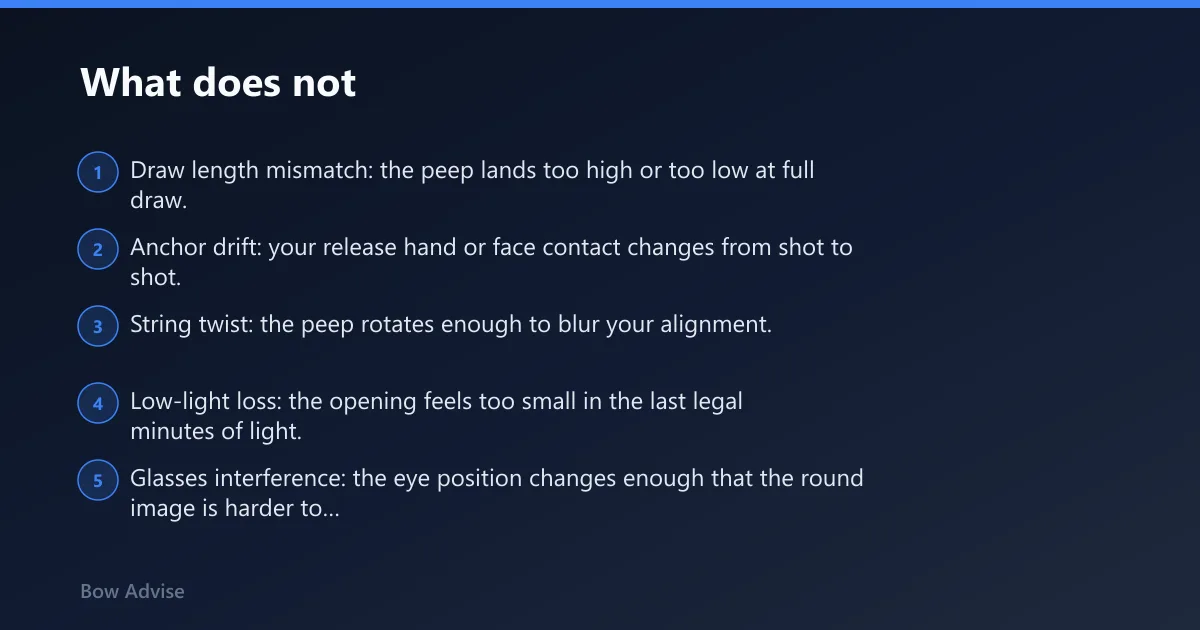
The main drawback is the fixed aperture itself. Once you pick the opening, you give up flexibility. If the sight picture is too dark at dawn, the answer is not a quick turn of a screw. If your anchor changes across seasons or your draw length is still being sorted, the peep can become a moving target.
Failure cases I watch for
- Draw length mismatch: the peep lands too high or too low at full draw.
- Anchor drift: your release hand or face contact changes from shot to shot.
- String twist: the peep rotates enough to blur your alignment.
- Low-light loss: the opening feels too small in the last legal minutes of light.
- Glasses interference: the eye position changes enough that the round image is harder to center.
The other issue is that fixed peeps are less forgiving for shooters who need adjustment. I have seen archers chase peep height all week because their anchor was not repeatable. In that case, a fixed design does not solve the real problem. It only makes the problem harder to ignore.
What size peep sight should I choose for low light?
I would start with the smallest opening that still lets you hold a usable sight picture at dawn and dusk. For most hunters, that means a tighter peep if you shoot in daylight woods, and a larger opening if you sit long enough for your target window to get dim. The right size is the one you can see through without rushing the shot.
Low light is a tradeoff between visibility and precision. A smaller aperture often helps the front sight look cleaner, but it can reduce the amount of light reaching your eye. If you hunt overcast afternoons or dark timber, test your peep under those exact conditions before you commit to it.
My setup-and-fit checklist
- Draw-length fit: draw the bow repeatedly and confirm the peep lands at the same eye line every time.
- Anchor repeatability: close your eyes, set anchor, open, and check whether the peep image is centered without head hunting.
- String-seating check: inspect whether the peep sits in the serving grooves without biting unevenly or leaning.
- Twist check: cycle the bow several times and watch for peep rotation at full draw.
- Low-light test: shoot during overcast light or late evening and judge whether the opening is still bright enough for a clean aim.
Will a fixed aperture peep limit visibility at dawn and dusk?
Yes, it can. A fixed aperture gives you less flexibility than an adjustable setup, and a smaller opening can make a dim sight picture even harder to read at the edge of legal light. That does not make the peep bad for hunting; it just means the opening must match your real light conditions.
If you hunt mostly in open cover or in daylight, the tradeoff may be worth it. If you sit in thick timber, hunt overcast weather often, or need every bit of light you can get, a larger opening or another peep style may fit you better.
Does the G5 peep sight beat a tubed peep?
For reliability, I give the fixed G5 design the edge. Tubed peeps add rubber tubing, and rubber brings stretch, age, and break risk. A fixed peep strips away those failure points and usually gives a cleaner, quieter hunting setup once the bow is tuned correctly.
Where tubing still helps some archers
That said, tubing still helps some shooters who need stronger alignment help or a more forgiving setup while they are sorting draw length. It can keep the peep oriented for archers who struggle to see through a fixed opening at their current anchor. The cost is more maintenance and more things that can fail in the field.
My rule is simple: if the shot process is already stable, I want the fixed peep. If the setup is still in motion, tubing can buy time while the rest of the system gets sorted.
Failure points I watch for in both designs
- String creep or serving wear
- Anchor inconsistency
- Head tilt changing the sight image
- Improper peep height for the draw length
How durable is the G5 Outdoors peep sight?
It looks durable enough for hunting use, and the material choice supports that. The review says there were no visible signs of wear and tear after several weeks, and the non-abrasive finish should help reduce contact wear on the string. That said, durability still depends on string condition and how hard the bow is cycled.
I care about durability in weather, not just on paper. A peep that stays quiet in cold gloves and does not chew the serving earns trust fast. G5 also says “Made in Michigan!” on its broader product branding, and while that does not tell me how this peep shoots, it does tell me the company talks in durability language rather than accessory fluff.
What material is the G5 peep sight made from?
The G5 Outdoors Meta Pro Peep is machined from a single piece of 7000 series aluminum, with a hand-anodized finish and a non-abrasive coating. That is the material story I want in a hunting peep because it points toward stiffness, low mass, and less string damage than a rough part would cause.
G5 uses strong language on its other products too, saying its broadheads are “100% Steel Tough” and “Made out of 100% Stainless Steel.” Those claims are for broadheads, not peeps, but they tell me the company leans hard into hard-use gear. That fits this peep’s job.
Is there any downside to a fixed-size peep sight?
Yes. The downside is that you lose flexibility. A fixed-size peep cannot adapt to every light condition, every anchor change, or every shooter who is still refining form. If your draw length shifts or your anchor point changes, the peep may stop feeling right fast.
That is why a fixed peep is a good tool, not a cure-all. It rewards clean bow setup. It does not replace it.
What should I look for when buying a peep sight for compound bows?
Look first at how the peep seats in the string and whether it matches your draw length. Then check whether the opening gives you enough light for the woods you actually hunt. After that, think about maintenance, tubing, and whether you need a fixed, tubed, or adjustable design.
If you wear glasses, confirm the sight picture still centers without head strain. If you shoot left-handed, confirm the peep orientation and anchor path make sense for your bow. The best peep is the one that disappears into the shot and leaves you with a calm, repeatable sight picture.
Alternatives

The HHA Optimizer Lite Ultra Sight Tapes are not a peep sight, but I include them because some hunters trying to improve consistency are really chasing the wrong problem. From the spec sheet and owner feedback, this is for archers who want range-marked sighting help from 20 to 80 yards and already know their bow speed band. The drawback is that it solves sight aiming, not peep alignment or low-light visibility.
The G5 Outdoors Meta Pro Peep Hunter Sight, Black, 3/16″ is the closest direct alternative in the same family. From the listed pros, its convex interior and anti-glare coating should help with round image quality and low-light use, but the larger opening can be a mixed bag if you want a tighter sight picture. I would compare this against the smaller opening only after I knew my draw length and hunting light conditions.
Should you buy it
Buy the G5 Meta Pro if you want a low-maintenance hunting peep and your bow is already tuned. Skip it if you still need peep height work, if your anchor is inconsistent, or if your dawn and dusk shots demand more light than a fixed opening can give. That is the clean answer.
For the right archer, this is a smart, quiet part that does its job without drama. For the wrong setup, it becomes one more thing to blame. I always prefer the part that fits the bow, not the part that forces the bow to adapt.
Frequently asked questions
Is the G5 Meta Pro peep sight good for hunting?
Yes, if you already have a consistent draw length and anchor. The fixed aperture, radial string grooves, and non-abrasive finish make it a good hunting part for archers who want repeatability more than on-the-fly adjustment. If you need constant tuning, I would choose a different style.
Does the G5 peep sight work better than a tubed peep?
For many hunters, yes. A fixed peep removes rubber tubing, so you avoid stretch and break risk. That said, tubing can still help shooters who need extra alignment help while their setup is being dialed in. The better choice depends on how stable your anchor and draw length are.
How do I know if the G5 peep sight will align at my draw length?
Draw the bow repeatedly and watch where the peep lands at full anchor. If the sight image centers the same way every time, your draw length and peep height are likely working together. If you have to hunt for the ring with your head or face, the fit is wrong.