Peep Sight Size Guide for Low-light Hunting
For low-light hunting, start with about a 1/8-inch peep for most single-pin or housing-first setups, use about 3/32 inch only if the sight ring stays fully visible, and avoid smaller apertures unless the pin picture is still fast. A peep that is too small slows the shot and can hide the housing at dawn or dusk. This guide shows how to choose peep size by sight-housing visibility, low-light conditions, and bow setup.
What peep size affects most

Peep aperture size changes two things at once: how much light reaches the eye and how much of the sight picture stays controlled. A smaller opening gives a tighter reference. A larger opening brightens the view. For hunting, the useful size is the one that keeps the housing and pins visible at full draw without making the picture sloppy.
Brightness versus precision
Small apertures sharpen the look of pin alignment because they cut stray edges from the sight picture. Large apertures help the eye find the housing faster and keep the picture usable in shade. The tradeoff is plain: more brightness usually brings less precision, and more precision usually brings less brightness.
Common hunting peep sizes usually fall around 1/16 inch, 3/32 inch, and 1/8 inch. Many hunters end up at 3/32 or 1/8 because those sizes keep a usable view in the field without making the bow feel slow. Very small peeps belong in special setups, not as a default for timber shade or last-light shots.
How the sight picture changes
The peep is not judged by diameter alone. At full draw, the eye sees the peep, the sight housing, the pins, and the target as one picture. If the housing nearly fills the opening, the peep is doing its job for aim. If the housing clips the edge or fades into shadow, the opening is too small or the light is too poor for that setup.
Suppose a bowhunter runs a five-pin hunting sight with a large housing and a 1/16-inch peep. At noon the pins may look crisp, but at dusk the outer pins and housing can fade into gray. A 1/8-inch opening often brings back enough field view to keep the whole housing readable.
How low light changes the choice
Dawn, dusk, overcast cover, and timber shade all reduce contrast before they fully reduce brightness. That matters because many misses happen not from total darkness, but from losing the housing edge or the top pin against a shadowed background. In low light, the best peep is the one that keeps the aiming system visible long enough to shoot cleanly.
Dawn and dusk
At first and last light, the pupil is already opening up, so a tiny peep can become the weak point in the system. A 3/32-inch peep often works well when the housing is moderate and the anchor is repeatable. A 1/8-inch peep is usually safer when the sight housing is large or the hunter wears glasses that narrow the usable field.
Target detail becomes the limit before the peep does in many hunts. If the animal’s shoulder line, vitals, or lane edge is already hard to read, making the peep smaller does not fix that. It only makes the sight picture darker.
Overcast cover and timber shade
Overcast light softens contrast, and timber shade can turn a dark sight housing into a dark circle inside a darker scene. In those conditions, a larger aperture often helps because it preserves the housing outline. The shot still depends on anchor consistency, but the peep needs enough opening to keep the pins from blending into the background.
A common first-timer mistake is choosing a tiny peep for a deer blind because it looks precise at full daylight. Then, in shaded timber, the housing edge disappears and the pin floats in a dark ring. The fix is usually a larger opening, not a different pin color.
What peep sight works best for hunting?
For most hunters, the best peep is the smallest opening that still gives a fast, complete view of the sight housing at full draw. That usually means 3/32 inch or 1/8 inch for hunting, with 1/8 inch the safer starting point when the setup includes a large housing, multiple pins, glasses, or heavy shade.
Small apertures and sharp pin alignment
Smaller apertures can make the pin picture look cleaner because the housing fills more of the opening. That helps some shooters who anchor very consistently and want a tighter aiming reference. The downside is field speed. If the eye has to search for the housing, the opening is too small for hunting light.
Larger apertures and easier light pickup
Larger apertures help the eye center faster and reduce the risk of losing the pin in shadow. They are especially useful for hunters who shoot from awkward positions or who see a slight change in head position from shot to shot. The tradeoff is a less controlled edge around the sight housing.
Where most hunters land in practice
Most hunting setups settle between 3/32 inch and 1/8 inch because that band balances brightness and usable precision. If the sight picture is fast but too loose, move smaller one step. If the picture is sharp in daylight but weak at dusk, move larger one step. Do not jump sizes without checking the full-draw picture.
Peep sight size chart by setup
A practical peep sight size chart has to account for draw length, distance from eye to peep, pin housing diameter, and pin count. A short draw can make a given peep look smaller to the eye, while a longer draw can make the same opening feel larger. Housing size matters because the peep needs to frame the sight, not erase it.
How draw length changes the opening you see
Longer draw length usually places the peep farther from the eye and changes the apparent size of the opening. That can make a given aperture look tighter than expected. Shorter draw lengths can make the same peep seem more open. This is why a bow setup chart should not stop at diameter alone.
How pin housing diameter affects fit
A large housing needs more peep space if the shooter wants a clean ring around it. A small housing can work in a smaller peep because it leaves more margin. The key is simple: if the housing edge is hard to center or partly clipped, the peep is too small for that sight.
Single-pin versus multi-pin setups
Single-pin sights usually tolerate a slightly smaller peep because the eye tracks one aiming reference. Multi-pin sights often need more opening because several pins and yardage marks compete for attention. Hunters with five-pin sights often prefer more light, while single-pin users can sometimes stay smaller if the housing is modest.
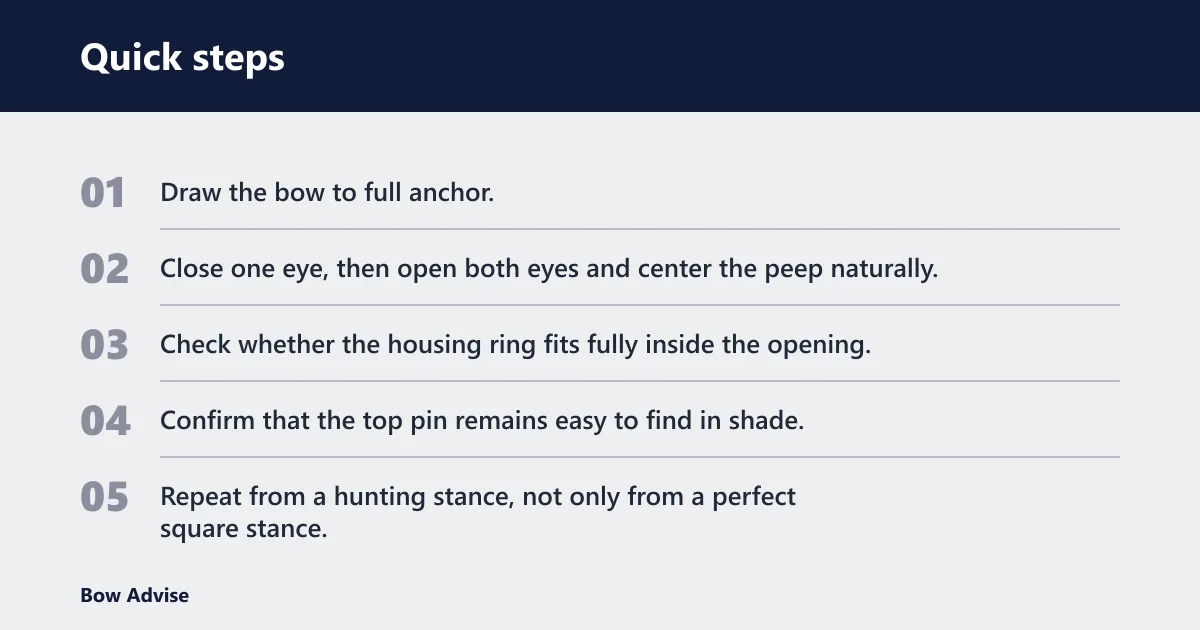
- Draw the bow to full anchor.
- Close one eye, then open both eyes and center the peep naturally.
- Check whether the housing ring fits fully inside the opening.
- Confirm that the top pin remains easy to find in shade.
- Repeat from a hunting stance, not only from a perfect square stance.
| Pin housing size | Draw length band | Hunting light level | Recommended peep range | Expected sight-picture tradeoff |
|---|---|---|---|---|
| Small housing, single-pin | 27 to 29 inches | Open shade to dusk | 3/32 to 1/8 inch | Fast pickup with decent edge control |
| Medium housing, 3-pin | 28 to 30 inches | Overcast to timber shade | 1/8 inch | Better brightness, slightly softer ring |
| Large housing, 5-pin | 28 to 31 inches | Dawn, dusk, or dark timber | 1/8 inch, sometimes larger if needed | More visibility, less crisp outer edge |
| Large housing, multi-pin | 26 to 28 inches | Heavy shade or poor contrast | 1/8 inch minimum | Prevents pin loss in shadow |
| Small housing, single-pin with glasses | Any typical hunting draw | Dusk or broken light | 3/32 to 1/8 inch | Keeps the housing visible through lenses |
How do you aim with a peep sight at dusk?
At dusk, aim by centering the peep first, then confirm that the housing ring and pin are still cleanly separated from the background. If the pin disappears in shadow, stop treating the peep as the problem alone. The issue may be a small aperture, a dark housing, or a head position that shifts the view off-center.
Centering the aperture at full draw
The eye should find a full, centered circle without hunting for the edges. That comes from a repeatable anchor point and head position. If the peep looks oval or off to one side, the problem may be twist timing or inconsistent head placement, not only aperture size.
Reading pin visibility in shadow
At low light, the pin should remain visible against the target and the sight ring. If the pin is visible but the housing disappears, the peep may still be usable but the setup is working close to its limit. If both housing and pin vanish, move to a larger opening or improve the sight’s contrast.
Avoiding haloing and tunnel vision
Haloing happens when the peep opening seems bright but the housing looks washed out or faint around the edge. Tunnel vision happens when the opening feels too narrow and the field outside the housing closes in. Both are warning signs that the peep size is wrong for the light and sight combination.
Peep sight with lens or standard peep?
A peep sight with lens can make the sight picture look clearer, but it also adds brightness tradeoffs and may increase tunnel effect for some hunters. A standard peep is simpler, lighter, and usually easier to keep legal and consistent in the field. The right choice depends on whether the setup needs clarity or more light.
Clarity and brightness tradeoff
A lens can sharpen the apparent sight ring for some users, especially when the sight housing is already easy to see. But that extra clarity may come with less brightness or a narrower usable field. If the hunt happens in dim timber, the lens can become a liability if it blocks too much light.
Tunnel effect and field limits
A lens can make the view feel more enclosed, especially when paired with a small peep. That can slow target pickup in poor light. Hunters who already run a large housing or multiple pins often gain more from a plain peep with the correct diameter than from adding optical complexity.
When a lens makes sense
A peep with lens makes more sense when the sight picture is bright enough already and the shooter wants a cleaner edge on the housing. It makes less sense in timber shade, deep dawn, or whenever the pin is already hard to separate from the background. Always confirm legal use before field setup, because peep light shade and lens arrangements may be restricted in some seasons or locations.
Peep sight size decision table
The best choice comes from three checks: can the housing be seen, can the pin be found fast, and does the anchor land the same way every draw. Use the table below as a setup guide, not a universal rule. If the sight picture fails at full draw, change the size before season.
| Setup clue | Recommended aperture range | What you should see |
|---|---|---|
| Small housing, single-pin, bright cover | 3/32 to 1/8 inch | Fast centering with a clean housing ring |
| Medium housing, three pins, mixed light | 1/8 inch | All pins readable without losing the ring |
| Large housing, five pins, timber shade | 1/8 inch minimum | Housing stays visible at dawn or dusk |
| Glasses or reduced contrast vision | 1/8 inch | Less strain finding the peep edge |
| Very consistent anchor, clear open-country light | 3/32 inch | Sharper aiming reference without losing speed |
How do you keep the peep aligned?
Keep the peep aligned by checking rotation, serving wear, and draw-cycle timing before hunting season. If the peep twists during the draw or settles off-center at anchor, aperture size will not fix the problem. A clean, repeatable full-draw view depends on the string and anchor working together.
String peep rotation and twist signs
If the peep turns sideways, shifts between shots, or lands at a different angle after each draw, the serving or twist timing needs attention. Common signs include a view that looks square one shot and oval the next. That inconsistency is easy to confuse with the wrong peep size.
Serving wear and timing issues
Serving wear near the peep can let the insert move enough to change the sight picture. Timing issues show up when the peep does not settle at full draw or arrives late in the cycle. Before changing aperture size, confirm that the peep stays in the same place through several full draws.
Anchor repeatability at full draw
The peep only works if the head returns to the same place each shot. A repeatable anchor point, nose touch, and string contact help the eye find the opening fast. If the opening looks different from shot to shot, the anchor is often the first thing to correct.
Picture a hunter who uses a 1/8-inch peep with a three-pin sight and notices the housing ring drifting high on every third draw. If the bowstring serving is wearing, the peep can rotate just enough to make the view feel inconsistent even though the aperture size itself is fine. Fix the twist before shrinking the opening.
Frequently asked questions
What size peep sight is best for hunting in low light?
For many low-light hunting setups, about 1/8 inch is a common starting point, especially with a medium or large sight housing. A 3/32-inch peep can work if the housing stays fully visible. Smaller than that usually starts to cost too much light unless the setup is unusually bright and consistent.
How do I use a peep sight with a pin sight at dawn or dusk?
At dawn or dusk, draw to the same anchor, center the peep, and confirm that the sight housing is fully inside the opening before looking for the pin. If the pin disappears in the shadow, try a larger peep before changing pin color or sight brand. Consistency matters more than speed alone.
What is the right peep sight aperture size for my bow?
The right size depends on draw length, anchor repeatability, pin housing diameter, pin count, and the light where the bow is actually hunted. A short, consistent setup may work well at 3/32 inch, while a larger housing or weaker light usually points to 1/8 inch.
Does a bigger peep sight help in low light?
Usually yes, but only up to the point where the sight picture stays useful. A bigger peep lets in more light and makes the housing easier to find. If it becomes too large, the aiming ring can feel less precise, and the pin may look less controlled.
How do I aim with a peep sight when visibility is poor?
Center the peep first, then find the housing ring, then settle the pin. Do not chase the target through a half-centered opening. If the view is too dim to separate those layers, the setup is too small or the light is too poor for a confident shot.
How do I get a proper sight picture with peep sights?
A proper sight picture starts with a repeatable anchor point and a centered opening at full draw. The housing should sit evenly in the peep, and the pin should be visible without strain. If the peep looks off-center, oval, or shadowed, correct the alignment before judging accuracy.