How to Replace a Worn Peep Sight on a Compound Bow
Replace a worn peep sight when the string groove is frayed, the aperture is cracked, or the sight picture no longer centers at full draw. Match the new peep’s diameter to your anchor and scope housing. A bad swap can twist the buss cable, shift draw length feel, and leave you with a peep that won’t line up cleanly at hunting weight. This guide covers wear checks, choosing the right replacement, and confirming a safe, repeatable install.
What you’ll need
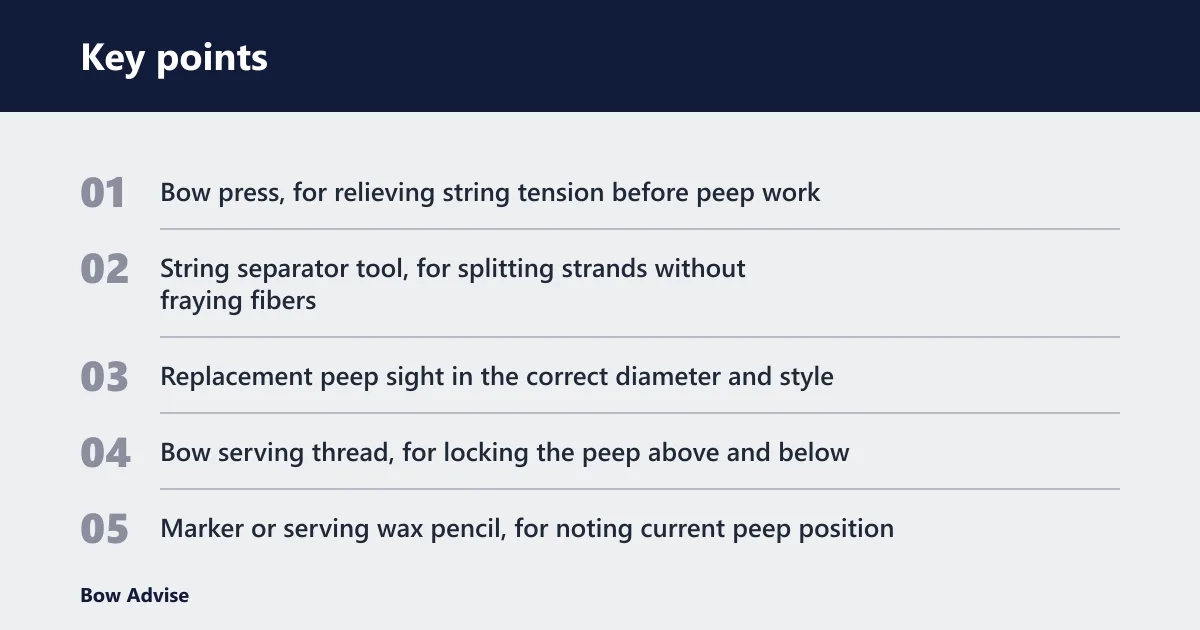


- Bow press, for relieving string tension before peep work
- String separator tool, for splitting strands without fraying fibers
- Replacement peep sight in the correct diameter and style
- Bow serving thread, for locking the peep above and below
- Marker or serving wax pencil, for noting current peep position
- Hex keys for any sight or rest checks needed after setup
- Bright light, for inspecting cracks, groove wear, and serving damage
- Draw board or a safe way to check full-draw alignment
How do you know the peep is worn out?
Replace the peep if the groove is chewed, the aperture is oval instead of round, or cracks are visible anywhere on the body. A worn peep can also show string chewing or loose serving around its seat, and many archers first notice it as a dim, off-center sight picture at full draw.
Inspect the old peep before you pull it
Look closely at the slot that cradles the string. If the groove is polished flat on one side, the peep may be rotating under load. If the opening is no longer round, light transmission and aiming consistency suffer. Cracks, chips, and a rough edge where fibers pass through are clear replacement cues.
Check the string, not only the part
If the peep has cut into the serving or left fuzzy, broken strands, the string may be the real problem. A peep that has moved up or down or sits at an angle can point to serving damage or string creep, not just a bad insert. In that case, replacing only the peep often gives the same problem again.
A 3/16 inch peep may have a clean body, but damaged serving below it can still let it drift. A fresh peep alone may fit, but the damaged serving can still let it drift. A serving repair or full string replacement may be the more durable fix.
Peep replacement checklist
This table gives a simple replacement decision path. Start with the symptom, then match the fix to the failure state instead of swapping parts blindly.
| Wear symptom | Recommended action | Tool needed | Verification step |
|---|---|---|---|
| Cracked peep body | Replace the peep with the same style first | Bow press | Full-draw sight picture centers cleanly |
| Oval aperture | Try a same-size swap; consider a larger aperture if visibility is poor | String separator tool | Opening looks round at anchor |
| String chewing or frayed fibers | Inspect serving; replace the string if damage is deep | Serving thread | String surface is smooth around the peep |
| Peep keeps rotating | Check string twist, then retime and serve the peep | Bow press | Peep faces the eye at full draw |
| Poor low-light sight picture | Move to 3/16 inch or 1/4 inch for hunting conditions | Replacement peep | Target is visible without forcing head position |
| Visible serving damage above or below the peep | Re-serve the area or replace the string | Serving thread | Peep sits firmly without vertical creep |
Seven-point post-install check
- Check the aperture is centered at full draw.
- Confirm equal strand split on both sides of the peep.
- Verify the D-loop sits centered in the opening.
- Draw to your normal anchor point and confirm repeatability.
- Inspect serving lock above and below the peep.
- Check eye relief so the peep is not too far in or out.
- Look through the sight in low light and confirm the picture stays clear.
How do you replace the peep sight?
Use a bow press, split the string strands, remove the old peep, set the new one at the same height, and serve it in place. That sequence protects the string, preserves anchor geometry, and gives you a clean baseline before any tuning changes. A shortcut without tension relief is where most mistakes start.
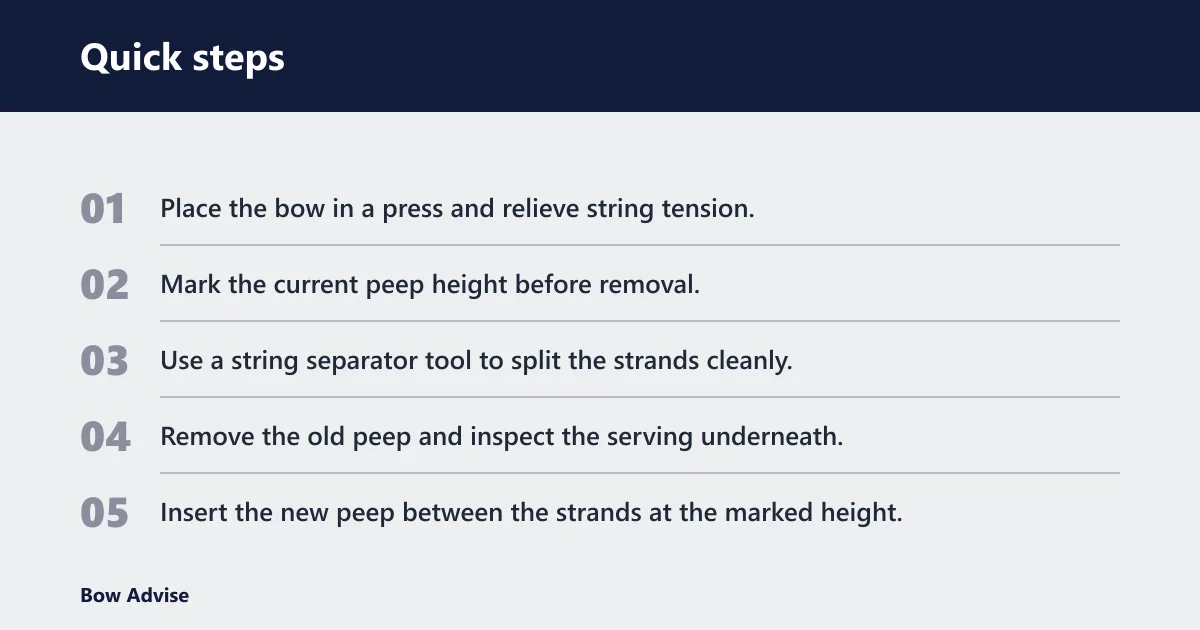
- Place the bow in a press and relieve string tension.
- Mark the current peep height before removal.
- Use a string separator tool to split the strands cleanly.
- Remove the old peep and inspect the serving underneath.
- Insert the new peep between the strands at the marked height.
- Set the opening so it faces your full-draw anchor point.
- Serve above and below the peep to lock it in place.
- Bring the bow back to full draw and verify alignment.
Why a bow press is the safest standard method
A bow press removes string tension so the peep can be installed without forcing strands apart by hand. Many installation guides recommend a bow press or, at minimum, a string separator tool. On compound bows, a press is the safer standard because it reduces strain on the string, cables, and serving during removal and insertion.
What the string separator tool does
The separator tool opens the string just enough to slide the peep into place while helping keep the split even. That matters because an uneven split can leave the peep canted at full draw. Used carefully, it helps avoid fraying and keeps the strand layout cleaner than prying fibers apart without a tool.
How do you stop a peep from twisting?
Stop twisting by matching the new peep to the bow’s existing string twist, then confirming the D-loop and anchor point at full draw before serving the peep in place. If the peep still rotates after that, the cause is often string creep or a serving lock issue rather than the peep itself.
Check the twist before you blame the peep
A tubeless peep depends on string tension and serving to help stay aligned. If the string has settled or crept since the last setup, the peep may rotate even when the insert is correct. A tube peep forces alignment with rubber tubing, but ArcheryBuddy warns that tube peeps can add noise and another failure point.
Use the D-loop and anchor as your reference
The D-loop must line up with the peep opening, and the full draw anchor point must stay consistent. If the anchor changes, the eye can move off center even when the peep itself is fine. That is why height should be set around the shooter’s repeatable anchor, not by guesswork alone.
Suppose a bow is set with a 3/16 inch peep and the opening is perfect at 28 inches of draw, but the archer shortens anchor contact slightly after the swap. The peep may look high or low even though the install is correct. In that case, the fix is setup consistency, not another peep change.
How do you replace a worn peep sight on a compound bow?
Replace the worn part by diagnosing the failure first, then installing the right style and size for the bow’s anchor and sight housing. If the old peep shows cracks or string chewing, a same-size swap is often enough. If visibility is poor, a 3/16 inch or 1/4 inch peep may fit hunting better.
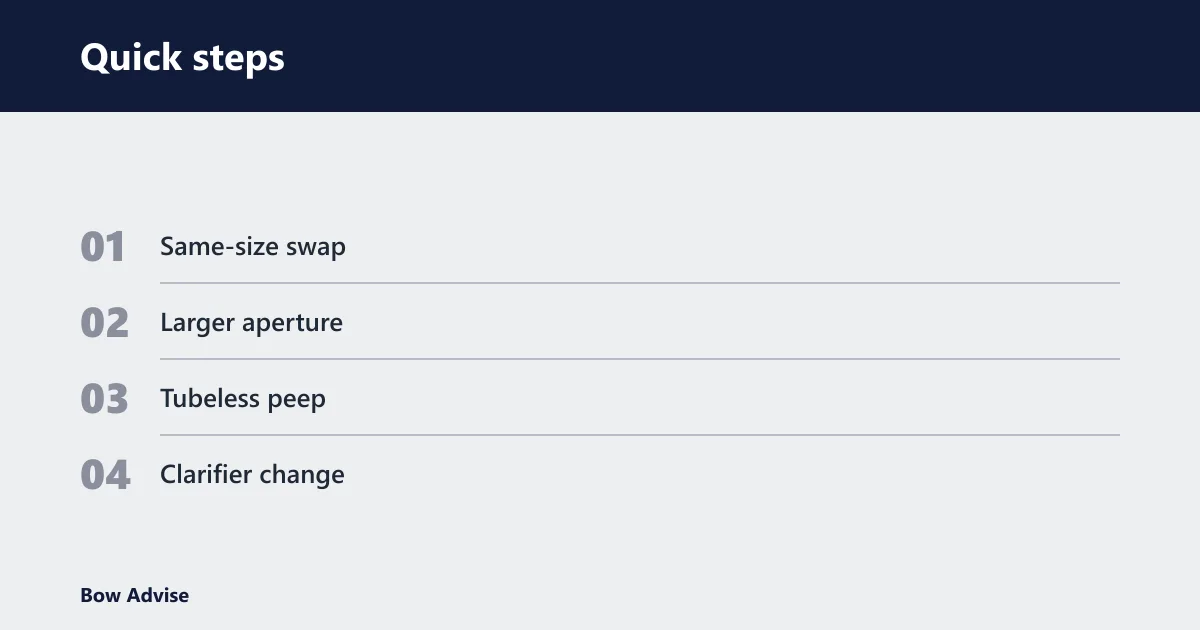
Choose the replacement that matches the failure state
- Same-size swap: best when the old peep failed from age or cracking but the sight picture was otherwise correct.
- Larger aperture: useful when low-light hunting visibility is the issue.
- Tubeless peep: works when you want fewer moving parts and a cleaner string setup.
- Clarifier change: useful with magnified scopes and long-distance aiming.
Pick peep size for the job
Common peep sight sizes include 1/8 inch, 3/16 inch, and 1/4 inch. It says 1/8 inch suits target archery and long-range precision, 3/16 inch is the most popular all-around size, and 1/4 inch is best for hunting and low-light shooting. Archery Support also recommends larger peeps like 3/16 inch or 1/4 inch for hunting.
A common first-timer mistake is moving from a damaged 1/8 inch peep straight to another 1/8 inch unit when the real complaint is dim dawn visibility. A 3/16 inch or 1/4 inch option usually makes more sense for hunting, especially when the sight housing or pin stack already blocks part of the view.
Should you serve the peep after installing it?
Yes. Serving above and below the peep helps prevent vertical migration and keeps the peep locked to the string. The serving should not crush the fibers, but it should hold the part firmly enough that the opening stays aligned after repeated draws. That lock is part of the install, not an optional extra.
Common mistakes
- Choosing the wrong aperture size for the application. A hunting bow often benefits from 3/16 inch or 1/4 inch, not the smallest opening available.
- Ignoring the old peep’s condition. Groove wear, cracks, and string damage can point to a bigger issue than the insert itself.
- Blaming the peep for rotation when the string twist or serving is the real cause.
- Setting height without checking the D-loop and full draw anchor point together.
- Using a tube peep as a quick fix without considering noise and the extra failure point.
- Skipping the post-install check and assuming the first shot proves the setup is right.
If the peep keeps drifting after serving, replace the string or re-evaluate the serving rather than adding more wraps forever. A peep that will not hold position usually has a setup problem somewhere else in the system.
Professional installation at a bow shop typically costs $15 to $30 for labor, and complete installation can total $23 to $55 including the peep sight. That option makes sense when the string shows wear, the bow needs retiming, or the archer cannot verify alignment at full draw with confidence.
Frequently asked questions
Do I need a bow press to replace a peep sight?
A bow press is the safest standard method on a compound bow. It relieves tension so the string can be split and the peep inserted cleanly. Most installation guides recommend a press or, at minimum, a string separator tool, but the press gives the most controlled result.
How do I stop a peep sight from twisting after replacement?
Start by matching the peep to the bow’s existing string twist and confirm alignment at your normal anchor point. Then serve the peep securely above and below. If it still turns, check for string creep, uneven strand split, or a loose serving lock before changing parts again.
What size peep sight should I use for hunting?
A 1/4 inch peep is a common hunting choice for low-light visibility, and 3/16 inch is often the all-around compromise. Smaller apertures can be better for target precision, but hunting usually rewards a brighter sight picture when dawn or dusk shots are part of the plan.
Can I replace a peep sight without changing my draw length setup?
Yes, if the new peep matches the old height and your anchor stays consistent. Draw length does not change just because the peep changes, but eye position can feel different if the aperture size or D-loop alignment shifts. Verify at full draw before assuming the setup is unchanged.
Should I serve a peep sight after installing it?
Yes. Serving the peep above and below helps keep it from migrating and keeps the opening stable through repeated draws. If the serving is too loose, the peep can drift; if it is too tight or sloppy, it can damage the string or leave the alignment inconsistent.