Peep sight materials explained: aluminum vs resin vs rubber
For most hunters, I pick aluminum. For quiet budget rigs, I pick resin. For the lowest upfront cost and simple string travel, I pick rubber. I switch when a peep slips, splits, twists, or starts to wander under use. Get it wrong and you fight light leaks, draw-cycle twist, and repeatable misses. I’ll compare aluminum, resin, and rubber by failure mode, low-light behavior, install effort, and upkeep.
| Factor | Peep sight materials explained: aluminum | resin vs rubber | Winner |
|---|---|---|---|
| Cost | Usually highest price. | Resin is lower than metal; rubber has the lowest entry cost. | resin vs rubber |
| Lifespan / durability | Lasts longest for most compound bows; strong, resists weather, and tolerates repeated draw cycles, though it can dent or show finish wear. | Resin has good impact and wear resistance but can crack or fade over time; rubber can stretch, crack, or dry rot. | Peep sight materials explained: aluminum |
| Maintenance / upkeep | Low if the finish and groove stay intact, but poor machining or sharp edges need inspection. | Resin is moderate upkeep; rubber is high upkeep because tube systems can stretch, twist, and dry rot and older budget setups need more checking. | Peep sight materials explained: aluminum |
| Install difficulty | Often needs careful setup and sometimes a bow press. | Resin is usually straightforward; rubber is simple to get on, but alignment and tube routing matter. | resin vs rubber |
| Low-light performance | Strong with the right aperture and anti-glare finish; matte or anti-glare surfaces reduce glare. | Resin is good but depends on shape and surface finish; rubber is usable, yet tube setups can look less crisp at full draw. | Peep sight materials explained: aluminum |
| String wear / bowstring friendliness | Can be very string-friendly if edges are smooth or coated; rounded edges and smooth surfaces matter most. | Resin is generally gentle if molded cleanly; rubber can be kind to the string, but tubing adds wear points and upkeep. | Tie |
| Best-fit use | Hunters, target archers, and clarifier-compatible setups. | Resin fits beginners, quiet budget rigs, and backup bows; rubber fits older bows and low-cost string-alignment setups. | Tie |
What a peep sight does on a compound bow
A peep sight gives my eye a repeatable rear reference on the string. That lets me center the front sight the same way at full draw, which matters more than people admit when the target is small or the light is flat. Material choice changes how the peep handles glare, wear, and alignment.
The body material also changes what fails first. Aluminum usually fails by finish wear, denting, or rough edges if the machining is poor. Resin usually fails by cracking or color change. Rubber and tubing fail by stretch, cracking, or dry rot, and that is why older budget setups need more checking.
The three material families and how they differ in use
Aluminum peep sight housings are typically CNC-machined or precision-machined, and that is why they show up so often on hunting bows. Resin peeps are synthetic polymer parts, so they cut cost and weight without feeling as flimsy as old-school soft plastic. Rubber peep systems usually mean a tube-based alignment setup, not a rigid housing.
I use that difference to think about the job. A hunter wants a peep that stays centered, handles weather, and keeps a clean sight picture in broken light. A beginner may care more about simple installation and lower cost. A target shooter may care more about a clarifier-compatible peep system and a consistent circle at full draw.
One quick comparison table before the deep dive
Here is the short version I use on my bench. Aluminum wins on long-term field confidence. Resin is the middle ground. Rubber is cheap and simple, but it brings the most upkeep.
According to Low Light Accuracy: Are Larger Peep Sights Better? Pros & Cons… — The guide says common peep sizes range from "1/8" to "1/4".
Which peep sight material lasts longest?
Aluminum lasts longest for most compound bows because the housing holds shape, resists weather, and tolerates repeated draw cycles better than resin or rubber. That does not mean it is immune to wear. It means the usual failure points are slower to show up if the part is machined well and the edges are smooth.
Aluminum housing: wear patterns, dent risk, and finish wear
A good aluminum peep usually fails gradually. I see finish wear first, then tiny burrs or edge roughness if the bow gets knocked around. TRUGLO’s Centra Pro-Series is made from precision CNC-machined aluminum, and that kind of construction is what I like for repeatable alignment and a cleaner fit.
If the housing has a matte black finish, glare stays lower in direct sun. That matters in the field because a shiny peep can throw a bright spot into the sight picture and distract your aim.
Resin peeps: impact resistance, crack risk, and color stability
Resin is a useful middle choice because it is lighter than aluminum and often cheaper, yet still more structured than rubber tubing. The weak point is aging. I watch for micro-cracks, edge chipping, or a shift in color that makes the peep harder to read at full draw.
Resin works well on bows that are not abused. If the bow lives in a case and sees normal practice, resin can hold up well enough for a long time. If the bow gets banged in a truck bed or dragged through brush, I trust aluminum more.
Rubber and tubing: stretching, cracking, and dry rot
Rubber peep systems age differently. The tube can stretch, twist, or soften before it wears out. Then the material can crack or dry rot, especially when it lives in heat and sunlight. That is why I do not treat rubber as a set-it-and-forget-it option.
SOPOGER’s tube kit uses a rubber/plastic construction and comes with 2 Pcs and two tubes, which tells you the repair mindset behind this style. It is easy to keep one in the kit bag. It is not the choice I want if I only want to think about my peep once a season.
Which peep sight material is best in low light?
For low light, aluminum usually gives me the best result when it has the right aperture size and anti-glare finish. Resin can work well, but the sight picture depends more on the molding and surface color. Rubber is usable, yet tube alignment can feel less crisp when the sun is nearly gone.
Aperture size: 1/8 inch vs 3/16 inch
A larger aperture lets more light through. A smaller aperture feels tighter and often looks more precise in bright conditions. Common peep sizes range from 1/8″ to 1/4″, and the practical tradeoff is simple: more light versus a narrower aiming window.
I lean smaller for bright target work and larger for dawn and dusk hunts. A 1/8 inch opening can feel sharp, but it may dim the sight picture too much at first light. A 3/16 inch opening is often the easier hunting compromise when the woods are dark.
Anti-glare coating and matte finishes on aluminum
Anti-glare treatment matters more than people think. HAMSKEA uses aerospace anti-glare technology to reduce glare, and the HAMSKEA peep also uses a proprietary TEFLON coating for smoother string contact. That combination handles two common complaints at once: reflection and string drag.
TRUGLO’s Centra Pro-Series uses a matte black finish to reduce glare. I like that idea because glare usually shows up at the worst time, when the sun is low and the sight picture is already dim. A matte surface gives me fewer bright hot spots.
Why rubber and resin can look different at dawn and dusk
Rubber usually stays non-reflective, but the tube can wander the peep position if the system is aging or poorly set. Resin may be easy on the eye, yet some colors can soften in dim light and feel less distinct than a clean black aluminum housing. The result is a sight picture that is functional, but not as crisp.
G5’s Meta Pro uses a convex interior to keep a circle true at full draw. That matters because when the peep image stays round, my eye has less work to do in low light. A distorted ring wastes attention when I want it on the pin and the target.
Do aluminum peep sights wear the bowstring less?
They can, if the housing is smooth and coated properly. Aluminum does not automatically mean more string wear. What hurts the string is rough machining, sharp edges, or a peep that twists and rubs under load. A clean aluminum peep can be kinder than a sloppy rubber setup with moving parts.
Smooth surfaces, coated edges, and string wear protection
Bowstring wear protection comes from reducing friction at the contact point. Rounded edges and smooth surfaces matter more than the metal itself. A good aluminum peep with a Teflon or similar smooth-surface treatment can slide cleaner than a rough molded part with tiny burrs.
That is why I inspect every peep under light before I trust it. If I feel a sharp edge with a fingernail, I assume the string will notice it too. On my own bows, I would rather correct that early than replace a string set later.
How rough grooves or sharp machining marks cause trouble
String groove angle and finish both matter. If the groove is cut poorly, the string can bite in one spot and wear unevenly. That can change alignment and eventually change how the peep rotates at full draw.
HAMSKEA uses dual string groove angles for short and long axle bows, which is a good reminder that geometry is not optional. The wrong groove shape or angle can turn a decent peep into a nuisance.
When resin or rubber may be kinder to the string
Resin can be gentle if the molded surfaces are clean and smooth. Rubber can also feel soft against the string, but tubing introduces its own wear and replacement issues. I would call rubber string-friendly only when the whole system is fresh and checked often.
If my goal is fewer hard contact points and less friction over time, I still prefer a well-finished aluminum peep over a tired rubber tube setup. Soft does not always mean kinder.
How do install difficulty and replacement frequency compare?
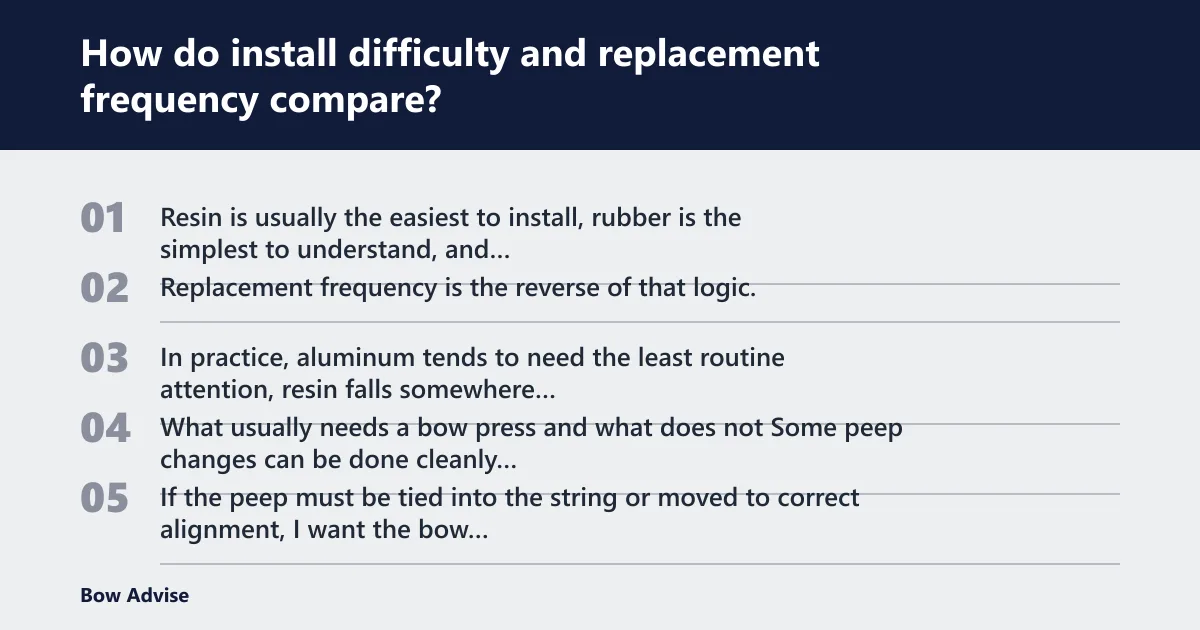
Resin is usually the easiest to install, rubber is the simplest to understand, and aluminum often asks for the most careful setup. Replacement frequency is the reverse of that logic. In practice, aluminum tends to need the least routine attention, resin falls somewhere in the middle, and rubber usually needs the most.
What usually needs a bow press and what does not
Some peep changes can be done cleanly with a bow press, and some cannot. If the peep must be tied into the string or moved to correct alignment, I want the bow safely supported. Many aluminum peeps are less fussy once installed, but getting the location right often still calls for a press.
Rubber tube systems look simple, yet the routing and tension of the tube can become messy fast. That is why I think beginners should not assume rubber means easier in every way. It may be simpler to see, but not always simpler to maintain.
Replacement intervals for hunting and target use
For hunting, I want the peep to survive the season without drama. Aluminum is the best bet for that. Resin can be fine on a backup bow or a low-mileage rig. Rubber often needs attention sooner, especially if the bow sits in heat or gets drawn a lot for practice.
Target archers are different. They may accept a little more setup time if the peep works with a clarifier-compatible peep system and gives a cleaner sight picture through a magnified lens. That is where aluminum usually pulls ahead again.
Budget cost versus long-term upkeep
Rubber looks cheapest at purchase, but frequent replacement and setup time add cost back in. Resin usually lands in the middle on both purchase price and maintenance. Aluminum costs more up front, though the longer service life often makes it cheaper over time on a bow that gets shot hard.
A peep is the same way. Cheap hardware can create expensive follow-up problems.
How do peep angle and bow geometry affect fit?
String groove angle matters because it controls how the peep lines up when the bow is at full draw. Short axle and long axle bows do not behave the same, so a peep that fits one may fight the other. The wrong angle can leave the aperture tilted or half-turned when you anchor.
Short axle and long axle bows
HAMSKEA’s dual string groove angles for short and long axle bows are a practical answer to that problem. A short axle hunting bow often needs different geometry than a longer target bow. If the peep does not match the bow’s path, alignment gets less consistent.
That inconsistency shows up fast. You see it as a circle that is slightly off, a pin that never sits quite right, or a peep that wants to twist after the shot.
37 degree and 45 degree options
Tube-style kits often come with angle options for different setups. The SOPOGER tube kit offers 37/45 degree apertures, which gives the installer more room to match the string path. Those angles are not a magic fix, but they do help when the bow geometry is picky.
Pick the angle that keeps the peep square at full draw, not the one that sounds best on paper. If the angle is wrong, no material choice can completely save the sight picture.
Peep sight material decision table
I use this table as my field decision framework. It is not about brand loyalty. It is about which material fails in a way I can live with.
| Criterion | Aluminum | Resin | Rubber | Winner |
|---|---|---|---|---|
| Durability | High | Medium | Low | Aluminum |
| Glare | Best with matte or anti-glare finish | Usually decent | Usually low shine, but less crisp | Aluminum |
| String wear | Low when smooth or coated | Low to medium | Medium | Aluminum |
| Weight | Light | Lightest feel | Light, but with tube hardware | Resin |
| Price | Higher | Lower | Lowest | Rubber |
| Install difficulty | Medium | Easy | Easy at first, but more setup checks later | Resin |
| Low-light use | Strong | Good | Fair | Aluminum |
| Replacement frequency | Low | Medium | High | Aluminum |
Hunter: aluminum wins. Target shooter: aluminum again, especially with a clarifier-compatible peep system. Beginner or strict budget: resin first, rubber only if you accept the extra upkeep and are okay replacing parts more often.
Choose aluminum if… / choose resin if… / choose rubber if…
Choose aluminum if you hunt often, shoot in dawn or dusk, want a matte or anti-glare finish, or care about long service life on a compound bow. I also choose aluminum when I want cleaner compatibility with magnified target setups and a peep that stays predictable after repeated draw cycles.
Choose resin if you want lower cost than metal, light weight, and a simpler install on a bow that sees moderate use. I like resin for beginners, backup bows, and archers who want a quiet, no-drama option without stepping into tubing maintenance.
Choose rubber if you need the lowest upfront cost, already run an older tube-based setup, or want a simple alignment system for a budget bow. I would not choose rubber for hard hunting use unless I was willing to inspect tubes often and replace them when they start to stretch or dry rot.
Frequently asked questions
Is aluminum or resin better for a peep sight?
For most serious hunting or target use, I pick aluminum because it holds shape better, resists weather better, and usually stays consistent longer. Resin makes sense when cost and light weight matter more than top-end longevity. If the bow sees hard use, aluminum usually becomes the safer long-term pick.
Are rubber peep sights durable enough for hunting?
They can work for hunting, but I would call them a compromise, not my first choice. Rubber and tube systems can stretch, crack, or dry rot, so I check them often. If the bow is a backup or a low-cost rig, they can be acceptable. On a primary hunting bow, I prefer something more stable.
Will a rubber peep sight stretch or rot over time?
Yes, that is one of the main reasons I treat rubber as a maintenance item. The tube can stretch, crack, or dry rot, especially with age, heat, and sunlight. It may work fine for a while, but it asks for more inspection than aluminum or resin.
What peep sight material is easiest to install?
Resin is usually the easiest for a straightforward install. Rubber tube systems can look simple, but the tube routing and alignment can become fussy. Aluminum often takes the most careful setup because the housing and groove angle need to match the bow geometry well.