Hunting Crossbow vs Target Crossbow: Which Should You Choose?
Choose a hunting crossbow if you need compact field handling, faster aim in cover, and a setup built for live-game use. Choose a target crossbow if you want steadier hold, easier follow-through, and repeatable accuracy on the range. Pick the wrong one and you usually end up with more fatigue, slower setup, or missed shots. This guide compares speed, weight, cocking effort, noise, balance, and hunting suitability so you can match the bow to the job.
| Decision factor | Hunting crossbow | Target crossbow | Winner |
|---|---|---|---|
| Noise and vibration | Usually tuned for field use, where quieter shots and less vibration matter more than raw speed. | Often tuned around repeatable shot cycles and bench consistency, even if that does not make it the quietest option. | Hunting crossbow |
| Weight and maneuverability | Better suited to stalking, stands, and awkward shooting angles when carry comfort matters. | Can be heavier or more specialized, which is fine on a bench but less friendly in the field. | Hunting crossbow |
| FPS and trajectory | Often chosen for flatter trajectory and quicker downrange arrival; published examples in the brief include 315 fps, 370 fps, and 405 fps. | May prioritize repeatable grouping over chasing the highest speed number. | Hunting crossbow |
| Cocking effort | Commonly paired with a rope cocking device or integrated cocking system so the shooter can manage higher draw weights. | May still need the same help; lower effort is not guaranteed by the label alone. | Tie |
| Scope type | Commonly sold with simple hunting optics such as red-dot or 3x32mm illuminated scopes. | May favor a sight picture that supports tiny groups from a steady rest. | Target crossbow |
| Best-fit shooter profile | Hunters who need a legal, game-ready setup that can be carried, aimed, and cocked in the field. | Range shooters who care most about repeatable groups, comfort, and predictable practice sessions. | Depends on use |
What does each crossbow prioritize?
Choose the hunting crossbow when the shot happens off the bench, in real weather, with movement and time pressure. Choose the target crossbow when the goal is repeatable groups, less fatigue, and easier practice. The labels overlap in ads, but the buying choice should start with use case, not logo or fps alone.
Hunting crossbow priorities
A hunting crossbow is built around field handling, game performance, and practical carry. That usually means enough speed and kinetic energy for the animal you plan to hunt, a scope that is quick to use, and enough noise control to avoid spooking game at close range.
It also needs to fit local hunting rules and the game species. A bow that feels right on a range can still be the wrong buy if it is too heavy for a stand, too loud for close cover, or outside minimum hunting requirements.
Target crossbow priorities
A target crossbow, or target-oriented setup, is about repeatable grouping, steadier hold, and comfort through long sessions. That can mean more bench-friendly balance, a calmer shot cycle, and a sight setup that makes small aiming errors easier to spot and correct.
It is not automatically easier to cock, and it is not automatically suitable for hunting. A target-first setup can be awkward to carry, slower to mount in the field, and less aligned with game-legal performance needs.
Why the labels overlap less than the marketing suggests
Many crossbows can do both jobs in a basic sense. The difference is priority. A faster hunting rig may be less forgiving in practice, while a comfort-first target rig may give up field portability or field-ready noise control.
Say your only use is whitetail hunting from a blind at 25 to 40 yards. A field-ready bow with a rope cocking device and a simple illuminated scope makes more sense than a heavier, bench-oriented setup that feels great indoors but becomes awkward to carry outside.
How do FPS, noise, and weight change the choice?
FPS helps, but it is only one buying metric. Speed can flatten trajectory, yet higher FPS can also bring more noise, more vibration, and more sensitivity to setup errors. Weight changes how easy the bow is to carry, how steady it feels, and how tired you get before the shot arrives.
FPS: when speed helps and when it creates trade-offs
Published crossbow examples in the brief appear to range from about 315 fps to 405 fps, and another source says crossbows are often reported in the 350 to 400+ FPS range. That tells you speed is common, not a stand-alone reason to buy. A faster bow can help if you want a flatter trajectory or more downrange energy, but it can also make the setup louder and less forgiving.
For beginners, a very fast bow can hide bad form less effectively when the rest of the setup is not dialed in. That matters because the same source says a beginner’s maximum range is 60 yards, while skilled shooters may reach 80 yards. Those distances are not a license to shoot that far at game; they are a reminder that skill, practice, and consistency matter more than the fps number on the box.
Noise and vibration: why the quietest setup is model-specific
Noise matters most for hunting, but the quietest bow is not simply the one labeled “hunting.” String mass, bolt weight, limb design, and dampening all affect the shot. A louder bow can also make a new shooter flinch more, which hurts accuracy on the range.
A common first-timer mistake is chasing the highest fps listed in a catalog and ignoring the sound profile. That can produce a fast bow that is unpleasant to shoot and less forgiving in a blind, where vibration and noise may spook game after the shot.
Crossbow weight: stalking use versus bench use
Crossbow weight affects mobility, steadiness, and fatigue. A 7.7-pound example like the Barnett Jackal is easier to live with on a stand than a heavier setup, while bench shooters may accept more mass if it settles the crossbow for practice.
Say your hunt involves still-hunting through timber with a pack and extra bolts. A lighter bow reduces carry strain and makes it easier to shoulder the crossbow quickly. In a target lane, that same lightness may feel less planted than a heavier, more specialized rig.
How important are draw weight, cocking aids, and scope choice?
Draw weight and cocking effort matter because they affect whether the shooter can load the crossbow consistently. Scope choice matters because the aiming system should match the job: fast, simple aiming for hunting and more precise repeatability for practice. Beginners should favor control and repeatability over raw spec chasing.
Draw weight and who can cock the bow consistently
The brief gives two useful examples: the Barnett Recruit Tactical is listed at 140 lbs draw weight, while the Excalibur Matrix Mega 405 is listed at 290 pounds. That spread shows how much effort can vary. A higher draw weight may support speed or energy, but it also increases the need for a reliable cocking method.
For beginners, smaller shooters, and injured users, the real question is not whether a bow is “powerful enough.” It is whether the shooter can cock it safely and repeatably without strain.
Cocking aids: rope cockers versus integrated systems
A rope cocking device reduces effective cocking strain and helps center the string, which is useful for many beginners. Integrated cocking systems do the same job with less manual effort, which can be a good fit for larger draw weights or repeated range sessions.
If a crossbow becomes easy to cock only after a long struggle or awkward body position, it is the wrong choice for that shooter. The best setup is the one that can be cocked the same way every time.
Scope choice: red-dot, illuminated, and low-power magnified options
Crossbows are often sold with scopes, and common examples include red-dot and 3x32mm illuminated scopes. A red-dot can keep aiming simple, while a low-magnification illuminated scope adds a clearer aiming reference for hunting light conditions.
Target-oriented setups may favor a sight picture that makes small aiming errors easier to see and correct. For hunting, the scope should be quick to acquire, reliable in changing light, and matched to the distances the bow is actually legal and practical for.
What hunting specs should you verify before buying?
Check the specs that affect real hunting use, not just the ones on a display tag. Kinetic energy, legal minimums, safety features, and usable range matter more than a single headline number. A hunting bow should fit the game, the rules, and the shooter’s ability to handle it safely.
Kinetic energy for game size and ethical range
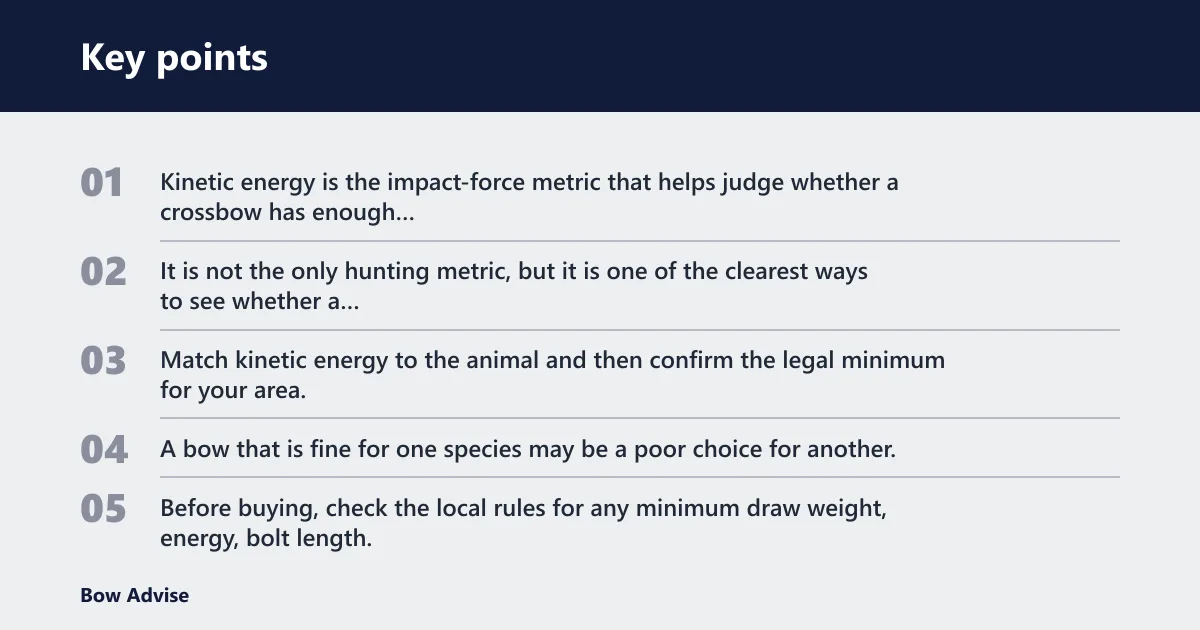
Kinetic energy is the impact-force metric that helps judge whether a crossbow has enough downrange punch for the game you plan to hunt. It is not the only hunting metric, but it is one of the clearest ways to see whether a fast bow is also a suitable hunting bow.
Match kinetic energy to the animal and then confirm the legal minimum for your area. A bow that is fine for one species may be a poor choice for another, especially if the local rulebook sets a minimum draw weight or KE requirement.
Local hunting rules and minimum requirements
Local rules come first. Before buying, check the local rules for any minimum draw weight, energy, bolt length, broadhead type, and season-specific restrictions that may apply. A crossbow can look ideal on paper and still be unusable if it misses a local standard.
A practical hunting range also matters. One source in the brief puts beginner maximum range at 60 yards, with skilled shooters reaching 80 yards, and another says practical hunting range is usually around 50 yards. Those figures reinforce the same point: choose a bow you can place confidently at the distances you will actually shoot.
Safety features and why they matter in the field
Safety features matter because crossbows are commonly loaded, cocked, and handled in awkward positions. Anti-dry-fire systems, clear safeties, and secure retention can reduce avoidable mistakes. That is especially important in blinds, treestands, and low-light conditions.
A beginner should look for the easiest-to-handle model that still meets the hunt’s legal and performance needs. A difficult bow does not become a better hunting tool just because it has more speed on the spec sheet.
Choose Hunting crossbow if… / Choose target crossbow if…
Choose a Hunting crossbow if your priority is game use, field carry, and a legal hunting setup. Choose a target crossbow if your priority is range work, repeatability, and comfort. A crossover model makes sense only when one bow must do both jobs without forcing a bad compromise.
- Choose Hunting crossbow if you will hunt game at legal, realistic distances and need a bow you can carry, cock, and aim in the field.
- Choose Hunting crossbow if your local rules require specific draw weight or energy thresholds and you want a setup built around those limits.
- Choose target crossbow if you spend most of your time on a range or at a bench and care most about repeatable groups.
- Choose target crossbow if comfort, steadier hold, and consistent practice matter more than portability or hunting-specific features.
- Choose a crossover model if you want one bow for both use cases and are willing to accept a compromise on noise, weight, or carry comfort.
- Confirm the main use: hunting, target shooting, or both.
- Check local hunting rules for draw weight, kinetic energy, and any bolt or broadhead limits.
- Match cocking effort to the shooter’s strength and available cocking aid.
- Pick a scope that fits the job: simple aiming for hunting, more repeatable sighting for practice.
- Compare weight, noise, and range before deciding on fps alone.
Can one crossbow handle both hunting and target shooting?
Yes, one crossbow can do both jobs if the setup is balanced and the shooter accepts some compromise. A hunting model often works well on the range, especially if it has a manageable draw weight, a good scope, and enough stability for consistent groups. The reverse is less reliable in the field.
When a hunting model works well on the range
A hunting crossbow can be a good range bow when the shooter wants to practice with the same rig used in the field. That builds familiarity with the safety, trigger, scope, and cocking routine. It also keeps sight settings and bolt selection consistent.
If the bow is too loud, too heavy, or too hard to cock, practice can become tiring and rushed. In that case, the range sessions may improve less than expected because the shooter spends more effort managing the bow than refining aim.
When a target-oriented setup becomes a poor hunting choice
A target-oriented setup becomes a poor hunting choice when it is too heavy to carry comfortably, too specialized for bench work, or not aligned with legal hunting minimums. It can shoot tight groups and still be the wrong tool once the shot moves into a blind or stand.
Suppose a shooter wants one bow for indoor practice and deer hunting at 35 yards. A lighter hunting crossbow with a dependable scope and a cocking aid is the safer buy than a bench-focused setup that feels great on paper but is awkward in the woods.
The shortest path to a sensible crossover buy
Start with the use that matters more. If hunting is the priority, buy for hunting and accept a little extra convenience on the range. If practice is the priority, buy for repeatability and only hunt with it after confirming the bow meets legal and ethical requirements.
That approach avoids the most common mistake: buying the fastest model or the heaviest model without checking whether it fits the shooter, the game, and the distances involved.
Frequently asked questions
What is the difference between a hunting crossbow and a target crossbow?
A hunting crossbow is built around field handling, game performance, and hunting requirements that may be set by local rules. A target crossbow, or target-oriented setup, puts repeatable accuracy, steadier hold, and shooting comfort first. The difference is not the label alone; it is the design priority behind the label.
Can I use a hunting crossbow for target shooting?
Yes. A hunting crossbow can work very well on the range if you are comfortable with its weight, trigger, noise, and cocking effort. Many shooters practice with the same bow they hunt with so the sight picture and handling stay consistent.
Is a target crossbow good for hunting deer?
Only if it meets local hunting rules, has enough kinetic energy, and can be carried and cocked reliably in the field. Some target-oriented setups are poor hunting tools because they are too heavy, too specialized, or not tuned for field conditions.
Which crossbow is quieter, hunting or target?
Neither label guarantees quietness. Noise depends more on the specific model, bolt weight, and dampening than on whether the bow is marketed for hunting or target use. For hunting, quieter is better, but the quietest setup is always model-specific.
How important is FPS when choosing a crossbow?
FPS matters because it affects trajectory and can contribute to downrange energy, but it should not be the only buying metric. Higher speed can also increase noise, vibration, and sensitivity to setup errors. Choose speed that fits the job, not speed for its own sake.
What draw weight should I look for in a hunting crossbow?
Look for a draw weight you can cock consistently and safely with the aid you plan to use. The brief includes examples at 140 lbs and 290 pounds, which shows how much effort can vary. Then check that the bow meets your local hunting minimums for the game you plan to take.