Crossbow Draw Weight vs Speed: How to Pick the Right Balance
Pick the lightest draw weight that you can cock safely and consistently, then make sure it still gives your bolt enough speed and energy for your target distance and game. For many beginners, the better starting point is not chasing a big fps number but choosing a setup they can actually cock, zero, and shoot well at the range they will use. Too much weight raises cocking effort, fatigue, and flinching; too little speed can hurt penetration and bolt flight. This guide shows how draw weight, fps, bolt mass, and your hunting or target distance fit together.
| Factor | Crossbow Draw Weight | Speed | Winner |
|---|---|---|---|
| Usability | Higher draw weight can be harder to cock, especially by hand. | Higher speed is easier to choose on paper than to live with in practice. | Crossbow Draw Weight |
| Trajectory | Can help raise speed, but not directly flatten the arc. | Flattens trajectory and makes range errors less severe. | Speed |
| Noise and vibration | More draw weight often brings more stored energy and more shot reaction. | Higher fps usually costs more and increases recoil and vibration. | Crossbow Draw Weight |
| Accuracy at real hunting ranges | Works well when the shooter can cock and hold the setup consistently. | Helps more at longer distance if the setup is zeroed for the actual bolt. | Speed |
| Best fit for beginners | Usually the better place to start because usability comes first. | Can tempt buyers into a setup they cannot cock or tune well. | Crossbow Draw Weight |
What matters more: draw weight or speed?
Draw weight matters more at the start, because a crossbow that cannot be cocked safely and consistently will not be shot well. Speed matters more once the bow is usable, because it flattens trajectory and gives more reach at longer distances. The right balance is usually the lightest draw weight that still gives enough fps and energy for your game.
Start with usable cocking effort
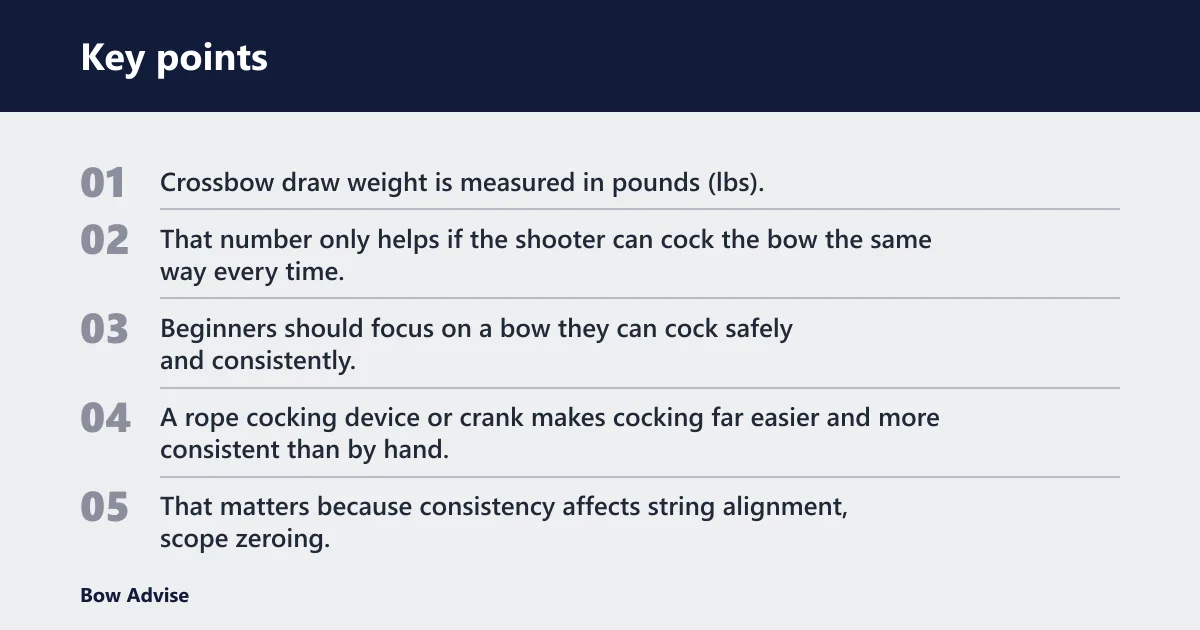
Crossbow draw weight is measured in pounds (lbs), and most hunting crossbows sit around 150–200 lbs. That number only helps if the shooter can cock the bow the same way every time. Beginners should focus on a bow they can cock safely and consistently, while intermediate and experienced users may prefer more power if they can still manage the bow well.
A rope cocking device or crank makes cocking far easier and more consistent than by hand. That matters because consistency affects string alignment, scope zeroing, and confidence under pressure. If the cocking method is awkward, the “stronger” bow may be the worse buy.
Why speed helps most at longer range
Crossbow speed is usually listed in fps, and most hunting crossbows shoot 300–450 feet per second. Higher fps flattens trajectory, which helps reduce holdover errors as distance grows. It also depends on bolt weight, so the same bow may not shoot the same speed with every shaft.
At a treestand shot inside normal woods distance, a moderate setup often gives enough practical speed. At longer open-country distances, speed matters more because range estimation errors show up faster when the bolt drops more between the muzzle and the target.
When extra draw weight stops paying off
More draw weight can increase power, speed, and impact energy, but it does not help if it makes the shooter hesitate, flinch, or cock the bow poorly. Faster bows can also bring more recoil and vibration in some setups. That tradeoff matters for practice frequency, because the setup that gets shot more often is usually the better hunting setup.
Suppose a buyer wants the fastest model on the rack but can only cock it with visible strain. The likely result is slower practice, more inconsistency, and poorer field accuracy. A slightly slower bow that is easy to cock and zero may produce better real-world results.
Crossbow Draw Weight vs Speed decision table
| Use case | Recommended draw-weight range | Practical fps target | Bolt-weight preference | When to use a cocking aid |
|---|---|---|---|---|
| Beginner target | 50–100 lbs | 300 fps or less is fine if the bow is easy to tune | Start with the bolt weight the maker recommends for stable flight | Use one as soon as hand cocking causes inconsistency |
| Whitetail treestand | 100–150 lbs | 300–375 fps | Moderate to heavier bolts for steadier flight and better penetration | Strongly recommended for repeatable cocking in a blind or stand |
| Whitetail open-country | 100–150 lbs | 350–400 fps | Keep the bolt within the model’s stable working window | Recommended, especially if you shoot often or at longer range |
| Small game | 50–100 lbs | 250–325 fps | Usually lighter bolts if the setup stays accurate and safe | Helpful for new shooters and for high-volume practice |
| Larger game | 150 lbs and up for advanced users | 350 fps or more, but only if the bolt weight still supports energy | Heavier bolts are usually the better choice | Use a crank unless the bow is easy to cock safely by hand |
How does bolt weight change speed and energy?
Bolt weight changes both speed and energy. Lighter bolts fly faster, while heavier bolts usually carry more penetration potential. That is why manufacturer speed ratings are often listed with the lightest recommended bolt, not with the bolt most people should hunt with.
Why lighter bolts fly faster
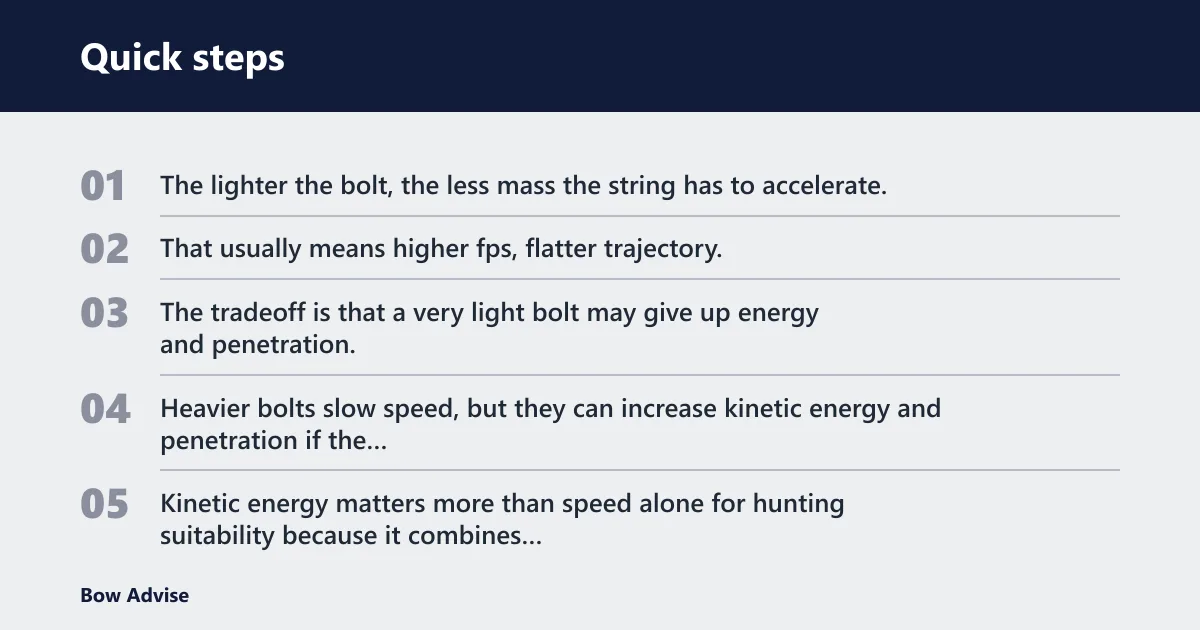
The lighter the bolt, the less mass the string has to accelerate. That usually means higher fps, flatter trajectory, and a smaller gap between the aiming point and the impact point at moderate range. The tradeoff is that a very light bolt may give up energy and penetration.
Why heavier bolts often hit harder
Heavier bolts slow speed, but they can increase kinetic energy and penetration if the setup stays within the bow’s safe working window. Kinetic energy matters more than speed alone for hunting suitability because it combines mass and velocity. For hunting, that combined result matters more than a speed banner.
For example, a bow set up for 400 fps may only reach that number with the lightest recommended bolt. If the hunter switches to the bolt they actually plan to carry, the speed will drop, so the more useful question is whether the setup still stays in the right energy band at the real hunting distance.
A common first-timer mistake is choosing the lightest possible bolt just to see a big fps number. That can produce a bolt that is too fast for the model’s tuning window, or too light for the game being hunted. The bow may look impressive and perform worse where it counts.
How manufacturer speed ratings can mislead buyers
Most crossbows are marketed with an “up to” speed rating. That figure usually assumes the lightest recommended bolt, ideal conditions, and a setup that may not match the buyer’s hunting load. Real speed changes with bolt weight, scope setup, and how the bow is cocked.
That is why a buyer should not shop by the highest fps number alone. A bow that posts a lower speed rating may still be the better choice if it is easier to cock, easier to zero, and easier to shoot well.
What speed and energy do you need?
For deer hunting, a crossbow does not need the highest fps on the market. It needs enough speed to keep the trajectory manageable and enough kinetic energy for dependable penetration with the bolt you plan to hunt with. Legal minimums and ethical minimums are not the same thing.
Practical fps targets for deer-sized game
For whitetail and similar game, many buyers do well in the 300–375 fps range, with open-country hunters often preferring the upper end. That range gives enough speed for practical sighting and enough room to keep a usable trajectory without paying for extreme output that may not improve field results.
If the shot distance stays short, speed matters less than repeatability. If the shot distance stretches out, speed helps with holdover and aiming precision, but only if the scope is zeroed for the actual bolt speed.
Ethical energy ranges for deer, antelope, elk, and black bear
Easton’s chart puts deer and antelope at 25–41 ft-lb. Elk and black bear are often discussed in the 42–65 ft-lb range, and larger game needs more penetration margin. Those numbers are useful, but they are a guide, not a permission slip.
KE = bolt weight in grains × speed² ÷ 450,240. That formula shows why a fast but very light bolt is not always the best hunting choice. A heavier bolt at a slightly lower speed can still land in a better energy band for the game.
Why shot placement still matters most
Energy does not replace placement. A crossbow that clears an energy chart can still fail on a poor angle or poor hit location. The reverse is also true: a well-placed shot from a properly zeroed setup can be more effective than a faster bow that the shooter handles badly.
How does cocking method change the choice?
Cocking method changes the real-world usable draw weight. A bow that looks fine on paper can become a poor fit if it is hard to cock by hand, especially from a seated position or in cold weather. A crank or rope aid can make a stronger bow far easier to use and more consistent to shoot.
Manual cocking versus crank aids
Manual cocking works best when the draw weight is modest and the shooter can repeat the motion cleanly. A rope cocking device or crank reduces effort and helps keep the string centered. That can improve safety, reduce fatigue, and make the setup more usable for a wider range of shooters.
How a crank changes the usable draw weight
A high-draw bow can be reasonable for a smaller-framed or newer shooter if a crank is part of the plan. The crank does not change the labeled draw weight, but it changes how that weight feels in use. In practice, that can turn an otherwise difficult bow into a workable one.
Picture a shooter choosing between two hunting models with similar speed, one easy to cock and one that demands a hard pull. The easier bow is more likely to get practiced with often, which usually matters more than chasing a few extra fps.
Why consistency matters for accuracy
Accuracy depends heavily on proper zeroing, and proper zeroing depends on using the actual bolt speed and the hunting distance you plan to use. A rope aid or crank helps keep cocking consistent, which helps keep point of impact more stable. That is especially important when the scope uses multiple aiming points.
Draw weight vs speed decision framework
Use draw weight as the usability filter, then use speed as the range and trajectory filter. If the bow is hard to cock, it is probably too much bow for that shooter, even if the fps number looks good. If the bow is easy to use but too slow for the planned distance, move up only as far as needed.
- Confirm the legal minimums for the state or province where the bow will be used.
- Choose the game first, then set a realistic energy target for that game.
- Pick the lightest draw weight that can still meet that energy target with the bolt you plan to hunt.
- Check whether the bow can be cocked safely and consistently by hand or with a crank.
- Zero the scope with the actual hunting bolt and the distance you will shoot most often.
Our picks by need
First crossbow buyer: Mission Archery Sub-1 XR 410FPS RT edge Camo crossbow with pro package #XK035

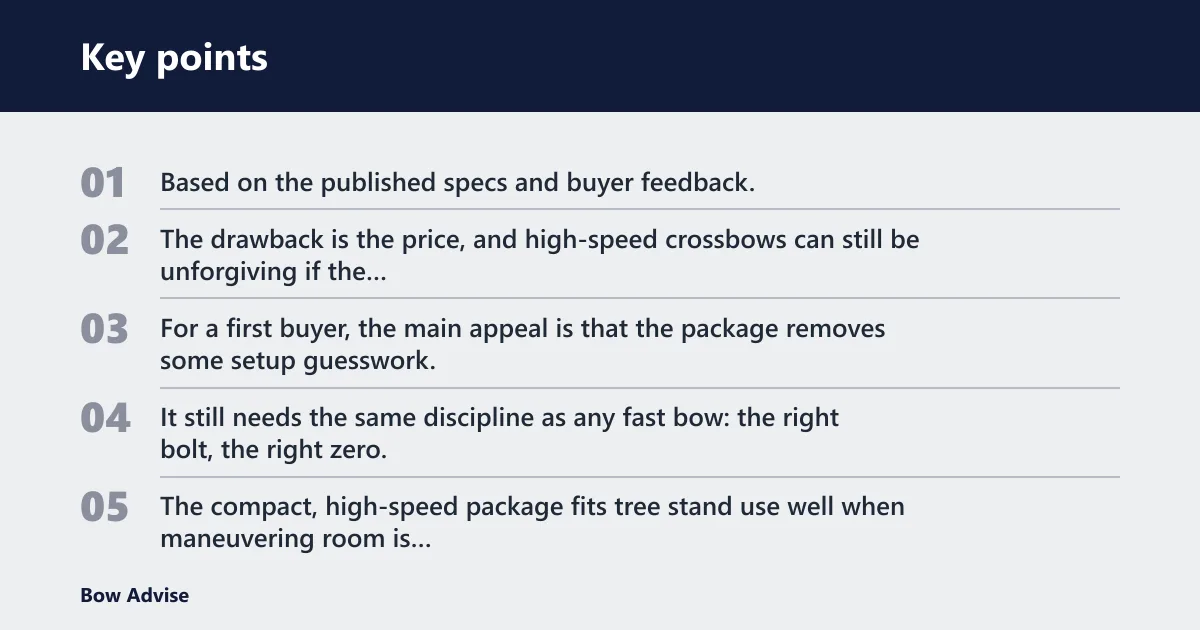
Based on the published specs and buyer feedback, this 410 fps package suits a buyer who wants a ready-to-hunt setup with strong speed and a complete kit. The drawback is the price, and high-speed crossbows can still be unforgiving if the shooter does not match the bolt weight and zero carefully. Price: $2,295.00.
For a first buyer, the main appeal is that the package removes some setup guesswork. It still needs the same discipline as any fast bow: the right bolt, the right zero, and a cocking method that the shooter can repeat safely.
Treestand hunting: Mission archery Sub-1 XR 410FPS RT edge camo crossbow with pro package #XK035
The compact, high-speed package fits tree stand use well when maneuvering room is limited and quick follow-through matters. Fps alone does not make a treestand bow better, though, and the user still has to manage recoil, vibration, and the actual cocking effort. Price: $2,295.00.
This is a good match when the hunter wants a lighter, easier-to-handle hunting profile in tight quarters and is willing to pay for a premium package. The drawback is the premium cost, which may be hard to justify if the shot distance stays short.
Open-country hunting: Ravin R10 Ultimate 400fps crossbow package – predator Camo

Based on the manufacturer’s specs and published product details, this 400 fps package fits open-country hunting where flatter trajectory helps at longer ranges. The main drawback is the price, and buyers still need to match bolt weight and zero to the actual setup rather than the headline speed. Price: $2,559.00.
Open-country hunters often care more about practical trajectory than about the biggest number on a box. This package suits that need if the shooter will also use a cocking aid and spend time zeroing for the bolt weight that will actually be carried afield.
Larger game: Ravin R10 Ultimate 400fps crossbow package – predator camo
The 400 fps rating gives this package enough speed headroom to support heavier bolts, which is often the better path for larger game. It is still not a shortcut around energy planning, shot placement, or legal rules. Price: $2,559.00.
For bigger game, the better question is whether the setup can produce the needed energy with enough penetration margin. This model gives a strong starting point, but the hunter still has to choose a bolt that fits the bow’s stable working window.
Mistakes to avoid
Do not choose speed without checking bolt weight. A bow’s listed fps usually depends on the lightest recommended bolt, and that is not always the best hunting bolt.
Do not ignore recoil and vibration. Faster bows can create more felt movement in some setups, which can reduce comfort and practice time.
Do not skip scope zeroing. Accuracy depends heavily on matching the actual bolt speed and the hunting distance you plan to use.
Do not buy more draw weight than you can cock safely. Beginners should prioritize a crossbow they can cock consistently and safely, and a crank can help make a stronger bow practical.
Do not blur legal minimums with ethical needs. A setup that meets a regulation may still be light for the game, the angle, or the distance you plan to shoot.
Verdict: Crossbow Draw Weight or Speed?
Choose Crossbow Draw Weight if you are a beginner and need a setup you can cock safely and consistently for treestand shots inside normal woods distance.
Choose Speed if you are shooting whitetail in open-country distances or longer-range hunting where a 350–400 fps setup flattens trajectory, reduces holdover errors, and makes range estimation less severe.
Frequently asked questions
What draw weight is best for a crossbow?
The best draw weight is the lowest one that still gives enough speed and energy for the game and distance you plan to shoot. Most hunting crossbows fall around 150–200 lbs, but beginners often do better with a setup they can cock safely and consistently.
Does higher draw weight always mean more speed?
No. Higher draw weight can increase speed and impact power, but only if the rest of the setup supports it. Bolt weight, power stroke, and cocking consistency all affect the final result, and a harder-to-cock bow can produce worse real-world accuracy even if the label is faster.
Is a faster crossbow better for hunting?
Not always. Faster crossbows flatten trajectory and help at longer range, but they often cost more and can bring more recoil and vibration. For many hunters, the better choice is the bow they can cock safely, zero correctly, and shoot with confidence in the field.
How does bolt weight affect crossbow speed and energy?
Lighter bolts usually fly faster, while heavier bolts usually fly slower but can carry more penetration potential. Bolt weight also changes kinetic energy, so speed alone does not tell the full story. The safest choice is usually the bolt weight the maker recommends for stable flight and hunting use.
What crossbow speed do I actually need for deer hunting?
Many deer hunters do well in the 300–375 fps range, with the exact need depending on distance and bolt choice. You do not need the fastest bow on the market. You do need a setup that zeroes well, carries enough energy, and stays manageable to shoot often.
How much kinetic energy do I need for deer or larger game?
Easton’s chart puts deer and antelope at 25–41 ft-lb, while elk and black bear are often discussed in the 42–65 ft-lb range. Those are useful guideposts, but shot placement, broadhead choice, and legal rules still matter. Larger game should always get more penetration margin.