Crossbow Scope vs Red Dot: Which Sighting Setup Is Better?
For most crossbow hunters, a scope is the better choice past 25 yards, in low light, or for new shooters; a red dot fits close-range, fast shots with simple aiming and bright conditions. Choose the wrong one and you give up accuracy, miss distance calls, or struggle to see the target at dawn and dusk. This guide compares crossbow scopes and red dots by hunting use, range, speed, light, and beginner error tolerance.
| Factor | Crossbow scope | Red dot | Winner |
|---|---|---|---|
| Aiming precision at distance | Magnification and a multi-dot reticle give more aiming reference for small targets and longer shots. | Non-magnified aiming is simple, but the dot can cover more of a small target as distance increases. | Crossbow scope |
| Close-range target pickup | Slower to settle because the shooter must align eye relief and the reticle picture. | Fast, both eyes open shooting helps find the target quickly. | Red dot |
| Low-light visibility | Illuminated reticles help, but magnification can still make the target look dimmer or blurrier. | Brightness settings can make the dot easier to see, though target detail still depends on ambient light. | Crossbow scope |
| Beginner error tolerance | More forgiving for judging distance and holding on a small vitals window. | More forgiving for simple aiming picture, but less help with distance calls. | Crossbow scope |
| Moving game and field of view | Magnification narrows the field of view, which can slow tracking. | Wide view makes it easier to stay on a moving animal. | Red dot |
Speed or precision
The trade-off is plain. A crossbow scope gives more aiming reference and usually more precision; a red dot gives a cleaner, faster sight picture. That difference matters most when the target is small, moving, or partly hidden.
What a scope adds at distance
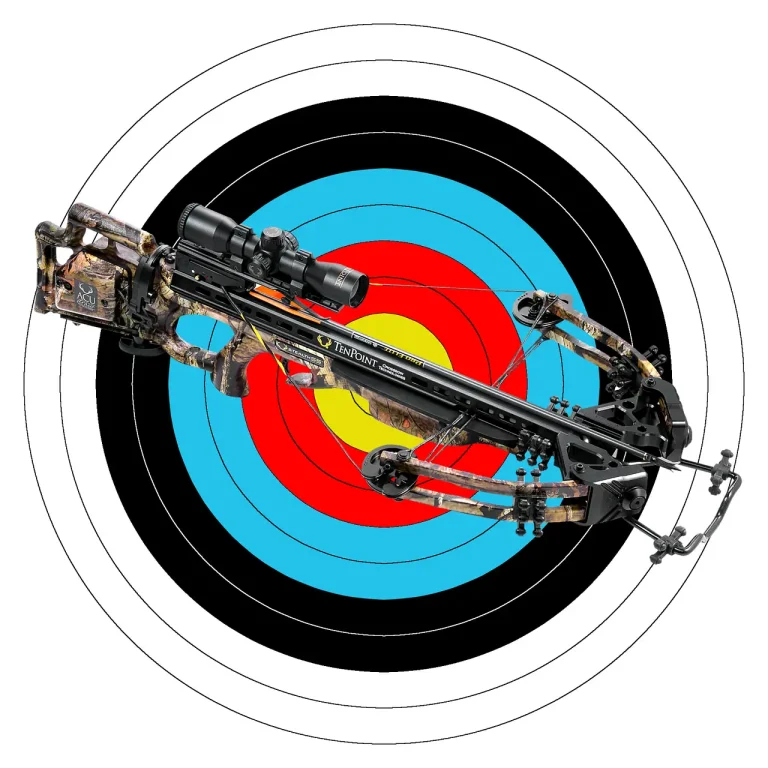
A crossbow scope adds magnification, a multi-dot reticle, and usually a clearer way to hold for different distances. Crossbowmen notes that magnification can improve accuracy, and that matters when the shot window shrinks past the easy, close range.
Most crossbow scopes are commonly zeroed at 20 yards, with the top-most reticle or dot used for the primary zero distance. That setup gives the shooter a baseline for reticle calibration and bolt trajectory instead of relying on guesswork.
What a red dot adds up close
A red dot is non-magnified, so the aiming point stays simple. That helps with rapid target acquisition and both eyes open shooting, especially on a close animal in bright conditions or on a short practice lane.
The tradeoff is that a dot does not add detail. It can also hide part of a small target, and brightness settings need to be right or the dot can wash out or look too bold against the background.
Where beginner error usually shows up
New crossbow shooters usually miss because of distance error, cant, or a sight picture that moves between shots. A scope gives more help when the sight is mounted correctly and the reticle is matched to the bow’s trajectory. A red dot is simpler to see, but it gives less help when the shooter misjudges range.
Say your target is a deer-size vitals zone at dusk and the shot is around the edge of your comfortable range. A scope gives more aiming reference. If the same deer is inside a short blind window and nearly broadside, a red dot can be quicker to find.
Is a crossbow scope better than a red dot?
For most hunters, yes. A crossbow scope is the better choice when the shot may stretch beyond close range, when the target is small, or when the shooter is still learning how the bolt drops at different distances. A red dot is better only when speed matters more than precision.
Best answer by shooting distance
At close range, the red dot has the edge because it is faster to pick up. Past that, the scope usually wins because magnification and a multi-dot reticle help the shooter hold more precisely as the bolt path drops and the target window gets smaller.
Best answer by target size
Small targets favor the scope. A crossbow bolt’s trajectory is sensitive enough that even slight hold errors matter more as range grows, and a magnified sight gives a cleaner picture of where the point belongs on the target. Large, forgiving targets narrow the gap.
Best answer by skill level
Beginners usually do better with a scope because it helps them understand where the bolt lands at a confirmed zero. A red dot can be easy to understand, but it gives less guidance when the shooter is still learning how rail setup, zero distance, and bolt flight interact.
How low light changes the choice
Low light pushes the decision toward the setup that keeps the target visible without making the aiming point hard to read. A crossbow scope often does better for dawn or dusk hunting, but only if the reticle and target remain clear enough to separate. A red dot can still work, yet it does not add target detail.
Dawn and dusk visibility
At dawn and dusk, the issue is not only seeing the dot. The hunter must see the target body, the shooting lane, and the exact impact point. A scope’s magnification and illuminated reticle can help, but the optics can also make the image feel darker than the naked eye view.
Reticle brightness vs target blur
Brightness settings matter on a red dot because the dot must be visible without overpowering the target. On a scope, illumination can help the reticle stand out, but too much brightness can make the aiming point bloom and hide detail. Neither sight should be assumed to solve low-light blur on its own.
Follow-up shot speed after the first hit
A red dot is usually faster for a second shot because it stays open and uncluttered. A scope slows the picture a bit, especially if the shooter is trying to re-find the target after recoil or movement. If a follow-up shot matters, field of view becomes part of the decision.
How to mount and zero either sight
Mounting errors cause more trouble than most sight-type debates. A crossbow mount has to match the rail, sit at the right ring height, and stay level. Zeroing then translates the bolt impact into a repeatable aiming system instead of a guess.
Rail fit and ring height
Check whether the optic fits a Weaver or 3/8-inch dovetail interface before tightening anything. Some crossbows use one standard, some use the other, and some need a specific base or ring height to avoid poor eye position. If the sight sits too high or too low, the aiming picture becomes inconsistent.
The same source notes that some Barnett crossbows use a 3/8-inch dovetail mount. That is useful as a model of how specific rail fit can be, not a universal rule for every crossbow.
Level mounting and cant prevention
Mount the sight level with the rail, then verify that the bow stays level in the shooting position. A slight cant changes where the bolt lands, especially with a scope where the reticle is calibrated around a level hold. Crossbowmen’s mounting method uses a level on the arrow flight rail and alignment to a horizontal line on the wall.
A scope also depends on eye relief. If the sight picture shifts because the shooter is too close or too far from the optic, the reticle can appear misaligned even when the mount is correct.
20-yard zero setup
Crossbow scopes are commonly zeroed at 20 yards. The top-most reticle or dot is used for that primary zero distance, and the rest of the aiming points are then matched to the bolt’s path as the range changes. Some manufacturer systems may use different distances or speed settings, so the manual still matters.
Most scope click adjustments are 1/4 inch at 100 yards. That same click equals 1/20 inch at 20 yards. Treat that as a calculation reference for a scope that uses that click system, not as a universal rule for every optic.
Using a shooting aid or vise
A stable shooting aid is recommended for sighting in. It reduces movement while the sight is being aligned and keeps the bolt group easier to read. That matters because the zero is only as good as the repeatability of the shots used to set it.
Crossbow bolts also matter. Heavier or lighter bolts can shift impact, and the sight should be set with the bolt type that will actually be used. Group size and trajectory sensitivity both change when the bolt weight changes.
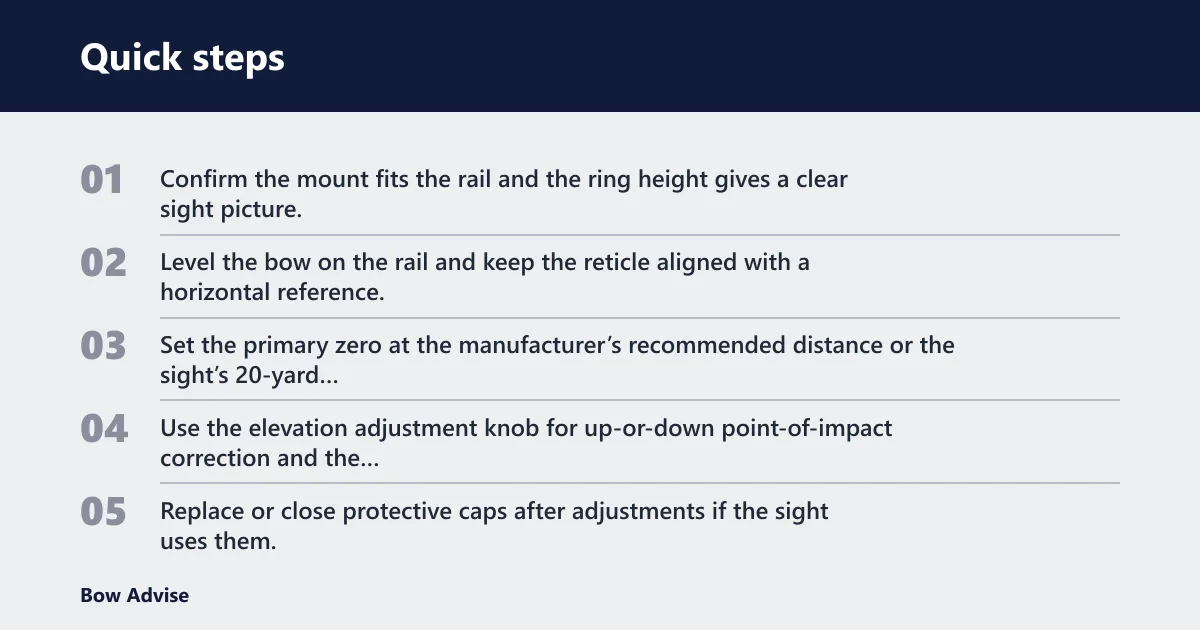
- Confirm the mount fits the rail and the ring height gives a clear sight picture.
- Level the bow on the rail and keep the reticle aligned with a horizontal reference.
- Set the primary zero at the manufacturer’s recommended distance or the sight’s 20-yard baseline.
- Use the elevation adjustment knob for up-or-down point-of-impact correction and the windage adjustment knob for left-or-right correction.
- Replace or close protective caps after adjustments if the sight uses them.
- Confirm the zero with the same bolt weight and same setup that will be used in the field.
Crossbow sight decision table
| Use case | Crossbow scope | Red dot | Winner |
|---|---|---|---|
| Close-range blinds | Works, but magnification can slow the sight picture. | Fastest for short, simple shots. | Red dot |
| Treestand deer hunting | Better for distance reference and aiming on smaller vitals. | Good if shots stay close and the lane is open. | Crossbow scope |
| Target practice | Better for reading impact and refining a zero. | Good for speed work and simple aiming drills. | Crossbow scope |
| Beginner sighting-in | More helpful for setting a baseline and learning bolt drop. | Simple, but less informative for distance calibration. | Crossbow scope |
| Low-light shooting | Usually better if the reticle stays visible and the target is still readable. | Can work, but the dot alone does not add target detail. | Crossbow scope |
| Follow-up shot needs | Slower to re-center after movement or recoil. | Faster to reacquire the target. | Red dot |
Close-range blinds
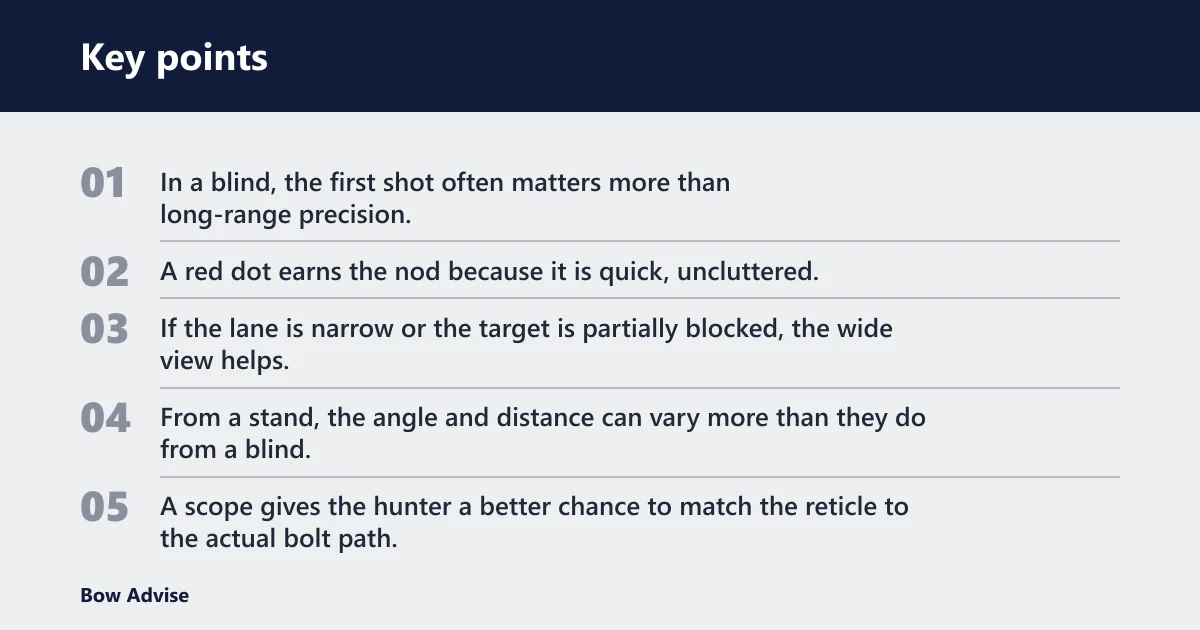
In a blind, the first shot often matters more than long-range precision. A red dot earns the nod because it is quick, uncluttered, and easy to use when the target appears inside a short shooting lane. If the lane is narrow or the target is partially blocked, the wide view helps.
Treestand deer hunting
From a stand, the angle and distance can vary more than they do from a blind. A scope gives the hunter a better chance to match the reticle to the actual bolt path, which helps when a deer stops at a less-perfect range. The added detail matters more than a split-second aim picture.
Target practice
Practice usually favors a scope because it gives more feedback on aim and impact. A red dot is fine for speed practice, but it does less to teach the shooter how range changes the hold. For a beginner, that extra feedback is valuable.
Beginner sighting-in
A beginner usually needs a setup that makes zeroing easy to verify. A scope paired with a stable shooting aid gives a clearer path from first groups to a usable zero. The goal is not speed; it is repeatable hits in the same spot.
Low-light shooting
Low light is often where the scope pulls ahead, because magnification and reticle reference help the shooter confirm the target and point of impact. That said, if the sight picture becomes dim or bloomed, the advantage shrinks. Brightness settings must be tuned carefully.
Follow-up shot needs
If a quick second shot is a real concern, the red dot is the more practical choice. It keeps the view open and easy to find again after the first shot. That can matter in fast, close hunting situations where time is short.
Choose Crossbow scope if… / Choose red dot if…
Choose a Crossbow scope if you want more aiming reference, hunt beyond close range, shoot in low light, or need help learning how your bolts drop at a 20-yard baseline. Choose a red dot if your shots are short, fast, and close, and you value a wide field of view over extra precision.
Choose a Crossbow scope if you are sighting in a new crossbow, want a multi-dot reticle, or need more confidence on small deer vitals. Choose a red dot if you mostly shoot from a blind, want rapid target acquisition, or expect follow-up shots more than measured holdovers.
Must-have
 As an Amazon Associate we earn from qualifying purchases. Prices and availability are accurate as of the date shown and are subject to change

TenPoint EVO-X Marksman Elite Scope 3.0 is the better fit for hunters who want a variable-speed crossbow scope with calibrated aiming dots and external windage and elevation adjustment. Its downside is cost, and its 2-8x format is more sight than a close-range shooter needs.
This kind of scope matters most when the crossbow must be set up around a primary zero and then confirmed at other distances. It also gives more aiming detail for target practice and longer hunting lanes.
Nice-to-have
As an Amazon Associate we earn from qualifying purchases. Prices and availability are accurate as of the date shown and are subject to change

Vortex Optics Venom Red Dot Sight fits hunters who want a clean, fast aiming point and a wide field of view. Its downside is that a dot does not add magnification, so it gives less help on small targets or at longer distances.
Based on the published details, the parallax-free design and auto-brightness are the main practical advantages. The tradeoff is simple: speed improves, but aiming detail does not.
Budget setups
| Setup | What to buy | Why it fits | Price |
|---|---|---|---|
| Starter | Crossbow scope with a basic stable sight-in setup | Best for learning a 20-yard baseline and reading bolt groups. | $499.99 |
| Mid | Red dot sight for close-range shooting | Best for simple aiming and quick shots from a blind or short lane. | $346.55 |
| Serious | Crossbow scope plus careful mount alignment and zero confirmation | Best for hunters who need precision, low-light confidence, and distance reference. | $499.99 |
Frequently asked questions
What is the best sight for a crossbow for beginners?
A scope is usually the better beginner choice because it gives more aiming reference and helps the shooter understand a set zero. A red dot is simpler to look through, but it does less to teach distance and bolt trajectory. Beginners usually benefit more from information than from speed alone.
Can you use a red dot on a crossbow?
Yes, a red dot can work well on a crossbow if the mount fits the rail and the sight is zeroed correctly. It is best for close-range, fast shooting. The main limitation is that it does not magnify the target or help much with longer-range holdover.
What distance should I sight in a crossbow scope?
Crossbow scopes are commonly zeroed at 20 yards, and that is a common starting point for reticle calibration. Still, the correct distance should match the sight manual and the crossbow’s speed setting. The zero is only useful if it matches the bolts and setup being used.
Do crossbow scopes have multiple aiming dots?
Many crossbow scopes do. A multi-dot reticle gives the shooter reference points for different distances, with the top-most reticle or dot often used for the primary zero distance. That makes the sight more useful than a single aiming point when bolt drop starts to matter.
How do you mount a crossbow scope correctly?
Mount it so the rail fit is correct, the ring height gives a natural sight picture, and the optic stays level with the rail. Check cant prevention carefully. Then zero with a stable shooting aid and confirm the impact with the same bolt weight you plan to hunt with.
What are the downsides of a red dot on a crossbow?
The biggest downsides are lack of magnification and less help with small targets at distance. Brightness settings also matter, because a dot that is too dim or too bright can be hard to use well. It is fast, but it offers less precision support than a scope.
What type of sight is faster for close-range crossbow hunting?
A red dot is faster for close-range crossbow hunting. The sight picture is simple, both eyes open shooting is easy, and the target is acquired quickly. A scope can still work, but its magnification and eye relief requirements usually slow the first shot slightly.