Crossbow Scope Price
Crossbow scope prices are often reported in a range of about $50 to $300; the right buy is usually the lowest tier that matches your crossbow’s speed rating, reticle needs, and mount standard. Buying above that often means paying for magnification, illumination, or calibration your setup cannot use. This guide breaks down price tiers, speed-rating fit, and the features worth paying for.
What crossbow scope price actually buys


Price usually reflects three things: calibration, optics features, and included hardware. A cheaper scope can still work well if the speed range fits, but once you move into midrange and premium pricing, you are usually paying for more magnification options, illuminated reticles, and wider speed matching.
MSRP versus street price
MSRP is the sticker reference. Street price is what the buyer actually sees on a product page or at checkout. The gap can be small on budget models and wide on midrange scopes, which is why the same scope family can look cheap in one store and expensive in another.
That matters because crossbow scopes are not bought on optics alone. A model with the wrong calibration range can cost more than a cheaper option that fits your bolt speed and zeroing needs. Paying more only makes sense when the extra feature solves a real setup problem.
Budget, midrange, and premium tiers
Under about $75, buyers usually get fixed magnification, basic reticles, and fewer adjustment features. From about $75 to $150, buyers more often see illuminated reticles and better calibration for common crossbow speeds. From about $150 to $300, variable magnification and wider speed ranges tend to become more common. Premium models sit above that and often include specialized features that many hunting setups will never use.
Which features move cost the most?
The biggest price drivers are illuminated reticles, variable magnification, objective lens size, and speed-specific calibration. A range-compensating reticle also adds cost when it is built around multiple holdover points. Night-vision related claims can push prices sharply higher, but those features matter only for buyers who truly need that use case.
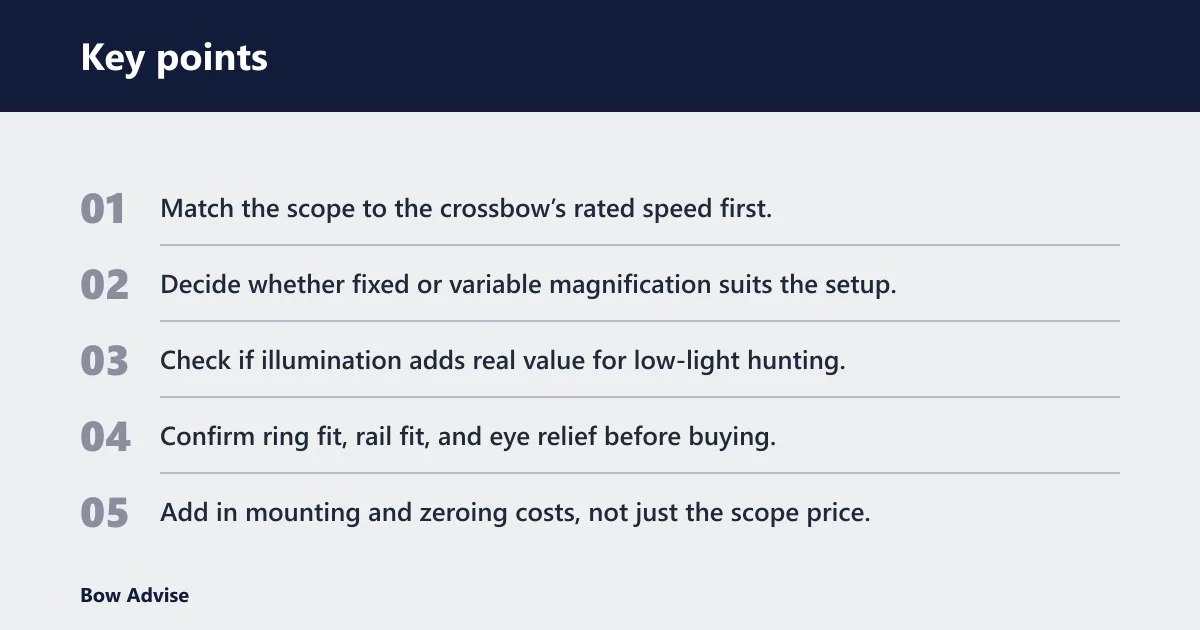
- Match the scope to the crossbow’s rated speed first.
- Decide whether fixed or variable magnification suits the setup.
- Check if illumination adds real value for low-light hunting.
- Confirm ring fit, rail fit, and eye relief before buying.
- Add in mounting and zeroing costs, not just the scope price.
Scope price matrix
This matrix shows how current models line up on price, features, and use case. It is the quickest way to separate useful upgrades from expensive extras that do not help a specific crossbow setup.
| Model | MSRP | Sale price | Magnification | Objective size | Reticle type | Speed rating | Best for | Not worth paying for if… |
|---|---|---|---|---|---|---|---|---|
| Hawke XB Crossbow Scope | Not listed | $99.99 | 3x fixed | 32mm | Illuminated red/green reticle | 340fps | Simple 340 fps setups that need a straightforward zero | Your bow is not near 340 fps or you want variable zoom |
| Hawke XB1 1.5-5×32 SR | Not listed | $159.99 | 1.5-5x | 32mm | Illuminated red/green reticle | 250-425 fps | Buyers who want flexibility across several bolt speeds | You only need a fixed-power budget optic |
| Truglo CROSSPEAK 2-7×32 | $218.99 | $164.85 | 2-7x | 32mm | Crossbow reticle | Not listed | Buyers comparing midrange variable scopes and sale pricing | You need the lowest possible cost and no zoom range |
| Truglo compact 4×32 crossbow scope | Not listed | $65.88 | 4x fixed | 32mm | BDC reticle | Not listed | Tight budgets and simple holdover shooting | You want zoom or illumination |
| Truglo compact 4×32 BDC variant | Not listed | $85.55 | 4x fixed | 32mm | BDC reticle | Not listed | Budget buyers who want a cleaner holdover setup | You do not need extra holdover marks |
| Truglo compact 4×32 IR BDC variant | Not listed | $89.67 | 4x fixed | 32mm | Illuminated BDC reticle | Not listed | Low-light budget hunting with holdover marks | Illumination will not help your hunting light conditions |
| BUKOPS Cycloptic-X Prime | Not listed | $699.99 | Not listed | Not listed | Not listed | Not listed | Premium buyers looking at advanced specialty features | You only need a practical hunting scope |
Say your crossbow shoots 340 fps and you plan to hunt at woods distances. The Hawke XB 3×32 can make sense because it is fixed calibrated for 340fps crossbows, and the five brightness levels help in changing light. A variable scope would cost more without solving a problem if the bow stays in that speed band.
Suppose a buyer picks the BUKOPS Cycloptic-X Prime because the listing mentions night-vision related claims. That premium price only pays off if the setup truly needs that feature set. For most hunters, the added cost is better spent on a scope that fits the bolt speed, the rail, and the ring height correctly.
What is a good crossbow scope?
A good crossbow scope matches the bow’s speed, mounts cleanly, and gives a reticle the shooter can actually use. For most buyers, that means a fixed 4×32 or 3×32 for simple setups, or a variable scope only when the speed range and aiming style call for it.
The minimum feature set that makes sense
At minimum, the scope should fit the rail, allow a proper cheek weld, and give usable eye relief. The reticle must suit the bolt speed so the holdover marks line up with actual trajectory. If those basics fail, higher magnification will not fix the problem.
When a fixed 4×32 is enough
A fixed 4×32 is enough for many hunting rigs because it keeps cost down and avoids paying for zoom that may never be used. The Truglo compact 4×32 line shows why this format stays popular: it is compact, budget-friendly, and the BDC reticle gives practical holdover marks without moving into premium pricing.
When variable magnification is worth the jump
Variable magnification is worth paying for when the same scope needs to serve multiple distances or multiple bolt speeds. The Hawke XB1 1.5-5×32 SR is a good example of that value tier because it is designed for 250-425 fps crossbows and adds flexibility that fixed scopes cannot match.
Do illuminated crossbow scopes cost more?
Yes. Illumination usually adds cost because the scope needs extra electronics, brightness settings, and a reticle system that can be seen against dark background or low light. For some buyers that is worth it. For others it is a paid feature that stays off most of the time.
Red and green illumination
Red and green illumination gives the shooter a brighter aiming point when the reticle is hard to pick out against bark, brush, or dim light. The Hawke XB 3×32 uses a red/green illuminated XB SR reticle and includes five brightness levels, which is the kind of control many hunters want when light changes by the minute.
Brightness settings and low-light aiming
Brightness levels matter because a reticle that is too bright can bloom and cover too much of the target, while a weak setting may disappear at dusk. Multiple settings let the shooter tune the dot or hash marks to the light in front of them instead of forcing one fixed brightness level.
When illumination is worth the premium
Illumination is worth the premium if hunting often happens at dawn, dusk, or under heavy canopy. It is less useful on bright range days or on simple setups where the reticle is already easy to see. In those cases, a non-illuminated BDC scope often delivers better value.
What crossbow scope works for a 340 fps crossbow?
A scope calibrated for 340 fps is the safest starting point for a 340 fps crossbow. The reticle marks need to match the bolt’s drop, or every holdover distance turns into guesswork. A speed mismatch is one of the most common reasons a scope feels “off” even when the mount is tight.
Speed-rated reticle calibration
Speed rating matters because crossbow reticles are usually built around a specific bolt arc. If the scope is cut for a faster or slower setup than the bow actually shoots, the holdover marks will not land where the shooter expects. That is a calibration issue, not just an aiming issue.
Hawke XB crossbow scope at 340 fps
The Hawke XB 3×32 is listed at $99.99 and is fixed calibrated for 340fps crossbows. That makes it a direct match for the 340 fps use case, and its five brightness levels add low-light flexibility without moving the buyer into a more expensive variable-magnification tier.
Fit and zeroing checks before purchase
Before buying, check rail fit, ring height, and whether the scope can be zeroed for the actual bolt speed. A scope may be close in price and still fail in practice if the reticle calibration does not match. The cheapest mistake is often the one that needs replacement after the first range session.
A common first-timer mistake is choosing a 2-7×32 because the zoom range sounds better, then discovering the reticle was not matched to the bow’s speed and the rings were not included. The fix is not more magnification. It is the right calibration, correct ring height, and a clean zero at the real bolt speed.
How much should you spend?
Spend enough to match the bow, but not enough to buy features you cannot use. For most crossbow buyers, the sensible spending range lands in the lower to mid tiers unless the setup needs variable magnification, wider speed calibration, or specialized low-light features.
Under $75
This tier fits the most basic needs. The Truglo compact 4×32 listed at $65.88 is the clearest budget example here. Buyers in this range should expect fixed magnification and practical holdover marks, not advanced illumination or wide speed flexibility.
$75 to $150
This is the sweet spot for many hunters because it can buy illumination and better calibration without pushing into premium territory. The Hawke XB 3×32 at $99.99 sits here, and it shows how a speed-specific fixed optic can still deliver useful features at a modest price.
$150 to $300
This range usually buys variable magnification and wider speed compatibility. The Hawke XB1 1.5-5×32 SR at $159.99 and the Truglo CROSSPEAK 2-7×32 at $164.85 both show that midrange pricing is where flexibility starts to matter. If the crossbow or hunting style changes, this tier can make sense.
Premium scope spending
Premium pricing should be reserved for buyers who know exactly why they need it. The BUKOPS Cycloptic-X Prime at $699.99 sits far above mainstream pricing, so the buyer should have a specific use case before paying that much. Without one, the extra money is hard to justify.
What features are worth paying for?
Pay for features that change how the scope performs on your bow. BDC reticles, illumination, and proper calibration can all be worth real money. Fancy branding, oversized feature lists, or specialty claims are not worth it unless they solve a specific shooting problem.
BDC reticle and range marks
A BDC reticle gives range holdover marks that help the shooter aim at different distances without guessing. That is why fixed 4×32 scopes often pair well with BDC designs. They offer a practical balance of price and function, especially for hunters who keep shots inside common crossbow distances.
Rings included versus extra cost
Rings included can reduce total cost and make the scope easier to mount right away. If the scope does not include rings, that extra purchase should be counted in the real price. A cheap scope with expensive rings can quickly stop being cheap.
When night-vision claims are above budget need
Night-vision related claims belong in the premium bucket, but that does not mean they are necessary for most hunting setups. If the bow is used at legal daylight hours, or if the hunter does not need specialty low-light gear, that money often buys more useful fit and calibration elsewhere.
Compatibility checklist
Use this before buying any crossbow scope. It prevents the common failure cases: over-scoping a budget bow, missing the correct ring height, or buying a reticle that cannot be matched to the actual bolt speed.
- Confirm the crossbow’s speed rating.
- Check whether the scope is calibrated for that speed band.
- Verify rail fit and mounting standard.
- Confirm eye relief for your shooting position.
- Check ring height against the scope tube and rail clearance.
- See whether rings are included or must be bought separately.
- Budget for mounting and zeroing time.
- Decide whether illumination is needed for your light conditions.
Frequently asked questions
What is a good crossbow scope: a good crossbow scope matches?
A good crossbow scope matches the bow’s speed, mounts securely, and gives a reticle that lines up with the bolt’s drop. For many buyers, a fixed 4×32 with a BDC reticle is enough. For speed-sensitive setups, a calibrated illuminated scope is the safer pick.
What is the average crossbow scope price?
The average practical buying range is about $50 to $300, but many solid options sit between $75 and $170. Budget scopes live below that, while premium models climb far above it. The best value is usually the lowest-priced scope that matches the bow’s speed and mounting needs.
Is a cheaper crossbow scope good enough for hunting?
Yes, if the scope is calibrated correctly and the reticle is usable for the expected shooting distance. A cheaper fixed 4×32 can be a smart hunting choice when the crossbow speed is known and the shot range is modest. Cheap becomes a problem when fit or calibration is wrong.
How much should I spend on a crossbow scope?
Above that, the buyer should have a specific reason tied to the setup, not just the price tag.