Crossbow Speed vs Accuracy: Which Matters More?
Accuracy beats raw speed for most hunts, but speed still matters when it cuts holdover error at your hunting distance. At 20–40 yards, pick the crossbow you can group tighter, then choose speed only if it clearly reduces aiming gaps. Miss that point, and you can hit high, clip brush, or wound game with a bow that shoots fast but not where you aim. This guide compares speed and precision for real hunting ranges, and shows how to choose for your skill level and setup.
| Decision factor | Crossbow speed | accuracy | Winner |
|---|---|---|---|
| Range forgiveness | Less drop from 20 to 50 yards reduces holdover error. | Cleaner groups reduce miss spread at any distance. | Crossbow speed |
| Shot placement repeatability | Depends on setup, but speed alone does not tighten groups. | Measured group size is the clearest field benchmark. | accuracy |
| Field noise and deer reaction | Fast models can still be loud. | A quieter, steadier setup can help before the deer reacts. | accuracy |
| Compact handling | Often built with high draw weight and more hardware. | Compactness can matter more in blinds and tight lanes. | accuracy |
| Ease of consistent use | Strong models may need more cocking help. | Repeatable cocking and trigger control support better hits. | accuracy |
Speed vs accuracy at a glance
Crossbow speed is a headline spec measured in FPS, and the fast end sits well ahead of most compound bows. The real question is not whether speed matters. It is whether speed matters more than the hunting errors that cost clean hits. For many deer shots inside 40 yards, accuracy and repeatability usually decide the result.
What FPS changes in the field
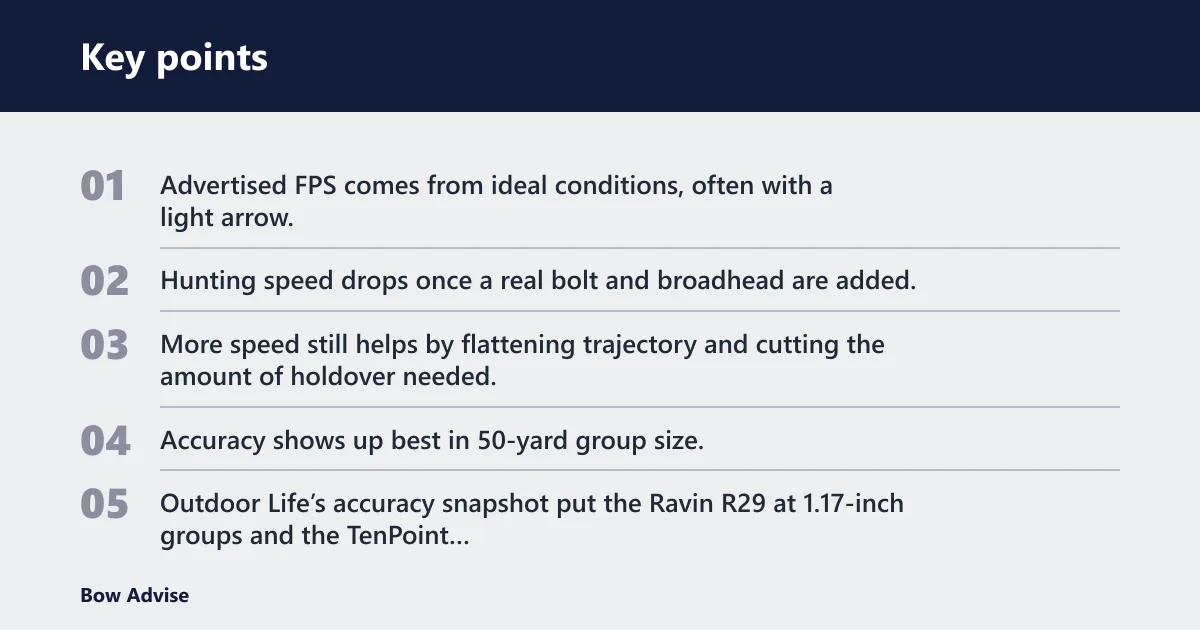
Advertised FPS comes from ideal conditions, often with a light arrow. Hunting speed drops once a real bolt and broadhead are added, so the number on the box should be treated as a ceiling, not a field promise. More speed still helps by flattening trajectory and cutting the amount of holdover needed.
What group size says about consistency
Accuracy shows up best in 50-yard group size. Outdoor Life’s accuracy snapshot put the Ravin R29 at 1.17-inch groups and the TenPoint Venom at 1.65-inch groups, while the PSE Mach 30 DS compound bow averaged 1.5-inch groups in a separate snapshot. Smaller groups matter because they shrink the chance of a left-right miss and a high or low hit.
Why setup matters as much as the bow itself
Bolt weight, broadhead design, cocking method, and noise all change field performance. A 300-pound-class crossbow may be fast, but if the setup is hard to cock, loud, or sensitive to broadhead choice, the practical result can be worse than a slower bow that holds tighter and shoots cleaner. One common first-timer mistake is buying speed first and then finding the field setup is awkward enough to hurt consistency.
Side-by-side comparison
| Factor | Crossbow speed | accuracy | Winner |
|---|---|---|---|
| Trajectory at hunting range | Flatter path, less drop. | Depends on how consistently the bolt leaves the rail. | Crossbow speed |
| Practical hit probability | Helps only if the shooter can still hold steady. | Measured groups translate directly to shot confidence. | accuracy |
| Setup sensitivity | Can be more sensitive to bolt choice and draw effort. | Better when tuned for one hunting setup and repeatable form. | accuracy |
| Deer reaction window | Faster bolt reaches the target sooner. | Quieter, more controlled setups reduce string-jump problems. | accuracy |
| Best use case | Longer shots, uneven range gaps, high holdover risk. | Everyday hunting inside common deer-shot windows. | accuracy |
Trajectory and holdover
Speed wins on drop, and that matters when a hunter is estimating 20, 30, or 40 yards by eye. Outdoor Life measured 2.5 inches of drop for the TenPoint 515 from 20 to 50 yards, 6.8 inches for the Ravin R29, and 28.5 inches for the Mathews Lift compound bow. Less drop reduces range-error exposure, especially if the shot lane is open and the distance is not perfectly known.
Repeatability and miss spread
Accuracy wins when the job is to place the bolt in the same spot every time. A flatter trajectory cannot fix a loose trigger break, poor rest position, or a broadhead that changes point of impact from practice field points. That is why 50-yard groups are the cleaner comparison than FPS alone.
Noise and handling
A faster bow can still be loud. Deer often react to the shot itself, not only the impact, and string jump can turn a good aim point into a high hit. Quietness does not beat speed at long range by itself, but it can matter more than extra FPS inside normal whitetail distances.
How much does crossbow speed matter for deer hunting?
Speed matters most when it reduces holdover error and shortens the deer’s reaction window. At 20 to 50 yards, a flatter arrow path gives the hunter more margin for small range errors, but the benefit fades if the bow groups poorly or the shot is already inside a short, forgiving distance.
Less drop means less holdover error
A fast bow is easier to aim when distances change quickly in the field. If a setup drops only a few inches across the common deer window, the hunter can keep the aim point simpler and reduce the chance of holding too high or too low. That matters most when the animal stops, starts, and moves within a narrow lane.
Where extra FPS helps at 20 to 50 yards
Extra FPS helps most at the edge of comfort, not at point-blank range. The higher the advertised speed, the less the bolt drops between short and midrange. The fastest crossbow cited reaches 495 fps with a 445-grain arrow, and the Ravin R29 is listed at 453 fps with a 402-grain arrow; both are built to limit trajectory error better than slower models.
When speed matters less than repeatable hits
Inside 30 yards, the real problem is often not drop. It is whether the shooter can place the bolt the same way under pressure. A quieter, better-tuned crossbow that groups tightly at 50 yards can beat a faster model that is harder to manage or inconsistent with the hunting setup.
Does a faster crossbow actually shoot more accurately?
No. Speed and accuracy are separate traits, and the faster bow is not automatically the tighter one. FPS changes trajectory, while accuracy shows up in how small the groups stay at distance and how well the setup repeats under hunting conditions.
Why speed and accuracy are not the same spec
Manufacturers list FPS as a speed number, usually under ideal conditions. Accuracy is better judged by 50-yard groups, broadhead consistency, and how the point of impact shifts when the hunting setup replaces the light test arrow. A 300-pound draw weight can produce impressive speed, but it does not guarantee smaller groups.
How hold sensitivity changes with speed
Faster bolts reduce the time the shooter must hold through the shot, which can help some hunters. But that advantage is small if the shooter already breaks the trigger cleanly and keeps the bow steady. In practice, better aim control and a clean tune usually matter more than raw speed.
Why a steady trigger break and clean tune still matter
A clean trigger break reduces flinch. A consistent rest position keeps the bolt leaving the bow the same way. That is why the better accuracy numbers in snapshot testing matter more than a marketing figure when the goal is a clean kill on a deer-sized target.
Crossbow decision matrix
This table turns hunting use into a simple rule. Favor speed when the shot window is wider and range changes are more likely. Favor accuracy when the shot is close, the lane is tight, or the setup must stay repeatable under pressure.
| Hunting scenario | Preferred speed band | Acceptable 50-yard group size | Noise tolerance | Cocking ease or compactness | Pick |
|---|---|---|---|---|---|
| Treestand | Fast enough to reduce drop | About 1.5 inches or better | Low | Compactness | accuracy |
| Ground blind | Moderate to fast | About 1.5 to 2 inches | Low | Compactness | accuracy |
| Tight timber | Fast enough to simplify range holds | About 1.5 inches or better | Low to moderate | Compactness | accuracy |
| Beginner practice | Moderate | About 1.5 to 2 inches | Moderate | Cocking ease | accuracy |
| Deer at 20 to 40 yards | Moderate to fast | About 1.5 inches or better | Low | Cocking ease | accuracy |
| Longer shots | Fast | About 1.5 inches or better | Low | Cocking ease | Crossbow speed |
Treestand priorities
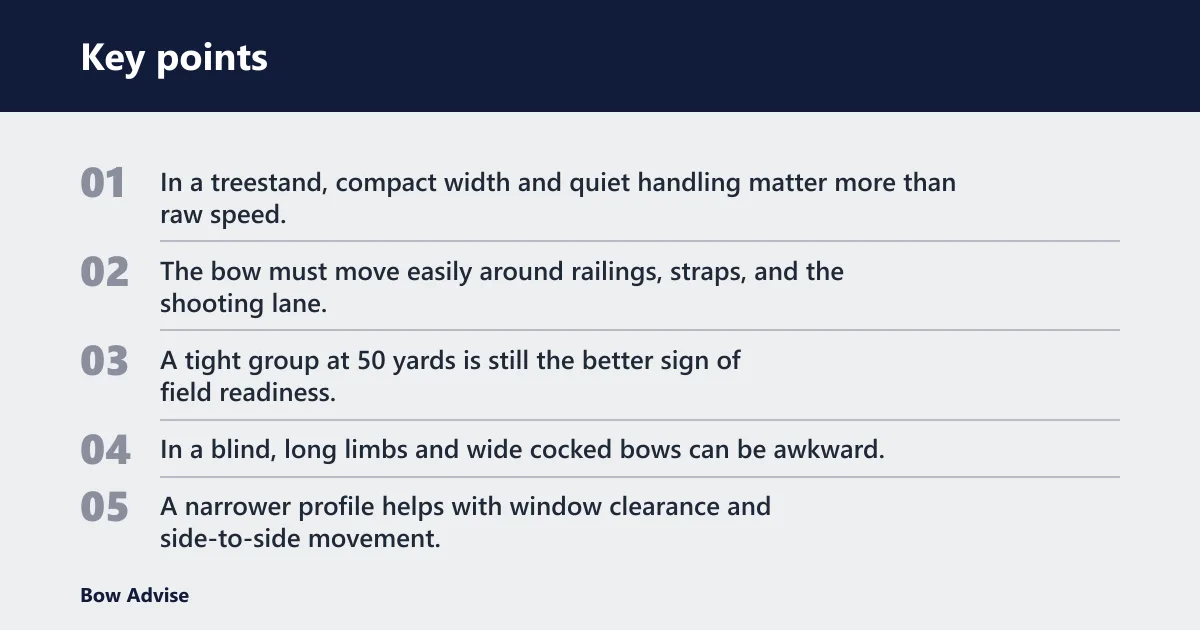
In a treestand, compact width and quiet handling matter more than raw speed. The bow must move easily around railings, straps, and the shooting lane, and it must let the hunter settle into the shot without fumbling. A tight group at 50 yards is still the better sign of field readiness.
Ground blind priorities
In a blind, long limbs and wide cocked bows can be awkward. A narrower profile helps with window clearance and side-to-side movement, while a quieter shot reduces the chance that the deer jumps before the bolt lands. Speed helps, but only after the setup fits the blind.
Tight timber priorities
Tight timber gives little room for error. A compact cocked width makes it easier to thread a lane, and a flatter trajectory helps when the range is guessed quickly. If the bow is hard to maneuver, the extra FPS is wasted before the shot breaks.
Beginner practice priorities
Beginners benefit from a setup that is easy to cock, easy to hold, and easy to repeat. That usually means prioritizing consistency over maximum speed. A reasonable beginner target is a bow that can keep groups around 1.5 to 2 inches at 50 yards before moving up in speed.
Deer at 20 to 40 yards priorities
For common deer shots in that window, accuracy comes first. The hunter still wants enough speed to reduce holdover error, but the shot is short enough that a clean trigger, quiet launch, and repeatable setup decide whether the bolt lands where intended. A slower bow that groups better is often the smarter pick here.
Longer shot priorities
Once the shot stretches out, speed starts to matter more. Extra FPS reduces drop and shrinks the aiming gap between distances. Even then, the bow still needs a tight 50-yard group, because range forgiveness is useless if the bolt prints wide.
What changes real-world FPS and point of impact?
Real hunting speed is lower than advertised speed because the hunting bolt is heavier and usually tipped with a broadhead. That change also shifts point of impact, which is why the test arrow on the package and the hunting setup in the field are not interchangeable.
Bolt weight and broadhead weight
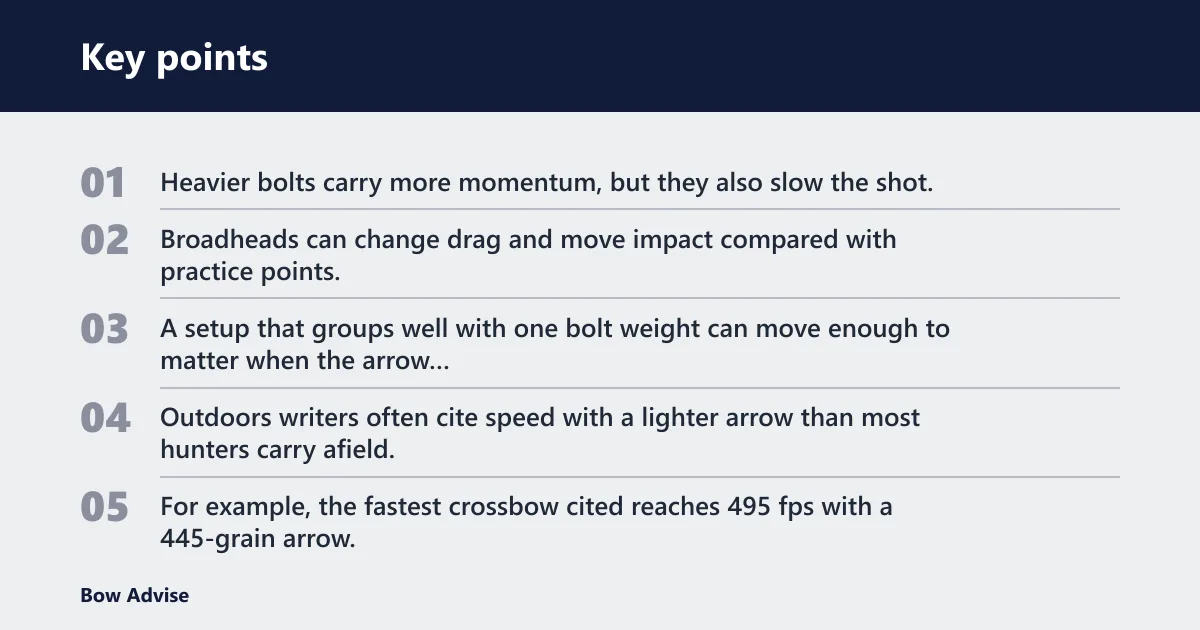
Heavier bolts carry more momentum, but they also slow the shot. Broadheads can change drag and move impact compared with practice points. A setup that groups well with one bolt weight can move enough to matter when the arrow is changed for hunting.
Why advertised FPS drops with hunting setup weight
Outdoors writers often cite speed with a lighter arrow than most hunters carry afield. For example, the fastest crossbow cited reaches 495 fps with a 445-grain arrow, while the Ravin R29 is listed at 453 fps with a 402-grain arrow and the Centerpoint Sinister 430 at 432 fps with a 398-grain arrow. Those numbers still show the speed class, but they do not replace a real hunting tune.
How setup changes trajectory and group shape
Trajectory changes as speed falls, and group shape can open up if the bow is not tuned to the bolt. Outdoor Life measured 2.5 inches of drop for the TenPoint 515 from 20 to 50 yards, 6.8 inches for the Ravin R29, and 28.5 inches for the Mathews Lift compound bow. That spread shows why setup choice affects aiming and why hunting distance must match the actual bolt path.
Which cocking system gives the best field results?
The best cocking system is the one that gives repeatable load, safe handling, and enough control to keep the bow consistent. Crank systems are easiest on high-draw-weight bows, rope systems are simpler and lighter, and internal systems can improve repeatability while staying compact.
Crank cocking
Cranks are common on powerful crossbows because they make heavy draw weights manageable. They reduce effort and can help maintain symmetry from shot to shot. They also tend to be safer for many hunters because they control the draw more gradually.
Rope cocking
Rope cocking is simpler and usually lighter to carry. It can work well on many midrange bows, but it asks more from the shooter and can be harder to repeat exactly under stress. For beginners, the easier method is often the steadier method.
Internal cocking systems
Internal systems are built into the bow and can improve convenience in the field. They often reduce loose parts and can make the process more repeatable. That matters because repeatable cocking helps the bolt leave the rail the same way each time.
Repeatability, safety, and de-cocking
Repeatability matters because small differences in cocking can change point of impact. Safety matters because a powerful bow may need a controlled de-cocking method at the end of the hunt. Hunters should choose the system that lets them load and unload without rushing or fighting the hardware.
Choose Crossbow speed if… / Choose accuracy if…
Choose Crossbow speed if the hunt involves longer ranges, uneven distance calls, or a setup where drop is the main concern. It also makes sense if the bow still groups well enough to stay inside your ethical window and the extra FPS clearly cuts aiming error.
Choose accuracy if the hunt is inside 20 to 40 yards, the shooting lane is tight, or you need the most repeatable hit pattern you can get. It is also the better pick when noise, cocking ease, or compact handling matter more than a flatter trajectory.
Frequently asked questions
Is accuracy or FPS more important in a crossbow?
Accuracy is more important for most hunters. FPS is useful because it flattens trajectory, but a flatter path does not fix poor grouping. If a bow cannot keep a tight 50-yard group, its speed advantage is wasted when the shot is taken under pressure.
What crossbow speed do I really need for hunting?
You need enough speed to keep holdover manageable at your usual distances, not the highest number available. For many hunters, a bow in the modern fast category is enough if it also groups well and matches the cocking and handling needs of the hunt.
Do slower crossbows have less arrow drop?
No. Slower crossbows have more drop, not less. Faster bolts stay flatter between 20 and 50 yards, which makes range mistakes less costly. The trade-off is that speed still has to be paired with a clean tune and a hunting setup that groups well.
Can a quieter crossbow beat a faster one in the field?
Yes. A quieter bow can be more effective if deer are likely to jump the string or if the shot lane is short and close. In those cases, sound control and consistent accuracy can matter more than a few extra FPS, especially inside common deer-shot windows.
How far can you ethically shoot a crossbow?
Ethical distance depends on the hunter’s real group size, not the marketing number. A practical limit is the farthest distance where the shooter can keep groups tight enough to stay inside the vital zone under field conditions. For many beginners, that is closer than their max range on paper.